My esteemed friend and colleague Professor Alan Simpson draws my attention this afternoon to this piece on the NHS Networks website, which points to a catastrophic collapse in the availability of NHS initiatives. Here’s a snippet:
The report, No More Burning Platforms: We’re Out of Job, produced by a leading think tank, paints a disturbing picture of a future health service where hundreds of millions of pounds a year currently devoted to transformation programmes, innovation schemes and reports that no one reads could be siphoned off by officials to fund wasteful and inefficient “frontline” services such as hospital A&E departments and GP surgeries.
As I type, NHS executives will be frantically planning emergency fishing trips to poach the initiatives of other countries. Let’s hope they’re able to replenish our dwindling supplies of TLAs* at the same time.
*TLAs: three-letter acronyms. Like SMI, CBT and ACT. These should never be confused with their four-letter cousins, like CMHT, DTOC and CRHT, which are quite different. For more on this, see this earlier piece.
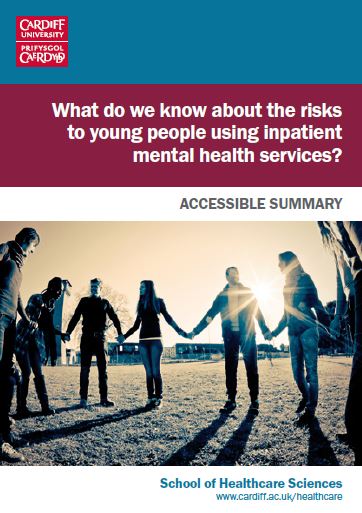
Over the last year or two I’ve used this blog to publicise information about the RiSC study, an evidence synthesis into ‘risk’ for young people in mental health hospital. We’ve now produced an accessible summary, outlining what we did in this project and what we found. For a copy, click the front cover of the summary reproduced below:
After finishing work next Thursday (October 15th 2015) I’ll be heading off to Chapter to take part in the 7th Public Uni. At Public Uni, which is organised by Marco Hauptmeier in the Cardiff Business School, academics get a ten minute opportunity to present their research to an assembled audience. I gather there is some retiring to the bar at some point in the evening, which seems very sensible.
Here’s the flyer for next week’s event: and what an eclectic bunch us five speakers are! In my slot the aim is to compress a history of mental health care, and a summary of where we are now, into 600 seconds of talking. What fun! For a taster of what I’m planning to say, here’s my summary:
Until the middle of the last century most formal mental health care was provided in hospitals. This changed with the emergence of community care. Dr Ben Hannigan, Reader in Mental Health Nursing in the School of Healthcare Sciences, explains how this change came about and discusses the people, policies and practices found within the system now.
Here’s a quick blog post sent from a train, en route from Preston to Cardiff following the Autumn term meeting of MHNAUK. We met at UCLAN, hosted by Joy Duxbury, Mick McKeown and Karen Wright. On the agenda were presentations from Nadeem Gire on tackling digital exclusion, and from Mick McKeown on ‘Democracy and Legitimacy in Mental Health Care’. Mick, as always, was thought-provoking and challenging: follow this link to access downloadable copies of many of his articles.
Sabine Hahn, Peter Wolfensberger and Swiss colleagues were present, with Sabine and Peter giving an overview of the development of mental health nursing and the establishment of the Swiss Academic Society of Psychiatric and Mental Health Nursing. Seamus Watson spoke about public mental health, and what role nurses might play.
In the post-lunch business section of the meeting there were discussions on (amongst other things) the Shape of Caring review, this year’s NPNR conference and plans for 2016, and on a future student mental health nursing conference.
The 21st Network for Psychiatric Nursing Research (NPNR) conference took place on Thursday and Friday, September 17th and 18th 2015, with the theme of ‘Building new relationships in mental health nursing: opportunities and challenges’. The occasion was a fine one, with just short of 200 people in attendance. For those not able to make it but wanting to know more, the programme can still be found here and the book of abstracts here.
I’ve been on the NPNR scientific and organising committee this year, courtesy of my membership of Mental Health Nurse Academics UK. This afforded me the chance to welcome delegates at the conference opening, and to draw attention to the just-breaking news of Professor Len Bowers’ planned retirement at the start of 2016. Len has been an inspirational mental health nurse researcher: more on this later.
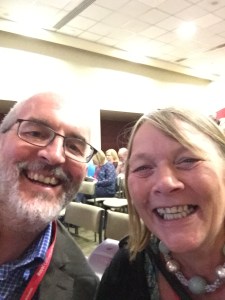
#NPNRselfie with Karina Lovell
Introduced by Professor Liz Hughes as day one conference chair, this year’s keynotes commenced with Professor Karina Lovell giving an overview of the current state of knowledge in remote psychological therapies. Karina is a world leader in research into interventions for people with commoner mental health problems such as depression and anxiety, as well as being actively involved in services and practice through her work with organisations like Anxiety UK and others. For an example of important new research in this area check out the REEACT trial into computerised CBT for people with depression. This is an important study which Karina both referenced in her talk, and is actively involved in.
Dr Geraldine Strathdee, NHS England’s National Clinical Director for Mental Health, delivered a second keynote on using mental health intelligence. She praised the work of nurses, and made a strong case for mental illness prevention. Geraldine also reminded delegates of the high rates of premature mortality of people living with mental health difficulties, and the continued exclusion of many from employment. As routes to improvement she pointed to leadership, and the value of data to benchmark and drive up standards.
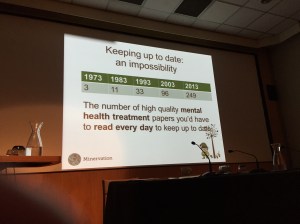
Keeping up with the evidence: an impossibility?
Day one’s final keynote presentation was delivered by André Tomlin, founder of the Mental Elf website and author of this pre-conference blogpost. André is an information scientist, who illustrated the challenge of keeping up-to-date with the evidence using this slide. Podcasts, social media, tweetchats and other new technologies are all part of André’s solution to the challenge of information overload, and as strategies to help plug the leaky evidence pipeline. The National Elf Service, of which the Mental Elf is a part, plays a big part in this area; for an overview of what’s on offer, here’s one of André’s videos:
Therapeutic approach, or therapeutic alliance?
Chair for day two was Professor Doug MacInnes, one of whose duties was to introduce Professor Shôn Lewis from the Institute of Brain, Behaviour and Mental Health at the University of Manchester as the deliverer of the conference’s fourth keynote lecture. Shôn spoke about current approaches to the care and treatment of people with psychosis and schizophrenia, using findings from the non-commercial CATIE and CUtLASS trials to suggest that newer antipsychotics are generally no better than first generation antipsychotics. Shôn also referenced the SoCRATES trial to evidence the idea that outcomes are associated with the quality of the therapeutic alliance, rather than with the specific therapeutic approach used. SoCRATES, I have now discovered, compared the effectiveness of (1) CBT plus routine care, (2) supportive counselling plus routine care and (3) routine care alone for people with schizophrenia. Shôn devoted the last part of his presentation to ClinTouch (a mobile phone app to record and upload symptoms) and CareLoop (which is testing if ClinTouch can be connecteded to NHS IT systems and to everyday practice).
Mark Brown about to begin his talk
#NPNR2015’s final keynote was delivered by Mark Brown, and the full text of his talk can be read here. Mark edited One in Four magazine, and is now development director of Social Spider, runs the Day in the Life project and is part of the team behind the WeMHNurses Twitter meeting place. Drawing on personal experience of its usefulness he described digital technology as less of a possible future than an unfolding present. One example of tech in action, which Mark referred to in his talk, is his own Doc Ready website. This was designed to help people prepare for discussions with doctors about their mental health difficulties.
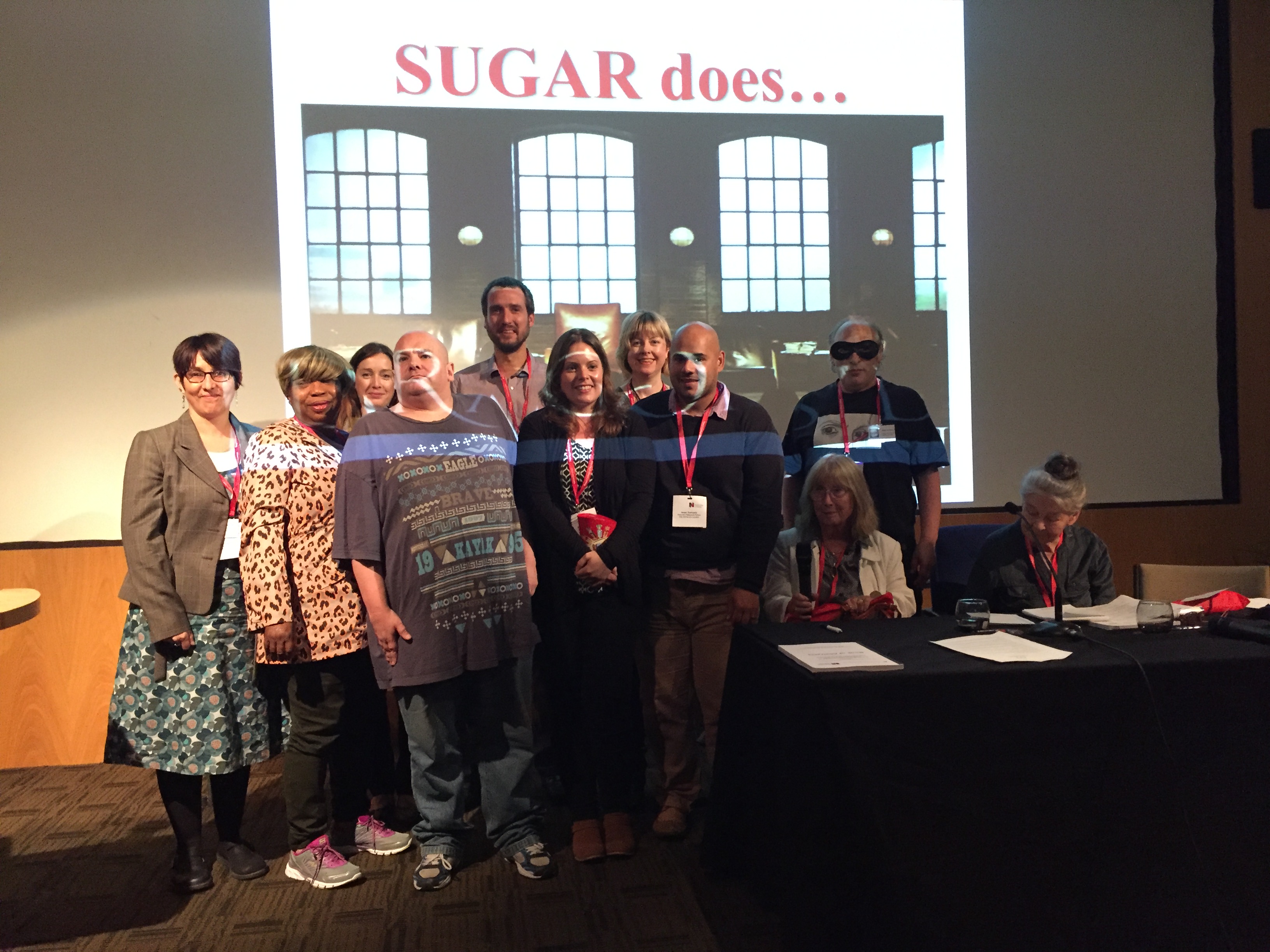
SUGAR does Dragons’ Den
That’s summary enough of the keynotes. From the concurrent sessions I participated in, chaired or observed I’ll first start with the SUGAR meets Dragons’ Den workshop. Three volunteers – Jason Hickey, Laoise Renwick and Cher Hallett – pitched their research ideas to SUGAR members. In the event, SUGAR offered their time and support to all three, but also voted Cher’s plans (on intramuscular injections) as the best of the batch. In the second concurrent I’m picking out, Julian Hunt, Alan Meudell and Michael Coffey presented reflections from Plan4Recovery. This project, which I’m also part of, is examining shared decision-making and social networks for people using secondary mental health services. And, finally, a word about our COCAPP symposium. This started with an overview paper from Alan Simpson, was followed by a presentation from Michael Coffey titled, ‘Ordinary risks and accepted fictions: how contrasting and competing priorities work in risk assessment care planning’ and concluded with a paper from Sally Barlow and me on participants’ views and experiences of recovery and personalisation.
The RCN’s history of mental health nursing exhibition
Organised by Laoise Renwick, this year for the first time the NPNR conference featured a poster trail. This worked well. Displayed posters were themed, and during lunchtime on day two guided delegates took opportunities to speak with those associated with them. Along the way I spotted some interesting posters from the RCN, drawing attention to an upcoming history of mental health nursing exhibition (organised with lots of help from Ian Hulatt) about to launch in London.
Finally, a word on Len Bowers. At Doug MacInnes’ invitation, Len took to the lectern during the afternoon of day two to confirm his upcoming retirement and his plans for the future. These include (we learned) playing the flute, travel, photography and electronic music-making. Very nice. Len is a generous, principled and humble man whose contribution to creating new knowledge for mental health nursing has been immense. Take Safewards as an example. This is Len’s NIHR-funded programme grant, findings from which are changing practice in the UK and around the world. That’s some achievement, in my book. We wish him well.
Following this link takes you to the new Labour leader’s proposed policies for mental health. These are clearly displayed on his campaign website; further evidence, perhaps, of the way mental health issues have become prominent in politics in recent years. To summarise, Corbyn’s plans include campaigning to reverse cuts to services, increase the numbers of professionals and improve services for young people. They also include introducing mental health education into the school curriculum, tackling stigma and loneliness and challenging the social causes of mental ill-health for women as well as investing in services. Corbyn also talks of addressing the over-representation of members of black and minority ethnic communities in mental health services, along with tackling homelessness, the mental health crisis in prisons, poverty, and failures in the welfare system and the workplace. He closes with this:
I am committed to a holistic approach that sees emotional well being as fundamentally connected with a society less atomised and individualistic, more socially connected, more caring, more inclusive and more equal.
A search through the new Labour leader’s website also turns up speeches he has given on mental health topics, the contents of which very much reflect the emphasis in his policy statement referenced above. An example can be read here. In the face of so many competing priorities, it will be interesting in the coming months to see how far mental health remains towards the top of the Leader of the Opposition’s agenda.
As the NPNR conference convenes for the 21st time developments in research, education and delivery of mental health nursing care continue apace. New knowledge opens the way for new forms of relationships with people who use services, their families and with colleagues within and outside our discipline. The way mental health nurses are educated and how they develop and research their practice is also changing, bringing with it new opportunities and many challenges.
This year’s conference will engage with the emerging evidence and changes in the landscape of care as we seek to craft new understandings of what it means to be a mental health nurse. As we become attuned to the vagaries of policy and the volume of new knowledge for our profession we must also rise to the challenge of ‘seeing’ in new ways. Our intention is to provide a space where colleagues can debate and critically engage with flux in the profession.
The NPNR is the place for mental health nurses and those we work with to present and learn new knowledge. We encourage you to participate in discussion so that you leave the conference informed, enlightened and with new energy to engage with the challenges ahead. Alongside our expert speakers, great practice development and research papers the conference promotes a friendly and welcoming atmosphere that has been the hallmark of NPNR for 20 years. This year in addition to our exciting themes we include new developments for 2015.
And, for a taster, here’s a snip from the conference website giving some information on this year’s keynote speakers. Very impressive indeed.
As always, the two-day programme also features concurrent sessions, supplemented (this year) with workshops and symposia. I’ll be part of a COCAPP delegation delivering three linked papers: a main findings presentation, a paper with an interesting emerging analysis of risk in care planning and coordination, and a presentation on how people talk about recovery and personalisation.
Here in the School of Healthcare Sciences at Cardiff University we’ve continued to think about how best to appeal to potential PhD students, and to simultaneously develop research capacity across nursing, midwifery and the allied health professions. A change which we’ve recently made is to invite applicants for postgraduate research study to make clear how their developing plans fit with the research already going on in at least one of the School’s research themes. To help in this process we’re now advertising areas for future PhD study, closely aligned to the substantive and methodological expertise already found in the School. This makes lots of sense, and will help us to grow research in programmatic fashion and ensure students are appropriately supervised.
The place to go for the current list of topics/areas is here, where under the Workforce, Innovation and Improvement theme you’ll find this:
The use of in-depth qualitative methods to examine mental health systems. Specifically, projects investigating aspects of policy; service organisation and delivery; work, roles and values and user and carer experiences.
That’s the kind of PhD I’m primarily interested in supervising. For an example of what a completed one looks like, then follow this link to the full text of Dr Mohammad Marie’s freshly minted thesis titled, Resilience of Nurses who work in Community Mental Health Workplaces in West Bank-Palestine.
St Hans Hospital, RoskildeI took the chance to indulge some professional interests during a just-finished summer trip to Denmark by paying a visit to the museum at St Hans Hospital in Roskilde.
St Hans was founded in 1816, and is Denmark’s oldest psychiatric hospital. The grounds are pleasant, with local tourist information indicating they remain a popular place for Roskilde’s residents to take a stroll.
Straitjacket, St Hans HospitalThe hospital, we learned, was once occupied by 2,000 inpatients. Around 200 beds remain and parts of the site are apparently scheduled for selling off; as in the UK, most mental health care in Denmark is now provided in the community. In the hospital’s museum we saw artwork, and exhibits which included a straitjacket and a restraining chair. How times and practices have changed.
Remains of Viking longboat, Roskilde Ship MuseumChanging subject at pace, here for anyone interested is a non-mental health related picture from Roskilde Ship Museum. The longboat is one of five ships deliberately scuttled, in the 11th century, in Roskilde Fjord (near a place called Skuldelev) to form a defence against attack. All five were found in the early 1960s, and came to be housed in the purpose-built museum we visited.
Roskilde FjordModern Danes enjoy a high standard of living, invest in welfare and are amongst the happiest people in the world. They also do living history better than most, and at both the Ship Museum and the Ribe Viking Centre there was plenty of 8th-11th century skill and craftwork on display.
But how, I now ask, did the Vikings experience, recognise and respond to mental ill-health? A niche area of research indeed, for which a quick scan online turns up this paper. Alas, it sits behind a publisher’s paywall and is in a journal I cannot access through Cardiff University’s library subscriptions.
Now back at work, a busy few months beckon with ongoing research projects, new projects to develop and students to teach, supervise and assess as the 2015-16 academic year unfolds. I’ll hope to get back up to speed with this blog site as things progress.
Here’s a brief post to flag this week’s appearance of a first published paper from COCAPP. This is the study protocol, and can be found in BMCPsychiatry. Clicking the image above will take you directly to the gold open access PDF of the article.
Protocol publishing is a fairly new phenomenon. It encourages transparency, and in the case of health intervention studies is a way of meeting the registration and reporting standards which organisations like AllTrials are campaigning for. COCAPP has not been an intervention study, but publishing the protocol is still valuable for the purposes of openness. When findings are published at a later point, readers can also be given the briefest of summaries of the methods used coupled with a reference to the protocol paper for the full detail.
 After finishing work next Thursday (October 15th 2015) I’ll be heading off to





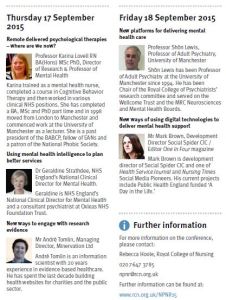 And, for a taster, here’s a snip from the conference website giving some information on this year’s keynote speakers. Very impressive indeed.
 Here in the


 Ben Hannigan's blog