Category: People

Meeting new students

This morning began in class with a group of 25 or so (very) new students of mental health nursing. The session revolved around a series of open-ended questions, in family therapy style, put to John Hyde and to me by Nicola Evans. Nic invited us to share something of our personal experiences in mental health nursing: as students, practitioners, educators and researchers. In a decidedly non-random way, one of Nic’s questions invoked the idea of ‘critical junctures’, echoing our paper in this area but referring, in this context, to pivotal moments within our individual careers thus far.

From a learning point of view the premise was to introduce new students to the rich and varied world of mental health nursing, via a listening in to a reflective conversation conducted on the same. I found it an interesting experience, and hope the students did too. In my early morning mental preparation before participating it became necessary to conjure up people, places and events dating back to at least the late 1980s. So today I remembered my first student placement working (in East London) with a community mental health nurse, my first job as a qualified practitioner, and my eventual move to Cardiff. Fascinating

Blogging for teaching

With apologies in advance for making an exceptionally obvious observation, but it has properly dawned on me this week that writing a blog might have significant advantages for teaching. A couple of days ago I was in class with a group of MSc students, talking about what we can learn from the study of service user trajectories. The sensible thing to do was to navigate to this site, and show people where they can download this recent paper. So that’s exactly what I did.

Unrelatedly, Mark Howard (who works at London South Bank University and who I used to work with in East London in the days when I was a community mental health nurse) has also been kind enough to comment on a post, and to mention that he sometimes points his students here. Hello again Mark, and hello to your students too – and thanks for your collective interest.

And today I’ve been planning a new Professional Doctorate module, and have been deliberately embedding links to this blog in my teaching materials. So what all of this is making me realise is that a blog (mostly) oriented towards research and academic stuff might, over time, become a useful educational resource. I actually can’t think of any other way in which a personal repository of papers, commentaries, onwards links and so on might be brought together.

Critical junctures

How pleasing it is to report that the paper I blogged about in this earlier post has now been accepted for publication. Co-written with Nicola Evans this (re)introduces the idea of ‘critical junctures’ and will appear in Social Theory & Health. We draw on two project datasets and show how action at pivotal moments can set individual service user trajectories on directions which are hard to reverse. We also show how, in certain circumstances, small-scale critical junctures can trigger (or be used to lever) larger organisational change.

Next up will be the checking of page proofs, and advance online publication via the journal’s website. What we won’t be able to do for another 18 months is upload a PDF of the post-peer review manuscript to ORCA. This is something Palgrave’s copyright rules are very clear about. In the meantime here’s the abstract which will, of course, be freely available:

Hannigan B. and Evans N. (in press) Critical junctures in health and social care: service user experiences, work and system connections. Social Theory & Health

This article makes an original contribution through the revitalisation, refinement and exemplification of the idea of the ‘critical juncture’. In the health and illness context, a critical juncture is a temporally bounded sequence of events and interactions which alters, significantly and in a lasting way, both the experience of the person most directly affected and the caring work which is done. It is a punctuating moment initiating or embedded within a longer trajectory and is characterised by uncertainty. As contingencies come to the fore, individual actions have a higher-than-usual chance of affecting future, enduring, arrangements. These ideas we illustrate with detailed qualitative data relating to one individual’s journey through an interconnected system of mental health care. We then draw on observations made in a second study, concerned with the improvement of mental health services, to show how micro-level critical junctures can be purposefully used to introduce instability at the meso-level in the pursuit of larger organisational change. In addition to demonstrating why scholars and practitioners should pay closer attention to understanding and responding to critical junctures we are, therefore, also able to demonstrate how their emergence and impact can be examined vertically, as well as horizontally.

MHNAUK launches a blog

Michael Coffey, chair of Mental Health Nurse Academics UK, has today launched the group’s blog at http://mhnauk.com.

On the site’s home page Michael writes that:

This is the first entry in what we hope will be a vibrant and engaging place for members of MHNAUK to communicate the range of work we as a group do […] we want to communicate to a wider audience via this blog to show what we are doing and to engage in dialogue about our views on the future direction of education, research and ultimately the practice of mental health nursing.

Michael also points to some of MHNAUK’s current projects. These include Andy Mercer (from Bournemouth University) gathering evidence on the different ways applicants for pre-registration mental health nursing courses are selected, and Fiona Nolan (from UCL) leading an overview of mental health nursing research in the UK.

I’ve posted a comment on the site, and look forward to others doing the same. Go check it out. Right now!

Learning from the study of trajectories

Trajectories paperHere’s a post about research, which draws on the paper Complex caring trajectories in community mental health: contingencies, divisions of labor and care coordination which I authored with Davina Allen.

One of the things I’m interested in is the study of ‘trajectories’. With colleagues, the US sociologist Anselm Strauss wrote about these in the book Social Organization of Medical Work. Most people will be familiar with the idea of illnesses ‘running their course’. To this everyday concept Strauss and his collaborators added a whole lot more, introducing the term ‘trajectory’ to refer:

…not only to the physiological unfolding of a patient’s disease but to the total organization of work done over that course, plus the impact on those involved with that work and its organization (Strauss et al. 1985: 8).

Trajectories are dynamic and often unpredictable, not least because they involve people. They are also vulnerable to being tilted by what Strauss et al term ‘contingencies’. Contingencies can have origins in the health and illness experience. So, a trajectory can (for example) veer off in a new direction because of an acute exacerbation of a chronic illness. But trajectories can additionally be shaped by contingencies which have organisational origins. These can relate to the biographies of workers, and to features of the system such as the availability of resources.

Trajectories can be studied. In my PhD I borrowed the design and methods used by Davina Allen, Lesley Griffiths and Patricia Lyne in their study of stroke care, and used these to understand the trajectories of people using community mental health services. In each of two contrasting parts of Wales I recruited three people currently using secondary mental health services. Each became the starting point for a detailed, small-scale, trajectory case study. Over a period of months I followed each person’s unfolding experiences, and the organisation of work surrounding. Using snowball sampling I mapped the network of (paid and unpaid) people providing care to each, and interviewed those identified in this way about their work. I observed care planning meetings, home visits, and read each service user participant’s National Health Service (NHS) records.

Community Mental Health JournalIn the publication for Community Mental Health Journal to which this post relates, Davina and I drew on these data to show how trajectories unfolding in the mental health field are shaped. We offered instances of trajectories being tilted by mental health crises, but also by key professionals leaving their posts and by a lack of resources within the larger system.

We then used data to reveal actual divisions of labour, in a way which has not (to the best of my knowledge) been done before  in the mental health context. By mapping the networks of care surrounding each user participant we were able to learn about work being done by all sorts of people, including many who (I suspect) are rarely thought of as making significant contributions at all. We wrote about the work of community pharmacists, support workers, lay carers and indeed the work of service users themselves.

Having laid all this out we closed by pointing to the importance of what Strauss et al called ‘articulation work’. This is the work associated with the management of trajectories, through mechanisms such as care coordination. Mental health workers in the UK know all about this through things like the care programme approach (CPA).

The detail of this paper you can read for yourself, with the link at the top of this post taking you to our author’s copy of the manuscript as stored on Cardiff University’s ORCA repository. This, word-for-word, is the same as the version of the article which is currently in press here.

For those interested in the paper’s back story, just to note that when it came to selecting a journal I was keen not to submit to a nursing publication. I have no problem with nursing journals per se, but this ‘trajectories’ paper was (and is) aimed at a wider readership. Community Mental Health Journal is based in the US, and publishes papers on, well, community mental health. And that fitted well with the intended audience. This said, one of the anonymous reviewers of the submitted manuscript had things to say about the language used, reminding us that the journal to which we had submitted is read by mental health practitioners and academics and not, primarily, by sociologists. Attending to the review meant some rewriting to improve accessibility. I’ll leave future readers to judge for themselves whether we succeeded.

Visiting the Netherlands

HAN 4
Bisschop Hamerhuis in Nijmegen, home to Dr Bauke Koekkoek and the Social Psychiatry and Mental Health Nursing research group

Michael Coffey and I have just returned from a four day trip to the Netherlands, an event supported with funding from the Mental Health Research Network Cymru. We were there to share and develop research ideas with the impressive Dr Bauke Koekkoek and colleagues, and to learn about the Dutch mental health system. Bauke, a mental health nurse, is Associate Professor of Social Psychiatry and Mental Health in the Hogeschool van Arnhem en Nijmegen (HAN) University of Applied Sciences, and is interested (amongst other things) in matching the needs of people with mental health difficulties with services. You can read more about Bauke’s work in his inaugural lecture.

RGF130319-1065
Bauke, in mid-flow

Bauke did a great job organising a full schedule of activities for our three working days away. Well done, Dutch train and bus companies, for delivering Michael and me to our various destinations in timely fashion. We were, though, reminded during our trip that it is the bicycle which remains the vehicle of choice for many Netherlanders.

We had the chance to meet with academics, practitioners and service users during our travels across Utrecht, Arnhem and Nijmegen. Our thanks to everyone who gave their time and who shared their expertise so generously: Dr Arjan Braam; Mark van Veen; the Kompas team at Pro Persona‘s Wolfheze site; Dr Ad Kaasenbrood and his colleagues in the Arnhem Functional Assertive Outreach Team (and particularly Vincent and Riska, who Michael and I spent Tuesday morning with); the Arnhem FACT Team service users who welcomed us into their homes; the HAN Social Psychiatry and Mental Health Nursing research group; and Hein, Rob and Leon who teach at HAN and have interests in developing international links.

RGF130319-1105
Michael, holding forth

The Social Psychiatry and Mental Health Nursing research group, who we met on Tuesday afternoon, are a capable and accomplished team. Their MATCH Project is supported by a significant grant, and Bauke and his collaborators have done exceptionally well in using this as a springboard for further, associated, studies. Examples include PhDs investigating the effectiveness of therapies, and a planned ethnographic examination focusing on discharge (and non-discharge) of people from community care.

It was good to hear people present and discuss their ideas, and in a spirit of collegiality Michael and I had the chance to share our interests and plans. I took the chance to talk about my research in a general sense, using as a prop this set of slides embedded below:

RGF130319-1126
Attentive listeners!

Interesting to learn during our time away was the system of preparing mental health nurses in the Netherlands. Yesterday, for example, we met Rob Keukens who runs HAN’s part-time, 18 month, post-qualification social psychiatric nursing programme. This is the nearest thing to what here, in the UK, we would describe as a post-registration course for community mental health nurses (CMHNs). For those interested, Bauke has described and analysed the Dutch CMHN profession in this paper.

RGF130319-1069
Me enjoying a joke. Or something like that.

The principal purpose of our trip was to further our research connections, and for Bauke, Michael and me to spend time putting our heads together to develop new research ideas. We know we’ll need to involve others, and target funding streams sympathetic to international research proposals which set out to create new knowledge to improve mental health and well-being and the organisation of mental health services.

More on all this to follow in due course, I am sure.

Disinvesting in mental health?

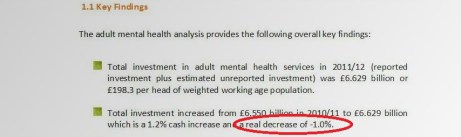
National Survey of Investment 2011-12Writing for The Guardian’s Healthcare Professionals Network this week, David Brindle reports that spending on mental health care in England has fallen for the second year in a row. He references unpublished figures disclosed last week to the House of Commons Health Committee, along with the 2011-12 National Survey of Investment in Adult Mental Health Services which appeared last August, and from which I have clipped these first two headline findings:

National Survey of Investment 2011-12b

The key figure here is the bit I have circled in red: that, in real terms, investment in mental health services in England in 2011-12 reduced by 1%. Last summer The Guardian reported the publication of this finding under the banner of mental health spending having fallen for the first time in 10 years, and if I am understanding David Brindle’s latest article correctly evidence of further cuts has been gathered since. Elsewhere in this piece Dr Hugh Griffiths, the Department of Health’s National Clinical Director for Mental Health, is quoted as having told the Health Committee last week of being ‘disturbed’ by reports of cutbacks to services in some English regions.

Meanwhile, via this piece in The Telegraph I see that the former coalition government Care Minister and LibDem MP Paul Burstow is heading up an independent Mental Health Commission with the liberal think-tank CentreForum. The Commission’s task is to ‘examine the state of mental health care provision in England’. This is a task made all the more urgent in the light of the finding, also contained in last August’s National Survey, of a £29.3 million reduction in investment in crisis resolution, assertive outreach and early intervention services.

All this paints a very bleak picture indeed. Reductions in funding and in services threaten to roll back the investments made in dedicated mental health care in the years following the publication, in England in 1999, of the National Service Framework for Mental Health. New Labour acted at tremendous speed in prioritising the mental health field. When in government Labour took action to develop community care through the creation of new types of services. It changed the law, put resources into improving access to psychological therapies and rewrote professional role boundaries. Some of the specifics were contentious, sure, but I for one did not doubt that the challenges of improving mental health and developing services were finally being taken seriously. In fact, Michael Coffey and I wrote about this period of policymaking in our wicked problems paper (which can be downloaded here). In this we urged careful consideration of the cumulative impact of policy actions, and the perils of trying to change everything in a complex system of health and social care all at the same time. But needless to say we made no case for cuts, which is what is evidently taking place around large parts of the country now.

As it happens, I can’t immediately find a Welsh equivalent for the Department of Health’s National Survey for England. If it’s out there, perhaps someone can point me in the right direction? It would be good to know the trends for investment in mental health services here in Wales. More generally, now I come to think of it, I want to learn more of the prospects for the future of the mental health system in this part of the UK now that the Welsh Government has a new Health Minister in Professor Mark Drakeford. The Minister is a Cardiff University Professor of Social Policy and Applied Social Sciences, and it will be interesting to see how future policy and services shape up under his direction.
 

Hello again, trainers

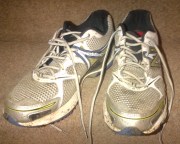
Today's trainersGreat to have been running again this morning, with my pal Simon. We chose a relatively flat route, taking us down the Penrhos Cutting and along the Taff Trail heading towards Pontypridd. It’s only been a week or so since I last got out, but I sure felt creaky.

To illustrate this event on this blog I might have uploaded a photograph or two of South Wales’ hills and trails, or even a piccie taken en route. These options are far too obvious. Instead I have elected to include a picture of my trainers, sitting proudly post-run on a staircase. Thank you, shoes, and I apologise if you deserve a more accomplished runner than me as your owner.

The COCAPP crew, and MHNAUK comes to Cardiff

Yesterday’s COCAPP meeting in Cardiff was both productive and fun. It was lovely to welcome those members of the London contingent able to make the trip, and I extend my apologies (again, and for the last time!) to those I conspired to keep waiting in a darkened corridor before turning up with a room key.

COCAPPers 07.13.13COCAPP is an exciting research project to be involved in, and pretty soon it will have its own blog. I’ll then add links from here for those who are interested. Briefly summarised, this is an England and Wales cross-national investigation into mental health care planning and coordination, and into the relationships between these processes and recovery and personalisation. It’s funded by the NIHR Health Services and Delivery Research Programme, and has lots of distinct elements: about which more will follow, I guess, once the dedicated project blog is up. For now, here’s a photo of yesterday’s assembled COCAPPers (where from left to right there’s Aled, Jitka, Alan (COCAPP’s chief investigator), Sally, me and Michael. We very much missed Alison and Jennifer and their wise contributions, and when we’re all in one place I imagine we’ll take another, and more complete, photo.

Yesterday evening was the traditional social involving food and drink with fellow members of Mental Health Nurse Academics UK, ahead of today’s meeting proper. As Cardiff hosted we got to select the venues, and I hope everyone who was able to make it enjoyed the selection of fine ales and wines, and indeed the general ambience, at The Rummer Tavern. Likewise the food at The Mango House.

MHNAUK’s first meeting of 2013 was a good ‘un. Jen French talked about mental health strategy in Wales, and Ian Hulatt updated us on the Willis Commission. Eschewing the usual format of host universities presenting their research and teaching activities in the morning, Michael Coffey (in the photo above, and MHNAUK chair) and Joy Duxbury (newly elected vice chair) invited reflections and discussion on the aims and purpose of the group, and on the character of research in mental health nursing and what can be done to nurture it. There was some lively discussion in the two groups (facilitated by Linda Cooper and Len Bowers respectively) which convened to talk to these areas. It occurred to me unhelpfully after the event that we might have taken a MHNAUK photo, including the 35 or so members participating today: not least as MHNAUK, like COCAPP, is collectively thinking of increasing its presence via a blog.

Work aside, running has taken a big back seat this week, what with one thing and another. Must get out soon!

Cardiff hosting, and NPNR news

This is the week that both Mental Health Nurse Academics and the COCAPP team come to Cardiff. MHNAUK’s meeting on Friday will take place in the Council Chamber in the Main Building, which is really rather grand. Visiting COCAPPers can look forward to a more everyday venue for our Thursday meet-up. This will be in Eastgate House (which is where I’m based).

Other news of note in the world of mental health nursing education and research is the impending move of this autumn’s Network for Psychiatric Nursing Research conference from Oxford to Warwick. The annual NPNR bash has taken place in Oxford pretty much since it was launched in the 1990s. I gather from my Twitter-using pals who sit on the scientific and organising committees that we can expect a relocation for an event scheduled, this year, for September 5th and 6th. It occurs to me that Warwick University is well-placed for delegates travelling from all parts of the UK, and indeed from around the world.