Category: Mental health

19th International Network for Psychiatric Nursing Research Conference

Here is just-published information on this autumn’s NPNR conference, which I’ve grabbed from the RCN website:

The Personal and Political of Mental Health Nursing Research

  • 05 September 2013 – 06 September 2013
  • Warwick Arts Centre, The University of Warwick, Coventry, CV4 7AL

Event home

Calling for papers NOW

This international conference aims to examine the personal everyday experiences of living with mental health problems and delivering mental health nursing care and some of the political responses and implications of the events and forces that provide the context within which we live and work.

Mental health nurses regardless of setting are engaged in highly personal alliances with individuals with mental distress. In that light, we wish to hear about research that examines the therapeutic alliances, mental health nursing interventions and creative partnerships that form the focus of much mental health care.

But these personal and professional alliances can also be influenced by wider events that can shape and determine the culture of mental health nursing practice. National responses to global financial crises in the form of austerity measures, cutbacks in services and changes to roles within the workforce can dovetail with existing patterns of inequality, stigma and discrimination to the detriment of mental health service users and staff alike.

The personal and political can be seen to be played out too in the relationships between nurses and the people they seek to support and help through issues of involvement, partnership and collaboration – whether in practice, education or research.

This conference provides an opportunity for an informed and critical look at the therapeutic alliance and the therapeutic environment from the personal and political perspectives of service users, carers, mental health nurses and colleagues. Papers examining interactions and interventions in mental health settings and the wider community are welcomed and could include nurse/patient interactions dealing with resistance, challenge, compliance, containment, risk, sexuality and gender, employment and inequalities.

Oral and poster papers are invited that seek to measure mental health outcomes and critically examine the ways in which these findings work to advance the development of interventions better suited to the needs of individuals and society.

Papers are invited which fall into the following themes:

  • Researching alliances, interventions, partnerships

Therapeutic alliances, mental health nursing interventions, creative partnerships in mental health care: this thread will include papers that focus on the personal and professional aspects of mental health nursing care.

  • Politics, populations, equality and diversity in mental health nursing research

We welcome contributions to this new thread that focuses on research that addresses political issues, including equality and diversity, in mental health nursing or that considers mental health needs in particular populations.

  • Austerity, costs and service delivery

We are keen to focus on service developments, evaluations and research that address the realities of financial restrictions and cuts in service delivery and some of the innovations and creative solutions that are emerging as a result.

  • New roles, new ideas, new researchers

We welcome papers reporting research that explore new or developing roles emerging in mental health care alongside papers that have something new and stimulating to say – give us something to think about! This thread is also open to new researchers perhaps presenting for the first time or presenting work in progress.

  • Innovation in teaching and learning

Developing new ways of delivering teaching and learning in mental health, for both staff and service users, has never been more urgent as roles and demands change, costs are considered and new technologies invite fresh ideas. We are keen to include papers that report research and evaluation of educational initiatives in mental health.

Concurrent sessions

These are presented orally. Each presenter is allocated a total of 20 minutes per session to include time for discussion (5 minutes).

Workshops

Workshops are interactive sessions of 50 or 70 minutes where the leader works with the participants to develop their knowledge and understanding within a specific field. A workshop is presented by an expert within the field and may be pitched at a novice, intermediate or advanced level. Please indicate the level in your submission. To be considered for a workshop you must submit an abstract (1000 words limit), detailing the focus of the workshop and the nature of participation.

PhD Symposium

This will be an interactive session of 90 minutes where PhD students are invited to present one aspect of their research, which may be related to their theoretical framework, methodology, preliminary findings etc. Each presenter is allocated a total of 20 minutes per session to include time for discussion (5 minutes). PhD students are invited to submit an abstract is the usual way, but mark the theme ‘PhD Symposium’.

Posters

Poster presentations form a significant part of the conference proceedings and presenters will have an excellent opportunity to interact with delegates. Posters should present key themes or findings in a clear and stimulating way.

Ready to submit your paper?

Please prepare your abstract submission in a word document, (using Arial, regular, font size 10), including all points within these guidelines and save a copy to your device. Please forward a copy of your paper via email to Laura Benfield at npnr@rcn.org.uk. Please note only submissions received via email can be accepted. You will receive an abstract reference number for use in all future correspondence regarding the abstract.

The process for accepting abstracts is carried out through a scientific committee and the critieria can be dowloaded here.  

Key dates for your diary

5 April Call for papers open
– 12 April Registration opens
– 17 May Deadline for submissions
– 12 June The Skellern Lecture (Prof Alan Simpson) Sign up
– 17 June Abstract outcomes communicated

– 1 July Final programme announced
– 31 July Special rate for presenters (£220) ends
– 5-6 September Conference

Start networking now!

www.twitter.com

Use #NPNR2013 to tweet with the network as well as keeping up to date with programme developments and other conference news!

uk.linkedin.com/pub/network-psychiatric-nursing-research/50/1b8/a92/

Join over 700 contacts engaged with NPNR, find us using the above link.

More details about NPNR can be found at www.rcn.org.uk/NPNR

Two day delegate fee
Presenter rate – £220
member rate – £260
Non member rate – £330
Student/carer/service user – £100
Conference banquet – £40


Event contact

Laura Benfield
Conference and Events Organiser
Royal College of Nursing
20 Cavendish Sq
London
W1G 0RN

Tel: 020 7647 3591
Email: NPNR@rcn.org.uk

Visiting the Netherlands

HAN 4
Bisschop Hamerhuis in Nijmegen, home to Dr Bauke Koekkoek and the Social Psychiatry and Mental Health Nursing research group

Michael Coffey and I have just returned from a four day trip to the Netherlands, an event supported with funding from the Mental Health Research Network Cymru. We were there to share and develop research ideas with the impressive Dr Bauke Koekkoek and colleagues, and to learn about the Dutch mental health system. Bauke, a mental health nurse, is Associate Professor of Social Psychiatry and Mental Health in the Hogeschool van Arnhem en Nijmegen (HAN) University of Applied Sciences, and is interested (amongst other things) in matching the needs of people with mental health difficulties with services. You can read more about Bauke’s work in his inaugural lecture.

RGF130319-1065
Bauke, in mid-flow

Bauke did a great job organising a full schedule of activities for our three working days away. Well done, Dutch train and bus companies, for delivering Michael and me to our various destinations in timely fashion. We were, though, reminded during our trip that it is the bicycle which remains the vehicle of choice for many Netherlanders.

We had the chance to meet with academics, practitioners and service users during our travels across Utrecht, Arnhem and Nijmegen. Our thanks to everyone who gave their time and who shared their expertise so generously: Dr Arjan Braam; Mark van Veen; the Kompas team at Pro Persona‘s Wolfheze site; Dr Ad Kaasenbrood and his colleagues in the Arnhem Functional Assertive Outreach Team (and particularly Vincent and Riska, who Michael and I spent Tuesday morning with); the Arnhem FACT Team service users who welcomed us into their homes; the HAN Social Psychiatry and Mental Health Nursing research group; and Hein, Rob and Leon who teach at HAN and have interests in developing international links.

RGF130319-1105
Michael, holding forth

The Social Psychiatry and Mental Health Nursing research group, who we met on Tuesday afternoon, are a capable and accomplished team. Their MATCH Project is supported by a significant grant, and Bauke and his collaborators have done exceptionally well in using this as a springboard for further, associated, studies. Examples include PhDs investigating the effectiveness of therapies, and a planned ethnographic examination focusing on discharge (and non-discharge) of people from community care.

It was good to hear people present and discuss their ideas, and in a spirit of collegiality Michael and I had the chance to share our interests and plans. I took the chance to talk about my research in a general sense, using as a prop this set of slides embedded below:

RGF130319-1126
Attentive listeners!

Interesting to learn during our time away was the system of preparing mental health nurses in the Netherlands. Yesterday, for example, we met Rob Keukens who runs HAN’s part-time, 18 month, post-qualification social psychiatric nursing programme. This is the nearest thing to what here, in the UK, we would describe as a post-registration course for community mental health nurses (CMHNs). For those interested, Bauke has described and analysed the Dutch CMHN profession in this paper.

RGF130319-1069
Me enjoying a joke. Or something like that.

The principal purpose of our trip was to further our research connections, and for Bauke, Michael and me to spend time putting our heads together to develop new research ideas. We know we’ll need to involve others, and target funding streams sympathetic to international research proposals which set out to create new knowledge to improve mental health and well-being and the organisation of mental health services.

More on all this to follow in due course, I am sure.

Disinvesting in mental health?

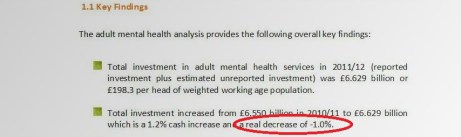
National Survey of Investment 2011-12Writing for The Guardian’s Healthcare Professionals Network this week, David Brindle reports that spending on mental health care in England has fallen for the second year in a row. He references unpublished figures disclosed last week to the House of Commons Health Committee, along with the 2011-12 National Survey of Investment in Adult Mental Health Services which appeared last August, and from which I have clipped these first two headline findings:

National Survey of Investment 2011-12b

The key figure here is the bit I have circled in red: that, in real terms, investment in mental health services in England in 2011-12 reduced by 1%. Last summer The Guardian reported the publication of this finding under the banner of mental health spending having fallen for the first time in 10 years, and if I am understanding David Brindle’s latest article correctly evidence of further cuts has been gathered since. Elsewhere in this piece Dr Hugh Griffiths, the Department of Health’s National Clinical Director for Mental Health, is quoted as having told the Health Committee last week of being ‘disturbed’ by reports of cutbacks to services in some English regions.

Meanwhile, via this piece in The Telegraph I see that the former coalition government Care Minister and LibDem MP Paul Burstow is heading up an independent Mental Health Commission with the liberal think-tank CentreForum. The Commission’s task is to ‘examine the state of mental health care provision in England’. This is a task made all the more urgent in the light of the finding, also contained in last August’s National Survey, of a £29.3 million reduction in investment in crisis resolution, assertive outreach and early intervention services.

All this paints a very bleak picture indeed. Reductions in funding and in services threaten to roll back the investments made in dedicated mental health care in the years following the publication, in England in 1999, of the National Service Framework for Mental Health. New Labour acted at tremendous speed in prioritising the mental health field. When in government Labour took action to develop community care through the creation of new types of services. It changed the law, put resources into improving access to psychological therapies and rewrote professional role boundaries. Some of the specifics were contentious, sure, but I for one did not doubt that the challenges of improving mental health and developing services were finally being taken seriously. In fact, Michael Coffey and I wrote about this period of policymaking in our wicked problems paper (which can be downloaded here). In this we urged careful consideration of the cumulative impact of policy actions, and the perils of trying to change everything in a complex system of health and social care all at the same time. But needless to say we made no case for cuts, which is what is evidently taking place around large parts of the country now.

As it happens, I can’t immediately find a Welsh equivalent for the Department of Health’s National Survey for England. If it’s out there, perhaps someone can point me in the right direction? It would be good to know the trends for investment in mental health services here in Wales. More generally, now I come to think of it, I want to learn more of the prospects for the future of the mental health system in this part of the UK now that the Welsh Government has a new Health Minister in Professor Mark Drakeford. The Minister is a Cardiff University Professor of Social Policy and Applied Social Sciences, and it will be interesting to see how future policy and services shape up under his direction.
 

Involving People, and watching football

Another started-on-the-train post, the length of which reflects (more or less) the length of my journey home.

Yesterday took in a trip to the Cardiff City Stadium for two, entirely unrelated, happenings. First was the annual event of Involving People, the organisation which works across Wales to promote public and service user participation in health and social care research. I’ve had contact with the Involving People team in connection with COCAPP, and the folk there are really very good. Yesterday’s event was excellent, too, and I learned plenty about public engagement from the earliest generation of research ideas onwards.

Following a short-ish break and a chance to catch up on work emails over a coffee, my return trip to the stadium was to watch Cardiff City put in a rather jittery performance against a visiting Leicester side looking to press their own promotion credentials. An at-the-death goal from the Bluebirds’ Rudy Gestede got the draw. Well done that man.

The COCAPP crew, and MHNAUK comes to Cardiff

Yesterday’s COCAPP meeting in Cardiff was both productive and fun. It was lovely to welcome those members of the London contingent able to make the trip, and I extend my apologies (again, and for the last time!) to those I conspired to keep waiting in a darkened corridor before turning up with a room key.

COCAPPers 07.13.13COCAPP is an exciting research project to be involved in, and pretty soon it will have its own blog. I’ll then add links from here for those who are interested. Briefly summarised, this is an England and Wales cross-national investigation into mental health care planning and coordination, and into the relationships between these processes and recovery and personalisation. It’s funded by the NIHR Health Services and Delivery Research Programme, and has lots of distinct elements: about which more will follow, I guess, once the dedicated project blog is up. For now, here’s a photo of yesterday’s assembled COCAPPers (where from left to right there’s Aled, Jitka, Alan (COCAPP’s chief investigator), Sally, me and Michael. We very much missed Alison and Jennifer and their wise contributions, and when we’re all in one place I imagine we’ll take another, and more complete, photo.
Yesterday evening was the traditional social involving food and drink with fellow members of Mental Health Nurse Academics UK, ahead of today’s meeting proper. As Cardiff hosted we got to select the venues, and I hope everyone who was able to make it enjoyed the selection of fine ales and wines, and indeed the general ambience, at The Rummer Tavern. Likewise the food at The Mango House.

MHNAUK’s first meeting of 2013 was a good ‘un. Jen French talked about mental health strategy in Wales, and Ian Hulatt updated us on the Willis Commission. Eschewing the usual format of host universities presenting their research and teaching activities in the morning, Michael Coffey (in the photo above, and MHNAUK chair) and Joy Duxbury (newly elected vice chair) invited reflections and discussion on the aims and purpose of the group, and on the character of research in mental health nursing and what can be done to nurture it. There was some lively discussion in the two groups (facilitated by Linda Cooper and Len Bowers respectively) which convened to talk to these areas. It occurred to me unhelpfully after the event that we might have taken a MHNAUK photo, including the 35 or so members participating today: not least as MHNAUK, like COCAPP, is collectively thinking of increasing its presence via a blog.

Work aside, running has taken a big back seat this week, what with one thing and another. Must get out soon!

End of the working day train blog

Here’s a quick post from the train heading home. At least there are plenty of seats to be had at this time of the evening, but missing a train can mean a fair wait until the next arrives. Anyway: this morning’s teleconference with the evidence synthesis team confirmed how much we’ve achieved so far in this project. This is a review in the area of ‘risk’ for young people using inpatient mental health services. I’m very much appreciating the design we’re using, which revolves around two reviewing stages. Following an initial scoping, representatives from the wider stakeholder field have the chance to shape the priorities for our second, in-depth, review phase.

Today has also brought some MSc-related work, and a chance to meet with pre-registration postgraduate students to talk about dissertations and research approvals. Tomorrow’s COCAPP team meeting is all planned for, and then it’s onwards to Mental Health Nurse Academics with a meal in the evening and the big meet-up of the clans on Friday. Goodness me, it’s all happening.

Cardiff hosting, and NPNR news

This is the week that both Mental Health Nurse Academics and the COCAPP team come to Cardiff. MHNAUK’s meeting on Friday will take place in the Council Chamber in the Main Building, which is really rather grand. Visiting COCAPPers can look forward to a more everyday venue for our Thursday meet-up. This will be in Eastgate House (which is where I’m based).

Other news of note in the world of mental health nursing education and research is the impending move of this autumn’s Network for Psychiatric Nursing Research conference from Oxford to Warwick. The annual NPNR bash has taken place in Oxford pretty much since it was launched in the 1990s. I gather from my Twitter-using pals who sit on the scientific and organising committees that we can expect a relocation for an event scheduled, this year, for September 5th and 6th. It occurs to me that Warwick University is well-placed for delegates travelling from all parts of the UK, and indeed from around the world.

Acronyms and initialisms abounding

Now we’ve completed our IRAS form and been to REC, its onwards to NIHR CSP and NISCHR PCU. Hopefully the SSI we give to R&D will be OK, and once we’ve been adopted by the CRN and CRC we’ll get help from a CSO or two.

So that’s all clear then, right? Apart from ‘OK’, which I presume needs no introduction, these are acronyms and initialisms associated with the process of applying for approval to conduct research in the NHS, and getting help to recruit participants and generate data once permission has been secured. I could add that, in the case of COCAPP, we’re making these applications because we’re interested in the CPA and CTPs, and that we should probably make links with a CLAHRC, an AHSP and keep in with the RRG. And did I mention the MNM we’ve already started? You don’t know about MNM? Then read the papers coming out of RAMESES.

Of course, in writing all this I am wilfully and rather mischievously seeking to confuse. The point, though, is that words matter. Shortcuts and abbreviations can save the time of people who are already in the know, but can present an impenetrable thicket to the outsider. Perhaps the process of navigating NHS research approvals should be described using only the commonest 1,000 words in the English language.

TTFN.

Nursing and the approved mental health professional role

AMHPFurther to my mentioning of a new paper on the development of the approved mental health professional (AMHP) role, and what this might mean for nurses, here now is a link to a full text open access version downloadable from ORCA.

In this article, my friend Michael Coffey and I discuss the implications of the changes made in 2007 to England and Wales’ Mental Health Act for the role of the mental health nurse. We were helped on our way by Jackie Neale, Michael’s colleague and Co-Director of the AMHP programme at Swansea University and by Dr Martin Webber, Reader in Social Work at the University of York, both of whom read and commented on an initial draft of our paper. Writing for this blog, Michael says:

Nurses for the first time can make applications for detention in hospital based upon their independent judgement and with regard to the opinions of their medical colleagues, based upon a social perspective and the principle of least restriction. This is as far as we know unprecedented in UK mental health law. In many ways this changes the provision of mental health nursing in ways that have as yet to be measured. These changes reflect similar moves internationally in mental health law.  There are huge challenges here though. Nurses are creeping into the territory of other professions who are not exactly welcoming them with open arms. Specific occupational knowledge and values are claimed by social workers who have traditionally fulfilled the approved role. These may be seen as jurisdictional claims and nurses have to show that they too can ‘pass’ as workers with a social perspective who are able to be independent of doctors. This is easier said than done and nurses have a chequered history in relation to occupational biomedical dominance. Added to this nursing is chiefly a biomedical task nowadays despite all the claims to being ‘holistic’ and being as focused on the social aspects of people as on anything else. Claims by nurses to be ‘psycho-social’ oriented or even ‘bio-psycho-social’ should be treated with some scepticism as many of these nurses subscribe to ideas of genetic determinism and are overly chemotherapy-focused. So can nurses actually juggle both a primarily biomedical focus and a social one to come to independent decisions in cases where the person might lose their liberty?

The backstory to this publication includes the fact that, with Jackie Neale, Michael runs Wales’ only AMHP programme. You can find out more about this post-qualification, postgraduate, course here. Our new article also comes out of Michael’s and my shared interest in mental health work and roles, and in thinking about (and researching) what nurses and others do. Another piece of behind-the-scenes detail is that Michael and I were once part of a team which came pretty close to getting a large grant to investigate AMHPs, and the experiences of people on the receiving end of their services.

Abstract-sifting, a new publication, and music to work by

Not much time for blogging lately, what with one thing and another. I’ve turned into a kind of abstract-sifting machine, poring over the details of papers for possible inclusion in two unrelated evidence syntheses/literature reviews. Amongst other things I’ve also been making some final preparations for a day away (as an examiner) later this week, catching up with colleagues over various bits and pieces, and arranging to meet up with undergraduate students.

Some good news over the weekend was confirmation of a new paper being accepted for publication, in the International Journal of Nursing Studies. My friend Michael Coffey is lead author, and we’ve written about the emergence of the role of approved mental health professional and what this means for nursing. A quick look at the SHERPA/RoMEO website suggests we’ll be able to add post-peer review versions to our respective institutional repositories. I’ll then add a link, and perhaps a bit of a commentary, on this blog.

As an aside, I am reminded of the majesty of Miles Davis’ Kind of Blue. It’s more than a decade since I was first introduced to this, and it now occupies a special place in my (eclectic) music collection. I mention this as Kind of Blue is an album I often turn to when I’m fretting over tasks requiring concentration: like writing, or indeed sifting abstracts. I listened to it today, in its entirety. Then I listened to it again.