What I do at work, described using only the commonest 1,000 words in the English language

Via a link in a tweet from @bengoldacre I came across the Bad Science (and now Bad Pharma) author’s secondary (!) blog, and this page in particular. Here, Ben describes how randomised controlled trials work, using the English language’s commonest 1,000 words.

The idea of making complex things simple in this way comes from Randall Munroe at http://xkcd.com, who produced the wonderful graphic I’ve reproduced here (with his permission) of how the Saturn V rocket works. Called Up Goer Five, the supporting text (as you can see for yourselves) explains things ‘using only the ten hundred words people use the most often’.

So that anyone can have a go at making difficult stuff understandable in this way, a text editor has now sprung up at http://splasho.com/upgoer5/. In goes your explanation, and if you happen to use a word from outside of the list of 1,000 commonest you’ll get a message telling you that it is not permitted. Such fun. You can also tell others of your efforts through Twitter using the #upgoerfive hashtag.

Yesterday and today I’ve been using this online tool to chip away at a description of what I do at work. It turns out that an awful lot of the words I’m fondest of fall outside of the list of those permitted. Examples include ‘process’, ‘system’, ‘nurse’, ‘health’, ‘complex’ and ‘organise’.

Anyway, here’s my effort:

For over 60 years people in this part of the world have believed that those who are sick should be looked after, without having to pay for their care at the time they need it. So to make sure there are always people around to do the job of caring, and to make sure there are places to go when we’re sick, everyone who works gives some of their money to pay for doctors, hospitals and so on. The important thing is that if you’re sick you should get the help you need, no matter how much money you have (or don’t have). I think this is a great way of doing things, and so do lots of other people.

But what do we mean by being sick, and what type of care is best? Some people have problems like their hearts not working in the way they should, or other bits of their bodies going wrong. But there are also people who have problems with how they think, feel or act when they are with others. They can get very sad, scared and worried. They can get confused, and/or hear things which aren’t really there. Families and friends get concerned when these things happen, but don’t always know what best to do. As it happens, we don’t completely know what causes these kinds of problem. It may be because something is wrong in the body, and/or it might be because bad stuff happens to people which makes them sad.

Maybe one day we’ll know much more about what causes people to be sick in these ways, and be able to help them more or even stop their problems happening in the first place. But for now, and I guess always, we need people who spend their time looking after those who get very sad, or worried, or confused, or who hear things which aren’t there. This is serious and important work, and there are lots of different types of people who do it. Those who do it as a job can be found in teams both in, and out of, hospitals. In truth, how these people and the teams they work in fit together can be really confusing. Nothing ever stands still, as new ways of getting stuff done appear.

So here’s what I do. I trained to look after people who have problems with thinking, feeling and acting and now I help to train others in this field. I also study people who do this kind of caring work, the teams they work in and what it’s like to be someone getting help. I do this because it’s important to find out how the different parts (the people, the teams) fit together, and to learn how caring work can be done in different, and maybe better, ways. Working with friends with the same interests I have used a number of approaches to study these things. I have sat with people and asked them questions about the work they do. I have read what people write about the care work they have done, and have watched people doing their day-to-day jobs. I have asked about the care work that people (like family and friends) do, and for which no-one is paid. I have asked people to tell me what it is like to get help from people in different jobs, and what it is like to have care across different teams over time. I have given people pieces of paper with questions about what they think and feel, and asked them to return their answers for us to read and study.

What have I found? The work that people do is changed by where and when they do it, and by who else is around. So you and I might think we know about the work that people in caring jobs do, but it turns out that there are lots of different ways of getting stuff done. Jobs change over time, and sometimes people do not agree who should do what. In teams, people sometimes do work which has to be done because there is no-one else to do it. I happen to think this is interesting and important, for lots of reasons. One reason is that if we don’t know what types of work people will end up doing, how do we know how best to train students? I have also found that a lot of caring work is hidden, because it is done by people who are not paid and/or who are on the edges. This is especially so in the case of people living in their own homes, and who get help from care teams which are placed outside of hospitals. Everyone thinks of doctors, but who remembers the work done by the person living next door? The way the different bits (the people, the teams) fit together means that those who are in need sometimes have problems getting the right help at the right time. And, when new teams appear, I have found that these can do great work but at the same time cause new problems to pop up somewhere else. This is because everything is joined to everything else. From studies completed with friends some years ago, I have also found that doing caring work is not easy. People who do it can get to feel very worn out.

Here is some new stuff I’m doing now. With friends I’m going to look at how people plan care, and what this means for the person who needs help. I’m also about to start a new study where we will read about young people in hospital, and how those who care for them keep them safe.

Snow, research and higher degrees

Red weather warningToday brought the predicted dollop of snow, meaning that yesterday there was no bread to be had in the shops. See this Met Office map of the UK, with its colour-coded weather warnings? See the red blob? That’s where I live, and where I am now.

This has been an interesting, and particularly research-oriented, working week. I spent part of Monday with a group of postgraduates, discussing processes for the review and approval of research and other projects. It has to be said that the opportunities for MSc students to complete small-scale data-generating studies are fewer than they once were, particularly if their plans are to generate data in the NHS. The time needed to secure R&D and research ethics approval can take a serious chunk out of the typical student’s period of candidature. Now, unless studies can be shown to be linked to larger research endeavours there’s also a fair chance that some NHS organisations will want to levy charges for processing R&D applications and for consuming their resources. As I ended up telling this particular MSc group, for NHS governance purposes there are also fine distinctions sometimes to be made between ‘research’ and other activities (like ‘service evaluation’ and ‘audit’) which, on the face of it, can look pretty ‘research-y’.

Monday also brought a meeting with second year, undergraduate, pre-registration mental health nursing students. That was nice, and we got to talk about all manner of things: the history of mental health nursing, developments in local services, experiences of practice.

Tuesday brought a project advisory group meeting chaired by Professor Billie Hunter. Billie’s study is funded by the Royal College of Midwives, and is examining midwives’ resilience. It’s interesting both methodologically and substantively, and one of the things I’m learning about is the generation of research data using social media.

Wednesday was an unusual day, involving a trip to another university to examine a doctoral thesis. People often have lots to say about preparing for vivas from the student point of view, and in every university there will be stories to be heard about students’ (good and bad) doctoral examination experiences. Less is said about the experiences of examiners. In my view the invitation to examine a doctorate is an honour, and the occasion demands careful preparation. After all, we’re talking here about the culmination of years of work, folks. On this week’s and on the few other occasions in which I have examined I have, I hope, combined rigorous enquiry with respectful courtesy. This is certainly how my examiners were on the day of my viva, I’m pleased to say.

Thursday (yesterday) began with a meeting to review a contract, connected to a funded research project I’m involved in which formally commences at the start of next month. I learnt some new stuff along the way, including the distinctions between ‘background’ and ‘foreground’ intellectual property and copyright. Michael Coffey, Aled Jones, Jennifer Egbunike and I met to make practical plans for a segment of another project, led by Alan Simpson. This study is also involving Alison Faulkner (whose website, if she has one, I do not know), Jitka Jancova and (soon) Sally Barlow. All very productive and interesting, and I was pleased to round off the day in the office with an expected conversation with the clinical psychologist, Andrew Vidgen, about his work in early intervention in psychosis, my Connections and consequences paper, and a few other things besides.

January 18th 2013And today the snow came (check out this photo, revealing the red blob’s local snowfall), and as anticipated a large thesis chunk to read and review from my esteemed colleague, Pauline Tang, who is also a research student. Pauline is interested in the use of electronic patient records, and I am again reminded of the discipline and hard work required by part-time doctoral students who have to combine their studies with the day job. The equally esteemed Jane Davies, my longstanding friend and colleague and now a full time (pretty much) PhD student, also sent me some interesting initial reflections relating to her planned study of decision-making in adolescent cancer.

Running looks out of the question this weekend, and, for all I know, the coming week. Today’s deep snow will be tomorrow’s ice, and that stuff’s not to be run on. Long walks look a tantalising possibility, though.

Student nurses and degrees (once again)

Writing in today’s Guardian Peter Wilby asks ‘if our long love affair with education is coming to an end’. He refers back to this earlier article reporting a UK government announcement that future accountants, lawyers, engineers and others will be able to qualify without having a degree. Noting that the children of affluent parents do best in education, Wilby argues that the raising over time of the academic bar for entry to many professions has effectively blocked poorer children from getting a foothold.

I agree that we should be concerned over post-compulsory education becoming the preserve of the privileged few, which is why I believe charging tuition fees for university study is a bad policy likely to deter many from applying. I’m also reminded of the efforts that colleagues in my workplace go to in order that people with non-traditional educational backgrounds put themselves forward for university entry, and the work that goes on to help students succeed once they have enrolled. Like Peter Wilby, I too think that education should be something which people engage in over the course of a lifetime, and not in their first two or three decades only.

What I object to is that part of Wilby’s argument where he turns to nursing specifically and says, ‘As Ilora Findlay, professor of palliative medicine at Cardiff University, has put it, “a nurse can graduate without being able…to apply the scientific basis of illness to real patients or respecting the importance of hands-on care”. This is not a scenario I recognise. Student nurses spend half of their time on placement, and whilst there have to demonstrate to the satisfaction of their mentors their ability to perform in practice. This includes providing real care, to real patients.

For more on this, here’s a link back to an earlier post on this site referencing the Willis Commission on Nursing Education.

New year…

Cardiff University Colleges and SchoolsHappy new year. 2013 promises plenty. I’m committed to two externally funded research projects, collaborating with outstanding folk located both in, and out, of Cardiff University. In the fullness of time I’ll perhaps blog about these studies when there’s more to say. I’ll be supervising people working on their doctorates, and as always will be teaching and assessing across the range of academic levels. I’ll be working up grant applications (there’s one in the pot at the moment), writing papers (including the one I’ve mentioned before), and contributing to various types of ethics and scientific review processes. I also have a number of external examining roles to fulfil, at doctoral and pre-registration undergraduate level.

In the year ahead I suspect there will be some interesting organisational changes to adjust to as Cardiff University refashions itself, and as the new College and School structure (which I’ve reproduced to the left of this post, with an added oval to highlight where I work) takes shape. As it happens, the University is making headlines at the moment. Just before the Christmas and New Year break Cardiff’s collaboration with the Open University (and others) to develop ‘MOOCS’ (Massive Open Online Courses) was widely reported. As I understand it, MOOCS are free-to-access courses made available via the web to pretty much anyone with use of a computer and an internet connection. I’m not sure how, if at all, people are able to work towards achieving formal academic awards in this way but I very much like the idea of freely available knowledge. Meanwhile, in this week’s Times Higher Education there’s a report on the new Vice Chancellor’s plans to develop the University’s international presence.

REF 2014In 2013 there’s also the small matter of the Research Excellence Framework (REF). I think the REF (like its predecessor the Research Assessment Exercise, or the RAE) is a flawed process, but it remains a (very) big deal for the UK’s universities. In this cycle, formal submissions will be made at the end of the year. Panel members will then have their work cut out in 2014, reading and assessing the quality of outputs (typically, journal papers), judging the impact of completed research beyond the realms of academia (for example, on policy and practice), and reviewing the institutional environment for research activity. Universities will be ranked on the results, and money will flow (or not). For an ambitious, research-led, Russell Group university like Cardiff this is an exercise of great import. It’s also significant for the professions of nursing and midwifery, which have spent the last decades upping their evidence base. In the last RAE, the outcomes of which were made known at the end of 2008, nursing and midwifery research fared pretty well. Let’s hope this can be sustained.

Outside of work I’ll keep running, hoping to stay injury free. As a meticulous record keeper I track my miles. So far for 2013 it’s 22-and-a-bit, and the aim is to manage 1,000 in total. This I achieved in 2012, and more besides. There’s also an increasingly good chance that this year will see Cardiff City climb out of the Football League Championship. I’m liking this, and it’s something I follow (with season tickets) with one of my boys. And, for those interested in the health and well-being angle of all this, check out the work of Alan Pringle and his colleagues on using football as a means to promote mental health, particularly amongst young men. Alan gave a fantastic talk on this at last year’s Network for Psychiatric Nursing Research conference.

That’ll do for now, I think: enough of the rambling.

Moving and mental health

Craig yr Allt 23.12.12Yesterday’s torrential rain meant I skipped a run, which I’ve instead done this morning. Both the Taff Trail and Fforest Fawr are full of impromptu rivulets and debris. None of this has put off the walkers or mountain cyclists, or indeed the other runners. There were plenty of all types out there today.
Here’s the view from the top of Craig yr Allt, looking east. On this part of my journey I saw not a single other person. Remarkable, really, when you consider this is only a few miles from Cardiff.

I enjoy getting out and about, and that’s reason enough for me. For readers interested in the relationships between exercise and mental health, check out this blog and this blog, written by The Mental Elf (who also tweets via @Mental_Elf). Both posts have good links to individual research papers and systematic reviews. All very interesting, and by the looks of it an area where (not a phrase so often heard these days) more research is needed.

Thoughts on a first month, and a photo of a fallen tree

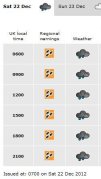
Officially I’ve knocked off for the Christmas and New Year holidays. I’m still awake earlier than I need to be, but the rotten weather this morning is (so far) putting me off a Saturday morning run. For today’s forecast, check out the clip to the left – which for the record I’ve extracted (in what I think is a permitted way) from the Met Office website.The weather! So for now it’s just me, my porridge, a mug of strong coffee and my computer. I reckon I have about 30 minutes before I’m joined by others, by then also awake and up for the day.

So I have a precious window in which to reflect on a first month of blogging. First up is to state how much I’ve enjoyed it. I began with the idea of writing about my research, drawing on my work as an academic mental health nurse at Cardiff University. I had the plan of blogging about papers and projects, and providing links wherever possible to articles available for public download via the University’s ORCA open access repository. I’ve certainly done some of this (as examples, check out my earlier posts on wicked problems here, here and here, my post on research ethics and governance and my post on the measurement of blood pressure and what this tells us about health care tasks).

But having gone to the bother of setting it up I’ve also found myself drawn to using this site as a place to record more general observations: on mental health care, nursing, policy, people and so on. That wasn’t completely planned, but I’m pleased to have used my blog for this purpose. It wasn’t a long post, but the short point I made in defence of student nurses earlier this week felt worth saying. I expect, as I head into what promises to be a very busy but exciting 2013, that I’ll continue to use this space in this additional way.

Fallen tree, Ridegeway, 15.01.12Others are now awake, and I should go. So without further ado, here at the right is the picture of the tree that’s mentioned in this post’s title. South Wales is full of trails, mountains and woodland. I enjoy this variety very much, as both a born-again runner and as a walker of longer standing. In January this year, heading out on a favourite route along the top of Craig yr Allt, I happened upon this enormous, fallen, monster. It had come down in high winds during the previous week, presumably missing by a whisker the telegraph wires you can see towards the top of the photo.

The tree rests, still, where it fell. For those using the path the way through is either over or under the branches to the right. Goodness knows how the horses are managing it.

The Mayan apocalypse and The King’s Fund

According to some interpretations of the Mayan long count calendar, tomorrow – December 21st 2012 – will see the end of the world. If the apocalypse does happen then none of us, I’m afraid, will get to know how accurate the predictions contained in Future Trends might otherwise have been.

I came across this report earlier today via a link tweeted by @TheKingsFund. It’s part of the organisation’s new Time to Think Differently programme, and sets out ‘the significant trends and drivers that we [The King’s Fund] believe will affect health and social care services over the next 20 years’. Properly speaking this is all about the outlook for England, though I think Future Trends offers plenty of food for thought for those of us in other parts of the UK, too.

The document addresses issues across a number of areas: demographic change, health-related behaviours, disease and disability, the workforce, attitudes and expectations, determinants of health, medical advances, information technology, sustainability and economic pressures. Future Trends also has some important, specific, things to say about mental health and illness and about services in this area. One is to restate the connections between mental and physical health. As The King’s Fund says, poor physical health is associated with poor mental health and vice versa. Future Trends also points to the existence of significant unmet mental health need, and to the fact that demand for services can be expected to rise at times (like now) of economic downturn. Elsewhere there are sections dealing with the workforce, and the risk of a growing ‘care gap’ as sources of informal care diminish. Changing patterns of disease are likely to increase demand for home (rather than hospital) care, and for new types of worker able to cross traditional professional boundaries.

To my mind the broad picture Future Trends paints is an entirely plausible, and simultaneously challenging, one. More plausible, certainly, than predictions of an imminent end to the world. I think we might want to start thinking, sooner rather than later, about how we improve the physical well-being of people using mental health services. We should consider what the rise of chronic conditions means for education and training, and how to better meet need.

In praise of…student nurses

Student nurses (and their teachers) have come in for some criticism lately, as I’ve observed on this blog before. I won’t say anything about nursing academics in this briefest of posts, but I will say something about students. Which is this: the vast majority of them are really rather good. In my view this simple truth is not stated sufficiently often. Again and again I come across hard-working, inquisitive, students who are (and here’s the thing) motivated to care. They put the shifts in, come home, and read about how to do it better. They arrive in class ready and willing to learn, share their experiences and improve. They don’t get paid much, and as their careers progress they probably never will. So, students, take the applause: you deserve it.

University of South Wales

A quick post before I head off for the train. Interesting to see that the merger of universities in this part of the world has taken a step forward. Yesterday it was reported that the name of the institution which will bring together the University of Glamorgan and the University of Wales Newport next year is to be the University of South Wales. Some of this has been quite fraught, what with Cardiff Met strongly resisting pressure from Welsh Government to join the party.

I’ve worked through an institutional merger of this type, having first been employed in the University of Wales College of Medicine before moving across to Cardiff University in 2004 when the two joined. In a day-to-day sense I’m not sure I ‘felt’ the significance of this move initially. Sometimes the impact of a change of this type takes time to work its way through the system, but I’m sure the limbering up for merger which has been taking place across other local universities has been anxiety-provoking for some. In the fullness of time it will be interesting to catch up with colleagues in Glamorgan’s Department of Care Sciences to hear how things are progressing. I wish them all well.

The train calls.

Mental Health Nurse Academics UK: hot off the press

For the last couple of weeks I’ve been acting as a returning officer of sorts, as members of Mental Health Nurse Academics UK (MHNAUK) have been voting for a new Vice Chair. This is a position held for two years, after which the incumbent becomes Chair for a further two years.

This morning I’ve emailed members of MHNAUK with news of the outcome. Well done to Professor Joy Duxbury, from UCLan, who is duly elected. Joy knows lots about risk, safety, aggression and coercion in mental health services (see, for example, this paper and this paper). She takes up her position in the new year, picking up from Dr Michael Coffey (Swansea University) who now becomes Chair. That’s a great combination of people, let it be said: MHNAUK remains in very capable hands. By the way, I’m not sure if Joy tweets, but for the Twitter-users out there Michael does as @D10Coff.

Taking a well-earned breather having done an excellent job chairing MHNAUK for the last two years is Professor Alan Simpson from City University, or @cityalan as he’s known in Twitter-land. Good work, Alan. Now go and prepare that talk you have to give as Skellern Lecturer for 2013!