Tag: Mental Health Nurse Academics UK

Ten good reasons to come to this year’s NPNR conference

This year’s International Network for Psychiatric Nursing Research Conference takes place on the 5th and 6th of September at Warwick University. Here are ten reasons to come along and participate:

  1. to learn from Professor Kate Pickett (co-author of The Spirit Level) talking about global inequalities in mental health;
  2. to hear Professor Len Bowers presenting new findings from his Safewards trial;
  3. to listen to Charles Walker MP, who has talked publicly about his personal experience of mental health difficulties, speaking on the topic of making the personal political;
  4. to hear Dr Simon Duffy from the Centre for Welfare Reform talking about personal responsibility and social justice;
  5. to listen to Dr Fiona Nolan from UCL/Camden and Islington NHS Foundation Trust discussing protected engagement time in acute mental health inpatient wards;
  6. in a packed programme of concurrent sessions, to learn from delegates (from the UK and beyond) talking about their research studies large and small;
  7. to renew existing friendships within the mental health nursing research field, and to make new ones;
  8. because I defy you to tell me you have anything more interesting to be doing over the two days the conference is taking place;
  9. because if (like me) you’re a regular at this conference, being there is the only way to find out how the NPNR at Warwick compares with the NPNR at Oxford;
  10. because you will, undoubtedly, enjoy yourself.

Research and mental health nursing

Over on the Mental Health Nurse Academics UK blog, the group’s chair Dr Michael Coffey writes:

The Research Excellence Framework (REF) looms large for many of us. This is part of the regular round of judging of peer-reviewed research publications on which the UK government bases its decisions on distribution of institutional research funding. Decisions within Higher Education Institutions are being made around now on who is considered returnable and then whether it is strategically advantageous to submit these researchers in the exercise. For individual research careers these decisions weigh heavy. For the profession of mental health nursing there may be wider implications. Previous research assessment exercises have seen more and more evidence of mental health nurses being returned. This has undoubtedly led to an improved profile within individual universities and recognition of the contribution of research to improving the experience of people using mental health services.  There remain significant opportunities for mental health nurse researchers to contribute and bring to bear a professional view on what needs researching and how this should be conducted. We will have to wait until 2014 for an idea of what the landscape will look like in relation to mental health nursing. One thing for sure is that we need a highly engaged mental health nurse academic workforce to continue to provide high quality education and research. By doing this we can make a meaningful contribution to the development of mental health care both here in the UK and beyond.

Nursing certainly did do well in the UK’s last Research Assessment Exercise, the precursor to the REF to which Michael refers in his post. Results for all higher education institutions submitting to Unit of Assessment (UoA) 11 (Nursing and Midwifery) in RAE 2008 can be found here. In his subject overview report for UoA11, Professor Hugh McKenna of Ulster University ended with this:

In conclusion, the sub-panel members were very impressed with most of the submissions they reviewed and with the pervasive pattern of world-leading and internationally excellent research. There are many models of good practice from which developing research groupings can learn in terms of research activities, outputs, environment and esteem. It is clear that investment by Governments, funding bodies and universities has increased research capacity and developed research leaders capable of undertaking nursing and midwifery research that is internationally excellent and world leading. These funding streams need to be sustained and enhanced if the upward trajectory and momentum are to continue and if the quality differentials between the strongest and weakest departments are to be addressed.

And, when the results from the last RAE were published in December 2008, The Guardian ran an article titled Nursing research takes its place on world stage. Here it said:

Nursing, for many years medicine’s poor relation, has come of age in the 2008 research assessment exercise (RAE). Academics in the field can justifiably claim to be world-leading in terms of research. Nursing and midwifery was among the subjects with the most highly rated research in the results published today.

Heady stuff indeed, and testimony to years of hard work, strategy, and capacity-building investment. All this does, though, seem an awful long time ago. As Michael reminds us in his MHNAUK post, attention has long since turned to preparations and prospects for REF 2014.

I have written about nursing and the Research Excellence Framework 2014 on this site before, drawing attention to the workload facing members of UoA A3 (Allied Health Professions, Dentistry, Nursing and Pharmacy) and to the challenges of demonstrating and assessing ‘impact’. So, as we hurtle towards the deadline for REF submission, in what shape does UK mental health nursing research find itself?

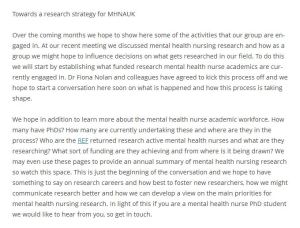
Readers of this blog will know that this is a question that MHNAUK is also asking, and is seeking an answer to in organised fashion. Professor Len Bowers led a discussion on this at the MHNAUK meeting held in Cardiff last March. When the group reconvened in Liverpool in June, Dr Fiona Nolan asked members for items to include in her planned survey of research activity and capacity.

Whilst we await findings from Fiona’s project in the first instance, my personal view is that there is much to celebrate in mental health nursing research but also room for development. A small number of universities are home to strong and established research groups. Leaders of these have built national and international collaborations across disciplinary and institutional boundaries. They have laboured to secure funding in open competition and to complete and publish studies with real implications for policy, services, education and practice. This is excellent progress, and I think we now need more of this type of activity across more universities. This means people (and I include myself here) extending their ambition, and perhaps being a little bolder. As an example, early next year the European Union’s Horizon 2020 research and innovation programme invites a first round of applications for funding. How excellent it would be for mental health nurses in the UK to be leading, and collaborating on, high-quality bids submitted there.

My more general reading of the field is that, in many universities, mental health nurse researchers are thinly spread. I’ll bet that in most of the sixty-plus universities represented at MHNAUK the number of people predominantly involved in teaching far outstrips the number predominantly engaged in research. Teaching is important – really important – but the lone researcher in a team of teachers is in a tough place indeed. As I cast an eye around the departments I am most familiar with I also wonder where the younger mental health nurse researchers are. How many mental health nurses in their 20s are studying for PhDs? If the answer is ‘not many’, then what should we collectively be doing to make research a viable, and attractive, career proposition for nurses at the start of their careers? How might we nurture a future generation of mental health nursing clinical academics?

Anyway: all is speculation until we have some evidence. The MHNAUK survey, I anticipate, will paint a more rounded and complete picture of the true state of research activity and capacity than will the Research Excellence Framework. The REF, being what it is, is subject to all sorts of inter- and intra-institutional politicking and will produce only a partial view of what’s really going on.

Mental Health Nurse Academics UK meets in Liverpool

Yesterday Mental Health Nurse Academics UK met at Liverpool John Moores University, for its third and final meeting of this academic year. Hosts were Lisa Woods and Grahame Smith, and the chair was Michael Coffey. In the first part of the day Grahame and Lisa gave an excellent presentation on their cross-European Innovate Dementia project. Business items included updates on plans made at the previous MHNAUK meeting held in March in Cardiff. Andy Mercer presented findings from his and Karen Wright‘s survey of the methods used by universities to select new students of mental health nursing. Fiona Nolan asked members of the group for their suggested items to be included in her forthcoming research expertise, interests and capacity mapping exercise. This will be useful indeed, and at some point soon we will have a better idea of the full range of mental health nursing research being conducted within the UK’s universities.

Skellern lecture, JPMHN lifetime achievement award and MHNAUK

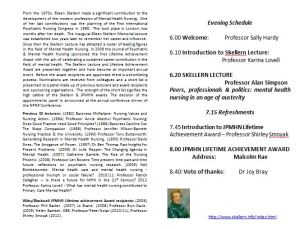
Just enough time for me to draw attention to some important happenings about to take place in the world of mental health nursing. Tomorrow evening (June 12th) Alan Simpson delivers this year’s Skellern Lecture and Malcolm Rae receives his Journal of Psychiatric and Mental Health Nursing Lifetime Achievement Award. Here are the flyers for these linked events, both taking place at City University London:

Next week brings this term’s meeting of Mental Health Nurse Academics UK, taking place at Liverpool John Moores University. Hosts are Lisa Woods and Grahame Smith, and the agenda is looking interesting.

The Next Big Things

Riverside walk, Builth Wells

Here’s what will probably be a final Hay Festival-related post. Last Thursday the Nobel Laureate Professor Sir John Sulston chaired a discussion titled The Next Big Thing. This began with four researchers talking about what they do: Alison Rust, a volcanologist; Zita Martins, an astrobiologist; Nicole Grobert, a nanotechnologist; and Jenny Nelson, a physicist working on materials for solar cells.

All gave fascinating talks, and exemplified the art of conveying complex ideas to the interested but non-specialist listener. And who doesn’t want to hear about supervolcanoes (for the record, they’re bad news, and are definitely best avoided)? Or amino acids from space, the practical applications of graphene or comparing different ways of capturing energy from the sun?

This discussion has since got me thinking about the Next Big Things in nursing and midwifery research (and mental health nursing research in particular). Generally nurses do not do fundamental or basic science, and are not in the business of discovering how bits of the natural world work. So, no volcanoes or extraterrestrial chemicals for us. But practical applications of health-related technologies, and exploring and comparing different ways of doing health work? That’s more up our street, I think, even if graphene and solar power are unlikely to immediately feature.

River Wye, Builth Wells

To the applications-of-technology and exploring-and-comparing questions which might be asked within mental health nursing I would personally add some others related to the examination of health and health care experiences. We know that mental health nurses do ‘people work’ in a big way, spend much of their time coordinating (or ‘articulating’) complex trajectories of care and are often present during service users’ critical junctures. There are applications of skill and technology in this, and how nurses do their work and the effects this has are wide-open areas for study. COCAPP, as I’ve mentioned on this site before, is aiming to distil the components of care planning and care coordination associated with recovery-oriented and personalised mental health services, and is a great example of applied research in this broad field. I’d like to think that its findings will, in some way, be directly useful to practitioners and others in the fullness of time.

But these are just my thoughts, reflecting the things that happen to interest me personally. I wonder what mental health nursing’s current, collective, priorities for research would be if people were asked? What might members of the profession see as The Next Big Things for the period immediately ahead? There are plenty of past examples of this kind of exercise being undertaken within nursing. Over a decade ago the National Coordinating Centre for NHS Service Delivery and Organisation R&D commissioned a study to ‘identify priorities for research funding in the fields of nursing and midwifery’. More recently, the Academy of Nursing, Midwifery and Health Visiting Research (UK) conducted a Delphi study to establish areas for research commonly agreed by nurse leaders in health services and in academia. Within mental health nursing exclusively, I recall (because I’ve cited it in past publications) Ted White’s 1994 paper in the journal Mental Health Nursing titled, ‘Research priorities for community psychiatric nursing’. In its second position paper, appearing in 2004, Mental Health Nurse Academics UK set out its view of the principles to underpin future research studies and the areas it believed were in need of development.

Thinking of Graham Thornicroft’s recent editorial on the poor physical health of people using mental health services, referred to on this blog here, if asked to give their research priorities now perhaps some would make a case for researchers and practitioners to combine their efforts to seriously improve this situation. I know there are people working in this area already, but given the magnitude of the problem it seems to deserve some serious new investment. And how about extending research into the mental health nursing contribution to the vital care of older and vulnerable people, including those with dementia? Again, there are people, such as John Keady, doing this already, but possibly not in sufficient numbers. Or research in the area of quality improvement and safety? And what about workforce research, including studies into factors sustaining nurses’ resilience to provide care in conditions of adversity?

However they might be identified and emerge I suspect that any Next Big Thing candidates for nursing research will be the products of sustained collaborations. To return to last Thursday’s four discussants at Hay: all were explicit about interdisciplinarity, and the importance of crossing boundaries to do high quality research aimed at answering ‘big questions’. There are established academic mental health nurses doing this already (I’m thinking of people like Len Bowers, Karina Lovell, Patrick Callaghan and Alan Simpson), but more of us need to make friends with colleagues possessing specific substantive and methodological expertise relevant to our intended studies. Depending on the questions at hand this might mean finding collaborators with disciplinary backgrounds in various of the social and physical sciences and in the humanities, and if necessary with experience in the practical conduct of clinical trials, qualitative investigation and so on. Crucially, and arguably most importantly, it also means forging meaningful collaborations with people with experience of using services, whose priorities are the ones which really matter.

MHNAUK launches a blog

Michael Coffey, chair of Mental Health Nurse Academics UK, has today launched the group’s blog at http://mhnauk.com.

On the site’s home page Michael writes that:

This is the first entry in what we hope will be a vibrant and engaging place for members of MHNAUK to communicate the range of work we as a group do […] we want to communicate to a wider audience via this blog to show what we are doing and to engage in dialogue about our views on the future direction of education, research and ultimately the practice of mental health nursing.

Michael also points to some of MHNAUK’s current projects. These include Andy Mercer (from Bournemouth University) gathering evidence on the different ways applicants for pre-registration mental health nursing courses are selected, and Fiona Nolan (from UCL) leading an overview of mental health nursing research in the UK.

I’ve posted a comment on the site, and look forward to others doing the same. Go check it out. Right now!

The COCAPP crew, and MHNAUK comes to Cardiff

Yesterday’s COCAPP meeting in Cardiff was both productive and fun. It was lovely to welcome those members of the London contingent able to make the trip, and I extend my apologies (again, and for the last time!) to those I conspired to keep waiting in a darkened corridor before turning up with a room key.

COCAPPers 07.13.13COCAPP is an exciting research project to be involved in, and pretty soon it will have its own blog. I’ll then add links from here for those who are interested. Briefly summarised, this is an England and Wales cross-national investigation into mental health care planning and coordination, and into the relationships between these processes and recovery and personalisation. It’s funded by the NIHR Health Services and Delivery Research Programme, and has lots of distinct elements: about which more will follow, I guess, once the dedicated project blog is up. For now, here’s a photo of yesterday’s assembled COCAPPers (where from left to right there’s Aled, Jitka, Alan (COCAPP’s chief investigator), Sally, me and Michael. We very much missed Alison and Jennifer and their wise contributions, and when we’re all in one place I imagine we’ll take another, and more complete, photo.

Yesterday evening was the traditional social involving food and drink with fellow members of Mental Health Nurse Academics UK, ahead of today’s meeting proper. As Cardiff hosted we got to select the venues, and I hope everyone who was able to make it enjoyed the selection of fine ales and wines, and indeed the general ambience, at The Rummer Tavern. Likewise the food at The Mango House.

MHNAUK’s first meeting of 2013 was a good ‘un. Jen French talked about mental health strategy in Wales, and Ian Hulatt updated us on the Willis Commission. Eschewing the usual format of host universities presenting their research and teaching activities in the morning, Michael Coffey (in the photo above, and MHNAUK chair) and Joy Duxbury (newly elected vice chair) invited reflections and discussion on the aims and purpose of the group, and on the character of research in mental health nursing and what can be done to nurture it. There was some lively discussion in the two groups (facilitated by Linda Cooper and Len Bowers respectively) which convened to talk to these areas. It occurred to me unhelpfully after the event that we might have taken a MHNAUK photo, including the 35 or so members participating today: not least as MHNAUK, like COCAPP, is collectively thinking of increasing its presence via a blog.

Work aside, running has taken a big back seat this week, what with one thing and another. Must get out soon!

Cardiff hosting, and NPNR news

This is the week that both Mental Health Nurse Academics and the COCAPP team come to Cardiff. MHNAUK’s meeting on Friday will take place in the Council Chamber in the Main Building, which is really rather grand. Visiting COCAPPers can look forward to a more everyday venue for our Thursday meet-up. This will be in Eastgate House (which is where I’m based).

Other news of note in the world of mental health nursing education and research is the impending move of this autumn’s Network for Psychiatric Nursing Research conference from Oxford to Warwick. The annual NPNR bash has taken place in Oxford pretty much since it was launched in the 1990s. I gather from my Twitter-using pals who sit on the scientific and organising committees that we can expect a relocation for an event scheduled, this year, for September 5th and 6th. It occurs to me that Warwick University is well-placed for delegates travelling from all parts of the UK, and indeed from around the world.