
Tag: CAMH-Crisis2

Belated CAMH-Crisis2 catch-up

Time flies, and that’s a fact. The last occasion I logged into this blog site was well over a year ago (!), to pass comment on Cardiff University’s plans to discontinue its programmes in nursing and other disciplines. Lots has happened since. Nursing in Cardiff remains, but with far fewer academics than previously. For my own part, along with many others I left the University’s employment at the end of July 2025. I keep my hand in as an emeritus professor.

In what has felt like a period of transition I’ve committed to working with colleagues to complete the NIHR-funded CAMH-Crisis2. This, as a reminder, is a study in the area of crisis care for children and young people, the protocol for which can be read here. The project has built on an underpinning evidence synthesis, about which more can be found in this earlier post. This is, then, a good example of research which is programmatic.
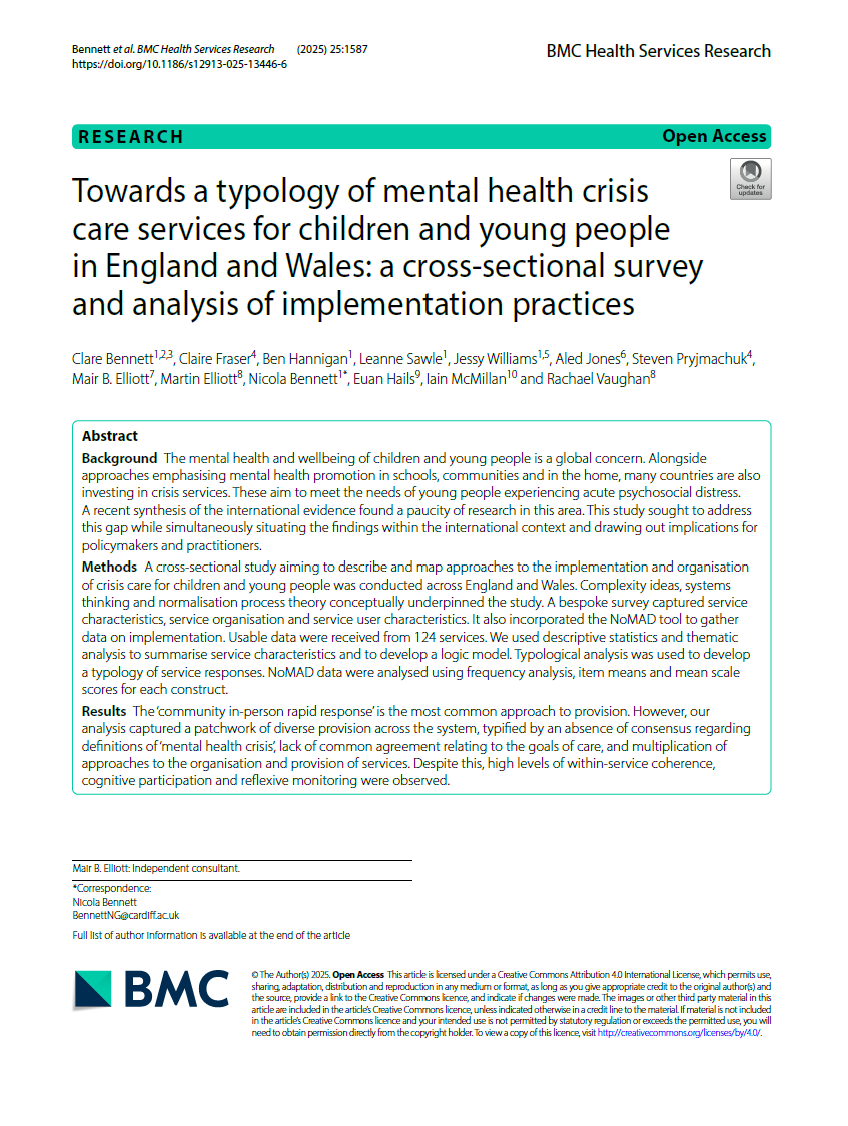
Towards the end of 2025 a first findings paper from CAMH-Crisis2 appeared, reporting on our analysis of responses to the survey developed and distributed in the opening part of the study. This appears in gold open access form in BMC Health Services Research, and this link will take you there. Here, too, is the abstract:

Background

The mental health and wellbeing of children and young people is a global concern. Alongside approaches emphasising mental health promotion in schools, communities and in the home, many countries are also investing in crisis services. These aim to meet the needs of young people experiencing acute psychosocial distress. A recent synthesis of the international evidence found a paucity of research in this area. This study sought to address this gap while simultaneously situating the findings within the international context and drawing out implications for policymakers and practitioners.

Methods

A cross-sectional study aiming to describe and map approaches to the implementation and organisation of crisis care for children and young people was conducted across England and Wales. Complexity ideas, systems thinking and normalisation process theory conceptually underpinned the study. A bespoke survey captured service characteristics, service organisation and service user characteristics. It also incorporated the NoMAD tool to gather data on implementation. Usable data were received from 124 services. We used descriptive statistics and thematic analysis to summarise service characteristics and to develop a logic model. Typological analysis was used to develop a typology of service responses. NoMAD data were analysed using frequency analysis, item means and mean scale scores for each construct.

Results

The ‘community in-person rapid response’ is the most common approach to provision. However, our analysis captured a patchwork of diverse provision across the system, typified by an absence of consensus regarding definitions of ‘mental health crisis’, lack of common agreement relating to the goals of care, and multiplication of approaches to the organisation and provision of services. Despite this, high levels of within-service coherence, cognitive participation and reflexive monitoring were observed.

Conclusions

There is significant variation in the organisation and provision of crisis services for children and young people. Through situating our findings in a prevailing international policy context, we suggest that the variation we observe reflects an absence of a developed evidence base and a proliferation of strategies and frameworks which fail to provide clear guidance on how crisis care might best be organised and provided.

Meanwhile, two other articles are planned from CAMH-Crisis2, and work on both is largely complete. The first reports on case study findings, arising from the second phase of the project. It also synthesises what we learned about young people’s crisis care across all sites and the study as a whole, and includes a set of principles intended to guide future services. This has been accepted for pre-peer review publication in NIHR Open Research, having passed through the journal’s editorial screening. The second article is a reflective one, which draws on our approach to linking theory, mixed methods and case studies. It also includes some thinking derived from our fieldwork experiences. This piece is still under review.

As part of the CAMH-Crisis2 dissemination strategy we’ve also worked with Nifty Fox Creative to produce a fine animation. There’s a version of this to be uploaded at some point with Welsh subtitles, but for now here is the animation in English only:

Another part of the work being done to share what we’ve learned in CAMH-Crisis2 is the production of an accessible summary, which can be downloaded here:

Now that I’ve reacquainted myself with my blog I’ll aim to add more on CAMH-Crisis2, and potentially other things, further down the line: hopefully before the passing of another year.

@benhannigan.bsky.social

CAMH-Crisis2 protocol and progress

Here is something of a project update, following another hiatus in blogging.

Working alongside a fine set of colleagues, much of my research work both last year and this has focused on the CAMH-Crisis2 project funded by the National Institute for Health and Care Research. This has been examining how mental health crisis services for children and young people in England and Wales are organised, implemented and experienced.

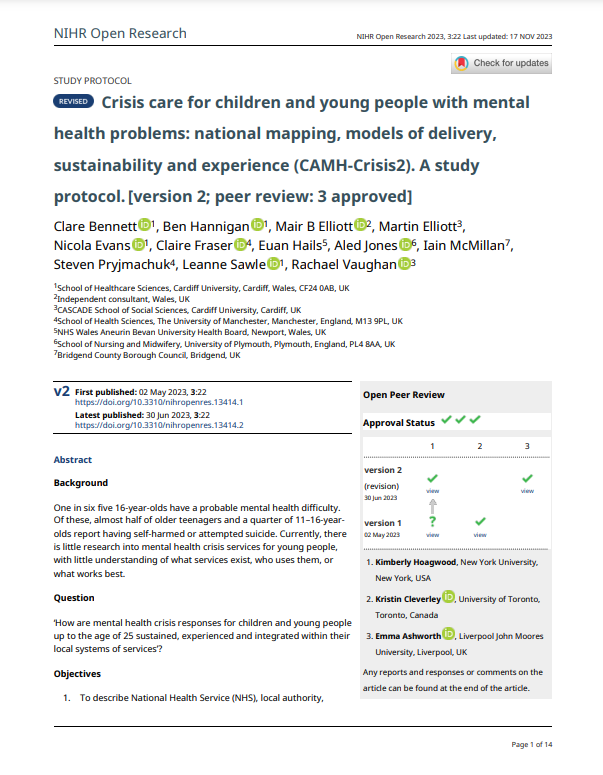
In June 2023 a final, approved, version of our protocol appeared in the new(ish) NIHR Open Research journal. The paper is free to download and to read, via the link above.

As an aside, this was my (and I think the whole team’s) first experience of jointly producing an article using a post-publication open peer review process. This involves article revisions in the light of reviews received following initial publication, and in our case led to version 2 of our manuscript becoming the definitive version.

Since publishing this protocol paper, lots (and lots!) has happened with this study. We’ve completed the data generation phase for our first work package (a survey of services), and are close to completing our analysis. We’re deep into data generation in our second work package, which is largely involving interviews with commissioners, managers, practitioners, young people and family members in each of eight case study sites across Wales and England. By design our cases are remarkably diverse: more to follow once we have findings to share.

Meanwhile, here’s a link to my just-opened Bluesky account, which I’m planning to start using in preference to Twitter:

@benhannigan.bsky.social

CAMH-Crisis2

Crisis care for children and young people with mental health problems: national mapping, models of delivery, sustainability and experience is a new project funded by the National Institute for Health and Care Research (NIHR) Health and Social Care Delivery Research (HSDR) Programme, which my colleague Clare Bennett and I are jointly leading. The wider team includes Martin Elliott, Leanne Sawle, Aled Jones, Steven Pryjmachuk, Claire Fraser, Euan Hails, Iain McMillan, Nicola Evans, Mair Elliott, Rachael Vaughan and Aneta Taylor.

Our study builds on the now-completed Crisis responses for children and young people: an evidence synthesis of service organisation, effectiveness and experiences, led by Nicola Evans, about which I most recently wrote a post here. It also has a clear connection to the Developing a model for high quality service design for children and young people with common mental health problems project led by Steven Pryjmachuk, with which it shares aspects of study design.

Our new CAMH-Crisis2 study began in November 2022, and a summary of what we’re doing is here:

There has been a sharp and worrying increase in mental health problems experienced by children and young people. Prior to the pandemic, one in eight 5-19 year olds in England had a probable mental disorder. In 2020, amongst 5-16 year olds this figure had risen to one in six. Amongst those with a mental health difficulty, almost half of older teenagers and a quarter of 11-16 year olds report having self-harmed or attempted suicide. Extreme psychosocial distress, with or without self-harm, is often referred to as a ‘crisis’. Services for young people in crisis are a UK priority, and provision is expanding in the NHS, social care and educational settings. However, despite this and the appearance of national standards very little research into crisis services for young people has been undertaken. We therefore do not know what crisis responses currently exist, who uses services, or what works best for children and young people and their families.

Against this background this project will answer the question, ‘How are mental health crisis responses for children and young people up to the age of 25 sustained, experienced and integrated within their local systems of services’? We will work with a group of young people who advise on research, some of whom have used crisis services, to address the following three objectives:

  1. To describe and map NHS, local authority, education and third sector approaches to the implementation and organisation of crisis care for children and young people across England and Wales.
  2. To identify eight contrasting case studies in which to evaluate how crisis services have developed and are currently organised, sustained, experienced and integrated within the context of their local systems of services.
  3. To compare and contrast these services in the context of the available international evidence, drawing out and disseminating clear implications for the design and delivery of future crisis responses for children and young people and their families.

To help us answer our research question and to meet our objectives we will make use of normalisation process theory. This supports studies into what helps, and what hinders, the implementation and sustainability of new approaches to care.

We will meet our first objective using a survey, creating a detailed record of crisis responses across England and Wales and how they are organised, implemented and used. To meet our second objective, from this detailed record we will identify eight contrasting services selected for variety in terms of: geographic and socioeconomic setting (England/Wales, urban/rural, and relative affluence/poverty); populations served (including ethnic diversity); and service configuration (including third sector and/or social care involvement). Treating each as a case study, we will conduct interviews with children and young people and family members who have used the service. We will also interview commissioners, managers and practitioners, including those providing a crisis response and those working in other parts of the local system. We will gather operational policies and related documents, and data on how each service is used and by whom. In our analysis we will focus on understanding how each crisis service is provided, experienced, implemented and sustained. To meet our final objective we will compare and contrast each case study, and use our synthesised findings to advance the available international evidence for best practice in service provision. We will close by drawing clear, actionable, lessons for the future commissioning and provision of high-quality crisis responses which are sensitive to the support and access needs of a diverse range of children and young people receiving care from a range of services.