
Time flies, and that’s a fact. The last occasion I logged into this blog site was well over a year ago (!), to pass comment on Cardiff University’s plans to discontinue its programmes in nursing and other disciplines. Lots has happened since. Nursing in Cardiff remains, but with far fewer academics than previously. For my own part, along with many others I left the University’s employment at the end of July 2025. I keep my hand in as an emeritus professor.
In what has felt like a period of transition I’ve committed to working with colleagues to complete the NIHR-funded CAMH-Crisis2. This, as a reminder, is a study in the area of crisis care for children and young people, the protocol for which can be read here. The project has built on an underpinning evidence synthesis, about which more can be found in this earlier post. This is, then, a good example of research which is programmatic.
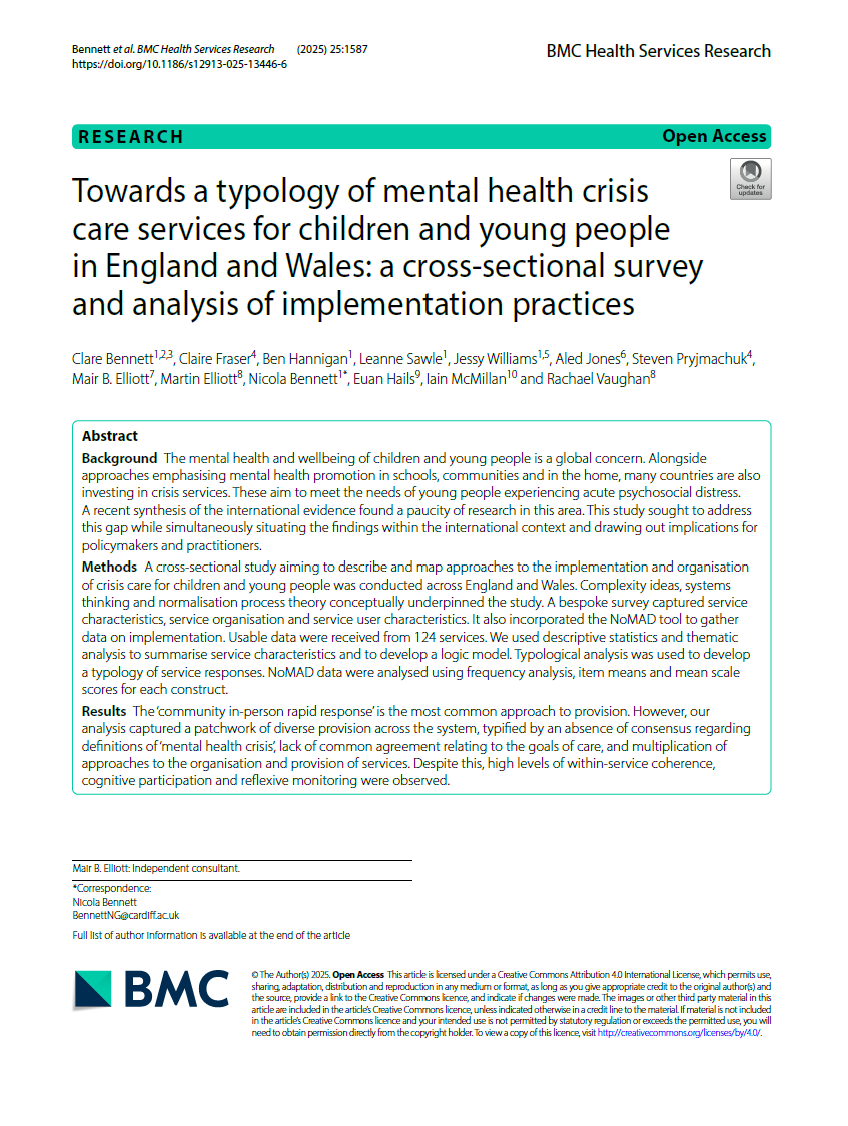
Towards the end of 2025 a first findings paper from CAMH-Crisis2 appeared, reporting on our analysis of responses to the survey developed and distributed in the opening part of the study. This appears in gold open access form in BMC Health Services Research, and this link will take you there. Here, too, is the abstract:
Background
The mental health and wellbeing of children and young people is a global concern. Alongside approaches emphasising mental health promotion in schools, communities and in the home, many countries are also investing in crisis services. These aim to meet the needs of young people experiencing acute psychosocial distress. A recent synthesis of the international evidence found a paucity of research in this area. This study sought to address this gap while simultaneously situating the findings within the international context and drawing out implications for policymakers and practitioners.
Methods
A cross-sectional study aiming to describe and map approaches to the implementation and organisation of crisis care for children and young people was conducted across England and Wales. Complexity ideas, systems thinking and normalisation process theory conceptually underpinned the study. A bespoke survey captured service characteristics, service organisation and service user characteristics. It also incorporated the NoMAD tool to gather data on implementation. Usable data were received from 124 services. We used descriptive statistics and thematic analysis to summarise service characteristics and to develop a logic model. Typological analysis was used to develop a typology of service responses. NoMAD data were analysed using frequency analysis, item means and mean scale scores for each construct.
Results
The ‘community in-person rapid response’ is the most common approach to provision. However, our analysis captured a patchwork of diverse provision across the system, typified by an absence of consensus regarding definitions of ‘mental health crisis’, lack of common agreement relating to the goals of care, and multiplication of approaches to the organisation and provision of services. Despite this, high levels of within-service coherence, cognitive participation and reflexive monitoring were observed.
Conclusions
There is significant variation in the organisation and provision of crisis services for children and young people. Through situating our findings in a prevailing international policy context, we suggest that the variation we observe reflects an absence of a developed evidence base and a proliferation of strategies and frameworks which fail to provide clear guidance on how crisis care might best be organised and provided.
Meanwhile, two other articles are planned from CAMH-Crisis2, and work on both is largely complete. The first reports on case study findings, arising from the second phase of the project. It also synthesises what we learned about young people’s crisis care across all sites and the study as a whole, and includes a set of principles intended to guide future services. This has been accepted for pre-peer review publication in NIHR Open Research, having passed through the journal’s editorial screening. The second article is a reflective one, which draws on our approach to linking theory, mixed methods and case studies. It also includes some thinking derived from our fieldwork experiences. This piece is still under review.
As part of the CAMH-Crisis2 dissemination strategy we’ve also worked with Nifty Fox Creative to produce a fine animation. There’s a version of this to be uploaded at some point with Welsh subtitles, but for now here is the animation in English only:
Another part of the work being done to share what we’ve learned in CAMH-Crisis2 is the production of an accessible summary, which can be downloaded here:
Now that I’ve reacquainted myself with my blog I’ll aim to add more on CAMH-Crisis2, and potentially other things, further down the line: hopefully before the passing of another year.


