Category: Policy

#MHNAUK meets in Leeds, and talks work and roles

MHNAUK members in Leeds
MHNAUK meets in Leeds

Mental Health Nurse Academics UK met yesterday in Leeds, hosted by John Baker and chaired by Joy Duxbury. Our discussions were wide-ranging: proposed changes to the composition of the English NHS workforce signalled by the introduction of associate nurses; the arrival, in England, of student fees for nursing degrees from 2017; safe staffing (see also this editorial in the Journal of Psychiatric and Mental Health Nursing); plans for #NPNR2016; arrangements for a second student mental health nursing conference; the Shape of Caring; England’s Five Year Forward View for Mental Health; guidance for adult field nurses caring for people with mental health problems; this year’s Skellern Lecture and JPMHN Lifetime Achievement Award; the current call for papers for a themed care planning and coordination issue of the Journal of Psychiatric and Mental Health Nursing (which Michael Coffey, Alan Simpson and I are co-editing); and the hot-off-the-press announcement of a Foundation of Nursing Studies-sponsored review into the role of mental health nurses.

In this post I’ll largely confine myself to some thoughts on the mental health workforce and on the place of nurses within this. Yesterday’s discussions in this area exercised MHNAUK members greatly. Proposed changes to the occupational mix to be found within mental health services, debates over nursing numbers and safe staffing, and new arrangments for the funding of education have the potential to trigger significant turbulence in an already-complex system of care. MHNAUK members rightly identified how the appearance of a new associate nurse role, sitting in between health care support workers and registered nurses, will trigger unrest. This is always the case when professional jurisdictions come under pressure (see here and here for papers I have co-written which expand on this point). In this current case, some registered nurses will see new associates as a threat to their hard-won jurisdiction. At a time when nurses are pressing for safe staffing, some are likely to argue that the introduction of associates will also open the door to role substitution and eventual reductions in numbers of registered nurses, thereby threatening both quality and safety.

Should associate nurses appear, we can be certain that plenty of inter-occupational jostling will take place as support workers, associates and registered nurses (amongst others) negotiate their relative positions and assert control over areas of work. In this regard, abstract descriptions of the tasks which new associates will (and will not) be permitted to carry out will provide only the most limited of guides. Differentiations between who does what will inevitably be hammered out in the workplace.

And what of the cross-UK implications for all of this, given that the Department of Health’s associate nurse announcement is for England only? To me it is unclear how new associates will be regulated, or how transferable their future qualifications might be should any wish to move to, say, Wales. Across the four countries of the UK important differences are appearing in the ways people are prepared for health care practice, and in the funding of this. Student nurses will pay fees in England from next year, but student nurses in Scotland will not and will continue to receive a bursary. Here in Wales (unless I’ve been asleep and have missed a piece of essential news), we will need to wait until after our forthcoming Assembly elections and the formation of a new Welsh Government for an announcement on future financial arrangments for nursing education. Perhaps we’ll hear more about the shape of the future Welsh NHS workforce then, too.

Safe staffing

In a post on this site last year I drew attention to the (highly contested) decision by NICE to suspend its work on safe nurse staffing in inpatient mental health settings. Now, and with thanks to Shaun Lintern from the Health Service Journal (and to John Baker, who amongst mental health nurses has worked particularly hard to keep this issue alive), NICE’s evidence review in this area has just been published.

Here’s how the news was broken earlier this week:

Here’s a quick summary. Seven research questions were asked in the review, with searches made of fifteen databases for evidence published since 1998. To be included, studies had to report on at least one of:

  • staffing in relation to outcomes;
  • staffing in relation to factors (such as service user factors, environmental factors);
  • staffing in relation to factors and outcomes.

Studies were eligible for inclusion if they reported findings from inpatient mental health areas serving people of any age. Outcomes of interest included serious incidents (e.g., self-harm, violence), delivery of nursing care (e.g., levels of contact) and other (e.g., nurse vacancy rates). Following a process of searching and sifting just 29 papers were finally included, and subject to quality appraisal. And the conclusions? Here they are, as extracted by John Baker with a call for action:


Cumulative insights

Not for the first time, I’ve attempted to produce some cumulative insights from the past and present mental health research studies I’ve had the opportunity to work on. These include my PhD investigation into work and roles in community mental health care, my post-doctoral study of crisis services, and more recent projects which Alan Simpson, Michael Coffey or I have led on.

The prompt, on this occasion, has been the chance to give a presentation at a School of Healthcare Sciences research seminar taking place this afternoon. For anyone interested, here is the PowerPoint I used. I opened with some general comments on the need for mental health research, and on the funding landscape. I then had some things to say about theory, design and methods. Many of the individual slides have hyperlinks to green open access publications:

Out of the Asylum

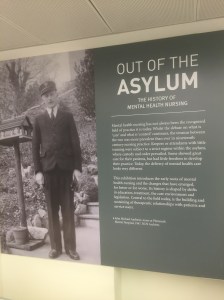
Belated happy new year. Visiting the Royal College of Nursing headquarters in London last Friday ahead of a meeting of the Network for Psychiatric Nursing Research (NPNR) conference committee (more on that below) gave me an opportunity to pop into the ‘Out of the Asylum’ exhibition. I’m glad I did. Texts, photographs and other artefacts illustrate the history of mental health nursing.

2016-01-08 11.25.57Here are some of the pictures I took. These include a photo of the RCN’s copy of a sixth edition of the Red Handbook, displayed alongside nurses’ badges, a Bethlem Royal Hospital pamphlet, a syringe and other items of interest. For more on the Red Handbook see this earlier post, along with this post which includes material from my copy of a fourth edition of the same. Another picture relates a set of regulations for the bathing of patients. 
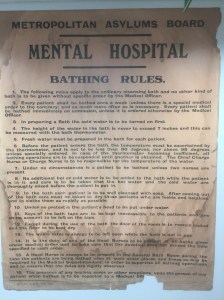
One of the display boards makes the observation that ‘few mental health nurses now wear uniforms’. As an unfortunate aside, this may need some future updating. From what I’m hearing, the historic trend towards mental health nurses wearing everyday clothes at work is reversing, with numbers of NHS trusts and health boards contemplating a return to uniforms. I regret that. But sticking with the exhibition…

…a final photograph I’m reproducing here is the front sheet of an early 1930s examination paper. Look hard and you’ll see questions on bones, asphyxia and antiseptics (amongst other things).

The NPNR planning meeting, this being the purpose of my trip,  was a productive one. This year’s event (the 22nd) will be taking place in Nottingham on September 15th and 16th. I’ll add more on this when I can, and include some regular updates on this site.


Fees, theses and project updates

Last week brought the news that, in England, people beginning nursing degrees from the 2017-18 academic year will need to take out student loans to cover the cost of their tuition fees. The cap on student numbers will also be removed. The Council of Deans of Health broadly supports this move, having previously argued for change. One of the things it points out is that current funding for students (via the agreement of the benchmark price) does not cover the real costs of educating new nurses. The Royal College of Nursing, on the other hand, is concerned that last week’s announcement prepares to break the connection between the NHS and financial support for student nurses, and simultaneously risks making nursing a less attractive career option. This concern particularly relates to mature students and those contemplating a second degree, for some of whom the prospect of additional debt may be exceptionally unappealing. As a nurse academic in Wales I wait with interest to see what policy on fees will emerge from the Welsh Government.

In other news, I find myself engaged in a prolonged period of doctoral student activity. I’ve examined a number of theses in and out of Cardiff in recent months, and have sat with students during their vivas as either supervisor or independent chair. This term has been particularly packed. Plenty of writing has also been taking place: papers and reports are being written from COCAPP, RiSC and Plan4Recovery, and from completed theses I have helped to supervise. Data generation in COCAPP-A has almost concluded, and new research ideas are taking shape. Exciting times, if a little frenetic. 

Higher education Green Paper

The much-trailed higher education Green Paper appeared last week. For the full document, the place to go is here and for a Times Higher summary the link is here. Immediately worth bearing in mind is that higher education in the UK is a matter for devolved government, meaning that most of what the Green Paper says relates to English universities. I say ‘most’ because, as is noted towards the beginning of the document, the Research Councils (like the MRC and the ESRC) have UK-wide remits, whilst the REF and the various editions of the RAE preceding it were carried out on a four-country basis. It would also be naive in the extreme to suggest that universities and policymakers here in Wales can ignore the England-only bits of what the Green Paper has to say; for a nice piece on the Green Paper and devolution, follow this link. And, for an insight into work ongoing in Wales on matters higher education-related, here’s a link to a current review of funding arrangements.

Fulfilling our potential: teaching excellence, social mobility and student choice, to give the Green Paper its full title, proposes plenty of change. It also leaves much of the detail unfilled, and (in at least one analysis) contributes to an emerging higher education policy framework which is both vague and contradictory. One idea is for the Higher Education Funding Council for England and the Office for Fair Access to combine functions within a new Office for Students. Plans for a Teaching Excellence Framework are outlined, along with variable rates of tuition fees. Ahead of the publication of the document there was some talk that REF2014 might have been the last of its kind. What the Green Paper actually says (briefly) is that dual support for research should remain, and that some version of the research excellence framework should continue and be used as the basis for the allocation of government block funding. The next REF, it is suggested, will take place by 2021. But there is obviously more to follow in this context, with sections in the document referring to the administrative burden and cost of the REF and the possible use of metrics to ‘refresh’ quality assessments in between full cycles of peer review. There is also the small matter of having to determine, if the Higher Education Funding Council for England disappears, which body should in the future assume the task of allocating quality-related funding to English universities.

Meanwhile, the sole nurse to get a mention in the Green Paper and its surrounding commentary is Sir Paul Nurse, Nobel Laureate, President of the Royal Society and chair of the review into the UK’s research councils. Nurses, of the type of which I am one, have to look elsewhere for the specifics on possible future arrangements for the organisation and funding of health care professional education and for debates in this area.

Initiatives crisis

My esteemed friend and colleague Professor Alan Simpson draws my attention this afternoon to this piece on the NHS Networks website, which points to a catastrophic collapse in the availability of NHS initiatives. Here’s a snippet:

The report, No More Burning Platforms: We’re Out of Job, produced by a leading think tank, paints a disturbing picture of a future health service where hundreds of millions of pounds a year currently devoted to transformation programmes, innovation schemes and reports that no one reads could be siphoned off by officials to fund wasteful and inefficient “frontline” services such as hospital A&E departments and GP surgeries.

As I type, NHS executives will be frantically planning emergency fishing trips to poach the initiatives of other countries. Let’s hope they’re able to replenish our dwindling supplies of TLAs* at the same time.

*TLAs: three-letter acronyms. Like SMI, CBT and ACT. These should never be confused with their four-letter cousins, like CMHT, DTOC and CRHT, which are quite different. For more on this, see this earlier piece.

Public Uni

After finishing work next Thursday (October 15th 2015) I’ll be heading off to Chapter to take part in the 7th Public Uni. At Public Uni, which is organised by Marco Hauptmeier in the Cardiff Business School, academics get a ten minute opportunity to present their research to an assembled audience. I gather there is some retiring to the bar at some point in the evening, which seems very sensible.
Here’s the flyer for next week’s event: and what an eclectic bunch us five speakers are! In my slot the aim is to compress a history of mental health care, and a summary of where we are now, into 600 seconds of talking. What fun! For a taster of what I’m planning to say, here’s my summary:

Changing landscapeUntil the middle of the last century most formal mental health care was provided in hospitals. This changed with the emergence of community care. Dr Ben Hannigan, Reader in Mental Health Nursing in the School of Healthcare Sciences, explains how this change came about and discusses the people, policies and practices found within the system now.

Labour on mental health

Politics in the UK has just become a whole lot more interesting with the election of Jeremy Corbyn as leader of the Labour Party. During the leadership campaign differences between the candidates on health care did not feature as strongly as they might. Perhaps this is because more obvious variances existed in other areas, such as in economic, foreign and defence policies.

Following this link takes you to the new Labour leader’s proposed policies for mental health. These are clearly displayed on his campaign website; further evidence, perhaps, of the way mental health issues have become prominent in politics in recent years. To summarise, Corbyn’s plans include campaigning to reverse cuts to services, increase the numbers of professionals and improve services for young people. They also include introducing mental health education into the school curriculum, tackling stigma and loneliness and challenging the social causes of mental ill-health for women as well as investing in services. Corbyn also talks of addressing the over-representation of members of black and minority ethnic communities in mental health services, along with tackling homelessness, the mental health crisis in prisons, poverty, and failures in the welfare system and the workplace. He closes with this:

I am committed to a holistic approach that sees emotional well being as fundamentally connected with a society less atomised and individualistic, more socially connected, more caring, more inclusive and more equal.

A search through the new Labour leader’s website also turns up speeches he has given on mental health topics, the contents of which very much reflect the emphasis in his policy statement referenced above. An example can be read here. In the face of so many competing priorities, it will be interesting in the coming months to see how far mental health remains towards the top of the Leader of the Opposition’s agenda. 

Spring election, and the politics of mental health

It hasn’t always been like this, but mental health is something which politicians now talk about. In the run-up to next week’s general election mental health has even featured in public appeals to voters. The Liberal Democrats have particularly campaigned in this area, and in their manifesto promise £500 million per year for better mental health, and specifically make a case for investing in research. Labour talk about giving mental health the same priority as physical health, and the Conservatives say pretty much the same. Reviewing all the main parties’ manifesto promises for evidence of concrete plans for post-election improvements to mental health care, over on his blogsite the Psychodiagnosticator observes ‘that many of them were so vague as to amount to no promise at all‘. I think he has a point.

Possibly the broad manifestos produced in the run-up to a general election are not the places to look for fully worked-up blueprints of what future mental health policy across the UK might look like. Perhaps, more accurately, we should not think about ‘UK policy’ in this context at all. Members of Parliament elected to Westminster next week, from amongst whom a new government will be formed, will have authority to directly shape services in England only. Health and social care remain areas over which devolved authorities have jurisdiction, and for a ballot delivering a government with the power to pronounce on mental health care here in Wales we must look to the National Assembly elections to be held in 2016. I’ve indicated before that mental health policy here is different from that in England, and indeed from other countries in the UK. Consider again the case of the Mental Health (Wales) Measure. This is a piece of legislation for Wales alone, mandating for care and treatment plans, care coordinators, access to advocates in hospital and the right of reassessment within secondary mental health services following discharge. It was introduced in the face of some strong, pre-legislative, criticism from at least one senior law academic (Phil Fennell) who in 2010 began his submission to the National Assembly by saying,

The gist of my submission to the Committee is that this measure, although well-intentioned, is cumbersome, unduly complex, and will lead to a delay in providing services which ought to have been available already to service users and their families in Wales under the National Service Framework for Adult Mental Health and the Care Programme Approach.

Five years on the Measure has not only passed into law, but been subjected to a round of post-legislative scrutiny by the National Assembly’s Health and Social Care Committee (see my post here), to which the Welsh Government has now responded. With data from across both England and Wales, COCAPP (and in the future, COCAPP-A) will have something to say about how care planning and care coordination are actually being done, and readers will be able to draw their own conclusions on the extent to which changes in the law trigger changes to everyday practice. And, whilst we’re in policy comparison mode, for a view from Scotland try Paul Cairney. He argues that divergence in mental health policy across the UK, exemplified by contrasting English and Scottish experiences of reforming the law, reflect differences in both the substance of policy and in policymaking style.

In all of this I am, again, reminded of the wicked problems facing all policymakers who seek to intervene in the mental health field. Whatever direction it takes, future policy will be open to contest and will surely trigger waves of consequences.