Category: People

Mental health needs and services in Palestine

Mohammad Marie, Aled Jones and I have co-authored a paper arising from Mohammad’s PhD. This appears in the gold open access International Journal of Mental Health Systems, and a copy can be downloaded by following this link.

The article is titled Mental health needs and services in the West Bank, Palestine and has this for an abstract:

Background: Palestine is a low income country with scarce resources, which is seeking independence. This paper discusses the high levels of mental health need found amongst Palestinian people, and examines services, education and research in this area with particular attention paid to the West Bank.
Methods: CINAHL, PubMed, and Science Direct were used to search for materials.
Results and conclusion: Evidence from this review is that there is a necessity to increase the availability and quality of mental health care. Mental health policy and services in Palestine need development in order to better meet the needs of service users and professionals. It is essential to raise awareness of mental health and increase the integration of mental health services with other areas of health care. Civilians need their basic human needs met, including having freedom of movement and seeing an end to the occupation. There is a need to enhance the resilience and
capacity of community mental health teams. There is a need to increase resources and offer more support, up-to-date training and supervision to mental health teams.

Further papers from Mohammad’s study will follow, and I’ll aim to post updates as work progresses.

End of an Era

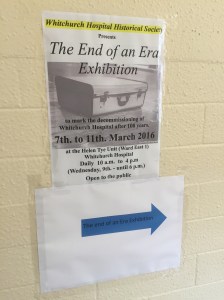
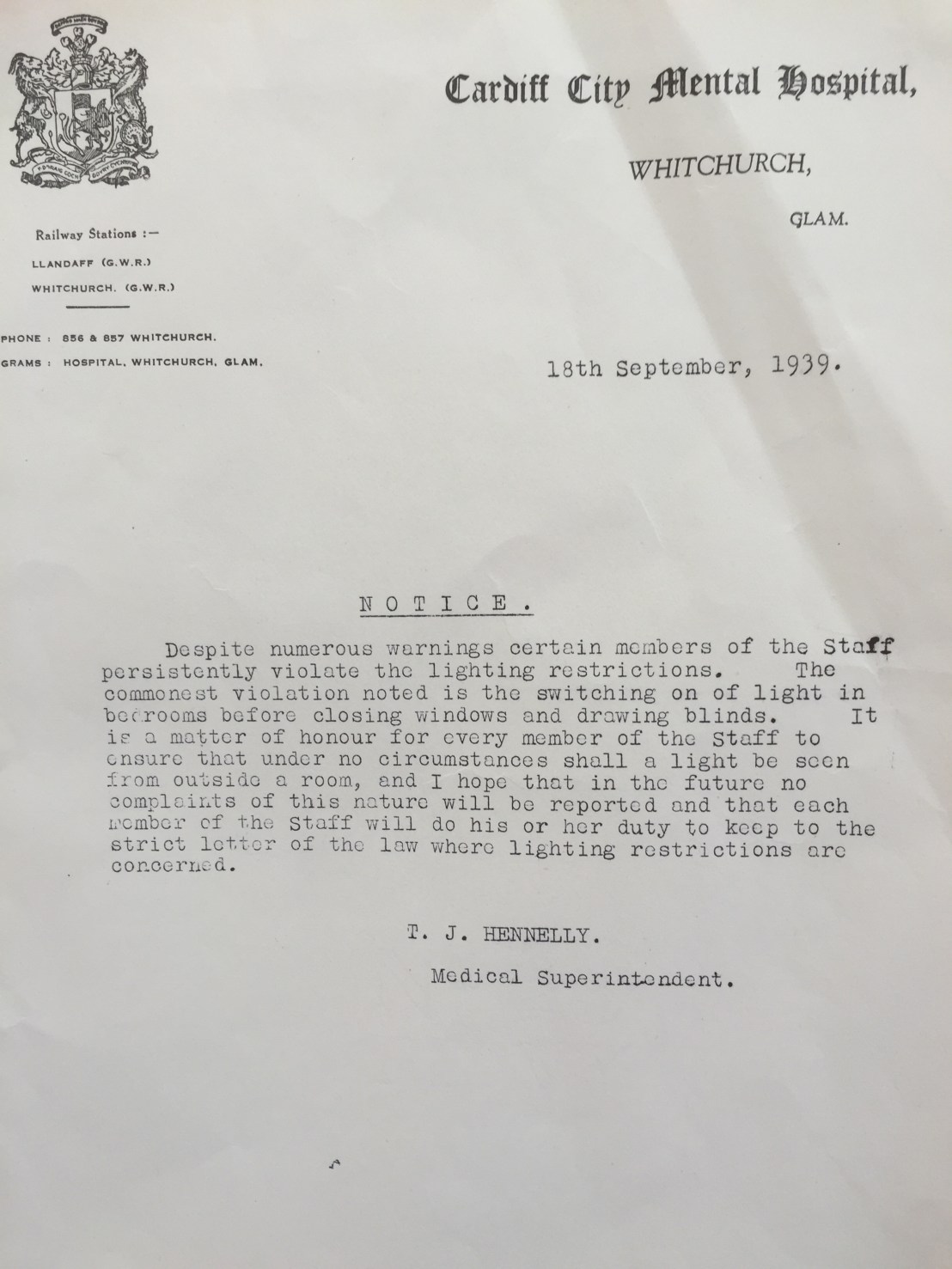
Last Friday afternoon I took the opportunity to visit the End of an Era exhibition at Whitchurch Hospital. The hospital opened in 1908, for more than a century providing inpatient mental health care for the people of Cardiff and its surroundings. Now, all clinical staff and current inpatients are about to move to a newly built facility in the grounds of Llandough Hospital in the Vale of Glamorgan.

The exhibition was the work of the Whitchurch Hospital Historical Society, and was excellent. Extracts from the written archives, images and objects were on display, painting a fascinating picture of life inside the hospital over the decades. I hope a permanent home is found for at least some of this in the future. Here, for now, are some of the photographs I took.

2016-03-11 14.58.092016-03-11 14.59.21

2016-03-11 15.10.05

Meanwhile, here is what people have been saying about the new Hafan y Coed unit which is about to open at the start of April 2016:

#MHNAUK meets in Leeds, and talks work and roles

MHNAUK members in Leeds
MHNAUK meets in Leeds

Mental Health Nurse Academics UK met yesterday in Leeds, hosted by John Baker and chaired by Joy Duxbury. Our discussions were wide-ranging: proposed changes to the composition of the English NHS workforce signalled by the introduction of associate nurses; the arrival, in England, of student fees for nursing degrees from 2017; safe staffing (see also this editorial in the Journal of Psychiatric and Mental Health Nursing); plans for #NPNR2016; arrangements for a second student mental health nursing conference; the Shape of Caring; England’s Five Year Forward View for Mental Health; guidance for adult field nurses caring for people with mental health problems; this year’s Skellern Lecture and JPMHN Lifetime Achievement Award; the current call for papers for a themed care planning and coordination issue of the Journal of Psychiatric and Mental Health Nursing (which Michael Coffey, Alan Simpson and I are co-editing); and the hot-off-the-press announcement of a Foundation of Nursing Studies-sponsored review into the role of mental health nurses.

In this post I’ll largely confine myself to some thoughts on the mental health workforce and on the place of nurses within this. Yesterday’s discussions in this area exercised MHNAUK members greatly. Proposed changes to the occupational mix to be found within mental health services, debates over nursing numbers and safe staffing, and new arrangments for the funding of education have the potential to trigger significant turbulence in an already-complex system of care. MHNAUK members rightly identified how the appearance of a new associate nurse role, sitting in between health care support workers and registered nurses, will trigger unrest. This is always the case when professional jurisdictions come under pressure (see here and here for papers I have co-written which expand on this point). In this current case, some registered nurses will see new associates as a threat to their hard-won jurisdiction. At a time when nurses are pressing for safe staffing, some are likely to argue that the introduction of associates will also open the door to role substitution and eventual reductions in numbers of registered nurses, thereby threatening both quality and safety.

Should associate nurses appear, we can be certain that plenty of inter-occupational jostling will take place as support workers, associates and registered nurses (amongst others) negotiate their relative positions and assert control over areas of work. In this regard, abstract descriptions of the tasks which new associates will (and will not) be permitted to carry out will provide only the most limited of guides. Differentiations between who does what will inevitably be hammered out in the workplace.

And what of the cross-UK implications for all of this, given that the Department of Health’s associate nurse announcement is for England only? To me it is unclear how new associates will be regulated, or how transferable their future qualifications might be should any wish to move to, say, Wales. Across the four countries of the UK important differences are appearing in the ways people are prepared for health care practice, and in the funding of this. Student nurses will pay fees in England from next year, but student nurses in Scotland will not and will continue to receive a bursary. Here in Wales (unless I’ve been asleep and have missed a piece of essential news), we will need to wait until after our forthcoming Assembly elections and the formation of a new Welsh Government for an announcement on future financial arrangments for nursing education. Perhaps we’ll hear more about the shape of the future Welsh NHS workforce then, too.

COCAPP findings published

This morning saw the publication of the full and final report from COCAPP. COCAPP has been led by Professor Alan Simpson from City University London, and (as readers of this blog will know) has been concerned with care planning and coordination in community mental health, and the relationships between these processes and recovery-oriented and personalised care.

Today’s report appears in a single issue of the NIHR’s Health Services and Delivery Research journal. Following the link above takes you to a page from which the complete, 218-page, document can be downloaded. For a shorter read, follow the links instead to either the scientific or the plain English summaries.

Over on the COCAPP blog site, meanwhile, Alan Simpson and Alison Faulkner have written this accessible summary:

Who carried out the research?

The research was carried out by a team of researchers from three universities: City University London in England, and Cardiff and Swansea Universities in Wales. The team was led by Professor Alan Simpson at City University.

Service user and carer involvement:

Of the 13 researchers working directly on the study, six were involved in part time roles as service user researchers: one as co-applicant and the others to interview service users and carers. In addition, there was an advisory group of people with lived experience.

Who funded the research?

The National Institute for Health Research (NIHR) Health Services and Delivery Research Programme (HS&DR 11/2004/12). This is a Government research funding body.

Why did we do the research?

Although there are two different systems in England and Wales, both mean that people receiving mental health services should have a care coordinator, a written care plan and regular reviews of their care. With the introduction of the recovery approach and personalisation, it is now expected that care planning and coordination should be recovery-focused and that people will be taking more control over their own support and treatment.

What were the aims of the research?

We wanted to find out what helps and what hinders care planning for people with mental health problems to be collaborative, personalised and recovery-focused.

By collaborative we mean that care planning is completed in partnership with the service user: the care coordinator works with the service user to plan their care.

By personalised we mean that care is designed with the full involvement of the service user and designed to meet their individual needs.

By recovery, we mean ‘a personal journey … one that may involve developing hope, a secure base and supportive relationships, being more in control of your life and care, social inclusion, how you develop coping skills, and self-management … often despite still having symptoms of mental illness.’

Where was the research carried out?

The research was carried out in six NHS mental health service provider organisations: four in England and two in Wales. One of the reasons for carrying out the research in both England and Wales is that Wales has a legal framework in place called the Mental Health Measure, introduced in 2010. This is intended to ensure that where mental health services are delivered, they focus more appropriately on people’s individual needs. In England, care planning is informed by guidance and is not legally required.

What did we do?

The focus of our research was on community mental health care. We wanted to find out the views and experiences of all of the different people involved: care coordinators (in community mental health teams), managers, senior practitioners, service users and their carers.

  1. We carried out an extensive literature review.
  2. We sent out questionnaires to large numbers of people, and received replies from service users (449) and care coordinators (205); these included questions on recovery, therapeutic relationships, and empowerment.
  3. We interviewed senior managers (12) and senior practitioners (27), care coordinators (28), service users (33) and carers (17).
  4. We reviewed 33 care plans with the permission of the service users concerned.

What did we find?

Summary of the survey findings:

  • There were no major differences between the six sites on the empowerment or recovery scores on the service user questionnaires;
  • There were some significant differences between the sites on therapeutic relationships: where there was good collaboration and input from clinicians, relationships were rated as more therapeutic;
  • We also found significant differences between sites on some recovery scores for the care coordinators: where they saw a greater range of treatment options, the service was rated as more recovery-focused;
  • We found a strong positive correlation between scores on the recovery scale and the therapeutic relationship scale for service users; this suggests that organisations perceived to be more recovery-focused were also perceived as having more therapeutic relationships.
Safe staffing

In a post on this site last year I drew attention to the (highly contested) decision by NICE to suspend its work on safe nurse staffing in inpatient mental health settings. Now, and with thanks to Shaun Lintern from the Health Service Journal (and to John Baker, who amongst mental health nurses has worked particularly hard to keep this issue alive), NICE’s evidence review in this area has just been published.

Here’s how the news was broken earlier this week:

Here’s a quick summary. Seven research questions were asked in the review, with searches made of fifteen databases for evidence published since 1998. To be included, studies had to report on at least one of:

  • staffing in relation to outcomes;
  • staffing in relation to factors (such as service user factors, environmental factors);
  • staffing in relation to factors and outcomes.

Studies were eligible for inclusion if they reported findings from inpatient mental health areas serving people of any age. Outcomes of interest included serious incidents (e.g., self-harm, violence), delivery of nursing care (e.g., levels of contact) and other (e.g., nurse vacancy rates). Following a process of searching and sifting just 29 papers were finally included, and subject to quality appraisal. And the conclusions? Here they are, as extracted by John Baker with a call for action:


Community Gateway 

Yesterday I spent the morning at the Grange Gardens Bowls Pavilion in Cardiff at a Community Gateway event. This was an opportunity to hear about mental health and wellbeing, and to learn how local services are set up. The day was organised by my School of Healthcare Sciences colleagues Alicia Stringfellow and Gemma Stacey-Emile, working with members of the community. I appreciated the update on the activities of the community mental health team (CMHT) based in the Hamadryad Centre, and learnt more about what local Hafal and CAVAMH services are doing. It will be interesting to see how mental health, and health more generally, feature in the Community Gateway in the future.

Community mental health teams are often described as the cornerstone of locally accessible, specialist, mental health services. Working with its two local authority partners, Cardiff and Vale University Health Board currently provides eight CMHTS for adults of working age. The team based at the Hamadryad, I was reminded yesterday, covers the south west of the city taking in the Bay, Butetown, Grangetown, Riverside, Canton and Pontcanna. Speaking in the Bowls Pavilion, CMHT manager Phil Ball did a good job in separating out the work of his team from that of the primary mental health support service (which happens to share use of the Hamadryad building).

Meanwhile…

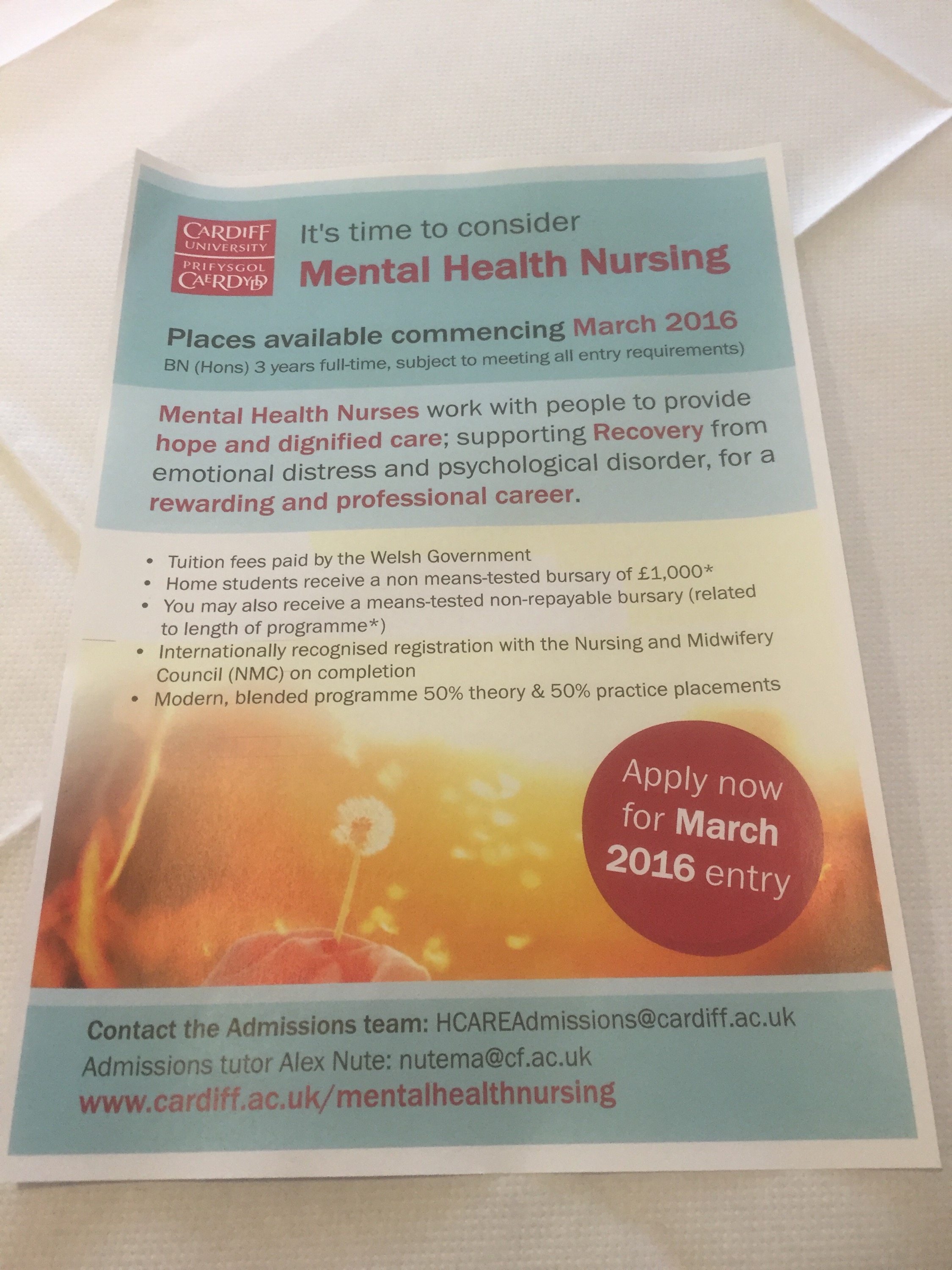
…for anyone wanting to become a mental health nurse, worth noting is that the School of Healthcare Sciences still has some places available for the BN Hons programme commencing in March 2016. The photo here, of a flyer brought to yesterday’s event, gives more information.

RCN in Wales award, public engagement and research student symposium

Lots of interesting things to relate in this post. November 13th saw Nicola Evans and me join Hayley Reed, Ed Janes, fellow-researchers Rhiannon Evans, Nina Jacob, Rhys Bevan-Jones and (most importantly) members of the mightily impressive ALPHA group at an ESRC Festival of Social Science-funded public engagement event focusing on young people and mental health. Organised with the help of SciSCREEN, the evening was hosted at Cardiff University’s Hadyn Ellis Building and began with a viewing of The Perks of Being a Wallflower. Post-film and post-food saw groups of young people, ALPHA members and researchers disappearing into interactive workshops. Nicola and I facilitated a discussion on supporting young people returning to school following a period of care in mental health hospital. This is a theme very much arising from our RiSC study, and in our session ideas and energy were in abundance. Interested readers wanting more on the work of ALPHA can see their video here:
https://www.youtube.com/watch?v=SRf1jSDwig8

November 17th was the School of Healthcare Sciences’ annual postgraduate research student symposium. This was, as usual, an excellent showcase for the PhDs and Professional Doctorates ongoing in the School. Follow this link for information on individual students and their projects.

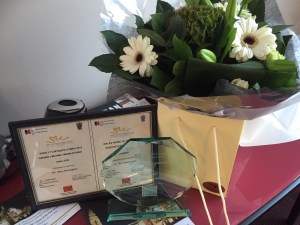
I’ll write more about this in a separate post, but on Thursday November 19th, in Cardiff City Hall I was pleased to receive the Research in Nursing Award for 2015 at the Royal College of Nursing in Wales Nurse of the Year event. I appreciated very much the kind messages from esteemed friends and colleagues received via Twitter, text and email. I am particularly happy to have won this award as a mental health nurse, again being reminded of the need for investment in both mental health services and in research to find out what helps.

Higher education Green Paper

The much-trailed higher education Green Paper appeared last week. For the full document, the place to go is here and for a Times Higher summary the link is here. Immediately worth bearing in mind is that higher education in the UK is a matter for devolved government, meaning that most of what the Green Paper says relates to English universities. I say ‘most’ because, as is noted towards the beginning of the document, the Research Councils (like the MRC and the ESRC) have UK-wide remits, whilst the REF and the various editions of the RAE preceding it were carried out on a four-country basis. It would also be naive in the extreme to suggest that universities and policymakers here in Wales can ignore the England-only bits of what the Green Paper has to say; for a nice piece on the Green Paper and devolution, follow this link. And, for an insight into work ongoing in Wales on matters higher education-related, here’s a link to a current review of funding arrangements.

Fulfilling our potential: teaching excellence, social mobility and student choice, to give the Green Paper its full title, proposes plenty of change. It also leaves much of the detail unfilled, and (in at least one analysis) contributes to an emerging higher education policy framework which is both vague and contradictory. One idea is for the Higher Education Funding Council for England and the Office for Fair Access to combine functions within a new Office for Students. Plans for a Teaching Excellence Framework are outlined, along with variable rates of tuition fees. Ahead of the publication of the document there was some talk that REF2014 might have been the last of its kind. What the Green Paper actually says (briefly) is that dual support for research should remain, and that some version of the research excellence framework should continue and be used as the basis for the allocation of government block funding. The next REF, it is suggested, will take place by 2021. But there is obviously more to follow in this context, with sections in the document referring to the administrative burden and cost of the REF and the possible use of metrics to ‘refresh’ quality assessments in between full cycles of peer review. There is also the small matter of having to determine, if the Higher Education Funding Council for England disappears, which body should in the future assume the task of allocating quality-related funding to English universities.

Meanwhile, the sole nurse to get a mention in the Green Paper and its surrounding commentary is Sir Paul Nurse, Nobel Laureate, President of the Royal Society and chair of the review into the UK’s research councils. Nurses, of the type of which I am one, have to look elsewhere for the specifics on possible future arrangements for the organisation and funding of health care professional education and for debates in this area.

Cardiff Public Uni

Last week on this site I wrote a brief piece trailing the seventh Cardiff Public Uni at Chapter. Here, now, is a summary of what happened extracted from the Cardiff Business School news archive:

Five academics presented their research in digestible bite-size chunks at the 7th Public Uni event held at Chapter Arts Centre, Thursday 15 October 2015.

The evening’s topics represented a diverse range of disciplines and themes, bringing together academics from the arts, humanities and sciences.

Dr Ben Hannigan, Reader in Mental Health Nursing at Cardiff University’s School of Healthcare Sciences, kicked off proceedings with a look at how the majority of formal mental health care, in the last century, was provided in hospitals but this changed with the emergence of community care. Dr Hannigan discussed how this came about and the people, policies and practices found within the system now.

Female menstruation remains a largely unspoken topic, simultaneously mundane and taboo. Dr Victoria Leonard, from the School of History, Archaeology and Religion at Cardiff University, explored how entrenched the silence is around monthly bleeding showing how it has been received and represented throughout history.

Dr Dan Read, from the Cardiff University’s School of Physics and Astronomy, highlighted how we have been aware of the existence of magnetic materials since the 4th century BC and asked what have they done for us? His talk illuminated the eventful and fascinating history of magnets.

Cardiff Business School’s Professor Peter Turnbull asked how safe is it to fly, given major cost cutting exercises, and looked at the growing concerns of European regulators that have yet to filter through to the travelling public.

The evening’s final speaker was Dr Emily Garside who explores how plays about AIDS often became first-line of response for activism, awareness raising and fundraising. She explored whether how we use theatre to talk about HIV/AIDS in the UK today.

Speaking about the event, moderator Dr Marco Hauptmeier from Cardiff Business School, said: “The Public Uni series continues to go from strength to strength, generating real buzz, enthusiasm and audience engagement.

“As researchers it is exciting to be able to breakdown your research for an audience, hear their response to it and consider their insights and perspectives. We look forward to continuing to develop the Public Uni series, providing an accessible platform for the diverse and important social, political and cultural research produced across Cardiff.”

The Public Uni series, organised by Dr Marco Hauptmeier from Cardiff Business School and Harriet Lloyd from the School of English, Communication & Philosophy, gives researchers the opportunity to present their ideas and findings to the public in short 10-minute segments. The informal setting and relaxed atmosphere helps to make the research more accessible to audiences outside of the academic arena. Each event highlights the breadth and depth of the exciting research undertaken at Cardiff University.

Follow on Facebook and Twitter to heart about forthcoming events in the Public Uni series or sign-up to the mailing list.

I can confirm that the evening was a thoroughly enlightening and enjoyable one. My thinking now is that the relationship between the ten minute Public Uni format and the standard lecture is comparable to the relationship between Twitter and the traditional academic essay. Succinct, direct, engaging.

Mental Health Nurse Academics UK meets in Preston

Here’s a quick blog post sent from a train, en route from Preston to Cardiff following the Autumn term meeting of MHNAUK. We met at UCLAN, hosted by Joy Duxbury, Mick McKeown and Karen Wright. On the agenda were presentations from Nadeem Gire on tackling digital exclusion, and from Mick McKeown on ‘Democracy and Legitimacy in Mental Health Care’. Mick, as always, was thought-provoking and challenging: follow this link to access downloadable copies of many of his articles.

Sabine Hahn, Peter Wolfensberger and Swiss colleagues were present, with Sabine and Peter giving an overview of the development of mental health nursing and the establishment of the Swiss Academic Society of Psychiatric and Mental Health Nursing. Seamus Watson spoke about public mental health, and what role nurses might play.

In the post-lunch business section of the meeting there were discussions on (amongst other things) the Shape of Caring review, this year’s NPNR conference and plans for 2016, and on a future student mental health nursing conference.