In a post on this site last year I drew attention to the (highly contested) decision by NICE to suspend its work on safe nurse staffing in inpatient mental health settings. Now, and with thanks to Shaun Lintern from the Health Service Journal (and to John Baker, who amongst mental health nurses has worked particularly hard to keep this issue alive), NICE’s evidence review in this area has just been published.
Here’s a quick summary. Seven research questions were asked in the review, with searches made of fifteen databases for evidence published since 1998. To be included, studies had to report on at least one of:
staffing in relation to outcomes;
staffing in relation to factors (such as service user factors, environmental factors);
staffing in relation to factors and outcomes.
Studies were eligible for inclusion if they reported findings from inpatient mental health areas serving people of any age. Outcomes of interest included serious incidents (e.g., self-harm, violence), delivery of nursing care (e.g., levels of contact) and other (e.g., nurse vacancy rates). Following a process of searching and sifting just 29 papers were finally included, and subject to quality appraisal. And the conclusions? Here they are, as extracted by John Baker with a call for action:
Belated happy new year. Visiting the Royal College of Nursing headquarters in London last Friday ahead of a meeting of the Network for Psychiatric Nursing Research (NPNR) conference committee (more on that below) gave me an opportunity to pop into the ‘Out of the Asylum’ exhibition. I’m glad I did. Texts, photographs and other artefacts illustrate the history of mental health nursing.
Here are some of the pictures I took. These include a photo of the RCN’s copy of a sixth edition of the Red Handbook, displayed alongside nurses’ badges, a Bethlem Royal Hospital pamphlet, a syringe and other items of interest. For more on the Red Handbook see this earlier post, along with this post which includes material from my copy of a fourth edition of the same. Another picture relates a set of regulations for the bathing of patients.
One of the display boards makes the observation that ‘few mental health nurses now wear uniforms’. As an unfortunate aside, this may need some future updating. From what I’m hearing, the historic trend towards mental health nurses wearing everyday clothes at work is reversing, with numbers of NHS trusts and health boards contemplating a return to uniforms. I regret that. But sticking with the exhibition…
…a final photograph I’m reproducing here is the front sheet of an early 1930s examination paper. Look hard and you’ll see questions on bones, asphyxia and antiseptics (amongst other things).
The NPNR planning meeting, this being the purpose of my trip, was a productive one. This year’s event (the 22nd) will be taking place in Nottingham on September 15th and 16th. I’ll add more on this when I can, and include some regular updates on this site.
Community mental health teams are often described as the cornerstone of locally accessible, specialist, mental health services. Working with its two local authority partners, Cardiff and Vale University Health Board currently provides eight CMHTS for adults of working age. The team based at the Hamadryad, I was reminded yesterday, covers the south west of the city taking in the Bay, Butetown, Grangetown, Riverside, Canton and Pontcanna. Speaking in the Bowls Pavilion, CMHT manager Phil Ball did a good job in separating out the work of his team from that of the primary mental health support service (which happens to share use of the Hamadryad building).
Meanwhile…
…for anyone wanting to become a mental health nurse, worth noting is that the School of Healthcare Sciences still has some places available for the BN Hons programme commencing in March 2016. The photo here, of a flyer brought to yesterday’s event, gives more information.
In other news, I find myself engaged in a prolonged period of doctoral student activity. I’ve examined a number of theses in and out of Cardiff in recent months, and have sat with students during their vivas as either supervisor or independent chair. This term has been particularly packed. Plenty of writing has also been taking place: papers and reports are being written from COCAPP, RiSC and Plan4Recovery, and from completed theses I have helped to supervise. Data generation in COCAPP-A has almost concluded, and new research ideas are taking shape. Exciting times, if a little frenetic.
November 17th was the School of Healthcare Sciences’ annual postgraduate research student symposium. This was, as usual, an excellent showcase for the PhDs and Professional Doctorates ongoing in the School. Follow this link for information on individual students and their projects.
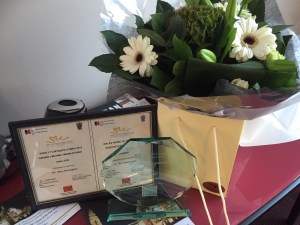
I’ll write more about this in a separate post, but on Thursday November 19th, in Cardiff City Hall I was pleased to receive the Research in Nursing Award for 2015 at the Royal College of Nursing in Wales Nurse of the Year event. I appreciated very much the kind messages from esteemed friends and colleagues received via Twitter, text and email. I am particularly happy to have won this award as a mental health nurse, again being reminded of the need for investment in both mental health services and in research to find out what helps.
The much-trailed higher education Green Paper appeared last week. For the full document, the place to go is here and for a Times Higher summary the link is here. Immediately worth bearing in mind is that higher education in the UK is a matter for devolved government, meaning that most of what the Green Paper says relates to English universities. I say ‘most’ because, as is noted towards the beginning of the document, the Research Councils (like the MRC and the ESRC) have UK-wide remits, whilst the REF and the various editions of the RAE preceding it were carried out on a four-country basis. It would also be naive in the extreme to suggest that universities and policymakers here in Wales can ignore the England-only bits of what the Green Paper has to say; for a nice piece on the Green Paper and devolution, follow this link. And, for an insight into work ongoing in Wales on matters higher education-related, here’s a link to a current review of funding arrangements.
Fulfilling our potential: teaching excellence, social mobility and student choice, to give the Green Paper its full title, proposes plenty of change. It also leaves much of the detail unfilled, and (in at least one analysis) contributes to an emerging higher education policy framework which is both vague and contradictory. One idea is for the Higher Education Funding Council for England and the Office for Fair Access to combine functions within a new Office for Students. Plans for a Teaching Excellence Framework are outlined, along with variable rates of tuition fees. Ahead of the publication of the document there was some talk that REF2014 might have been the last of its kind. What the Green Paper actually says (briefly) is that dual support for research should remain, and that some version of the research excellence framework should continue and be used as the basis for the allocation of government block funding. The next REF, it is suggested, will take place by 2021. But there is obviously more to follow in this context, with sections in the document referring to the administrative burden and cost of the REF and the possible use of metrics to ‘refresh’ quality assessments in between full cycles of peer review. There is also the small matter of having to determine, if the Higher Education Funding Council for England disappears, which body should in the future assume the task of allocating quality-related funding to English universities.
After finishing work next Thursday (October 15th 2015) I’ll be heading off to Chapter to take part in the 7th Public Uni. At Public Uni, which is organised by Marco Hauptmeier in the Cardiff Business School, academics get a ten minute opportunity to present their research to an assembled audience. I gather there is some retiring to the bar at some point in the evening, which seems very sensible.
Here’s the flyer for next week’s event: and what an eclectic bunch us five speakers are! In my slot the aim is to compress a history of mental health care, and a summary of where we are now, into 600 seconds of talking. What fun! For a taster of what I’m planning to say, here’s my summary:
Until the middle of the last century most formal mental health care was provided in hospitals. This changed with the emergence of community care. Dr Ben Hannigan, Reader in Mental Health Nursing in the School of Healthcare Sciences, explains how this change came about and discusses the people, policies and practices found within the system now.
Here’s a quick blog post sent from a train, en route from Preston to Cardiff following the Autumn term meeting of MHNAUK. We met at UCLAN, hosted by Joy Duxbury, Mick McKeown and Karen Wright. On the agenda were presentations from Nadeem Gire on tackling digital exclusion, and from Mick McKeown on ‘Democracy and Legitimacy in Mental Health Care’. Mick, as always, was thought-provoking and challenging: follow this link to access downloadable copies of many of his articles.
Sabine Hahn, Peter Wolfensberger and Swiss colleagues were present, with Sabine and Peter giving an overview of the development of mental health nursing and the establishment of the Swiss Academic Society of Psychiatric and Mental Health Nursing. Seamus Watson spoke about public mental health, and what role nurses might play.
In the post-lunch business section of the meeting there were discussions on (amongst other things) the Shape of Caring review, this year’s NPNR conference and plans for 2016, and on a future student mental health nursing conference.
The 21st Network for Psychiatric Nursing Research (NPNR) conference took place on Thursday and Friday, September 17th and 18th 2015, with the theme of ‘Building new relationships in mental health nursing: opportunities and challenges’. The occasion was a fine one, with just short of 200 people in attendance. For those not able to make it but wanting to know more, the programme can still be found here and the book of abstracts here.
I’ve been on the NPNR scientific and organising committee this year, courtesy of my membership of Mental Health Nurse Academics UK. This afforded me the chance to welcome delegates at the conference opening, and to draw attention to the just-breaking news of Professor Len Bowers’ planned retirement at the start of 2016. Len has been an inspirational mental health nurse researcher: more on this later.
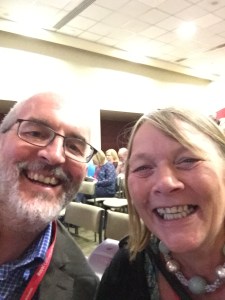
#NPNRselfie with Karina Lovell
Introduced by Professor Liz Hughes as day one conference chair, this year’s keynotes commenced with Professor Karina Lovell giving an overview of the current state of knowledge in remote psychological therapies. Karina is a world leader in research into interventions for people with commoner mental health problems such as depression and anxiety, as well as being actively involved in services and practice through her work with organisations like Anxiety UK and others. For an example of important new research in this area check out the REEACT trial into computerised CBT for people with depression. This is an important study which Karina both referenced in her talk, and is actively involved in.
Dr Geraldine Strathdee, NHS England’s National Clinical Director for Mental Health, delivered a second keynote on using mental health intelligence. She praised the work of nurses, and made a strong case for mental illness prevention. Geraldine also reminded delegates of the high rates of premature mortality of people living with mental health difficulties, and the continued exclusion of many from employment. As routes to improvement she pointed to leadership, and the value of data to benchmark and drive up standards.
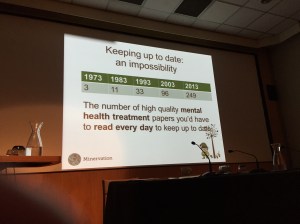
Keeping up with the evidence: an impossibility?
Day one’s final keynote presentation was delivered by André Tomlin, founder of the Mental Elf website and author of this pre-conference blogpost. André is an information scientist, who illustrated the challenge of keeping up-to-date with the evidence using this slide. Podcasts, social media, tweetchats and other new technologies are all part of André’s solution to the challenge of information overload, and as strategies to help plug the leaky evidence pipeline. The National Elf Service, of which the Mental Elf is a part, plays a big part in this area; for an overview of what’s on offer, here’s one of André’s videos:
Therapeutic approach, or therapeutic alliance?
Chair for day two was Professor Doug MacInnes, one of whose duties was to introduce Professor Shôn Lewis from the Institute of Brain, Behaviour and Mental Health at the University of Manchester as the deliverer of the conference’s fourth keynote lecture. Shôn spoke about current approaches to the care and treatment of people with psychosis and schizophrenia, using findings from the non-commercial CATIE and CUtLASS trials to suggest that newer antipsychotics are generally no better than first generation antipsychotics. Shôn also referenced the SoCRATES trial to evidence the idea that outcomes are associated with the quality of the therapeutic alliance, rather than with the specific therapeutic approach used. SoCRATES, I have now discovered, compared the effectiveness of (1) CBT plus routine care, (2) supportive counselling plus routine care and (3) routine care alone for people with schizophrenia. Shôn devoted the last part of his presentation to ClinTouch (a mobile phone app to record and upload symptoms) and CareLoop (which is testing if ClinTouch can be connecteded to NHS IT systems and to everyday practice).
Mark Brown about to begin his talk
#NPNR2015’s final keynote was delivered by Mark Brown, and the full text of his talk can be read here. Mark edited One in Four magazine, and is now development director of Social Spider, runs the Day in the Life project and is part of the team behind the WeMHNurses Twitter meeting place. Drawing on personal experience of its usefulness he described digital technology as less of a possible future than an unfolding present. One example of tech in action, which Mark referred to in his talk, is his own Doc Ready website. This was designed to help people prepare for discussions with doctors about their mental health difficulties.
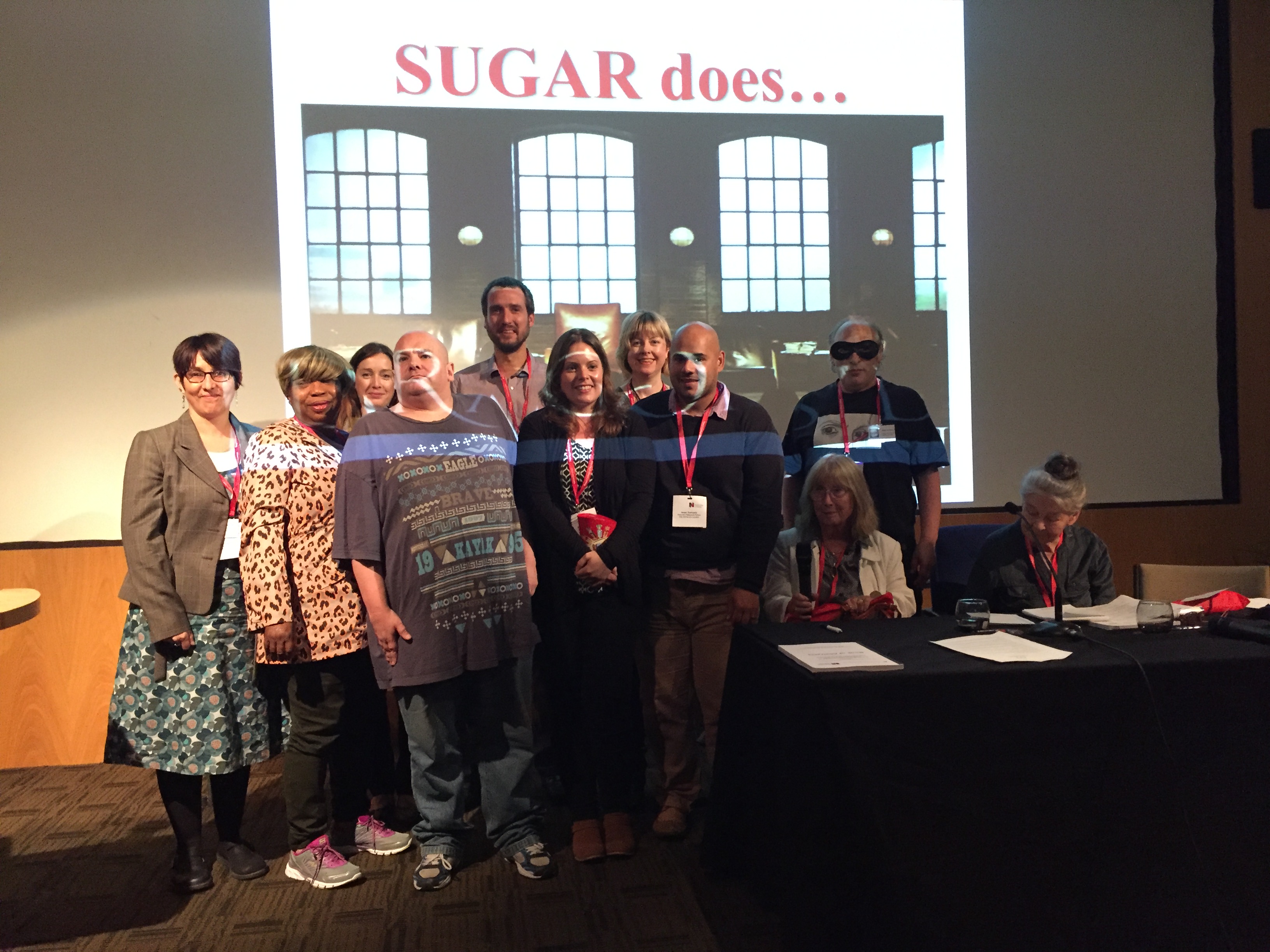
SUGAR does Dragons’ Den
That’s summary enough of the keynotes. From the concurrent sessions I participated in, chaired or observed I’ll first start with the SUGAR meets Dragons’ Den workshop. Three volunteers – Jason Hickey, Laoise Renwick and Cher Hallett – pitched their research ideas to SUGAR members. In the event, SUGAR offered their time and support to all three, but also voted Cher’s plans (on intramuscular injections) as the best of the batch. In the second concurrent I’m picking out, Julian Hunt, Alan Meudell and Michael Coffey presented reflections from Plan4Recovery. This project, which I’m also part of, is examining shared decision-making and social networks for people using secondary mental health services. And, finally, a word about our COCAPP symposium. This started with an overview paper from Alan Simpson, was followed by a presentation from Michael Coffey titled, ‘Ordinary risks and accepted fictions: how contrasting and competing priorities work in risk assessment care planning’ and concluded with a paper from Sally Barlow and me on participants’ views and experiences of recovery and personalisation.
The RCN’s history of mental health nursing exhibition
Organised by Laoise Renwick, this year for the first time the NPNR conference featured a poster trail. This worked well. Displayed posters were themed, and during lunchtime on day two guided delegates took opportunities to speak with those associated with them. Along the way I spotted some interesting posters from the RCN, drawing attention to an upcoming history of mental health nursing exhibition (organised with lots of help from Ian Hulatt) about to launch in London.
Finally, a word on Len Bowers. At Doug MacInnes’ invitation, Len took to the lectern during the afternoon of day two to confirm his upcoming retirement and his plans for the future. These include (we learned) playing the flute, travel, photography and electronic music-making. Very nice. Len is a generous, principled and humble man whose contribution to creating new knowledge for mental health nursing has been immense. Take Safewards as an example. This is Len’s NIHR-funded programme grant, findings from which are changing practice in the UK and around the world. That’s some achievement, in my book. We wish him well.
As the NPNR conference convenes for the 21st time developments in research, education and delivery of mental health nursing care continue apace. New knowledge opens the way for new forms of relationships with people who use services, their families and with colleagues within and outside our discipline. The way mental health nurses are educated and how they develop and research their practice is also changing, bringing with it new opportunities and many challenges.
This year’s conference will engage with the emerging evidence and changes in the landscape of care as we seek to craft new understandings of what it means to be a mental health nurse. As we become attuned to the vagaries of policy and the volume of new knowledge for our profession we must also rise to the challenge of ‘seeing’ in new ways. Our intention is to provide a space where colleagues can debate and critically engage with flux in the profession.
The NPNR is the place for mental health nurses and those we work with to present and learn new knowledge. We encourage you to participate in discussion so that you leave the conference informed, enlightened and with new energy to engage with the challenges ahead. Alongside our expert speakers, great practice development and research papers the conference promotes a friendly and welcoming atmosphere that has been the hallmark of NPNR for 20 years. This year in addition to our exciting themes we include new developments for 2015.
And, for a taster, here’s a snip from the conference website giving some information on this year’s keynote speakers. Very impressive indeed.
As always, the two-day programme also features concurrent sessions, supplemented (this year) with workshops and symposia. I’ll be part of a COCAPP delegation delivering three linked papers: a main findings presentation, a paper with an interesting emerging analysis of risk in care planning and coordination, and a presentation on how people talk about recovery and personalisation.
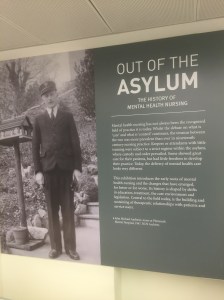 Belated happy new year. Visiting the Royal College of Nursing headquarters in London last Friday ahead of a meeting of the Network for Psychiatric Nursing Research (NPNR) conference committee (more on that below) gave me an opportunity to pop into the ‘Out of the Asylum’ exhibition. I’m glad I did. Texts, photographs and other artefacts illustrate the history of mental health nursing.
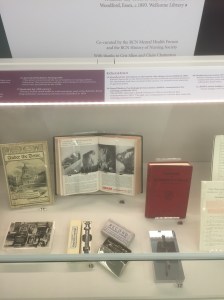 Here are some of the pictures I took. These include a photo of the RCN’s copy of a sixth edition of the Red Handbook, displayed alongside nurses’ badges, a Bethlem Royal Hospital pamphlet, a syringe and other items of interest. For more on the Red Handbook see this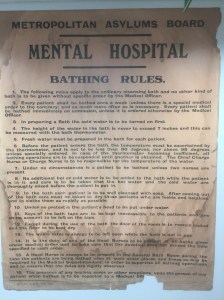

 The NPNR planning meeting, this being the purpose of my trip, was a productive one.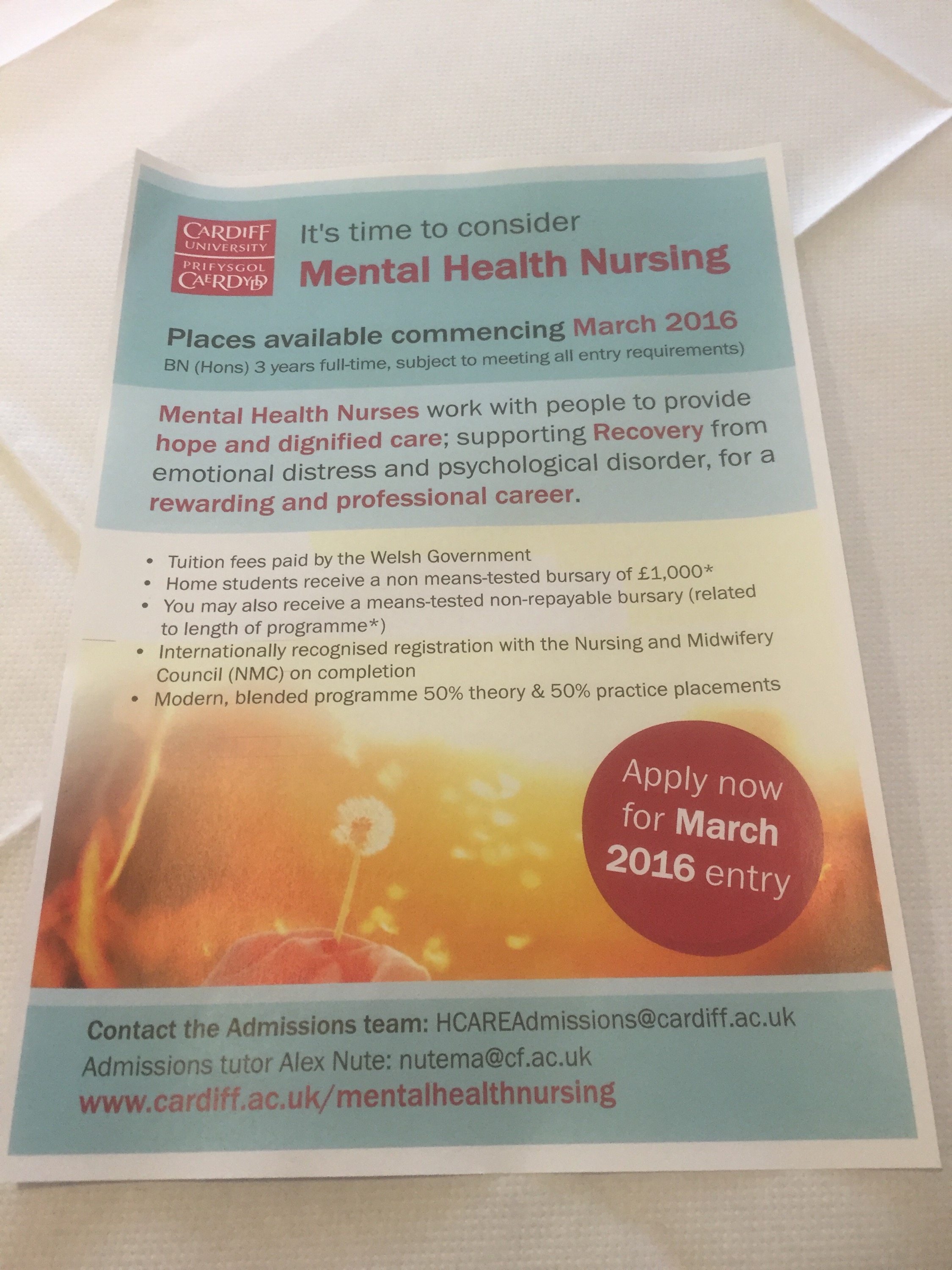
 Lots of interesting things to relate in this post. November 13th saw
  I’ll write more about this in a separate post, but on Thursday November 19th, in
  After finishing work next Thursday (October 15th 2015) I’ll be heading off to





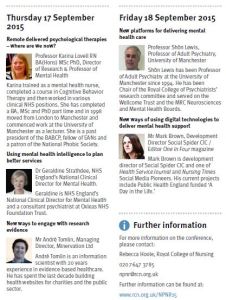 And, for a taster, here’s a snip from the conference website giving some information on this year’s keynote speakers. Very impressive indeed.
 Ben Hannigan's blog