Category: Mental health

#NPNR2014 call for abstracts

Not much time for blog-writing lately, for various reasons, but this morning I want to point readers to the full details and call for abstracts for this September’s International NPNR Conference. The event website can be found by following this link, from where I have lifted this:


20th International Network for Psychiatric Nursing Research conference

  • 18 September 2014 – 19 September 2014
  • The University of Warwick, Coventry, UK CV4 7AL

Event home

This year is the 20th international NPNR conference and it’s going to be a celebration.

We wish to celebrate and promote some of the outstanding mental health nursing research that shapes mental health policy and nursing practice across the world. We will also acknowledge some of the best psychiatric and mental health nursing research that helped create the strong foundation for our work today. And we will invite delegates to look ahead to map out the future for mental health nursing research, education and practice.

**The NPNR steering committee are proud to announce the call for abstract submissions is now open until 30 April 2014**

Conference themes


Programme themes for 2014

Contemporary practice in mental health nursing research

Involving people – where has it got us?

Reflections and reminders

Building new knowledge for effective partnerships

Methodologies, methods and magic

Innovation in teaching, learning and practice

Call for abstracts

Check out the abstract section for full details and to submit an abstract.

Keynote speakers

Understanding Pathways in Mental Health Care | Professor Swaran P Singh, Head of Division, Mental Health and Wellbeing, Warwick Medical School, University of Warwick, Coventry, UK

Mental health and Wellbeing: Books on Prescription | Debbie Hicks, Director of Research, The Reading Agency

Co-production and the future role of Mental Health Nursing | Dr Julie Repper, Recovery LeadNottingham Healthcare Trust, Nottingham, UK

Managing and delivering evidence-based mental health and substance use services | Dr Kevin Ann Huckshorn, State Division Director for the Division of Substance Abuse and Mental Health, Delaware, USA

Quotes from NPNR 2013

” NPNR – Power to the people conference” A service user

“Good key speakers, relevant content and engaging presentations. Excellent concurrent sessions” A delegate

“I’ve found the conference extremely inspiring. This was my very first conference; I enjoyed presenting my research and valued the feedback given. It’s great to see frontline staff carrying out research and being supported by their organisations in doing so. I would like to do further research myself. The keynote lectures were great especially ‘spirit level.” New Researcher

Piece in the Guardian by Helene Mulholland (4 September 2013)

“Charles Walker MP: ‘Mental illness is not a weakness'”
http://www.theguardian.com/society/2013/sep/04/charles-walker-mental-illness-not-weakness

#NPNR2014

Join the pre conference discussions on www.twitter.com now…

Professor Alan Simpson, chair of NPNR steering committee
@cityalan

Dr Michael Coffey, chair of MHNAUK and chair of NPNR scientific committee
@D10Coff


Event contact

Laura Benfield
Conference Organiser
Royal College of Nursing
20 Cavendish Square
London
W1G 0RN

Tel: 020 7647 3591
Email: npnr@rcn.org.uk
Early community mental health nursing

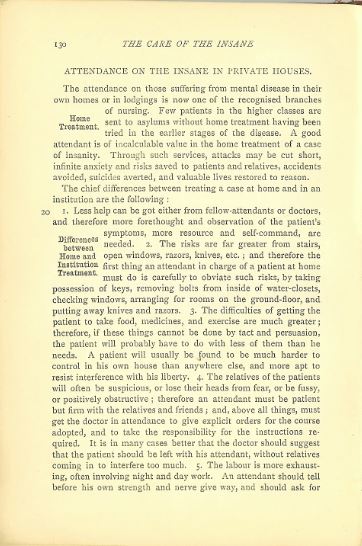
Perusing, for no particular reason, my fourth edition of the Red Handbook (published, I think, just after the start of the last century) I find this early reference to mental health nursing in people’s homes. Here are the relevant pages for those interested:

Note the sections implying that attendance in private houses is for the higher classes only, along with the description of all those things which should be done to reduce risk.

Interesting, too, that attendants are reminded that drinking alcohol on duty might not be the best of ideas. Advice like that never goes out-of-date.

For other posts drawing on this first-ever textbook for mental health nurses, try From ‘The Red Handbook’ to ‘The Art and Science of Mental Health Nursing’ and Exam time.

Identity and education

One of the things I discussed with Swansea University’s Approved Mental Health Professional (AMHP) students today was how the emergence of a system of community mental health care opened up important new sites for the advancement of professional jurisdictional claims. For more on this idea of jurisdiction (which comes from the sociology of work) check out these earlier posts and embedded links to full-text articles here, here, here and here. It implies that in a dynamic division of labour professions engage in a constant jostling to cement and advance their positions, against the claims of others. The appearance of the AMHP role, fulfilled not just by social workers (as was the case with the old ASW role) but also by nurses, occupational therapists and psychologists, shows how the relationships between professions and tasks can change over time.

It is additionally the case that occupational groups are not homogeneous, but are internally segmented. This means that within a single profession differentiated elements can find themselves battling it out to control work and its underpinning knowledge, or to determine what counts as a necessary preparation for new entrants. And nursing, it appears to me, has plenty of form when it comes to internal divisions and disputes of this type.

With all this in mind, two papers caught my eye before heading off to teach this morning. Both are authored by Professor Brenda Happell. In her editorial in the current issue of the International Journal of Mental Health Nursing, titled Let the buyer beware! Loss of professional identity in mental health nursing, Brenda says (amongst other things):

Most of the time, I feel eternally grateful for my decision to pursue a career in mental health nursing […] At other times, I despair and wonder about the future of our profession, and the care of people experiencing mental health challenges.

I’ll quote some more, as the full text of the editorial is behind a subscription paywall. Writing about the Australian context in particular (this being a part of the world where nurses are trained as generalists rather than, as here in the UK, for a specific field of practice), Brenda adds:

Some of my concern can be traced back to the professional identity of mental health nursing. Identity is such an important part of being professional, and how we consider and present ourselves both individually and collectively.

[…]

Mental health nursing is becoming integrated into other content, in the absence of any evidence to suggest this is an effective means of education and plenty of anecdotal evidence to suggest it isn’t. Nurses without any specialist qualifications,
and often without experience in mental health, are increasingly teaching the content, medical-surgical wards are being considered suitable places to gain clinical experience in mental health, and nurses who work in mental health for more than 5 minutes are referred to as mental health nurses, despite not having the appropriate qualifications.

That’s a dismal picture indeed. Through a ‘jurisdictions’ prism it might be thought of as a case of one segment within a highly differentiated profession claiming possession of sufficient knowledge to capture the work previously done by another, and to reframe what counts as adequate educational preparation.

Brenda and colleagues’ second paper has just appeared in early online form in Perspectives in Psychiatric Care. Majors in Mental Health Nursing: Issues of Sustainability and Commitment reports findings from an interview study involving representatives of Australian universities which had committed to (or actually implemented) mental health ‘majors’ within their comprehensive undergraduate nursing curricula, but which then discontinued them. Noting the lack of sustainability of embedded mental health nursing options within larger courses of generalist pre-registration education, Brenda and her team conclude:

[…] these experiences suggest that the current comprehensive nursing education programs are not well suited to promoting mental health nursing education as a positive future career destination. While such apparent attitudes prevail, the workforce problems in mental health nursing are likely to persist and indeed worsen.

A dismal conclusion again, linked once more in Brenda’s analysis to a shift away from a pre-qualification route to specialist mental health nursing practice.

Arguments for comprehensive, generalist, nurse education and thus for greater homogeneity in the workforce are frequently made here in the UK. When the Nursing and Midwifery Council opened a consultation on proposed new standards for pre-registration nursing in 2007 it specifically asked people to give a view on whether the branches (Mental Health, Adult, Children and Learning Disabilities) should remain. Mental Health Nurse Academics UK (drawing in part on Sarah Robinson and Peter Griffiths’ National Nursing Research Unit international comparison of approaches to specialist training at pre-registration level) submitted this in its 2008 response:

Experiences from other countries that have gone down the generalist pre-qualifying nursing education route show that this leads to a lack of skilled MHN workforce, difficulties in recruiting to post-registration MHN training and a reduction in the quality of care and service provision for those with MH problems […] In attempting to achieve some unitary, generalist view of nursing to fit with other countries, many of whom are envious of our branch specific pre-registration model, we run the very real and significant risk of simply repeating the errors of others for no gain.

We’ve had changes in formal interprofessional divisions of work (which takes me back to this morning’s AMHP students, notwithstanding that all in this class happened to be social workers). But we’ve hung on to branches (or ‘fields’, to use the current nomenclature) in UK nursing, and continue to prepare nurses to exclusively do mental health work from pre-registration level onwards. Six years on, Brenda Happell’s cautionary tales from Australia remind us of what might have been had decisions been made differently.

Making psychiatric wards safer and more peaceful

Safewards, led by Professor Len Bowers, has been funded through a National Institute for Health Research (NIHR) Programme Grant for Applied Research and aims to make psychiatric hospitals more peaceful, safer and therapeutic.Twice in the last year I have had the opportunity to hear Len present the thinking behind the Safewards model, outline the design and methods of the Safewards randomised controlled trial and talk through its main findings.

Following the link from the Safewards logo above takes you to the project’s website. This is packed full of useful information, including the detail of the simple nursing practices which Len and his team found reduced rates of conflict and containment in the hospital wards participating in their study. For an accessible introduction to what Safewards is all about, there is also this video in which Len presents his work to an audience in Melbourne in October 2013:

As I suggested in a meeting yesterday with esteemed Cardiff and Vale University Health Board colleagues, this really is exceptionally important new knowledge for mental health nurses. Now that the main trial is complete Len and his collaborators look to be devoting much of their energies to helping inpatient mental health staff and managers make use of the Safewards interventions in their everyday practice. I wish them every success, and am encouraging people to find out more and to spread the word.

Multiple Mini Interviews

Over the weekend I was sorry to learn that Inspector Michael Brown’s much-respected, and award winning, MentalHealthCop blog and twitter account have been suspended. I hope he is able to get back to both in the very near future.

Meanwhile, back at base I spent pretty much all of today helping select future students of nursing using multiple mini interviews (MMIs). Not sure about MMIs? Neither was I until recently. Here’s what we’re saying about them in the School of Healthcare Sciences at Cardiff University:

The interviews at Cardiff University School of Health Care Sciences for Nursing involve the use of a Multi Mini Interview procedure which is based on the Objective Structured Clinical Examination format that is commonly used by Health Sciences programmes to evaluate clinical competence.

The interview process is an opportunity to assess interviewees in person and assess information, such as personal qualities, that is not readily forthcoming in traditional application processes. The majority of these interviews will take place the week commencing 17 February 2014. 

The MMIs are made up of a series of short, carefully timed interview stations which provide information about applicants’ ability to think on their feet, critically appraise information, communicate ideas and demonstrate that they have thought about some of the issues that are important to the nursing profession. There are six stations in total. Each mini interview lasts a maximum of 5 minutes.

The School assesses the ability to apply general knowledge to issues relevant to the culture and society in which students will be practising, should they be successful in gaining admission to (and ultimately graduating from) the School. Equally important will be an assessment of the ability to communicate and defend personal opinions.

That’s pretty much it in a nutshell. Sticking to time is clearly important, and there’s plenty of moving around for applicants as they shuttle from station to station. As a process I rather liked it. I’ll be back for another slice of the same tomorrow, but will spare a thought for my esteemed Mental Health Nurse Academics UK colleagues who will be meeting at Lincoln University.

Restrictive practices

Today is the closing date for responses to the RCN’s consultation on the use of restrictive practices in health and adult social care and special schools. Michael Coffey has solicited views from members of Mental Health Nurse Academics UK, and has used these to inform the group’s formal submission. You can see what MHNAUK has contributed by following this link.

End of week catch-up

This week I learnt a whole lot more about framework analysis, having made the trip to City University London to join others in the COCAPP team for a NatCen training event. This was also my first introduction to the use of NVivo (a computer-assisted qualitative data analysis software package), my experience having previously been with Atlas.ti.

Elsewhere the RiSC project team convened, via teleconference, for an important decision-making meeting. We’re entering the closing stages of this study, and it’s interesting stuff: about which I’ll be able to say more in time.

And, as planned, this was also the week I made the short hop to Cardiff Met (at the invitation of Lynette Summers in the University’s Library and Information Services) to meet with folk there to talk about my experiences in using this blog, and other things, to bring my research and writing to a wider audience. That was fun, and I hope useful, too.

Along with some classroom teaching, marking, a committee meeting and reading a nearly-there doctoral thesis that just about sums up my recent workplace activities. Varied, as always. Looking ahead, I realise that (unusually) I’ll be missing the next meeting of Mental Health Nurse Academics UK due to take place at Lincoln University on February 18th. Other commitments have won out on this occasion.

20th International NPNR Conference: call for abstracts

Early news of this year’s International Network for Psychiatric Nursing Research conference, and a call for abstracts, have just appeared. The event takes place at Warwick University on September 18th and 19th, and more information can be found by following this link. With support once again from both the Royal College of Nursing and Mental Health Nurse Academics UK this promises to be a special occasion, this being the 20th running of this esteemed event.

Monitoring the Mental Health Act: what’s happening in Wales?

Just enough time this morning to note this week’s publication of the Care Quality Commission’s annual report into the use of the Mental Health Act in England, and to pose a question. Here are word-for-word snips taken from the CQC report’s summary, covering the year 2012/13:

Our findings on the experience of people detained under the MHA are in the context of a system where:

  • The number of people subject to the MHA continues to rise.

  • There are nationally recognised problems with access to care during a mental health crisis. There is evidence that pressure on services continues to obstruct timely access to less restrictive crisis treatment. Service commissioners in local authorities and clinical commissioning groups need to give a higher priority to translating local needs assessments into evidence-based commissioning of services.

And:

  • On almost all wards, patients had access to independent advocacy services. This is a considerable improvement.

  • We saw improvements in helping patients draw up advance statements of their preferences for care and treatment.

  • But more than a quarter (27%) of care plans showed no evidence of patients being involved in creating them. More than a fifth (22%) showed no evidence of patients’ views being taken into account. This is no improvement on the previous year, and is unacceptable. Services who do not demonstrate good practice in this area should learn from areas who are demonstrating that it is possible to deliver best practice.

  • We continue to see widespread use of blanket rules including access to the internet, outside areas, room access, and rigid visiting times. Some type of blanket rule was in place in more than three quarters of the wards we visited. Such practices have no basis in law or national guidance on good practice and are unacceptable.We continue to hear accounts of patients’ experiences of being restrained. In this report we promote examples of good practice where providers of inpatient mental health services have taken positive steps to reduce the use of restraint.

  • Health-based places of safety, for people experiencing a mental health crisis, are often not staffed at all times. Some have lain empty while a patient has been taken to police custody.

  • Only 17% of recorded uses of hospital-based places of safety under section 136 resulted in further detention, following assessment by mental health professionals.

  • Carers have told us they are not always provided with enough information on how to get help in a crisis.

  • In one area police told us that 41 young people had been detained in police cells over the previous year; the youngest was 11. This is unacceptable.

  • In 2011/12 and 2012/13 we were notified of 595 deaths of people subject to the Act. There were 511 deaths of detained patients, and 84 deaths of patients subject to CTOs. The majority of deaths reported to us were natural causes with a third of those taking place before the person reached the age of 60. Attendance to the physical health needs of people with mental illness must be a priority for all services. We will be working with partner organisations to review national data on all deaths and how this can be combined and shared to improve scrutiny and embed learning.

There’s plenty here to think about and act upon, but as a COCAPP researcher I immediately spot the CQC’s observation on the general lack of service user involvement in care planning. In its coverage, The Guardian emphasised the rise in numbers of detained patients, whilst Community Care ran with the headline, ‘Mental health system failings breaching patient rights and damaging care’.

In this part of the UK the work of monitoring the Mental Health Act falls to the Healthcare Inspectorate Wales. In addition, statistics on admissions in psychiatric hospital in Wales are published here, from which data from 2012/13 can be downloaded. Back on the HIW site I see a Mental Health Act monitoring report for the year 2010/11, which states in its summary:

We generally found detained patients to be cared for and treated by staff who have the necessary knowledge and skills, however, there were gaps in provision. We are particularly concerned that record keeping in relation to consent to treatment was not always appropriately followed. As the Act allows for some medical treatment for mental disorder to be given without an individual’s consent it is important the correct procedures are followed by organisations. We are also concerned that patients were not always being made aware of their rights in a timely manner.

The lack of activities and therapeutic input that was evident in many settings needs to be addressed and we will continue to focus on this matter in the year ahead. Access to therapies including psychologists was found to be variable between organisations. This is concerning as such therapeutic input can assist in recovery and lead to shorter periods of detention.

The HIW states in this document that it has responsibilities to publish its Mental Health Act monitoring findings on an annual basis. It is entirely possible that I’m looking in the wrong place, but I find it odd that the last report available online appears to be that covering the year 2010/11. Am I missing something?

Closing the Gap?

Earlier this week, over the border in England Deputy Prime Minister Nick Clegg put his name to a new policy document titled Closing the Gap: Priorities for essential change in mental health. The foreword to this includes the line that ‘Mental health is moving up the policy agenda across government’. This is a welcome assertion. It is also one which deserves to be examined alongside evidence of recent cuts in funding and retractions in services at a time of rising demand (see here and here for my earlier posts on mental health in an era of austerity).

This is a document listing 25 areas for change in four areas: increasing access to mental health services; integrating physical and mental health care; starting early to promote mental wellbeing and prevent mental health problems; and improving the quality of life of people with mental health problems. It closes with the maxim that mental health is everybody’s business. Initial coverage in The Guardian included a fairly straightforward description of the document’s content, and particularly its promise of increased choice for people using services and the introduction of waiting time targets. In The Independent, Paul Jenkins (from the organisation Rethink Mental Illness) was more searching, contrasting Closing the Gap‘s aspiration with what we know about frontline services:

[…] historically, mental health has always had a raw deal when it comes to NHS spending and accounts for 22% of illness in this country, but only gets 11% of the NHS budget. On top of this, over the last two years, we’ve seen a 2% cut in mental health spending despite increasing demand. Services which were already struggling are being squeezed even further. So how can the Government now make real inroads into significantly improving care and introducing choice when the services simply aren’t there? People are waiting months, even years for treatment.

If politicians really want to improve the lives of people with mental illness, we need to see investment in mental health services – in the very least services should not be cut. We should also be making sure that people who are too ill to work are properly supported with the benefits there are entitled to and with services that respond when and where they are needed. And when we see an action plan, it needs to set out specific commitments on how things are going to change and by when.

Well said. Personally I am minded to think, again, about the mental health field’s wicked problems, and how large-scale policy always contains just one version of what a system’s most pressing challenges (and their solutions) might be. Closing the Gap has plenty to say on what ought to be happening at local level (better preparation of commissioners of mental health services, more mental health training for primary care workers, more psychological therapies, and so on). What it does not unequivocally say is that ‘the problem’ may also be one of underfunding relative to levels of need.

I am also reminded of how local service change in response to national policy can lead to unintended consequences (something I have written about at length here). Here’s a speculative example to illustrate this point. Typically, mental health teams have responsibilities to respond in timely fashion to new requests for help (from colleagues in primary care, for example) whilst simultaneously providing care to people already using their services. Who knows, then, what the wider system effects might be when waiting limits for mental health services are introduced next year, as Closing the Gap promises they will? At local level, will redoubled efforts to respond to new referrals mean that the delivery of ongoing care and treatment will suffer? Will NHS organisations be tempted to establish new types of service specifically to reduce waiting times? If so, how will these find their feet in systems which are already organisationally complex? None of this is to say, of course, that waiting periods are problems which do not deserve to be tackled, but it is to say that actions to address perceived deficiencies always reverberate.