Category: Mental health

Parity of esteem?

Today’s Guardian interview with Professor Simon Wessely, President of the Royal College of Psychiatrists, reveals how large the mental health care and treatment gap has become. Professor Wessely draws comparisons between mental health and cancer services, saying:

“People are still routinely waiting for – well, we don’t really know, but certainly more than 18 weeks, possibly up to two years, for their treatment and that is routine in some parts of the country. Some children aren’t getting any treatment at all – literally none. That’s what’s happening. So although we have the aspiration, the gap is now so big and yet there is no more money,” he said.

Wessely said there would be a public outcry if those who went without treatment were cancer patients rather than people with mental health problems. Imagine, he told the Guardian, the reaction if he gave a talk that began: “‘So, we have a problem in cancer service at the moment. Only 30% of people with cancer are getting treatment, so 70% of them don’t get any treatment for their cancer at all and it’s not even recognised.”

NHS England places considerable emphasis on ‘parity of esteem‘, with the Improving Access to Psychological Therapies (IAPT) programme intended to be a one, key, part of making this happen. Evidence like Simon Wessely’s, combined with (for example) BBC/Community Care investigatory evidence of cuts in services, points to a chasm between the stated intention and the frontline reality.

This lack of parity extends to research. Within the last week or so the Liberal Democrats made a promise to include in their general election manifesto a commitment to increase mental health research funding by £50m each year. It has often struck me how poorly funded mental health research is. Mental health researchers can apply for support to bodies like the NIHR and NISCHR, and many do with some success (see all my previous posts on this site relating to COCAPP, RiSC and Plan4Recovery, for example). But unlike most other areas of health care the mental health field has no large-scale, dedicated, charitable research funding. Mental Health Research UK was founded in 2008 as (it says on its website) the UK’s first charity devoted specifically to raising funds to support research into the causes and treatments of mental illness. And that’s about it, I think: unless someone is able to tell me differently?


Summer research catch-up

Some time away and pressure of work explain the absence of recent posts on this site. So here’s a catch-up. In COCAPP, data generation and analysis are pressing ahead, whilst COCAPP-A (which is asking questions about care planning in acute mental health hospitals) has officially commenced. Plan4Recovery (which is concerned with shared decision-making and social connections for people using mental health services) is generating data. The draft final report from the RiSC study has now been peer reviewed and is back with us, the research team, for revisions. Methods and findings from this project (an evidence synthesis in the area of risk for young people moving into, through and out of inpatient mental health hospital) were also presented last month at the CAMHS conference at the University of Northampton. Many thanks to Steven Pryjmachuk for doing this.

Further conference presentations, from all but COCAPP-A, will also be delivered at this year’s NPNR conference. And, for the first time, I’m off to an event organised by Horatio: European Psychiatric Nurses. Horatio is a member of ESNO: European Specialist Nurses Organisations, and the event I’m speaking at in November is the 3rd European Festival of Psychiatric Nursing. One of the papers I’m delivering is titled, ‘Mental health nursing, complexity and change’. Here’s my abstract:

In this presentation I principally draw on two studies conducted in the UK to share some cumulative insights into the interconnected worlds of mental health policy, services, work (including that of nurses) and the experiences of users. I first set the scene with a brief review of the historic system-wide shift away from hospitals in favour of care being increasingly provided to people in their own homes. I emphasise the importance of this development for the mental health professions, and show how community care opened up new jurisdictional opportunities for nurses, social workers and others. I then draw on data from a project using a comparative case study design and ethnographic methods to show how the everyday work of mental health nurses (and others) is shaped both by larger jurisdictional claims and the contextual peculiarities of the workplace. From this same project I also show how the detailed, prospective, study of unfolding service user trajectories can lay bare true divisions of labour, including the contributions made by people other than mental health professionals (including support staff without professional accreditation, community pharmacists and lay carers) and by users themselves. I then introduce the second study, an investigation into crisis resolution and home treatment (CRHT) services, with an opening account of the unprecedented policymaking interest shown in the mental health system from the end of the 1990s. CRHT services appeared in this context, alongside other new types of community team, and I draw on detailed ethnographic case study data to examine crisis work, the wider system impact of setting up new CRHT services and the experiences of users. I close the presentation overall with some reflections on the cumulative lessons learned from these linked studies, and with some speculative ideas (on which I invite discussion) on the continued reshaping of the mental health system at a time of economic constraint, health policy contestation and political devolution.

I’ve given myself something of a challenge in attempting all this in a single concurrent session, but I’ll do my best and can signpost interested participants to papers I have published in these areas. One of my reasons for heading off to the Horatio event (in Malta, as it happens) is to make connections with international colleagues, with whom I might usefully share my projects, interests and ideas and perhaps find common ground.

Prospects and challenges: revisited

In 1999 I wrote a paper for the journal Health and Social Care in the Community titled Joint working in community mental health: prospects and challenges. The back story is that the work for this article was mostly done during my first year of part-time study for an MA in Health and Social Policy, during my time working as a community mental health nurse in East London.

Frustratingly, I can’t find my original wordprocessed copy of this paper from which to create a green open access version for uploading to the Orca repository and for embedding a link to here. But not to worry. The abstract, at least, is a freebie:

This paper reviews the opportunities for, and the challenges facing, joint working in the provision of community mental health care. At a strategic level the organization of contemporary mental health services is marked by fragmentation, competing priorities, arbitrary divisions of responsibility, inconsistent policy, unpooled resources and unshared boundaries. At the level of localities and teams, these barriers to effective and efficient joint working reverberate within multi-disciplinary and multi-agency community mental health teams (CMHTs). To meet this challenge, CMHT operational policies need to include multiagency agreement on: professional roles and responsibilities; target client groups; eligibility criteria for access to services; client pathways to and from care; unified systems of case management; documentation and use of information technology; and management and accountability arrangements. At the level of practitioners, community mental health care is provided by professional groups who may have limited mutual understanding of differing values, education, roles and responsibilities. The prospect of overcoming these barriers in multidisciplinary CMHTs is afforded by increased opportunities for interprofessional ‘seepage’ and a sharing of complementary perspectives, and for joint education and training. This review suggests that policy-driven solutions to the challenges facing integrated community mental health care may be needed and concludes with an overview of the prospects for change contained in the previous UK government’s Green Paper, ‘Developing Partnerships in Mental Health’.

Fifteen years on the structural divisions remain. As with other areas, community mental health care continues to be funded and provided by a multiplicity of agencies, with ‘health care’ and ‘social care’ distinctions still very much in place. This year’s Report of the Independent Commission on Whole Person Care for the Labour Party and the King’s Fund’s work on integrated care are examples of recent initiatives aimed at closing these gaps. Labour’s Independent Commission recommends the creation of a new national body, Care England, bringing together NHS and local authority representatives at the highest level. Note, of course, that these proposals are for England only: these are ideas for health and social care in one part of a devolved UK.

In my article I drew attention to the problem of competing policies and priorities for NHS and local authority organisations, the lack of shared organisational boundaries, non-integrated information technology systems and separate pathways bringing service users into, through and out of the system. An illustrative example I gave was the parallel introduction, in the early 1990s, of the care programme approach (CPA) and care management. Here in Wales, with the introduction of the Mental Health (Wales) Measure there is now, at least, a single care and treatment plan (CTP) to be used with all people using secondary mental health services. But how many health and social care organisations in Wales and beyond have managed to integrate their information systems? This, I suspect, remains an idea for the future.

And then there are the distinctions, and the relationships, between the various occupational groups involved in community mental health care. In my Joint working paper I emphasised the differences in values, education and practice between (for example) nurses and social workers, and (perhaps rather glibly) suggested that the route to better interprofessional practice lay through clearer operational policies at team level. Getting mental health professionals to work differently together became, for a time at least, something of a policymakers’ priority in the years following my article’s appearance. Here I’m thinking of the idea of distributed responsibility, and ‘new ways of working’ more generally, of which more can be found in this post and in this analysis of recent mental health policy trends (for green open access papers associated with both these earlier posts, follow this link and this link).

Two other things strike me when I look back on this 1999 article and reflect on events in the time elapsing. First is how much I underemphasised, then, the importance and influence of the service user movement. Over 15 years much looks to have been gained on this front, and I detect improved opportunities now for people using services to be involved in decisions about their care. Services have oriented to the idea of promoting recovery, as opposed to responding solely to people’s difficulties and deficits. This all takes me neatly to COCAPP and Plan4Recovery, two current studies in which I am involved which are investigating these very things in everyday practice. Second, I realise how little I foresaw in the late 1990s the changes then about to happen in the organisation of community mental health teams. Not long after my paper appeared crisis resolution, early intervention, assertive outreach and primary care mental health teams sprung into being across large parts of the country. More recent evidence suggests a rolling back of some of these developments in a new era of austerity.

And what of the community mental health system’s opportunities and challenges for the fifteen years which lie ahead? Perhaps there’s space here for an informed, speculative, paper picking up on some of the threads identified in my Joint working piece and in this revisiting blog. But that’s for another day.

2014 Skellern Lecture, JMPHN Lifetime Achievement Award and MHNAUK meet-up

Last week brought a trip to London for a series of events: a COCAPP update on framework analysis; a COCAPP project advisory group meeting; the 2014 Skellern Lecture and the Journal of Psychiatric and Mental Health Nursing Lifetime Achievement Award; and this term’s meeting of Mental Health Nurse Academics UK.

Gary Winship, who does an excellent job organising the Skellern and JPMHN events, wrote this piece on the MHNAUK blog ahead of the lectures taking place at the Institute of Psychiatry. He wrote how Professor Joy Duxbury in her Skellern Lecture:

…will endeavour to balance the evident need for improved compassionate based care against a backdrop of risk aversion [and will place] a particular focus on coercive practices, more specifically restraint in mental health settings.

And that was exactly what Joy did on the night. She lined up, and tackled, the reasons mental health nurses give for using physical restraint and using video evidence drew her audience’s attention to what can go wrong. This includes patient deaths, something which the national charity Mind has been campaigning about since last year (see this post from June 2013) and which has helped drive the Department of Health’s guidance on positive and proactive care.

Professor Hugh McKenna took a break from his REF duties as Chair of the Allied Health Professions, Dentistry, Nursing and Pharmacy sub-panel to receive this year’s JPMHN Lifetime Achievement Award. Here’s Gary Winship’s preamble from the MHNAUK site:

Professor McKenna has a long and illustrious career. He was appointed an International Fellow of the American Academy of Nursing in 2013 which is an accolade accorded to very few people outside the USA. He was made an Honorary Fellow of the Royal College of Surgeons in Ireland (1999), Fellow of the Royal College of Nursing (2003) and Fellow of the European Academy of Nursing Science (2003). In 2008, Professor McKenna received a CBE for contributions to health care and the community, and in the same year he was appointed to Chair the Nursing Panel in the 2008 Research Assessment Exercise.

Hugh delivered a personable, good-humoured, lecture which also contained some important messages for nurses aiming to build programmes of research. These included the importance of working collaboratively and across disciplinary boundaries, aiming high, and getting funding. These are all things which Hugh has excelled at in his own career, though he was far too modest to draw explicit attention to this himself. Many congratulations both to him and to Joy: two recipients very worthy of their awards.

Following events on June 11th, the 12th brought the final meet-up in the current academic year of Mental Health Nurse Academics UK, convened on this occasion at London South Bank University. The morning was devoted to these presentations:

Colin Gale, Archivist, Bethlem Museum of the Mind
As if to, drive me mad: an Edwardian’s experience of sedatives and the asylum

Tony Leiba, Emeritus Professor, LSBU
Lessons of social inclusion through policy

Tommy Dickinson, Lecturer, Manchester University
‘Curing Queers’: giving a voice to former patients who received treatments for their ‘sexual deviations’, 1935-1974

The afternoon saw MHNAUK members get down to business. This included a discussion, led by Andy Mercer, on how best to influence the latest round of nursing reviews including the Shape of Caring and The Lancet Commission on UK Nursing. Elsewhere on the agenda were updates on this year’s Network for Psychiatric Nursing Research conference, MHNAUK’s in-progress position paper on physical health and well-being (led by Patricia Ryan-Allen and Jacquie White) and possible journal affiliations.


London calling

Time this evening to note tomorrow’s COCAPP project advisory group meeting (to be held at City University London), to be followed by a trip to the Institute of Psychiatry to hear the delivery of this year’s Eileen Skellern Lecture by Professor Joy Duxbury and Professor Hugh McKenna’s acceptance of the JPMHN Lifetime Achievement award. Time, too, to note Thursday’s meeting of Mental Health Nurse Academics UK at London South Bank University.

So, lots to talk about and listen to.

Safewards comes to Cardiff

Sadly for me I couldn’t be at Geoff Brennan‘s meet-up today with Cardiff and Value UHB mental health nurses to talk about the Safewards study and its implications. But here’s a message Geoff sent, and a fine photo, to mark the occasion:

Work and roles in the ECT clinic

Last Wednesday (May 14th 2014 ) I had the chance to speak at the 4th National Association of Lead Nurses in ECT (NALNECT) conference. ECT (electro-convulsive therapy) has been around since the 1930s. It’s sparingly used, typically as a treatment for severe depression and only after other interventions have been tried and found wanting. The procedure involves the use of electricity to induce a seizure, and is conducted under anaesthesia. In the UK there are standards for ECT clinics, which place particular emphasis on quality and safety.

I’m no expert in ECT as a treatment, but I do know something about work and roles and it was this that I spoke about at the NALNECT event. I suggested that, rather like the physical holding of patients and other restrictive practices, ECT might be thought of as an example of the mental health system’s ‘dirty work’. It arouses strong views, and may well be an area about which there is more heat than light. A quick pre-conference search on Scopus turned up just 100 articles at the intersection of ‘ECT’ and ‘nursing’, with only 12 citations attributed to authors in the UK. Amongst these I found this paper investigating nurses’ attitudes, and this paper reporting findings from an observational study of the ECT workplace.

At Wednesday’s event I also talked about the ECT clinic’s unusually complex division of labour. Where else do mental health nurses, psychiatrists, anaesthetists, operating department practitioners and health care assistants routinely work together? The main item at the NALNECT conference was a debate on nurse-led clinics, though there seemed to be a number of different versions of what this might actually look like. Large parts of the discussion centred on the technical: who might apply which bit of the machinery, and who might press which button. I pointed out that tasks have forever moved around in the mental health system, and that a bigger question may not be the physical handling and usage of the ECT kit but nursing’s possession of sufficient knowledge to sustain claims to jurisdiction.

Mid-May catch-up post

RiSC front pageWork on the RiSC and COCAPP studies means that, of necessity, I’ve had to let this blog site (and pretty much everything else) take something of a back seat in recent weeks. The picture on the left is a screen shot of the RiSC study final report, which is now perilously close to completion. Once submitted to the funding body (the National Institute for Health Research (NIHR) Health Services and Delivery Research (HS&DR) Programme) it will be peer reviewed, and once accepted for the NIHR Journals Library progress through an editorial process before (hopefully sometime before the end of this year) appearing online.

Elsewhere, I see that the call for abstracts for this year’s NPNR conference remains open for a little while yet, as this tweet from Laura Benfield who works for the RCN Events team indicates:

I’m pleased to say that both the RiSC and COCAPP teams have already submitted abstracts. The conference will again be at Warwick University, and promises to a special affair. Here’s a snip from the event’s website:

This year is the 20th international NPNR conference and it’s going to be a celebration.

We wish to celebrate and promote some of the outstanding mental health nursing research that shapes mental health policy and nursing practice across the world. We will also acknowledge some of the best psychiatric and mental health nursing research that helped create the strong foundation for our work today. And we will invite delegates to look ahead to map out the future for mental health nursing research, education and practice.

Whilst my head has been somewhere else I see that the Department of Health has now published Positive and Proactive Care: reducing the need for restrictive interventions (something which members of Mental Health Nurse Academics contributed to) and that, yesterday, it was announced that NICE is about to step into the debate on nursing numbers. Here’s how The Guardian reported this:

Nurses in hospitals should not have to look after more than eight patients each at any one time, the body that sets NHS standards will urge next week in a move that will add to pressure to end what critics claim is dangerous understaffing.

Responding to concerns about standards of patient care in the aftermath of the Mid Staffs scandal, the National Institute for Health and Care Excellence (Nice) will warn that registered nurses’ workloads should not exceed that number because patients’ safety could be put at risk.

The regulator’s intervention will intensify the pressure on hospitals, growing numbers of which are in financial difficulty, to hire more staff to tackle shortages even though many have little spare money. Campaigners on the subject believe at least 20,000 extra nurses are urgently needed at a cost of about £700m.

This looks to be a very important intervention indeed, with all sorts of potential implications. It will be interesting to see how policymakers respond. I also wonder how this debate will play out in the context of community health care, and whether we might expect some kind of consideration of caseload sizes. This is a fiendishly difficult area, and is far more complex than simply saying that (for example) ‘each community mental health nurse should have a caseload of no more than x‘.

I also see that Community Care has been continuing to highlight the extraordinary pressures facing people working in, and using, the mental health system. Austerity is very harmful, and Community Care is drawing necessary attention to the problems of lack of beds, funding cuts and retractions in community services.

Before I get my head back down into report-writing here’s a final plug, this time to a piece Michael Coffey has written over on the MHNAUK blog:

As we roll up to the end of April and summer is just around the corner the planning of our next meeting is starting to fall into some sort of shape. MHNAUK meetings usually take the form of morning presentations and afternoon group business items. After a meeting devoted to group strategy and plans in Cardiff in the Spring of 2013 we have attempted to get work done in our meetings and be much more strategic in terms of themes for presentations and outputs arising from these. This has meant that in the past year we have focused on dementia care and produced a position paper from this and in subsequent meetings we have discussed restrictive practices and physical health care in mental health which will result in further position papers.
For our coming meeting this June we are currently discussing ideas around the history of mental health nursing as one possible theme alongside plans to further our relationships with the mental health nurse consultants group. In addition we will revisit our plans for future themes so that we keep the focus firmly on supporting education and research in our field. Agendas are never truly fully complete and over the next few weeks new items will arise and suggestions will arrive that members feel we must discuss. This is as it should be and I welcome this as evidence of the vitality of the wider group, anyone fancy discussing yet another review of nurse education for instance?

Michael Coffey
Chair of MHNAUK

Mental health policy for nurses

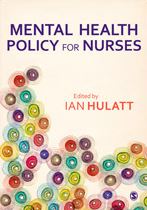
Congratulations to RCN Mental Health Advisor Ian Hulatt for editing this new book, Mental health policy for nurses. This hits the shelves any day now, and I want to give it a plug via this post. Here is what the publisher is saying:
Policy determines much of what nurses actually do on a daily basis, which means it is essential for nurses to engage with policy if they are to understand their own practice. Mental health nursing in particular has been shaped by a variety of policy factors in the past fifty years. In this new textbook, edited by the mental health advisor to the Royal College of Nursing, a range of experts in their field introduce the essential elements of mental health policy to students and experienced practitioners. The book covers a broad range of areas, including settings for care and the historical context, policy affecting various diagnoses and service user groups, and how policy is translated into action. Clinical examples are drawn on throughout, to help students think about the real-life context of what can be a difficult subject.

It will be essential reading for pre-registration mental health nursing students, and valuable to those working in practice who want to gain an understanding of policy.

There are some nice-looking chapters here, as the contents list suggests:

The History of Mental Health Policy in the United Kingdom Peter Nolan
The European Context Neil Brimblecombe
Community Services Ben Hannigan
Psychosis Norman Young
Older People Elizabeth Collier and Catherine McQuarrie
Dementia Trevor Adams
Personality Disorder Karen M. Wright
Service User Involvement Mick McKeown and Fiona Jones
Equalities in Mental Health Nursing Ann Jackson
Child Mental Health Policy in the UK Tim McDougall
Dual Diagnosis Cheryl Kipping
Policy into Action? Cris Allen

I was pleased to have a chance to contribute, writing a chapter addressing past and present policy for mental health care in the community. I started with an account of historical developments, and worked my way towards an analysis of recent policy including changing roles for nurses and the impact of austerity.


Synthesising evidence

evidenceToday, returning to this blog after something of a gap, I find reason to reflect on the many flavours of evidence review which now exist.

In the RiSC project we’ve been using the EPPI-Centre approach, developed by people working at the Institute of Education in London. This framework has a number of desirable features, including the combination of a phase 1 mapping with a more in-depth phase 2 involving quality appraisal. Deciding the focus of phase 2 in an EPPI-Centre review involves discussion with stakeholding collaborators. That’s all to the good, proving that in evidence syntheses, as in primary data-generating studies, it is possible for researchers to work jointly with service user, carer and practitioner colleagues.

Last week, with other members of the Wales chapter of the COCAPP team, I spoke on our meta-narrative mapping of care planning and care coordination at a Swansea University seminar. Amongst other things meta-narrative mapping traces the different research traditions found within a given field. And, today, I mock-examined a delightful doctoral thesis containing a scoping review, which lays out what’s there but does not include formal quality appraisal. Then there are realist syntheses, where reviewers look across multiple studies for evidence of the generative mechanisms underpinning change in policy, services or practice. The list goes on, encompassing thematic literature reviews and, of course, Cochrane-style systematic reviews. This latter approach has been very important in driving the evidence-based practice movement, but personally I’ve always been a little disappointed at its insistence on hierarchies with randomised trials as the gold standard.

So how might decisions be made on selecting one approach over another? Practical considerations have a bearing, but perhaps more important are commitments to certain intellectual or other principles. We chose the EPPI-Centre approach in RiSC because we valued user, carer, practitioner and manager perspectives and wanted a way of hearing these and using them to inform our project. Realist reviewers sign up to particular sets of ideas on how programmes work, and meta-narrative mappers embrace the idea, and seek out examples, of paradigmatic differerence. Perhaps the key thing is to be aware of, and articulate, these in justifying the choices which inevitably have to be made.