Category: Education

December catch-up

Competing priorities have kept me away from this site in recent weeks. There’s been work to do on COCAPP, which is close to the finish line, and doctoral students’ drafts to read and comment on (before imminent thesis submission, in one case). I’ve also been reading a thesis ahead of a PhD examination I’m involved in at the end of the coming week. So if this catch-up post feels a little bitty, then that’s because it is: there’s been lots happening that I want to comment on.

First up is the RiSC study, which I’ve mentioned here plenty of times before. In the last ten or so days the NIHR has published a first look summary of our aims, methods and findings. This is a precursor to the publication of our whole report, which is now post-peer review. Sometime in the new year we’ll be reconvening as a research team to plan our next project.

In October I made the short trip to the University of South Wales to hear Professor Linda Aiken from the University of Pennsylvania deliver this year’s RCN Winifred Raphael Lecture. Professor Aiken spoke on Quality nursing care: what makes a difference?, drawing on findings from the RN4Cast study and more. As promised, the RCN Research Society has now uploaded its video of the event for the world to see. It’s well worth watching.

News on the Mental Health Nurse Academics UK front includes an election, which we are now midway through, for the group’s next Vice Chair and Chair Elect. I’m overseeing this process (as I’ve done twice before), and will be in a position to announce the successful nominee on December 15th. One of the things that MHNAUK does is to work with the RCN to run the annual NPNR conference, and I’m very pleased to have had the chance to join the NPNR scientific and organising committee for a three year stint. More to follow on that front in the future, including details of next year’s event as they emerge.

Elsewhere I read that the Shape of Caring review, chaired by Lord Willis, is looking at the UK practice of preparing new nurses, at the point of registration, for work in one of four fields (mental health, adult, child and learning disability). This is something to keep a close eye on, with reports from last month’s Chief Nursing Officer Summit in England suggesting that the fields may be on their way out. For a useful, balanced, review in this area I refer the reader to the 2008 King’s College London Policy+ paper Educating students for mental health nursing practice: has the UK got it right? and, for a longer read, to Approaches to specialist training at pre-registration level: an international comparison.

Building research capacity

Last night I enjoyed an evening event in Cardiff with other past, and present, members of the RCBC (Research Capacity Building Collaboration) Wales Community of Scholars. This is a collaborative venture supported by higher education institutions, with funds now coming from NISCHR. Since coming into being in 2006 the RCBC programme has sought to develop research capacity across nursing, midwifery and the allied health professions. I’ve written about the scheme on this blog before (see here and here), and am personally grateful for the support I received as an RCBC Post-Doctoral Fellow which enabled me to complete my study into the work and system impact of crisis resolution and home treatment teams. For more on what I found in that project, check out these green open access articles saved in Cardiff University’s ORCA repository:

Hannigan B. and Coffey M. (2011) Where the wicked problems are: the case of mental health. Health Policy 101 (3) 220-227

Hannigan B. (2014) ‘There’s a lot of tasks that can be done by any’: findings from an ethnographic study into work and organisation in UK community crisis resolution and home treatment services. Health: an Interdisciplinary Journal for the Social Study of Health, Illness and Medicine 18 (4) 406-421

Hannigan B. and Evans N. (2013) Critical junctures in health and social care: service user experiences, work and system connections. Social Theory & Health 11 (4) 428-444

Hannigan B. (2013) Connections and consequences in complex systems: insights from a case study of the emergence and local impact of crisis resolution and home treatment services. Social Science & Medicine 93 212-219

Last night began with a talk from Tina Donnelly, Director of RCN Wales and Commanding Officer of the 203 Welsh Field Hospital. In introducing Tina, RCBC Grant Holder Professor Donna Mead (from the University of South Wales) shared the news that the RCBC scheme has received confirmation from NISCHR of continued funding. That’s good, and means we can look forward to more doctoral (and hopefully, post-doctoral) opportunities in the coming months and years.


New academic year post

University departments for the health professions, like Cardiff University’s School of Healthcare Sciences, have long academic years. We welcome intakes of new pre-registration undergraduate nurses every September, which is a time when students of many other disciplines are still enjoying the tail end of their summer holidays. In September we also welcome back existing students, and this afternoon – assuming I can navigate across Cardiff and its NATO summit-encircling ring of steel – I’m off to the School’s University Hospital of Wales (UHW) campus to meet a group of third year undergraduates to talk about the ethical aspects of nursing and healthcare research.

More generally, I start the 2014-15 academic year as incoming Co-Director of Postgraduate Research in the School, sharing this work with my esteemed colleague Dr Tina Gambling. Currently in the School of Healthcare Sciences we have almost 80 students studying for either the degree of PhD or the Professional Doctorate in Advanced Healthcare Practice (DAHP). The student group is a rich and varied one, and includes many who have made significant commitments to leave their homes (and often, their families) in other parts of the world to live and study in Cardiff. An example is Mohammad Marie, who I have written about on this site before.

In the case of new, or intending, postgraduate research students in the School some helpful advice is: keep an eye on the School’s website. We’re in the process of launching a new research strategy with distinct themes, and our aim is to recruit new PhD and Professional Doctorate students whose interests are clearly aligned with these. Research theme groups will, we’re all hoping, become communities of scholars drawing in researchers with all levels of experience: including those just starting out, and those who are internationally regarded.

Academics and social media

Time this evening to give a quick plug to Deborah Lupton’s Survey on academics’ use of social media. I spotted the online questionnaire when it first appeared, and was pleased to take part. Now, some months later, Deborah has published her results. Here’s the abstract from the main report, reproduced in its entirety:

This report outlines findings from an international online survey of 711 academics about their use of social media as part of their work conducted in January 2014. The survey sought to identify the tools that the respondents used, those they found most useful and the benefits and the drawbacks of using social media as a university faculty member or postgraduate student. The results offer insights into the sophisticated and strategic ways in which some academics are using social media and the many benefits they have experienced for their academic work. These benefits included connecting and establishing networks not only with other academics but also people or groups outside universities, promoting openness and sharing of information, publicising and development of research and giving and receiving support. While the majority of the respondents were very positive about using social media, they also expressed a range of concerns. These included issues of privacy and the blurring of boundaries between personal and professional use, the risk of jeopardising their career through injudicious use of social media, lack of credibility, the quality of the content they posted, time pressures, social media use becoming an obligation, becoming a target of attack, too much self-promotion by others, possible plagiarism of their ideas and the commercialisation of content and copyright issues. The report ends by contextualising the findings within the broader social and political environment and outlining areas for future research.

The report makes for an interesting read. For those looking for a condensed-but-longer-than-an-abstract version, follow this link for Prof Lupton’s accompanying piece for The Conversation website.

2014 Skellern Lecture, JMPHN Lifetime Achievement Award and MHNAUK meet-up

Last week brought a trip to London for a series of events: a COCAPP update on framework analysis; a COCAPP project advisory group meeting; the 2014 Skellern Lecture and the Journal of Psychiatric and Mental Health Nursing Lifetime Achievement Award; and this term’s meeting of Mental Health Nurse Academics UK.

Gary Winship, who does an excellent job organising the Skellern and JPMHN events, wrote this piece on the MHNAUK blog ahead of the lectures taking place at the Institute of Psychiatry. He wrote how Professor Joy Duxbury in her Skellern Lecture:

…will endeavour to balance the evident need for improved compassionate based care against a backdrop of risk aversion [and will place] a particular focus on coercive practices, more specifically restraint in mental health settings.

And that was exactly what Joy did on the night. She lined up, and tackled, the reasons mental health nurses give for using physical restraint and using video evidence drew her audience’s attention to what can go wrong. This includes patient deaths, something which the national charity Mind has been campaigning about since last year (see this post from June 2013) and which has helped drive the Department of Health’s guidance on positive and proactive care.

Professor Hugh McKenna took a break from his REF duties as Chair of the Allied Health Professions, Dentistry, Nursing and Pharmacy sub-panel to receive this year’s JPMHN Lifetime Achievement Award. Here’s Gary Winship’s preamble from the MHNAUK site:

Professor McKenna has a long and illustrious career. He was appointed an International Fellow of the American Academy of Nursing in 2013 which is an accolade accorded to very few people outside the USA. He was made an Honorary Fellow of the Royal College of Surgeons in Ireland (1999), Fellow of the Royal College of Nursing (2003) and Fellow of the European Academy of Nursing Science (2003). In 2008, Professor McKenna received a CBE for contributions to health care and the community, and in the same year he was appointed to Chair the Nursing Panel in the 2008 Research Assessment Exercise.

Hugh delivered a personable, good-humoured, lecture which also contained some important messages for nurses aiming to build programmes of research. These included the importance of working collaboratively and across disciplinary boundaries, aiming high, and getting funding. These are all things which Hugh has excelled at in his own career, though he was far too modest to draw explicit attention to this himself. Many congratulations both to him and to Joy: two recipients very worthy of their awards.

Following events on June 11th, the 12th brought the final meet-up in the current academic year of Mental Health Nurse Academics UK, convened on this occasion at London South Bank University. The morning was devoted to these presentations:

Colin Gale, Archivist, Bethlem Museum of the Mind
As if to, drive me mad: an Edwardian’s experience of sedatives and the asylum

Tony Leiba, Emeritus Professor, LSBU
Lessons of social inclusion through policy

Tommy Dickinson, Lecturer, Manchester University
‘Curing Queers’: giving a voice to former patients who received treatments for their ‘sexual deviations’, 1935-1974

The afternoon saw MHNAUK members get down to business. This included a discussion, led by Andy Mercer, on how best to influence the latest round of nursing reviews including the Shape of Caring and The Lancet Commission on UK Nursing. Elsewhere on the agenda were updates on this year’s Network for Psychiatric Nursing Research conference, MHNAUK’s in-progress position paper on physical health and well-being (led by Patricia Ryan-Allen and Jacquie White) and possible journal affiliations.


Safewards comes to Cardiff

Sadly for me I couldn’t be at Geoff Brennan‘s meet-up today with Cardiff and Value UHB mental health nurses to talk about the Safewards study and its implications. But here’s a message Geoff sent, and a fine photo, to mark the occasion:

Review fever

Just what we need: another review of nurse education. Yesterday the Nursing Times carried this item reporting a joint Health Education England and Nursing and Midwifery Council plan to investigate standards. The NT says:

Health Education England and the Nursing and Midwifery Council will launch the review in May to specifically investigate the standard of education provided to around 60,000 nursing and midwifery students each year.

The Shape of Caring Review, which will be led by Lord Willis of Knaresborough, will also consider the standard of post-registration training for the NHS nurses once they have qualified. The review is due to produce a final report by early next year.

It follows concerns over the standard of nurse training raised by the Francis report into care failings at Mid Staffordshire Foundation Trust.

As part of its work, the review will examine the controversial pre-nursing experience pilots that have seen around 160 students work as healthcare assistants for a year before starting courses, and which were a key plank of the government’s initial response to the Francis report.

This is the same Lord Willis who chaired the RCN’s review of nursing education which reported in 2012, and about which I wrote a piece on this site here. As I wrote then, there was some scepticism on the timing given that universities and their partners in the NHS were in the throes of reshaping their pre-registration curricula following the publication in 2010 of new NMC standards for pre-registration education. This latest review is going to start before more than a handful of new, post-2010, nurses have registered and certainly before we know anything of the impact of these new regulatory standards on practice. This is exactly a point the NT goes on to make:

But Professor Ieuan Ellis, chair of the Council of Deans of Health, said he was concerned the review would duplicate work already underway by “multiple different projects and working groups”.

“This group needs to reflect on the reviews that have already happened, some quite recently – otherwise there will be a lot of duplication going on,” he added.

Jackie Kelly, head of nursing at the University of Hertfordshire, pointed out that the NMC had already imposed new standards for pre-registration courses in 2010, and stressed 50% of nursing students time was spent in a clinical setting away from the classroom.

She said: “We have already gone a long way and I wouldn’t want the review to move in a direction of travel before we have seen the output from the new standards agreed in 2010.”

Quite so.

Early community mental health nursing

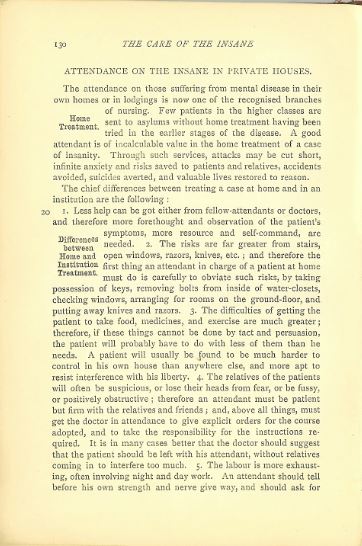
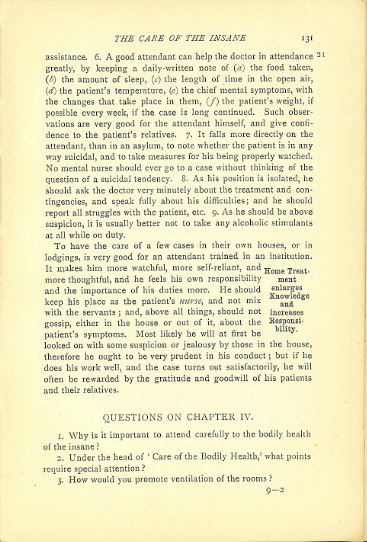
Perusing, for no particular reason, my fourth edition of the Red Handbook (published, I think, just after the start of the last century) I find this early reference to mental health nursing in people’s homes. Here are the relevant pages for those interested:

Note the sections implying that attendance in private houses is for the higher classes only, along with the description of all those things which should be done to reduce risk.

Interesting, too, that attendants are reminded that drinking alcohol on duty might not be the best of ideas. Advice like that never goes out-of-date.

For other posts drawing on this first-ever textbook for mental health nurses, try From ‘The Red Handbook’ to ‘The Art and Science of Mental Health Nursing’ and Exam time.

Identity and education

One of the things I discussed with Swansea University’s Approved Mental Health Professional (AMHP) students today was how the emergence of a system of community mental health care opened up important new sites for the advancement of professional jurisdictional claims. For more on this idea of jurisdiction (which comes from the sociology of work) check out these earlier posts and embedded links to full-text articles here, here, here and here. It implies that in a dynamic division of labour professions engage in a constant jostling to cement and advance their positions, against the claims of others. The appearance of the AMHP role, fulfilled not just by social workers (as was the case with the old ASW role) but also by nurses, occupational therapists and psychologists, shows how the relationships between professions and tasks can change over time.

It is additionally the case that occupational groups are not homogeneous, but are internally segmented. This means that within a single profession differentiated elements can find themselves battling it out to control work and its underpinning knowledge, or to determine what counts as a necessary preparation for new entrants. And nursing, it appears to me, has plenty of form when it comes to internal divisions and disputes of this type.

With all this in mind, two papers caught my eye before heading off to teach this morning. Both are authored by Professor Brenda Happell. In her editorial in the current issue of the International Journal of Mental Health Nursing, titled Let the buyer beware! Loss of professional identity in mental health nursing, Brenda says (amongst other things):

Most of the time, I feel eternally grateful for my decision to pursue a career in mental health nursing […] At other times, I despair and wonder about the future of our profession, and the care of people experiencing mental health challenges.

I’ll quote some more, as the full text of the editorial is behind a subscription paywall. Writing about the Australian context in particular (this being a part of the world where nurses are trained as generalists rather than, as here in the UK, for a specific field of practice), Brenda adds:

Some of my concern can be traced back to the professional identity of mental health nursing. Identity is such an important part of being professional, and how we consider and present ourselves both individually and collectively.

[…]

Mental health nursing is becoming integrated into other content, in the absence of any evidence to suggest this is an effective means of education and plenty of anecdotal evidence to suggest it isn’t. Nurses without any specialist qualifications,
and often without experience in mental health, are increasingly teaching the content, medical-surgical wards are being considered suitable places to gain clinical experience in mental health, and nurses who work in mental health for more than 5 minutes are referred to as mental health nurses, despite not having the appropriate qualifications.

That’s a dismal picture indeed. Through a ‘jurisdictions’ prism it might be thought of as a case of one segment within a highly differentiated profession claiming possession of sufficient knowledge to capture the work previously done by another, and to reframe what counts as adequate educational preparation.

Brenda and colleagues’ second paper has just appeared in early online form in Perspectives in Psychiatric Care. Majors in Mental Health Nursing: Issues of Sustainability and Commitment reports findings from an interview study involving representatives of Australian universities which had committed to (or actually implemented) mental health ‘majors’ within their comprehensive undergraduate nursing curricula, but which then discontinued them. Noting the lack of sustainability of embedded mental health nursing options within larger courses of generalist pre-registration education, Brenda and her team conclude:

[…] these experiences suggest that the current comprehensive nursing education programs are not well suited to promoting mental health nursing education as a positive future career destination. While such apparent attitudes prevail, the workforce problems in mental health nursing are likely to persist and indeed worsen.

A dismal conclusion again, linked once more in Brenda’s analysis to a shift away from a pre-qualification route to specialist mental health nursing practice.

Arguments for comprehensive, generalist, nurse education and thus for greater homogeneity in the workforce are frequently made here in the UK. When the Nursing and Midwifery Council opened a consultation on proposed new standards for pre-registration nursing in 2007 it specifically asked people to give a view on whether the branches (Mental Health, Adult, Children and Learning Disabilities) should remain. Mental Health Nurse Academics UK (drawing in part on Sarah Robinson and Peter Griffiths’ National Nursing Research Unit international comparison of approaches to specialist training at pre-registration level) submitted this in its 2008 response:

Experiences from other countries that have gone down the generalist pre-qualifying nursing education route show that this leads to a lack of skilled MHN workforce, difficulties in recruiting to post-registration MHN training and a reduction in the quality of care and service provision for those with MH problems […] In attempting to achieve some unitary, generalist view of nursing to fit with other countries, many of whom are envious of our branch specific pre-registration model, we run the very real and significant risk of simply repeating the errors of others for no gain.

We’ve had changes in formal interprofessional divisions of work (which takes me back to this morning’s AMHP students, notwithstanding that all in this class happened to be social workers). But we’ve hung on to branches (or ‘fields’, to use the current nomenclature) in UK nursing, and continue to prepare nurses to exclusively do mental health work from pre-registration level onwards. Six years on, Brenda Happell’s cautionary tales from Australia remind us of what might have been had decisions been made differently.

More, and more educated, nurses make a difference

Whilst I was wandering around Cornwall last week (see photograph for evidence), The Lancet was busy publishing the latest paper from Professor Linda Aiken and her colleagues in the RN4CAST consortium. Nurse staffing and education and hospital mortality in nine European countries: a retrospective observational study uses discharge data for 422,730 surgical patients in 300 hospitals in nine countries along with survey data from 26,516 practising nurses. That’s one big study. The abstract goes on to say:

Finding
An increase in a nurses’ workload by one patient increased the likelihood of an inpatient dying within 30 days of admission by 7% (odds ratio 1·068, 95% CI 1·031—1·106), and every 10% increase in bachelor’s degree nurses was associated with a decrease in this likelihood by 7% (0·929, 0·886—0·973). These associations imply that patients in hospitals in which 60% of nurses had bachelor’s degrees and nurses cared for an average of six patients would have almost 30% lower mortality than patients in hospitals in which only 30% of nurses had bachelor’s degrees and nurses cared for an average of eight patients.
Interpretation
Nurse staffing cuts to save money might adversely affect patient outcomes. An increased emphasis on bachelor’s education for nurses could reduce preventable hospital deaths.

[NB: Not sure about odds ratio? Check out the relevant Wikipedia entry here.]

On the day the article was published in early online form the Council of Deans of Health here in the UK ran with this, The Conversation ran with this and The Guardian ran with this. The Lancet supplemented its article with this podcast.

The media interest reflects the scale of the study and the importance of its findings, which make a strong case for investment in nursing. A year ago, the International Journal of Nursing Studies published this special issue on the nursing workforce and outcomes, carrying a series of open access papers from the same RN4CAST team. There are other papers published elsewhere arising from this same study, and no doubt more to come.

What the RN4CAST researchers have not done is to have generated any data in psychiatric hospitals or involving mental health nurses. This is very reasonable, as theirs has been a complex-enough study ‘focused on general acute hospitals’, to quote from its published protocol. But it would be good to know more of the relationships across Europe between mental health nurse staffing and practitioner characteristics, organisational and management features and service user outcomes. Now there’s a challenge for someone.