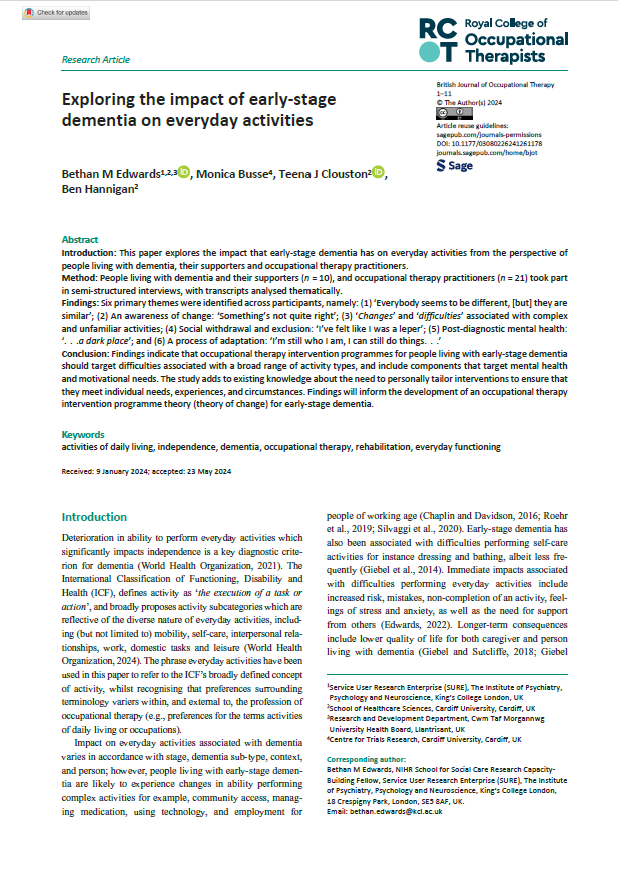
Here are links to two new papers led by Bethan Edwards, arising from her PhD which she completed in the School of Healthcare Sciences in Cardiff in 2022. Bethan is now working as a Capacity-Building Fellow at King’s College London, and her doctorate focused on the creation of an occupational therapy intervention for people living with early-stage dementia.
The first of these publications, which appears in the British Journal of Occupational Therapy, reports on interviews with people living with dementia, people supporting them and practitioners and has the aim of examining the impact that early dementia has on everyday activities. Here’s the abstract in full:
Introduction: This paper explores the impact that early-stage dementia has on everyday activities from the perspective of people living with dementia, their supporters and occupational therapy practitioners.
Method: People living with dementia and their supporters (n = 10), and occupational therapy practitioners (n = 21) took part in semi-structured interviews, with transcripts analysed thematically.
Findings: Six primary themes were identified across participants, namely: (1) ‘Everybody seems to be different, [but] they are similar’; (2) An awareness of change: ‘Something’s not quite right’; (3) ‘Changes’ and ‘difficulties’ associated with complex and unfamiliar activities; (4) Social withdrawal and exclusion: ‘I’ve felt like I was a leper’; (5) Post-diagnostic mental health: ‘. . .a dark place’; and (6) A process of adaptation: ‘I’m still who I am, I can still do things. . .’
Conclusion: Findings indicate that occupational therapy intervention programmes for people living with early-stage dementia should target difficulties associated with a broad range of activity types, and include components that target mental health and motivational needs. The study adds to existing knowledge about the need to personally tailor interventions to ensure that they meet individual needs, experiences, and circumstances. Findings will inform the development of an occupational therapy intervention programme theory (theory of change) for early-stage dementia.

The second of Bethan’s two papers has just appeared in Dementia, and draws on interview data to examine real-world community occupational therapy interventions for people with early-stage dementia. Here is this article’s abstract:
Aim: There is an absence of evidence generated in a UK context to support interventions based on occupational therapists’ core skills for people living with early-stage dementia. To inform the development of a programme theory and a future evaluation, this paper aimed to describe real-world (routine) community-based occupational therapy interventions for this population and contextual barriers.
Method: Occupational therapy practitioners (n = 21) from five Health Boards in Wales, UK participated in semi-structured interviews (n = 17) which were audio recorded, transcribed, and analysed thematically.
Findings: The availability of, and access to, real-world community-based interventions was variable, and associated with multilevel contextual barriers (resources, understanding of dementia specialist occupational therapy, professional influence, and evidence base). Where available and accessible, contents comprised a pre-intervention component (relational work, assessment, and goal setting) and intervention component (personalised problem-solving and coping strategies, emotional support, and advice and signposting), to meet needs associated with everyday activities and poor wellbeing. Variation in mode, duration, contents, and who received interventions, was associated with contextual barriers.
Conclusion: Findings indicate that the development of an intervention programme theory and future evaluation design, will need to account for the impact context may have on the variability of real-world intervention characteristics, and how this in turn may influence outcomes.
Bethan’s doctorate was an excellent one, and has laid the foundations for a programme of intervention research. Elsewhere in her thesis is a detailed two-stage evidence synthesis, and this, too, is well worth a read by anyone interested in this important field.

 First, researchers might want to blog because this is a very direct, free-to-access, way of communicating. This is especially important in disciplines in which most research papers are published in journals which sit behind paywalls. In applied areas like my own (mental health nursing, systems and services), a blog can be one way of connecting with important audiences (practitioners, policymakers, managers, service users) likely to lack the necessary subscriptions
 Ben Hannigan's blog