Tag: Mental Health Nurse Academics UK

Mid-May catch-up post

RiSC front pageWork on the RiSC and COCAPP studies means that, of necessity, I’ve had to let this blog site (and pretty much everything else) take something of a back seat in recent weeks. The picture on the left is a screen shot of the RiSC study final report, which is now perilously close to completion. Once submitted to the funding body (the National Institute for Health Research (NIHR) Health Services and Delivery Research (HS&DR) Programme) it will be peer reviewed, and once accepted for the NIHR Journals Library progress through an editorial process before (hopefully sometime before the end of this year) appearing online.

Elsewhere, I see that the call for abstracts for this year’s NPNR conference remains open for a little while yet, as this tweet from Laura Benfield who works for the RCN Events team indicates:

I’m pleased to say that both the RiSC and COCAPP teams have already submitted abstracts. The conference will again be at Warwick University, and promises to a special affair. Here’s a snip from the event’s website:

This year is the 20th international NPNR conference and it’s going to be a celebration.

We wish to celebrate and promote some of the outstanding mental health nursing research that shapes mental health policy and nursing practice across the world. We will also acknowledge some of the best psychiatric and mental health nursing research that helped create the strong foundation for our work today. And we will invite delegates to look ahead to map out the future for mental health nursing research, education and practice.

Whilst my head has been somewhere else I see that the Department of Health has now published Positive and Proactive Care: reducing the need for restrictive interventions (something which members of Mental Health Nurse Academics contributed to) and that, yesterday, it was announced that NICE is about to step into the debate on nursing numbers. Here’s how The Guardian reported this:

Nurses in hospitals should not have to look after more than eight patients each at any one time, the body that sets NHS standards will urge next week in a move that will add to pressure to end what critics claim is dangerous understaffing.

Responding to concerns about standards of patient care in the aftermath of the Mid Staffs scandal, the National Institute for Health and Care Excellence (Nice) will warn that registered nurses’ workloads should not exceed that number because patients’ safety could be put at risk.

The regulator’s intervention will intensify the pressure on hospitals, growing numbers of which are in financial difficulty, to hire more staff to tackle shortages even though many have little spare money. Campaigners on the subject believe at least 20,000 extra nurses are urgently needed at a cost of about £700m.

This looks to be a very important intervention indeed, with all sorts of potential implications. It will be interesting to see how policymakers respond. I also wonder how this debate will play out in the context of community health care, and whether we might expect some kind of consideration of caseload sizes. This is a fiendishly difficult area, and is far more complex than simply saying that (for example) ‘each community mental health nurse should have a caseload of no more than x‘.

I also see that Community Care has been continuing to highlight the extraordinary pressures facing people working in, and using, the mental health system. Austerity is very harmful, and Community Care is drawing necessary attention to the problems of lack of beds, funding cuts and retractions in community services.

Before I get my head back down into report-writing here’s a final plug, this time to a piece Michael Coffey has written over on the MHNAUK blog:

As we roll up to the end of April and summer is just around the corner the planning of our next meeting is starting to fall into some sort of shape. MHNAUK meetings usually take the form of morning presentations and afternoon group business items. After a meeting devoted to group strategy and plans in Cardiff in the Spring of 2013 we have attempted to get work done in our meetings and be much more strategic in terms of themes for presentations and outputs arising from these. This has meant that in the past year we have focused on dementia care and produced a position paper from this and in subsequent meetings we have discussed restrictive practices and physical health care in mental health which will result in further position papers.
For our coming meeting this June we are currently discussing ideas around the history of mental health nursing as one possible theme alongside plans to further our relationships with the mental health nurse consultants group. In addition we will revisit our plans for future themes so that we keep the focus firmly on supporting education and research in our field. Agendas are never truly fully complete and over the next few weeks new items will arise and suggestions will arrive that members feel we must discuss. This is as it should be and I welcome this as evidence of the vitality of the wider group, anyone fancy discussing yet another review of nurse education for instance?

Michael Coffey
Chair of MHNAUK

Identity and education

One of the things I discussed with Swansea University’s Approved Mental Health Professional (AMHP) students today was how the emergence of a system of community mental health care opened up important new sites for the advancement of professional jurisdictional claims. For more on this idea of jurisdiction (which comes from the sociology of work) check out these earlier posts and embedded links to full-text articles here, here, here and here. It implies that in a dynamic division of labour professions engage in a constant jostling to cement and advance their positions, against the claims of others. The appearance of the AMHP role, fulfilled not just by social workers (as was the case with the old ASW role) but also by nurses, occupational therapists and psychologists, shows how the relationships between professions and tasks can change over time.

It is additionally the case that occupational groups are not homogeneous, but are internally segmented. This means that within a single profession differentiated elements can find themselves battling it out to control work and its underpinning knowledge, or to determine what counts as a necessary preparation for new entrants. And nursing, it appears to me, has plenty of form when it comes to internal divisions and disputes of this type.

With all this in mind, two papers caught my eye before heading off to teach this morning. Both are authored by Professor Brenda Happell. In her editorial in the current issue of the International Journal of Mental Health Nursing, titled Let the buyer beware! Loss of professional identity in mental health nursing, Brenda says (amongst other things):

Most of the time, I feel eternally grateful for my decision to pursue a career in mental health nursing […] At other times, I despair and wonder about the future of our profession, and the care of people experiencing mental health challenges.

I’ll quote some more, as the full text of the editorial is behind a subscription paywall. Writing about the Australian context in particular (this being a part of the world where nurses are trained as generalists rather than, as here in the UK, for a specific field of practice), Brenda adds:

Some of my concern can be traced back to the professional identity of mental health nursing. Identity is such an important part of being professional, and how we consider and present ourselves both individually and collectively.

[…]

Mental health nursing is becoming integrated into other content, in the absence of any evidence to suggest this is an effective means of education and plenty of anecdotal evidence to suggest it isn’t. Nurses without any specialist qualifications,
and often without experience in mental health, are increasingly teaching the content, medical-surgical wards are being considered suitable places to gain clinical experience in mental health, and nurses who work in mental health for more than 5 minutes are referred to as mental health nurses, despite not having the appropriate qualifications.

That’s a dismal picture indeed. Through a ‘jurisdictions’ prism it might be thought of as a case of one segment within a highly differentiated profession claiming possession of sufficient knowledge to capture the work previously done by another, and to reframe what counts as adequate educational preparation.

Brenda and colleagues’ second paper has just appeared in early online form in Perspectives in Psychiatric Care. Majors in Mental Health Nursing: Issues of Sustainability and Commitment reports findings from an interview study involving representatives of Australian universities which had committed to (or actually implemented) mental health ‘majors’ within their comprehensive undergraduate nursing curricula, but which then discontinued them. Noting the lack of sustainability of embedded mental health nursing options within larger courses of generalist pre-registration education, Brenda and her team conclude:

[…] these experiences suggest that the current comprehensive nursing education programs are not well suited to promoting mental health nursing education as a positive future career destination. While such apparent attitudes prevail, the workforce problems in mental health nursing are likely to persist and indeed worsen.

A dismal conclusion again, linked once more in Brenda’s analysis to a shift away from a pre-qualification route to specialist mental health nursing practice.

Arguments for comprehensive, generalist, nurse education and thus for greater homogeneity in the workforce are frequently made here in the UK. When the Nursing and Midwifery Council opened a consultation on proposed new standards for pre-registration nursing in 2007 it specifically asked people to give a view on whether the branches (Mental Health, Adult, Children and Learning Disabilities) should remain. Mental Health Nurse Academics UK (drawing in part on Sarah Robinson and Peter Griffiths’ National Nursing Research Unit international comparison of approaches to specialist training at pre-registration level) submitted this in its 2008 response:

Experiences from other countries that have gone down the generalist pre-qualifying nursing education route show that this leads to a lack of skilled MHN workforce, difficulties in recruiting to post-registration MHN training and a reduction in the quality of care and service provision for those with MH problems […] In attempting to achieve some unitary, generalist view of nursing to fit with other countries, many of whom are envious of our branch specific pre-registration model, we run the very real and significant risk of simply repeating the errors of others for no gain.

We’ve had changes in formal interprofessional divisions of work (which takes me back to this morning’s AMHP students, notwithstanding that all in this class happened to be social workers). But we’ve hung on to branches (or ‘fields’, to use the current nomenclature) in UK nursing, and continue to prepare nurses to exclusively do mental health work from pre-registration level onwards. Six years on, Brenda Happell’s cautionary tales from Australia remind us of what might have been had decisions been made differently.

Multiple Mini Interviews

Over the weekend I was sorry to learn that Inspector Michael Brown’s much-respected, and award winning, MentalHealthCop blog and twitter account have been suspended. I hope he is able to get back to both in the very near future.

Meanwhile, back at base I spent pretty much all of today helping select future students of nursing using multiple mini interviews (MMIs). Not sure about MMIs? Neither was I until recently. Here’s what we’re saying about them in the School of Healthcare Sciences at Cardiff University:

The interviews at Cardiff University School of Health Care Sciences for Nursing involve the use of a Multi Mini Interview procedure which is based on the Objective Structured Clinical Examination format that is commonly used by Health Sciences programmes to evaluate clinical competence.

The interview process is an opportunity to assess interviewees in person and assess information, such as personal qualities, that is not readily forthcoming in traditional application processes. The majority of these interviews will take place the week commencing 17 February 2014. 

The MMIs are made up of a series of short, carefully timed interview stations which provide information about applicants’ ability to think on their feet, critically appraise information, communicate ideas and demonstrate that they have thought about some of the issues that are important to the nursing profession. There are six stations in total. Each mini interview lasts a maximum of 5 minutes.

The School assesses the ability to apply general knowledge to issues relevant to the culture and society in which students will be practising, should they be successful in gaining admission to (and ultimately graduating from) the School. Equally important will be an assessment of the ability to communicate and defend personal opinions.

That’s pretty much it in a nutshell. Sticking to time is clearly important, and there’s plenty of moving around for applicants as they shuttle from station to station. As a process I rather liked it. I’ll be back for another slice of the same tomorrow, but will spare a thought for my esteemed Mental Health Nurse Academics UK colleagues who will be meeting at Lincoln University.

Restrictive practices

Today is the closing date for responses to the RCN’s consultation on the use of restrictive practices in health and adult social care and special schools. Michael Coffey has solicited views from members of Mental Health Nurse Academics UK, and has used these to inform the group’s formal submission. You can see what MHNAUK has contributed by following this link.

End of week catch-up

This week I learnt a whole lot more about framework analysis, having made the trip to City University London to join others in the COCAPP team for a NatCen training event. This was also my first introduction to the use of NVivo (a computer-assisted qualitative data analysis software package), my experience having previously been with Atlas.ti.

Elsewhere the RiSC project team convened, via teleconference, for an important decision-making meeting. We’re entering the closing stages of this study, and it’s interesting stuff: about which I’ll be able to say more in time.

And, as planned, this was also the week I made the short hop to Cardiff Met (at the invitation of Lynette Summers in the University’s Library and Information Services) to meet with folk there to talk about my experiences in using this blog, and other things, to bring my research and writing to a wider audience. That was fun, and I hope useful, too.

Along with some classroom teaching, marking, a committee meeting and reading a nearly-there doctoral thesis that just about sums up my recent workplace activities. Varied, as always. Looking ahead, I realise that (unusually) I’ll be missing the next meeting of Mental Health Nurse Academics UK due to take place at Lincoln University on February 18th. Other commitments have won out on this occasion.

20th International NPNR Conference: call for abstracts

Early news of this year’s International Network for Psychiatric Nursing Research conference, and a call for abstracts, have just appeared. The event takes place at Warwick University on September 18th and 19th, and more information can be found by following this link. With support once again from both the Royal College of Nursing and Mental Health Nurse Academics UK this promises to be a special occasion, this being the 20th running of this esteemed event.
More on mental health services at a time of austerity

For the second time in two months the BBC and Community Care have collaborated to establish the extent of funding cuts to mental health services in England. Freedom of Information requests were sent to 51 NHS trusts, of whom 43 responded. Summaries of this investigation, and headline findings, can be found on the BBC website here and on the Community Care website here. Community Care says:

Data returned by over two-thirds of the mental health trusts, obtained in two separate Freedom of Information requests, showed that:

  • Overall trust budgets for 2013/14 had shrunk by 2.3% in real terms from 2011/12. Ten out of 13 trusts that provided forecast budgets for 2014/15 are projecting further cuts next year.
  • Budgets for ‘crisis resolution teams’ fell 1.7% in real terms compared to 2011/12 while the average monthly referrals to these teams rose 16%. The teams provide intensive home treatment in a bid to prevent acutely unwell people being hospitalised.
  • Budgets for community mental health teams flatlined in real terms but referrals rose 13.3%. These services provide ongoing support in a bid to prevent people’s mental health deteriorating to crisis point.

Community Care also lists 10 ways this underfunding is damaging care.

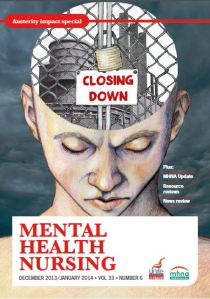
This is also the month that a special, free-to-download, ‘impact of austerity’ edition of Mental Health Nursing journal has appeared. In an email forwarded to all members of Mental Health Nurse Academics UK by Steve Hemingway (who is both an MHNA member and a member of the MHN editorial board), Dave Munday at Unite the Union (which publishes the journal) says:

This month the Mental Health Nursing journal is focused on austerity and mental health. I hope you’ll agree with me that this is a vitally important topic that not only every mental health nurse should know about, but every citizen. We hope that the journal will help to trigger some thoughts and debates that you can have locally in your workplaces but also outside of work. To this end we’re making the journal free to access even if you’re not a MHNA member or MHN subscriber.

Research priorities for mental health nursing

Last week’s arrival in my email inbox of the notes taken at Mental Health Nurse Academics UK‘s most recent meeting, held on October 8th at Teesside University, reminds me that MHNAUK is still conducting a research priorities exercise. These minutes, taken by Joy Duxbury and circulated by Michael Coffey, note that Len Bowers led our discussions on the day and has offered to collate responses:

The group discussed the scope of future research for the profession of mental health nursing. The idea is to develop research priorities to influence what research gets funded and funders will be interested to hear about this. The priority setting exercise included discussions on the following:

  • The role of the mental health nurse – What works and what doesn’t? What we are good at and what we aren’t so good at.
  • The role of theory as well as empirical research – how does this influence funders and how research might still be theory driven?
  • What do mental health nurses contribute that aids recovery?
  • Transitions
  • Care co-ordination
  • Does it have to be unique to mental health nursing? Maybe not
  • Underpinning values
  • Public Health

As there seemed to be problems with consensus e.g. defining what counts as mental health nursing research as opposed to mental health research of relevance to nursing it was felt that we need first to feedback top ten priorities for research to Len before Christmas. He will then collate to discuss at a future meeting. It might also help if we report what research we are currently doing too.

Meanwhile, over on MHNAUK’s blog there’s this post from Alan Simpson to kick-start this exercise off, and room for people to add their thoughts beneath via the comments function. In his ‘starter for 26’ Alan writes:

Inspired by last week’s MHNAUK meeting, today staff at our mental health research team meeting were asked to identify their research priorities for mental health nursing research. The meeting consists of various academic research staff and clinical academics discussing on-going and forthcoming research studies and various research-related issues. Today, I simply asked each person to write a short list of priorities, which we then shared and discussed. Here’s our Top 30 in no particular order with repeats removed. Most frequent repeat was physical healthcare. Second was recovery. Third – racism and culture. What’s your Top 10?

  1. Generic vs Specialist MHN training
  2. Measures of Compassion
  3. Effects of selection procedures for MHN students and staff
  4. Nursing and PTSD
  5. Tool development
  6. Risk assessment and MHN
  7. The 6 Cs and MHN
  8. Mental capacity and issues of consent
  9. Racism and stigma in MHN
  10. Values and beliefs and how they impact on practice
  11. Mental health and the performing arts
  12. MHN training and learning disabilities
  13. MHN views on developments that may threaten MHN, e.g. peer support, self-care
  14. Physical healthcare in secondary mental health care settings
  15. Philosophy and MHN: The Art of Living
  16. Identity and body image in people with MI
  17. Community and third sector organisations and how they link with mental health teams/services
  18. Communication, especially information giving and the first contact
  19. Culture and ‘cultural safety’ as a useful model
  20. Fear – underpinning MHN and service user behaviours
  21. Brokerage roles, self-care and MHN
  22. Workforce planning and nurse education/training and physical/mental health divide
  23. Evaluation of education/training and preparation of MHNs for the job
  24. Recovery and MHN interventions
  25. MHN interventions to maximise engagement
  26. Liaison mental health care

We’re looking to conduct an informal exercise of this type amongst Cardiff University’s mental health nurse academics, with a view to forwarding our collective ideas to Michael Coffey for wider incorporation. Ahead of this, here are some initial suggestions of my own, which I’ll also add to the MHNAUK blog:

  1. What do mental health nurses do?
  2. What do/can mental health nurses do which promotes recovery and individually tailored care?
  3. What do/can mental health nurses do to better promote physical health and well-being in people with severe and enduring mental health difficulties?
  4. What do/can nurses do to help people in their journeys into, through and out of the mental health system?
  5. What are mental health nursing values, and what difference do/can they make?
  6. How are/should students of mental health nursing be prepared for practice?
  7. How can nurses use new technologies to improve care and its organisation?
  8. What are the intended and unintended consequences of organisational and therapeutic innovation on the experiences of people both using, and providing, mental health services?

These are all ideas occurring this evening, though it’s also true to say most reflect lines of inquiry I’m fortunate enough to already be associated with. More to follow, perhaps.

Teesside story

So here’s a brief post from a train, as I make my way home from Mental Health Nurse Academics UK‘s meeting at Teesside University. The journey is long, but the company is good: next to me is Michael Coffey, and in front are Linda Cooper and Julia Terry.

The day has been an interesting one. Len Bowers reprised findings from his Safewards trial (and very important they are, too). Ian Hulatt and Joy Duxbury led a discussion on positive behavioural support. PBS? Not something I know much about, I have to confess. The possibility of establishing research priorities for mental health nursing was also explored. I now realise, as I type, that a discussion on Twitter is taking place on what these priorities might be. A similar round is taking place on themes for future MHNAUK meetings. Time to dive in, perhaps?

MHNAUK meeting at Teesside University

This afternoon I’m off to Darlington (a place I’ve never visited before) ahead of tomorrow’s Mental Health Nurse Academics UK (MHNAUK) meeting. As a reminder, MHNAUK’s website can be found here, and its blog can be found here.
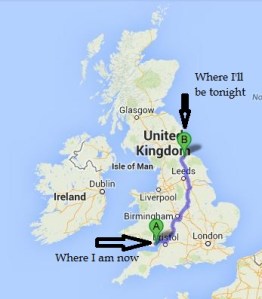
This is going to be a considerable train journey (check out the map below), so I’ll be bringing work to be getting on with and plenty of light refreshments. The other thing I’ll be doing en route is catching up with friends and colleagues, where in the course of a normal working week it can be difficult to find time to converse.

The meeting itself is being hosted by Gordon Mitchell from Teesside University, and is being chaired by Michael Coffey. Taken from the MHNAUK website here is the agenda:

9.15 – 10.00 Arrival and Refreshments

10.00 – 10.10 Welcome from the Chair and Introductions – Michael Coffey

10.10 – 10.20 Welcome to the School and Teesside University – Dean Prof Paul Keane OBE

10.20 – 10.50 Safewards and coercion – Professor Len Bowers

10.50 – 11.20 Department of Health commissioned report on physical interventions – Ian Hulatt, RCN Mental Health Nurse Advisor and Professor Joy Duxbury

11.20 – Discussion re MHNAUK statement on research and education in physical interventions

11.30-11.45 Comfort Break

Main Business

11.45-12.45 Research Priority Setting: a proposal – Professor Len Bowers

Lunch and Networking

13.15 – 13.45 Revisiting Cardiff Proposals – Michael Coffey

13.45 – 14.00 Mental Health Nurse recruitment and selection – Enkanah Soobadoo

14.00 -14.15 NPNR News – Michael Coffey

14.15 – 14.25 Feedback on Academy of Nursing, Midwifery and Health Visiting Research – Professor Alan Simpson

14.25 – 14.35 Mental Health Nurse Metrics – Sue McAndrew

14.35 – 14.45 MHNAUK statement on Dementia care, education and research – Grahame Smith

14.45 – 14.50 Doctoral student network: fringe event at NPNR – Julia Terry

14.50 AOB – Mental Health Nursing history archive – Michael Coffey and MHNAUK new journal discussions – Ben Hannigan

15.00 Close of Meeting