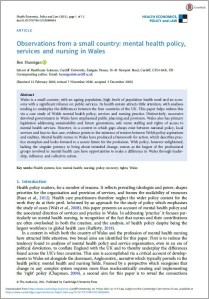
 This new paper has been a long time in the making. Work on it began with preparations for an address given at the Australian College of Mental Health Nurses conference in 2018. Refinements and updates happened towards the end of 2019, in the context of preparing for a talk delivered at a Royal College of Nursing-sponsored event in Cardiff in 2019, with a further version presented at an online conference organised by Julia Terry, from Swansea University, during the 2020 coronavirus lockdown. Along the way the written article has benefited from a critical reading from both Michael Coffey and Nicola Evans, and from no fewer than four anonymous peer reviewers. My thanks to all of them.
Observations from a small country: mental health policy, services and nursing in Wales can be downloaded in green open access form from the Cardiff University institutional repository, and has this as its abstract:
Wales is a small country, with an aging population, high levels of population health need and an economy with a significant reliance on public services. Its health system attracts little attention, with analyses tending to underplay the differences between the four countries of the United Kingdom (UK). This paper helps redress this via a case study of Welsh mental health policy, services and nursing practice. Distinctively, successive devolved governments in Wales have emphasised public planning and provision. Wales also has primary legislation addressing sustainability and future generations, safe nurse staffing, and rights of access to mental health services. However, in a context in which gaps always exist between national policy, local services and face-to-face care, evidence points to the existence of tension between Welsh policy aspirations and realities. Mental health nurses in Wales have produced a framework for action, which describes practice exemplars and looks forward to a secure future for the profession. With policy, however enlightened, lacking the singular potency to bring about intended change, nurses as the largest of the professional groups involved in mental health care have opportunities to make a difference in Wales through leadership, influence and collective action.
The argument I’ve developed here is that policy for health care in Wales, and for mental health care specifically, has distinctive features. As a peer reviewer I continue to have to correct manuscripts which conflate ‘England’ with the ‘UK’, and I’ve tried in this article to point out some of the things which make Wales different. I have also highlighted what seem, to me, to be gaps between well-intentioned policy aspirations and actual experiences as revealed through research. Overall, though, I intend the paper to convey a message of optimism, noting (amongst other things) the high value placed on the relational work of mental health nurses and the positive differences nurses make. Enjoy the read!
Follow @benhannigan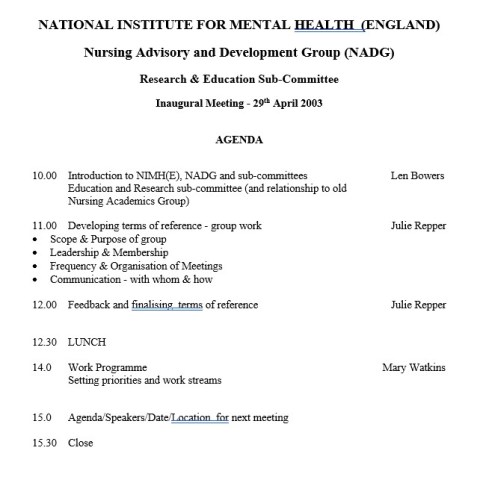 I was at the first-ever meeting of the group now calling itself ‘Mental Health Nurse Academics UK’, which took place on April 29th 2003 hosted at City University and convened by Len Bowers, Julie Repper and Mary Watkins. I’ve attached to this post the agenda for the meeting, which reveals how the group began its life linked to organisational arrangements in England, uniquely. That changed once those present determined that the group should simultaneously become both UK-wide and independent from any other organisation or government department.
 This year’s International Mental Health Nursing Research Conference (#MHNR2020) happened over two weeks in September, as planned through
  For many years I led a
  In July 2020, with colleagues I received peer review feedback on our draft MENLOC study final report, about which
  In the case of MENLOC the journal in which our final report will be published is
  Back in summer 2019 (which seems, for pandemic-related reasons, to be much longer than a year ago) I wrote
  How much has changed since then. As an organising committee we made a relatively early decision to call off the face-to-face conference originally scheduled for June 11th at Middlesex University. Now, in May 2020, #MHNR2020 is being brought into a new initiative called #mhTV.
 Meanwhile, one type of research relatively unaffected by the coronavirus outbreak is the evidence synthesis. In Cardiff we have the
