Category: Services

REF results out, COCAPP in

The publication of results from the Research Excellence Framework 2014 (#REF2014) has made this a big week for universities. REF is important for lots of reasons. First, it is assumed that recurring, quality-related (QR), research funding from the UK’s four higher education funding councils will be weighted to the REF results (I say ‘assumed’ here in the light of reports, today, on possible changes to the dual support system: see below for more). Second, universities and the departments within them are ranked based on REF outcomes, making the exercise a crucial one for relative reputations. Third, for governments the REF (like the various research assessment exercises (RAEs) before it) is a way of showcasing the value of research investment and the wider benefits this brings.

Universities will have followed different strategies in managing their REF submissions. In Cardiff a selective return produced a result comfortably better than had been aimed for with the University now ranked in the top five based on research quality. Check out this short video for an overview:

As I hinted above there are, already, questions being asked of how the REF results will (or will not?) be converted into future funding. A report in today’s Observer suggests that changes may be afoot to the dual support (QR and programme/project-related) system. Here’s an early morning tweet from Phil Baty at the Times Higher Education:

So that’s an evolving story which deserves to be closely watched.

Meanwhile…

…moving from research in the round to research projects specifically, this has also been the week that our draft final report from COCAPP has been submitted for peer review to the NIHR Health Services and Delivery Research Programme:

COCAPP has been an investigation into care planning and care coordination in mental health services, and has already been partnered by COCAPP-A. This related study is asking questions in the hospital setting similar to those asked by COCAPP in the community. The coming year sees COCAPP-A getting into full swing, with qualitative and quantitative data being generated across multiple NHS sites in England and Wales.

December catch-up

Competing priorities have kept me away from this site in recent weeks. There’s been work to do on COCAPP, which is close to the finish line, and doctoral students’ drafts to read and comment on (before imminent thesis submission, in one case). I’ve also been reading a thesis ahead of a PhD examination I’m involved in at the end of the coming week. So if this catch-up post feels a little bitty, then that’s because it is: there’s been lots happening that I want to comment on.

First up is the RiSC study, which I’ve mentioned here plenty of times before. In the last ten or so days the NIHR has published a first look summary of our aims, methods and findings. This is a precursor to the publication of our whole report, which is now post-peer review. Sometime in the new year we’ll be reconvening as a research team to plan our next project.

In October I made the short trip to the University of South Wales to hear Professor Linda Aiken from the University of Pennsylvania deliver this year’s RCN Winifred Raphael Lecture. Professor Aiken spoke on Quality nursing care: what makes a difference?, drawing on findings from the RN4Cast study and more. As promised, the RCN Research Society has now uploaded its video of the event for the world to see. It’s well worth watching.

News on the Mental Health Nurse Academics UK front includes an election, which we are now midway through, for the group’s next Vice Chair and Chair Elect. I’m overseeing this process (as I’ve done twice before), and will be in a position to announce the successful nominee on December 15th. One of the things that MHNAUK does is to work with the RCN to run the annual NPNR conference, and I’m very pleased to have had the chance to join the NPNR scientific and organising committee for a three year stint. More to follow on that front in the future, including details of next year’s event as they emerge.

Elsewhere I read that the Shape of Caring review, chaired by Lord Willis, is looking at the UK practice of preparing new nurses, at the point of registration, for work in one of four fields (mental health, adult, child and learning disability). This is something to keep a close eye on, with reports from last month’s Chief Nursing Officer Summit in England suggesting that the fields may be on their way out. For a useful, balanced, review in this area I refer the reader to the 2008 King’s College London Policy+ paper Educating students for mental health nursing practice: has the UK got it right? and, for a longer read, to Approaches to specialist training at pre-registration level: an international comparison.

Turning back the clock?

Here’s a post to draw attention to the RCN‘s newly published Report on Mental Health Services in the UK. This looks to be the latest document from Frontline First, a campaign revealing the effects of funding cuts on NHS care and nursing.

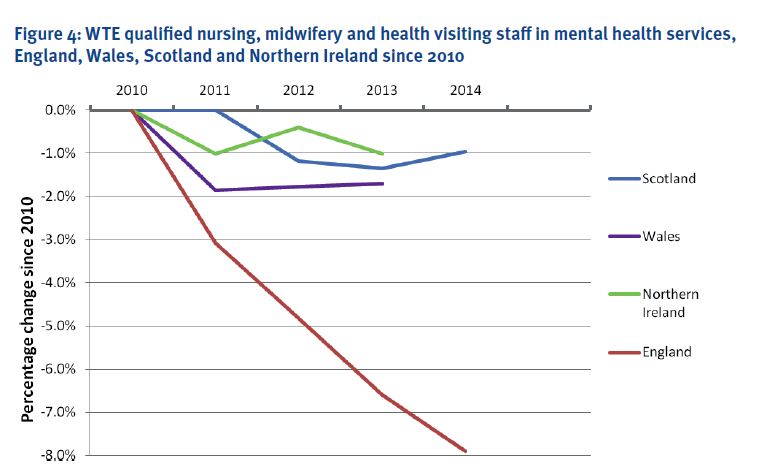
Working with the charity Rethink Mental Illness, and drawing on publicly available data, the RCN shows how (since 2010) the number of staffed mental health hospital beds across all four countries of the UK has reduced. The number of nurses working in NHS mental health services has also fallen, those remaining being revealed as an ageing group. Year on year, an increasing proportion is shown to be over the age of 50.

Here’s a chart showing reductions in the mental health nursing workforce, which I’ve extracted from page 16 of the report:

And, right at the front of the document, I see a clear case for investment contained in these recommendations which I reproduce word-for-word:

1) Governments must ensure there is equal
access to mental health services and that
the right treatment is available for people
when they need it.

2) Governments and NHS providers must
ensure that the commitment to parity of
esteem is directly reflected in the funding,
commissioning of services, workforce
planning, and patient outcomes.

3) Local commissioners and health boards
must make available enough local beds
to meet demand.

4) The principle of least restriction must
be embedded across all mental health
services. Detention under mental health
legislation should always be based on
clinical opinion and never be a result
of local failures to provide appropriate
care. Due to the significant increase in
detentions under the Mental Health Act
there should be a national objective set
to reduce detention rates in England.

5) There must be a consistent shift across
the UK from inpatient acute care to
community-based services which
recognises that prevention and early
intervention results in better outcomes,
reduces the pressure on acute services,
and reduces the overall cost to the NHS
in the long term.

6) Urgent action must be taken to address
the workforce shortages. Resources must
be committed to training and recruiting
enough mental health nurses who are able
to deliver specialist care in the changing
health and social care landscape.

7) NHS providers must invest in the current
mental health nursing workforce.
Band 6, 7 and 8 mental health nurses
should be developed to become advance
practitioners to deliver effective
recovery-led care in mental health
services.

8) There must be a sustainable and
long-term workforce planning strategy
which acknowledges the current
challenges facing the mental health
nursing workforce.

Horatio Festival of Psychiatric Nursing

Horatio is the European Association for Psychiatric Nurses. On the group’s website it says:

The aims of the Association are twofold: to advocate for the interest of the members by providing input into the decision-making processes on issues relevant to psychiatric and mental health nursing in Europe and to promote the development of psychiatric and mental health nursing practice, education, management and research.

I’m just back from Horatio’s latest gathering: the Third European Festival of Psychiatric Nursing, with its theme of ‘Creativity in Care’. This took place between November 6th-9th in Malta, which (unfortunately for those of us aiming to sightsee on our single free afternoon) happened to be experiencing some unseasonably miserable weather.

As an event, this was a large and properly international one. Whilst there I delivered two presentations: one from the RiSC study, and one a knitting-together of ideas, methods and findings from a series of interconnected and now-completed studies into changing mental health systems and nursing work. My themes in this second presentation will be familiar to readers of this blog, but if it’s worth saying once it’s worth saying again. Here are my slides, for anyone interested:


Voting for mental health

In this post I underestimated the number of charities which specifically fund mental health research. Last week Hugh McKenna sent a message to members of Mental Health Nurse Academics UK alerting us to the Alliance of Mental Health Research Funders, and particularly to this group’s Prioritising Mental Health Research manifesto produced ahead of next year’s general election.

I count 13 members of the Alliance, and read this from the about section of the organisation’s website:

We are a group of charities and foundations that support mental health research. We meet regularly to share progress and generate new ideas for improving mental health research in the UK. We believe that more and better research is urgently needed to find ways of promoting good mental health, treating mental health problems, and supporting the wellbeing of individuals, families and communities. Research can help people with mental health problems, and those around them such as family members or friends, practitioners and leaders of organisations, to find solutions so individuals can enjoy better health and longer, more fulfilling lives.

In its 2015 manifesto the AMHRF says:

We all know someone with a mental health problem and can see how lives would be improved with better treatments and support and less stigma. Mental health research saves lives, relieves significant distress
and improves quality of life. It also benefits the whole of our society by generating social and economic benefits that contribute to thriving communities built upon resilience, reduced levels of mental ill-health and less stigma and discrimination.

Yet mental health research is underfunded and under-prioritised by government. We are missing opportunities to achieve breakthroughs seen in other areas of healthcare that could transform people’s lives and enhance wellbeing.

The 2015 General Election is a landmark opportunity for political parties to build on growing public awareness of mental health and the value of all health and social care research.

The Alliance is right about a growing public awareness of mental health issues, and its message on underfunding is an important one which deserves to be heeded. The LibDems have promised to include a commitment to increasing mental health research in their 2015 manifesto, and other parties (including those with a chance of forming a government) might consider following suit. Personally I would like to see this wrapped up in a more overarching promise to invest properly in mental health across the board, including in services. Elsewhere this week announcements have been made of extra funds to reduce waiting times for mental health care in England. This is a good thing, but needs to be seen in the context of persistent cuts to the mental health system over the lifetime of this government which have  had serious implications for people left in need.

Parity of esteem?

Today’s Guardian interview with Professor Simon Wessely, President of the Royal College of Psychiatrists, reveals how large the mental health care and treatment gap has become. Professor Wessely draws comparisons between mental health and cancer services, saying:

“People are still routinely waiting for – well, we don’t really know, but certainly more than 18 weeks, possibly up to two years, for their treatment and that is routine in some parts of the country. Some children aren’t getting any treatment at all – literally none. That’s what’s happening. So although we have the aspiration, the gap is now so big and yet there is no more money,” he said.

Wessely said there would be a public outcry if those who went without treatment were cancer patients rather than people with mental health problems. Imagine, he told the Guardian, the reaction if he gave a talk that began: “‘So, we have a problem in cancer service at the moment. Only 30% of people with cancer are getting treatment, so 70% of them don’t get any treatment for their cancer at all and it’s not even recognised.”

NHS England places considerable emphasis on ‘parity of esteem‘, with the Improving Access to Psychological Therapies (IAPT) programme intended to be a one, key, part of making this happen. Evidence like Simon Wessely’s, combined with (for example) BBC/Community Care investigatory evidence of cuts in services, points to a chasm between the stated intention and the frontline reality.

This lack of parity extends to research. Within the last week or so the Liberal Democrats made a promise to include in their general election manifesto a commitment to increase mental health research funding by £50m each year. It has often struck me how poorly funded mental health research is. Mental health researchers can apply for support to bodies like the NIHR and NISCHR, and many do with some success (see all my previous posts on this site relating to COCAPP, RiSC and Plan4Recovery, for example). But unlike most other areas of health care the mental health field has no large-scale, dedicated, charitable research funding. Mental Health Research UK was founded in 2008 as (it says on its website) the UK’s first charity devoted specifically to raising funds to support research into the causes and treatments of mental illness. And that’s about it, I think: unless someone is able to tell me differently?


Summer research catch-up

Some time away and pressure of work explain the absence of recent posts on this site. So here’s a catch-up. In COCAPP, data generation and analysis are pressing ahead, whilst COCAPP-A (which is asking questions about care planning in acute mental health hospitals) has officially commenced. Plan4Recovery (which is concerned with shared decision-making and social connections for people using mental health services) is generating data. The draft final report from the RiSC study has now been peer reviewed and is back with us, the research team, for revisions. Methods and findings from this project (an evidence synthesis in the area of risk for young people moving into, through and out of inpatient mental health hospital) were also presented last month at the CAMHS conference at the University of Northampton. Many thanks to Steven Pryjmachuk for doing this.

Further conference presentations, from all but COCAPP-A, will also be delivered at this year’s NPNR conference. And, for the first time, I’m off to an event organised by Horatio: European Psychiatric Nurses. Horatio is a member of ESNO: European Specialist Nurses Organisations, and the event I’m speaking at in November is the 3rd European Festival of Psychiatric Nursing. One of the papers I’m delivering is titled, ‘Mental health nursing, complexity and change’. Here’s my abstract:

In this presentation I principally draw on two studies conducted in the UK to share some cumulative insights into the interconnected worlds of mental health policy, services, work (including that of nurses) and the experiences of users. I first set the scene with a brief review of the historic system-wide shift away from hospitals in favour of care being increasingly provided to people in their own homes. I emphasise the importance of this development for the mental health professions, and show how community care opened up new jurisdictional opportunities for nurses, social workers and others. I then draw on data from a project using a comparative case study design and ethnographic methods to show how the everyday work of mental health nurses (and others) is shaped both by larger jurisdictional claims and the contextual peculiarities of the workplace. From this same project I also show how the detailed, prospective, study of unfolding service user trajectories can lay bare true divisions of labour, including the contributions made by people other than mental health professionals (including support staff without professional accreditation, community pharmacists and lay carers) and by users themselves. I then introduce the second study, an investigation into crisis resolution and home treatment (CRHT) services, with an opening account of the unprecedented policymaking interest shown in the mental health system from the end of the 1990s. CRHT services appeared in this context, alongside other new types of community team, and I draw on detailed ethnographic case study data to examine crisis work, the wider system impact of setting up new CRHT services and the experiences of users. I close the presentation overall with some reflections on the cumulative lessons learned from these linked studies, and with some speculative ideas (on which I invite discussion) on the continued reshaping of the mental health system at a time of economic constraint, health policy contestation and political devolution.

I’ve given myself something of a challenge in attempting all this in a single concurrent session, but I’ll do my best and can signpost interested participants to papers I have published in these areas. One of my reasons for heading off to the Horatio event (in Malta, as it happens) is to make connections with international colleagues, with whom I might usefully share my projects, interests and ideas and perhaps find common ground.

Prospects and challenges: revisited

In 1999 I wrote a paper for the journal Health and Social Care in the Community titled Joint working in community mental health: prospects and challenges. The back story is that the work for this article was mostly done during my first year of part-time study for an MA in Health and Social Policy, during my time working as a community mental health nurse in East London.

Frustratingly, I can’t find my original wordprocessed copy of this paper from which to create a green open access version for uploading to the Orca repository and for embedding a link to here. But not to worry. The abstract, at least, is a freebie:

This paper reviews the opportunities for, and the challenges facing, joint working in the provision of community mental health care. At a strategic level the organization of contemporary mental health services is marked by fragmentation, competing priorities, arbitrary divisions of responsibility, inconsistent policy, unpooled resources and unshared boundaries. At the level of localities and teams, these barriers to effective and efficient joint working reverberate within multi-disciplinary and multi-agency community mental health teams (CMHTs). To meet this challenge, CMHT operational policies need to include multiagency agreement on: professional roles and responsibilities; target client groups; eligibility criteria for access to services; client pathways to and from care; unified systems of case management; documentation and use of information technology; and management and accountability arrangements. At the level of practitioners, community mental health care is provided by professional groups who may have limited mutual understanding of differing values, education, roles and responsibilities. The prospect of overcoming these barriers in multidisciplinary CMHTs is afforded by increased opportunities for interprofessional ‘seepage’ and a sharing of complementary perspectives, and for joint education and training. This review suggests that policy-driven solutions to the challenges facing integrated community mental health care may be needed and concludes with an overview of the prospects for change contained in the previous UK government’s Green Paper, ‘Developing Partnerships in Mental Health’.

Fifteen years on the structural divisions remain. As with other areas, community mental health care continues to be funded and provided by a multiplicity of agencies, with ‘health care’ and ‘social care’ distinctions still very much in place. This year’s Report of the Independent Commission on Whole Person Care for the Labour Party and the King’s Fund’s work on integrated care are examples of recent initiatives aimed at closing these gaps. Labour’s Independent Commission recommends the creation of a new national body, Care England, bringing together NHS and local authority representatives at the highest level. Note, of course, that these proposals are for England only: these are ideas for health and social care in one part of a devolved UK.

In my article I drew attention to the problem of competing policies and priorities for NHS and local authority organisations, the lack of shared organisational boundaries, non-integrated information technology systems and separate pathways bringing service users into, through and out of the system. An illustrative example I gave was the parallel introduction, in the early 1990s, of the care programme approach (CPA) and care management. Here in Wales, with the introduction of the Mental Health (Wales) Measure there is now, at least, a single care and treatment plan (CTP) to be used with all people using secondary mental health services. But how many health and social care organisations in Wales and beyond have managed to integrate their information systems? This, I suspect, remains an idea for the future.

And then there are the distinctions, and the relationships, between the various occupational groups involved in community mental health care. In my Joint working paper I emphasised the differences in values, education and practice between (for example) nurses and social workers, and (perhaps rather glibly) suggested that the route to better interprofessional practice lay through clearer operational policies at team level. Getting mental health professionals to work differently together became, for a time at least, something of a policymakers’ priority in the years following my article’s appearance. Here I’m thinking of the idea of distributed responsibility, and ‘new ways of working’ more generally, of which more can be found in this post and in this analysis of recent mental health policy trends (for green open access papers associated with both these earlier posts, follow this link and this link).

Two other things strike me when I look back on this 1999 article and reflect on events in the time elapsing. First is how much I underemphasised, then, the importance and influence of the service user movement. Over 15 years much looks to have been gained on this front, and I detect improved opportunities now for people using services to be involved in decisions about their care. Services have oriented to the idea of promoting recovery, as opposed to responding solely to people’s difficulties and deficits. This all takes me neatly to COCAPP and Plan4Recovery, two current studies in which I am involved which are investigating these very things in everyday practice. Second, I realise how little I foresaw in the late 1990s the changes then about to happen in the organisation of community mental health teams. Not long after my paper appeared crisis resolution, early intervention, assertive outreach and primary care mental health teams sprung into being across large parts of the country. More recent evidence suggests a rolling back of some of these developments in a new era of austerity.

And what of the community mental health system’s opportunities and challenges for the fifteen years which lie ahead? Perhaps there’s space here for an informed, speculative, paper picking up on some of the threads identified in my Joint working piece and in this revisiting blog. But that’s for another day.

2014 Skellern Lecture, JMPHN Lifetime Achievement Award and MHNAUK meet-up

Last week brought a trip to London for a series of events: a COCAPP update on framework analysis; a COCAPP project advisory group meeting; the 2014 Skellern Lecture and the Journal of Psychiatric and Mental Health Nursing Lifetime Achievement Award; and this term’s meeting of Mental Health Nurse Academics UK.

Gary Winship, who does an excellent job organising the Skellern and JPMHN events, wrote this piece on the MHNAUK blog ahead of the lectures taking place at the Institute of Psychiatry. He wrote how Professor Joy Duxbury in her Skellern Lecture:

…will endeavour to balance the evident need for improved compassionate based care against a backdrop of risk aversion [and will place] a particular focus on coercive practices, more specifically restraint in mental health settings.

And that was exactly what Joy did on the night. She lined up, and tackled, the reasons mental health nurses give for using physical restraint and using video evidence drew her audience’s attention to what can go wrong. This includes patient deaths, something which the national charity Mind has been campaigning about since last year (see this post from June 2013) and which has helped drive the Department of Health’s guidance on positive and proactive care.

Professor Hugh McKenna took a break from his REF duties as Chair of the Allied Health Professions, Dentistry, Nursing and Pharmacy sub-panel to receive this year’s JPMHN Lifetime Achievement Award. Here’s Gary Winship’s preamble from the MHNAUK site:

Professor McKenna has a long and illustrious career. He was appointed an International Fellow of the American Academy of Nursing in 2013 which is an accolade accorded to very few people outside the USA. He was made an Honorary Fellow of the Royal College of Surgeons in Ireland (1999), Fellow of the Royal College of Nursing (2003) and Fellow of the European Academy of Nursing Science (2003). In 2008, Professor McKenna received a CBE for contributions to health care and the community, and in the same year he was appointed to Chair the Nursing Panel in the 2008 Research Assessment Exercise.

Hugh delivered a personable, good-humoured, lecture which also contained some important messages for nurses aiming to build programmes of research. These included the importance of working collaboratively and across disciplinary boundaries, aiming high, and getting funding. These are all things which Hugh has excelled at in his own career, though he was far too modest to draw explicit attention to this himself. Many congratulations both to him and to Joy: two recipients very worthy of their awards.

Following events on June 11th, the 12th brought the final meet-up in the current academic year of Mental Health Nurse Academics UK, convened on this occasion at London South Bank University. The morning was devoted to these presentations:

Colin Gale, Archivist, Bethlem Museum of the Mind
As if to, drive me mad: an Edwardian’s experience of sedatives and the asylum

Tony Leiba, Emeritus Professor, LSBU
Lessons of social inclusion through policy

Tommy Dickinson, Lecturer, Manchester University
‘Curing Queers’: giving a voice to former patients who received treatments for their ‘sexual deviations’, 1935-1974

The afternoon saw MHNAUK members get down to business. This included a discussion, led by Andy Mercer, on how best to influence the latest round of nursing reviews including the Shape of Caring and The Lancet Commission on UK Nursing. Elsewhere on the agenda were updates on this year’s Network for Psychiatric Nursing Research conference, MHNAUK’s in-progress position paper on physical health and well-being (led by Patricia Ryan-Allen and Jacquie White) and possible journal affiliations.


Safewards comes to Cardiff

Sadly for me I couldn’t be at Geoff Brennan‘s meet-up today with Cardiff and Value UHB mental health nurses to talk about the Safewards study and its implications. But here’s a message Geoff sent, and a fine photo, to mark the occasion: