Category: Services

Critical junctures

How pleasing it is to report that the paper I blogged about in this earlier post has now been accepted for publication. Co-written with Nicola Evans this (re)introduces the idea of ‘critical junctures’ and will appear in Social Theory & Health. We draw on two project datasets and show how action at pivotal moments can set individual service user trajectories on directions which are hard to reverse. We also show how, in certain circumstances, small-scale critical junctures can trigger (or be used to lever) larger organisational change.

Next up will be the checking of page proofs, and advance online publication via the journal’s website. What we won’t be able to do for another 18 months is upload a PDF of the post-peer review manuscript to ORCA. This is something Palgrave’s copyright rules are very clear about. In the meantime here’s the abstract which will, of course, be freely available:

Hannigan B. and Evans N. (in press) Critical junctures in health and social care: service user experiences, work and system connections. Social Theory & Health

This article makes an original contribution through the revitalisation, refinement and exemplification of the idea of the ‘critical juncture’. In the health and illness context, a critical juncture is a temporally bounded sequence of events and interactions which alters, significantly and in a lasting way, both the experience of the person most directly affected and the caring work which is done. It is a punctuating moment initiating or embedded within a longer trajectory and is characterised by uncertainty. As contingencies come to the fore, individual actions have a higher-than-usual chance of affecting future, enduring, arrangements. These ideas we illustrate with detailed qualitative data relating to one individual’s journey through an interconnected system of mental health care. We then draw on observations made in a second study, concerned with the improvement of mental health services, to show how micro-level critical junctures can be purposefully used to introduce instability at the meso-level in the pursuit of larger organisational change. In addition to demonstrating why scholars and practitioners should pay closer attention to understanding and responding to critical junctures we are, therefore, also able to demonstrate how their emergence and impact can be examined vertically, as well as horizontally.

Learning from the study of trajectories

Trajectories paperHere’s a post about research, which draws on the paper Complex caring trajectories in community mental health: contingencies, divisions of labor and care coordination which I authored with Davina Allen.

One of the things I’m interested in is the study of ‘trajectories’. With colleagues, the US sociologist Anselm Strauss wrote about these in the book Social Organization of Medical Work. Most people will be familiar with the idea of illnesses ‘running their course’. To this everyday concept Strauss and his collaborators added a whole lot more, introducing the term ‘trajectory’ to refer:

…not only to the physiological unfolding of a patient’s disease but to the total organization of work done over that course, plus the impact on those involved with that work and its organization (Strauss et al. 1985: 8).

Trajectories are dynamic and often unpredictable, not least because they involve people. They are also vulnerable to being tilted by what Strauss et al term ‘contingencies’. Contingencies can have origins in the health and illness experience. So, a trajectory can (for example) veer off in a new direction because of an acute exacerbation of a chronic illness. But trajectories can additionally be shaped by contingencies which have organisational origins. These can relate to the biographies of workers, and to features of the system such as the availability of resources.

Trajectories can be studied. In my PhD I borrowed the design and methods used by Davina Allen, Lesley Griffiths and Patricia Lyne in their study of stroke care, and used these to understand the trajectories of people using community mental health services. In each of two contrasting parts of Wales I recruited three people currently using secondary mental health services. Each became the starting point for a detailed, small-scale, trajectory case study. Over a period of months I followed each person’s unfolding experiences, and the organisation of work surrounding. Using snowball sampling I mapped the network of (paid and unpaid) people providing care to each, and interviewed those identified in this way about their work. I observed care planning meetings, home visits, and read each service user participant’s National Health Service (NHS) records.

Community Mental Health JournalIn the publication for Community Mental Health Journal to which this post relates, Davina and I drew on these data to show how trajectories unfolding in the mental health field are shaped. We offered instances of trajectories being tilted by mental health crises, but also by key professionals leaving their posts and by a lack of resources within the larger system.

We then used data to reveal actual divisions of labour, in a way which has not (to the best of my knowledge) been done before  in the mental health context. By mapping the networks of care surrounding each user participant we were able to learn about work being done by all sorts of people, including many who (I suspect) are rarely thought of as making significant contributions at all. We wrote about the work of community pharmacists, support workers, lay carers and indeed the work of service users themselves.

Having laid all this out we closed by pointing to the importance of what Strauss et al called ‘articulation work’. This is the work associated with the management of trajectories, through mechanisms such as care coordination. Mental health workers in the UK know all about this through things like the care programme approach (CPA).

The detail of this paper you can read for yourself, with the link at the top of this post taking you to our author’s copy of the manuscript as stored on Cardiff University’s ORCA repository. This, word-for-word, is the same as the version of the article which is currently in press here.

For those interested in the paper’s back story, just to note that when it came to selecting a journal I was keen not to submit to a nursing publication. I have no problem with nursing journals per se, but this ‘trajectories’ paper was (and is) aimed at a wider readership. Community Mental Health Journal is based in the US, and publishes papers on, well, community mental health. And that fitted well with the intended audience. This said, one of the anonymous reviewers of the submitted manuscript had things to say about the language used, reminding us that the journal to which we had submitted is read by mental health practitioners and academics and not, primarily, by sociologists. Attending to the review meant some rewriting to improve accessibility. I’ll leave future readers to judge for themselves whether we succeeded.

Visiting the Netherlands

HAN 4
Bisschop Hamerhuis in Nijmegen, home to Dr Bauke Koekkoek and the Social Psychiatry and Mental Health Nursing research group

Michael Coffey and I have just returned from a four day trip to the Netherlands, an event supported with funding from the Mental Health Research Network Cymru. We were there to share and develop research ideas with the impressive Dr Bauke Koekkoek and colleagues, and to learn about the Dutch mental health system. Bauke, a mental health nurse, is Associate Professor of Social Psychiatry and Mental Health in the Hogeschool van Arnhem en Nijmegen (HAN) University of Applied Sciences, and is interested (amongst other things) in matching the needs of people with mental health difficulties with services. You can read more about Bauke’s work in his inaugural lecture.

RGF130319-1065
Bauke, in mid-flow

Bauke did a great job organising a full schedule of activities for our three working days away. Well done, Dutch train and bus companies, for delivering Michael and me to our various destinations in timely fashion. We were, though, reminded during our trip that it is the bicycle which remains the vehicle of choice for many Netherlanders.

We had the chance to meet with academics, practitioners and service users during our travels across Utrecht, Arnhem and Nijmegen. Our thanks to everyone who gave their time and who shared their expertise so generously: Dr Arjan Braam; Mark van Veen; the Kompas team at Pro Persona‘s Wolfheze site; Dr Ad Kaasenbrood and his colleagues in the Arnhem Functional Assertive Outreach Team (and particularly Vincent and Riska, who Michael and I spent Tuesday morning with); the Arnhem FACT Team service users who welcomed us into their homes; the HAN Social Psychiatry and Mental Health Nursing research group; and Hein, Rob and Leon who teach at HAN and have interests in developing international links.

RGF130319-1105
Michael, holding forth

The Social Psychiatry and Mental Health Nursing research group, who we met on Tuesday afternoon, are a capable and accomplished team. Their MATCH Project is supported by a significant grant, and Bauke and his collaborators have done exceptionally well in using this as a springboard for further, associated, studies. Examples include PhDs investigating the effectiveness of therapies, and a planned ethnographic examination focusing on discharge (and non-discharge) of people from community care.

It was good to hear people present and discuss their ideas, and in a spirit of collegiality Michael and I had the chance to share our interests and plans. I took the chance to talk about my research in a general sense, using as a prop this set of slides embedded below:

RGF130319-1126
Attentive listeners!

Interesting to learn during our time away was the system of preparing mental health nurses in the Netherlands. Yesterday, for example, we met Rob Keukens who runs HAN’s part-time, 18 month, post-qualification social psychiatric nursing programme. This is the nearest thing to what here, in the UK, we would describe as a post-registration course for community mental health nurses (CMHNs). For those interested, Bauke has described and analysed the Dutch CMHN profession in this paper.

RGF130319-1069
Me enjoying a joke. Or something like that.

The principal purpose of our trip was to further our research connections, and for Bauke, Michael and me to spend time putting our heads together to develop new research ideas. We know we’ll need to involve others, and target funding streams sympathetic to international research proposals which set out to create new knowledge to improve mental health and well-being and the organisation of mental health services.

More on all this to follow in due course, I am sure.

Disinvesting in mental health?

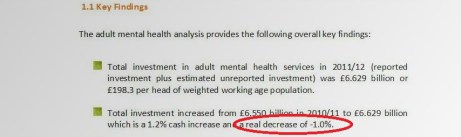
National Survey of Investment 2011-12Writing for The Guardian’s Healthcare Professionals Network this week, David Brindle reports that spending on mental health care in England has fallen for the second year in a row. He references unpublished figures disclosed last week to the House of Commons Health Committee, along with the 2011-12 National Survey of Investment in Adult Mental Health Services which appeared last August, and from which I have clipped these first two headline findings:

National Survey of Investment 2011-12b

The key figure here is the bit I have circled in red: that, in real terms, investment in mental health services in England in 2011-12 reduced by 1%. Last summer The Guardian reported the publication of this finding under the banner of mental health spending having fallen for the first time in 10 years, and if I am understanding David Brindle’s latest article correctly evidence of further cuts has been gathered since. Elsewhere in this piece Dr Hugh Griffiths, the Department of Health’s National Clinical Director for Mental Health, is quoted as having told the Health Committee last week of being ‘disturbed’ by reports of cutbacks to services in some English regions.

Meanwhile, via this piece in The Telegraph I see that the former coalition government Care Minister and LibDem MP Paul Burstow is heading up an independent Mental Health Commission with the liberal think-tank CentreForum. The Commission’s task is to ‘examine the state of mental health care provision in England’. This is a task made all the more urgent in the light of the finding, also contained in last August’s National Survey, of a £29.3 million reduction in investment in crisis resolution, assertive outreach and early intervention services.

All this paints a very bleak picture indeed. Reductions in funding and in services threaten to roll back the investments made in dedicated mental health care in the years following the publication, in England in 1999, of the National Service Framework for Mental Health. New Labour acted at tremendous speed in prioritising the mental health field. When in government Labour took action to develop community care through the creation of new types of services. It changed the law, put resources into improving access to psychological therapies and rewrote professional role boundaries. Some of the specifics were contentious, sure, but I for one did not doubt that the challenges of improving mental health and developing services were finally being taken seriously. In fact, Michael Coffey and I wrote about this period of policymaking in our wicked problems paper (which can be downloaded here). In this we urged careful consideration of the cumulative impact of policy actions, and the perils of trying to change everything in a complex system of health and social care all at the same time. But needless to say we made no case for cuts, which is what is evidently taking place around large parts of the country now.

As it happens, I can’t immediately find a Welsh equivalent for the Department of Health’s National Survey for England. If it’s out there, perhaps someone can point me in the right direction? It would be good to know the trends for investment in mental health services here in Wales. More generally, now I come to think of it, I want to learn more of the prospects for the future of the mental health system in this part of the UK now that the Welsh Government has a new Health Minister in Professor Mark Drakeford. The Minister is a Cardiff University Professor of Social Policy and Applied Social Sciences, and it will be interesting to see how future policy and services shape up under his direction.
 

Cash for compassion?

After Francis, what is to be done? Should we employ new hospital staff, and improve the ratio of nurses to health care assistants? Invest in the development of a cadre of strong clinical leaders, equipped with the skills and vision to drive up quality? Abolish gagging clauses? Overhaul professional regulation? Or perhaps instigate a regime of tough external inspections, including unannounced spot-checks? Take nursing education out of universities, and return it in its entirety to the NHS via a new apprenticeship model? Or expand the role of universities by giving them some responsibility for the preparation of health care assistants? Should we draft people in from private companies to show frontline public sector staff how it should be done? How about increasing local accountability by requiring senior hospital managers to report directly to elected councillors or similar? Or might we look to science, by commissioning a research team to design and validate a robust measure of caring of a type which might be administered to all potential entrants to nursing, to newly qualified members of the profession, and to experienced staff at intervals thereafter? We could even link periodic re-registration to the securing of a minimum score.

Who is to say which of these (or any other) solutions, alone or in combination, is what the NHS needs? And how might we know if any selected course of action has ‘worked’? Truly the problems facing the health service are complex and intertwined, and proposed responses to them value-laden and open to challenge. In the event, February 7th’s Guardian led with the headline David Cameron’s prescription for NHS failings: target pay of nurses. The paper went on to say that the Prime Minister:

[…] wants nurses’ pay to be tied to how well they look after patients as part of changes to banish poor care in the NHS in response to the devastating findings of a report published on Wednesday into the Mid Staffordshire hospital scandal.

Well, that’s another ‘solution’, for sure. And how might we determine how well a nurse performs, and quantify this for the purposes of financial reward or sanction? In this version of what ought to be done we might need that researcher-designed measure of caring after all. But let’s think about this further: at what scale would performance and pay be linked? Should the salaries of all staff in a single hospital or organisation be bound together? Or might workers in a ward or team be grouped, each paid a sum reflecting some aggregated measure of performance or collective compassion? How about differentiating at the level of the individual practitioner? And what might the unintended consequences of each and all of these options be (because I can think of a few)?

So, as you will have gathered, I contest the idea of cash for compassionate care. I also thought that Chris Ham from The King’s Fund spoke sense when he wrote, in February 6th’s Independent, that Edicts from Whitehall are not enough. Dignity, quality and a culture of care cannot be driven solely by a deluge of initiatives from the top. If they could, we would by now have created the perfect health system.

Giving a fig about roles

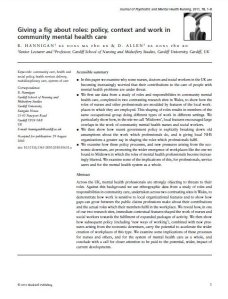
Hannigan and Allen 2011In a paper published in the Journal of Psychiatric and Mental Health Nursing at the start of 2011, Davina Allen and I drew on detailed, qualitative, research data to examine the relationships between policy, local organisational context and the work of community mental health practitioners. A version of the article, which carries the short title Giving a fig about roles, can be downloaded from the ORCA repository here.

Our paper drew on many of the social scientific ideas previously introduced on this blog in my Sphygmomanometers, remedial gymnasts and mental health work post, and which are rehearsed more fully in this earlier Complexity and change paper. Davina and I observed how recent mental health policy had triggered disruption in the system of work, with occupational groups advancing new, public, jurisdictional claims in response to perceived threats to their positions in a dynamic division of labour. One of the examples we gave was the response by sections within the profession of psychiatry to the policy of new ways of working, and its emphasis on ‘distributed interprofessional responsibility’ in particular.

The larger part of our paper reported new research findings. In the project from which it was drawn I had the opportunity to compare and contrast the organisation of community mental health services in two parts of Wales. With a view to understanding each site’s contextual features I read local policy documents, interviewed senior managers and practitioners and observed people at work. I was also interested in gaining a detailed, micro-level, view of the actual delivery and receipt of care. To this end I had permission from three service users in each site to follow their journeys through the mental health system, each over a period of four to five months. I interviewed all six about their experiences, and using snowball sampling mapped out the range of people providing them with care, whether paid or unpaid. The nurses, social workers, psychiatrists, psychologists, occupational therapists, general medical practitioners, pharmacists, health and social care assistants, family members and neighbours identified in this way were invited to take part in interviews focusing on work and roles. I also observed interprofessional care planning meetings and home visits, and read the written notes about each of the six service user participants made by practitioners.

As the full text of the paper reveals, in the analysis developed here we were particularly interested to explore the relationships between workplace characteristics and what practitioners actually did. Not unexpectedly, nurses carried out medication tasks, social workers (as the sole group able to do this at the time data were generated) fulfilled the ‘approved’ role during the operation of the Mental Health Act, doctors diagnosed and prescribed, and the sole participating psychologist provided structured therapy.

Word cloud 02.02.13Beyond this we also found that the work of professionals was ‘patterned’ (to use the phrase coined in this context by Anselm Strauss) by immediate organisational forces. In one of the two sites nurses and social workers had enlarged ‘bundles of tasks’ (this being Everett Hughes’ term). This shaping of what people did could be understood with reference to a variety of contextual features. Key informants in this site described a particularly long and positive history of health and social care staff working together. This manifested during fieldwork in an approach to care provision which emphasised shared tasks and downplayed rigid demarcations. Single community mental health workers, rather than multiple representatives of different groups, tended to be attached to the care of individual service users. Health and social care organisations in this site were also small, lacking pools of staff from which people might be drawn to cover gaps left by departed colleagues. In this constellation of circumstances nurses and other members of staff fulfilled roles which were more ‘generalist’ than was the case in the other of the two sites.

Davina and I were interested to set our findings in the new and emerging context for mental health care. We pointed to larger policy trends favouring unpredictability in working practices, and to the idea that competency (rather than professional background) should determine practitioners’ eligibility to fulfil roles. We observed that ‘flexible, boundary-blurring, professionals competent to carry out multiple tasks may find favour with managers concerned with meeting local needs in local ways’. We reflected on the implications of this for continuity of care, capability and the preparation of new professionals. The paper ended with our thoughts on the challenges all this poses to professions and their jurisdictional claims.

In a later post I’ll return to this study, and in particular to what I learned about the experiences of the people whose unfolding care I followed as each moved through the different parts of his or her local, interconnected, system of mental health care. But that’s for another day.

More on health and social care

A second brief post, now that Andy Burnham (Labour’s Shadow Health Secretary) has delivered the speech I heard mention of earlier today. I’ve found this version on the Labour Party’s website, and also this response from Chris Ham at the King’s Fund.

It’s interesting, and bold in places, and there’ll be more on the way as this is the start of a major Labour Party policy review. I see that Andy Burnham describes the mental health system as being quite separate from the system of social care, and from the system providing care for people with physical conditions. I also see that, in England, a future Labour government would seek ways of improving integration and coordination without imposing a further round of top-down structural change. I guess there might be different ideas about what counts as ‘structural change’, as some of what is proposed here is pretty radical: single points of access for all care, single budgets for all services provided, just one body (the NHS) providing ‘whole person care’. And whilst I like what I’m reading, I’m also aware that there are no ‘final fixes’ for the challenges facing public services. Change, even that which is driven by laudable ideas like promoting integration, can trigger unintended as well as desired consequences, and solve problems in one place only to create new problems elsewhere. Which takes me back to wicked problems and complex systems

Here’s to hearing the next, more detailed instalments: and indeed, any initial response from within Wales where responsibility for health and social care is a matter for the devolved Government.

Integrating health and social care

I caught a brief news item on this morning’s Today programme pointing to a speech that Labour’s Shadow Health Secretary Andy Burnham is expected to make introducing the idea of combined NHS and social care budgets in England. This is interesting, particularly if it develops into proposals Labour puts into its next election manifesto.

The fragmentation of health and social care is a problem. NHS organisations and local authorities have to work together, but have different obligations, priorities and funding. Accountability arrangements differ, and geographical boundaries are often not shared. Variations exist in models of commissioning and providing services.

These are hardly new observations. Years ago I wrote about the problem of fragmented community mental health services, and more recently have argued that the separation of agency responsibilities is one of the reasons the mental health system is so complex. It also contributes to the proliferation of wicked problems.

So, Andy Burnham: let’s hear what you have to say.

The Mayan apocalypse and The King’s Fund

According to some interpretations of the Mayan long count calendar, tomorrow – December 21st 2012 – will see the end of the world. If the apocalypse does happen then none of us, I’m afraid, will get to know how accurate the predictions contained in Future Trends might otherwise have been.

I came across this report earlier today via a link tweeted by @TheKingsFund. It’s part of the organisation’s new Time to Think Differently programme, and sets out ‘the significant trends and drivers that we [The King’s Fund] believe will affect health and social care services over the next 20 years’. Properly speaking this is all about the outlook for England, though I think Future Trends offers plenty of food for thought for those of us in other parts of the UK, too.

The document addresses issues across a number of areas: demographic change, health-related behaviours, disease and disability, the workforce, attitudes and expectations, determinants of health, medical advances, information technology, sustainability and economic pressures. Future Trends also has some important, specific, things to say about mental health and illness and about services in this area. One is to restate the connections between mental and physical health. As The King’s Fund says, poor physical health is associated with poor mental health and vice versa. Future Trends also points to the existence of significant unmet mental health need, and to the fact that demand for services can be expected to rise at times (like now) of economic downturn. Elsewhere there are sections dealing with the workforce, and the risk of a growing ‘care gap’ as sources of informal care diminish. Changing patterns of disease are likely to increase demand for home (rather than hospital) care, and for new types of worker able to cross traditional professional boundaries.

To my mind the broad picture Future Trends paints is an entirely plausible, and simultaneously challenging, one. More plausible, certainly, than predictions of an imminent end to the world. I think we might want to start thinking, sooner rather than later, about how we improve the physical well-being of people using mental health services. We should consider what the rise of chronic conditions means for education and training, and how to better meet need.