Category: People

More on mental health services at a time of austerity

For the second time in two months the BBC and Community Care have collaborated to establish the extent of funding cuts to mental health services in England. Freedom of Information requests were sent to 51 NHS trusts, of whom 43 responded. Summaries of this investigation, and headline findings, can be found on the BBC website here and on the Community Care website here. Community Care says:

Data returned by over two-thirds of the mental health trusts, obtained in two separate Freedom of Information requests, showed that:

  • Overall trust budgets for 2013/14 had shrunk by 2.3% in real terms from 2011/12. Ten out of 13 trusts that provided forecast budgets for 2014/15 are projecting further cuts next year.
  • Budgets for ‘crisis resolution teams’ fell 1.7% in real terms compared to 2011/12 while the average monthly referrals to these teams rose 16%. The teams provide intensive home treatment in a bid to prevent acutely unwell people being hospitalised.
  • Budgets for community mental health teams flatlined in real terms but referrals rose 13.3%. These services provide ongoing support in a bid to prevent people’s mental health deteriorating to crisis point.

Community Care also lists 10 ways this underfunding is damaging care.
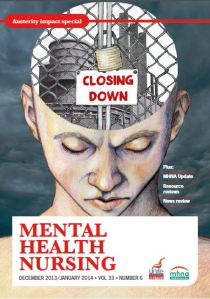
This is also the month that a special, free-to-download, ‘impact of austerity’ edition of Mental Health Nursing journal has appeared. In an email forwarded to all members of Mental Health Nurse Academics UK by Steve Hemingway (who is both an MHNA member and a member of the MHN editorial board), Dave Munday at Unite the Union (which publishes the journal) says:

This month the Mental Health Nursing journal is focused on austerity and mental health. I hope you’ll agree with me that this is a vitally important topic that not only every mental health nurse should know about, but every citizen. We hope that the journal will help to trigger some thoughts and debates that you can have locally in your workplaces but also outside of work. To this end we’re making the journal free to access even if you’re not a MHNA member or MHN subscriber.

Research priorities for mental health nursing

Last week’s arrival in my email inbox of the notes taken at Mental Health Nurse Academics UK‘s most recent meeting, held on October 8th at Teesside University, reminds me that MHNAUK is still conducting a research priorities exercise. These minutes, taken by Joy Duxbury and circulated by Michael Coffey, note that Len Bowers led our discussions on the day and has offered to collate responses:

The group discussed the scope of future research for the profession of mental health nursing. The idea is to develop research priorities to influence what research gets funded and funders will be interested to hear about this. The priority setting exercise included discussions on the following:

  • The role of the mental health nurse – What works and what doesn’t? What we are good at and what we aren’t so good at.
  • The role of theory as well as empirical research – how does this influence funders and how research might still be theory driven?
  • What do mental health nurses contribute that aids recovery?
  • Transitions
  • Care co-ordination
  • Does it have to be unique to mental health nursing? Maybe not
  • Underpinning values
  • Public Health

As there seemed to be problems with consensus e.g. defining what counts as mental health nursing research as opposed to mental health research of relevance to nursing it was felt that we need first to feedback top ten priorities for research to Len before Christmas. He will then collate to discuss at a future meeting. It might also help if we report what research we are currently doing too.

Meanwhile, over on MHNAUK’s blog there’s this post from Alan Simpson to kick-start this exercise off, and room for people to add their thoughts beneath via the comments function. In his ‘starter for 26’ Alan writes:

Inspired by last week’s MHNAUK meeting, today staff at our mental health research team meeting were asked to identify their research priorities for mental health nursing research. The meeting consists of various academic research staff and clinical academics discussing on-going and forthcoming research studies and various research-related issues. Today, I simply asked each person to write a short list of priorities, which we then shared and discussed. Here’s our Top 30 in no particular order with repeats removed. Most frequent repeat was physical healthcare. Second was recovery. Third – racism and culture. What’s your Top 10?

  1. Generic vs Specialist MHN training
  2. Measures of Compassion
  3. Effects of selection procedures for MHN students and staff
  4. Nursing and PTSD
  5. Tool development
  6. Risk assessment and MHN
  7. The 6 Cs and MHN
  8. Mental capacity and issues of consent
  9. Racism and stigma in MHN
  10. Values and beliefs and how they impact on practice
  11. Mental health and the performing arts
  12. MHN training and learning disabilities
  13. MHN views on developments that may threaten MHN, e.g. peer support, self-care
  14. Physical healthcare in secondary mental health care settings
  15. Philosophy and MHN: The Art of Living
  16. Identity and body image in people with MI
  17. Community and third sector organisations and how they link with mental health teams/services
  18. Communication, especially information giving and the first contact
  19. Culture and ‘cultural safety’ as a useful model
  20. Fear – underpinning MHN and service user behaviours
  21. Brokerage roles, self-care and MHN
  22. Workforce planning and nurse education/training and physical/mental health divide
  23. Evaluation of education/training and preparation of MHNs for the job
  24. Recovery and MHN interventions
  25. MHN interventions to maximise engagement
  26. Liaison mental health care

We’re looking to conduct an informal exercise of this type amongst Cardiff University’s mental health nurse academics, with a view to forwarding our collective ideas to Michael Coffey for wider incorporation. Ahead of this, here are some initial suggestions of my own, which I’ll also add to the MHNAUK blog:

  1. What do mental health nurses do?
  2. What do/can mental health nurses do which promotes recovery and individually tailored care?
  3. What do/can mental health nurses do to better promote physical health and well-being in people with severe and enduring mental health difficulties?
  4. What do/can nurses do to help people in their journeys into, through and out of the mental health system?
  5. What are mental health nursing values, and what difference do/can they make?
  6. How are/should students of mental health nursing be prepared for practice?
  7. How can nurses use new technologies to improve care and its organisation?
  8. What are the intended and unintended consequences of organisational and therapeutic innovation on the experiences of people both using, and providing, mental health services?

These are all ideas occurring this evening, though it’s also true to say most reflect lines of inquiry I’m fortunate enough to already be associated with. More to follow, perhaps.

Mental health R&D 2013

Yesterday I made it to the SWALEC Stadium for the annual Cardiff and Vale UHB Mental Health R&D meeting. I was pleased to again be invited, and appreciated the opportunity to talk about mental health research activity across the new School of Healthcare Sciences.

I was also reminded of the work of the National Centre for Mental Health (NCMH). Funded as Wales’ only Biomedical Research Centre by the National Institute for Social Care and Health Research (NISCHR), and led by Professor Nick Craddock, the NCMH supports mental health research, undertakes mental health research and communicates and engages. Newly housed in Cardiff University’s Hadyn Ellis Building, members of the NCMH do all three elements extremely well. The Centre’s website has recently been revamped, and is well worth a visit. Here, too, is an NCMH call for volunteers video:

Catching up post

Plenty going on in the last week or so. I had the chance to join pre-registration mental health nurses and occupational therapists for a second day as they made preparations for an interprofessional event scheduled for early December. Some of these students have also been giving me drafts of assessed work to comment on, but as the deadline for receipt of these is first thing next week I expect a deluge then. ’twas ever thus.

Elsewhere there has been RiSC reviewing to crack on with, assignment marking, and peer review reports to both consider and write. I’ve also put myself in the frame to act as a reviewer for another university’s proposed new MSc mental health programme, this being the kind of curriculum work I haven’t had the chance to do for a while.

I’m not normally one for formal, suit-and-boot, events, but made an exception last Wednesday (November 27th) to join a posse of colleagues from the School of Healthcare Sciences at the RCN Wales Nurse of the Year awards. These took place at Cardiff City Hall, and the overall winner was Cardiff and Vale UHB ward sister Ruth Owens. Congratulations, Ruth. Congratulations, too, to the individual category winners: including Andy Lodwick (also from Cardiff and Vale) for picking up the Mental Health and Learning Disabilities award and Dr Carolyn Middleton, doctoral graduate from what was the Cardiff School of Nursing and Midwifery Studies, for winning the Research in Nursing award.

This week also brought me to a meeting of the MHRNC Service User and Carer Partnership Research Development Group and, yesterday morning, to the Cardiff City Stadium for an open meeting to discuss NISCHR’s infrastructure and programme funding review. Both were lively events, and on the NISCHR front I see big changes ahead from 2015.

And to close this summary post: via the twitter grapevine I see that the RCN is now giving early notification of the Network for Psychiatric Nursing Research 2014 conference. This will take place at Warwick University on the 18th and 19th of September. I’ll post a link to the call for abstracts once this appears, but for now will reproduce this extract from the event website:

This year [2014] is the 20th international NPNR conference and it’s going to be a celebration.

We wish to celebrate and promote some of the outstanding mental health nursing research that shapes mental health policy and nursing practice across the world. We will also acknowledge some of the best psychiatric and mental health nursing research that helped create the strong foundation for our work today. And we will invite delegates to look ahead to map out the future for mental health nursing research, education and practice.

Doughnut meetings

My esteemed colleague Professor Jane Hopkinson facilitates a Wednesday lunchtime research drop-in, to which people in the School of Healthcare Sciences at Cardiff University are invited. Affectionately known as doughnut meetings (see photo of today’s goodies attached), these provide a loosely-structured, supportive, space for the sharing of ideas and experiences. The gatherings are really very good: informal, but always informed. I make a point of getting along when I can.

Typically those who meet up get to propose themes for future meetings. This afternoon’s topic was ‘research and evaluation’, and more particularly the distinctions between the two. People involved in health services research (or indeed, health services evaluation) will know how important this differentiation is for NHS governance and approval purposes. Projects classified as ‘research’ require independent NHS research ethics committee (REC) approval. Projects classified as ‘evaluation’ do not. The NHS Health Research Authority provides guidance to help people work out what type of project it is that they are proposing, but in my experience making these determinations remains a wholly inexact science.

I have also learned that a project can be ‘evaluation’ in one context (e.g., for NHS research governance and ethics review) and ‘research’ in another (e.g., for academic progression and award purposes). My own PhD was designed, part-funded through open competition, completed and examined as ‘research’: what else could it possibly have been, as a research degree? But it was also categorised as something else when I offered it up for NHS REC approval, as I’ve written about here and (at length) in this paper.

So there we have it. Potentially all rather confusing, and certainly enough to make me want to eat a doughnut.

Standard professions?

The Times Higher Education reports this week on comments made by Vince Cable at an event hosted by the Sutton Trust. According to the THE, the Business Secretary:

[…] has criticised the “qualification inflation” that means entrants to “very standard” professions such as nursing require a degree.

In truth I find the THE‘s report a little disjointed, as elsewhere it quotes Vince Cable on a host of other matters including private schooling, support for postgraduate study and the promotion of social mobility.

But I understand enough of it to take issue with the Business Secretary’s side-swipe at graduate nurses. On what grounds might we distinguish ‘standard’ from ‘elite’ professions, or sustain the argument that only those joining the latter must of necessity possess degrees? We await an explanation. In the meantime, for a considered review of nursing education I refer readers to the report of the Willis Commission, which I wrote about on this blog last year. For a research-oriented post on the division of labour in health care (and particularly, on professions in the mental health field), try this post.

Returning to the REF

Photo by Antony Theobald (ant.photos) Creative Commons 2.0 (CC BY-NC-ND 2.0) licence

This is the month that universities in the UK make their submissions to the Research Excellence Framework (REF) 2014. The REF is a big deal, as I’ve written about before. It is also continuing to attract plenty of commentary, much of it critical. For some time Dorothy Bishop, Professor of Developmental Neuropsychology at Oxford University, has been using her personal blog to critique exercises in research rating. Her objections include their poor cost-effectiveness and the dangers of using journal impact factors as a proxy for the quality of individual papers. In his blog Peter Coles, Professor of Theoretical Astrophysics at Sussex University, has attacked the REF for becoming self-serving. Quoting from a Times Higher Education (THE) story he also writes of the practice in some universities of research-active academics not selected for REF return being shifted onto teaching-only contracts. This week, Professor Peter Scott from the Institute of Education writes in The Guardian that research assessment is now ‘out of control’ whilst the THE has recently reported on the case of Lancaster University historian Professor Derek Sayer who has appealed against the decision to include him in the REF on the grounds that the procedures used to exclude some of his colleagues have been discriminatory.

And so it goes on. In the REF proper, outputs (typically articles in journals) will be graded by experts as ‘world leading’ (4*), ‘internationally excellent’ (3*), ‘internationally recognised’ (2*), ‘nationally recognised’ (1*) or as either ‘sub-national’ or ‘not research’. These gradings will be made using the criteria of originality, significance and rigour. Universities get to select which of their staff will be included in their returns, drawing on their preparatory assessments of the quality of eligible outputs and underpinned by strategic ambitions of where they want to be in the HE firmament once the official REF results are published and institutions ranked. My guess is that, for most researchers and their employers, the most important distinction needing to be made will have been between outputs which are internationally excellent (3*) and outputs which are ‘only’ internationally recognised (2*). For reasons of reputation and likely future funding an article assessed as being at least the former is much more likely to be included in a REF submission than one which is not.

Quality assessments informing imminent REF returns will have been made by busy people with varying degrees of expertise in the (sub)areas in which the papers they have been reading lie. I’m going to speculate that there will be many hundreds (thousands?) of academics with outputs which will have attracted inconsistent scores from internal and external reviewers. Who knows, perhaps there are even some with individual outputs assessed by different people as simultaneously being ‘world leading’ and ‘unclassified’. Many will certainly have papers differentially judged as being 2* or 3*, leaving all sorts of tricky decisions to be made on submission or non-submission with all manner of possible consequences for both individuals and universities.

Back in the world of actually doing research, as opposed to the world of assessing research outputs and fretting over returns to assessment exercises, I am pleased to say COCAPP is now receiving questionnaires from service users and RISC is deep into phase 2. If you head over to this NISCHR page you’ll also find news of the Plan4Recovery project, led by Michael Coffey. This is a collaboration involving Hafal, and I’m very pleased to be a co-applicant along with Sherrill Evans and Alan Meudell. Plan4Recovery is advertising for a research officer, and is about to have its first advisory group meetings. Exciting times.

Supporting doctoral students in mental health nursing

Over on the Mental Health Nurse Academics UK blog, Julia Terry from Swansea University has written a post introducing the new Mental Health Nurse Doctoral Students’ Network which she has worked so hard to convene. The group met, for the first time, as part of an NPNR conference fringe at Warwick University last month.

Here’s what Julia has to say:

Welcome to the first official blog post for the:

paperchain people

 Mental Health Nurse Doctoral Students’ Network

At the NPNR in Warwick this year 10 Mental Health Nurse Doctoral Students came forward and agreed that a network was a good idea.

This network can work in a number of ways:

  • Meeting up for occasional face to face discussions
  • Using an email group to contact like-minded people
  • And using this blog

You may have questions, tips to share, events and books to recommend, the possibilities are wide.

As you’re reading this we’ve now increased the network to 24 interested doctoral students already, so the interest seems to be there. Thanks for your support.

Top tip:

2 great books I read from start to finish and keep going back to –

Petre, M., Rugg, G. (2010) The unwritten rules of PhD research. 2nd ed. Berkshire: Open University Press

Phillips, E., Pugh, D. (2010) How to get a PhD: a handbook for students and their supervisors.  Berkshire: Open University Press

I found them very easy to read, and good to dip in and out of. Tips about writing, planning your time, supervision, etc..Well worth a read.

Bw, Julia Terry

Great work, Julia: I hope people get involved.

Whilst I’m on the topic of postgraduate research, I note that the European Academy of Nursing Science (of which I am a Fellow) runs a doctoral student summer school for nurse researchers. There’s also the Academy of Nursing, Midwifery and Health Visiting Research with its mentorship scheme.

World Mental Health Day 2013 [update]

Now that I have learned how to embed YouTube videos into this blog (it isn’t difficult, really) I can update this morning’s post by adding a clip of Welsh Government Minister for Health and Social Services Professor Mark Drakeford speaking, on the occasion of World Mental Health Day 2013, at the Senedd. My thanks to Hafal for using its twitter account to draw my (and everyone else’s) attention to this:

World Mental Health Day 2013

Today is World Mental Health Day. Here’s a snip from the WHO:

Every year on 10th of October, The World Health Organization joins in celebrating the World Mental Health Day. The day is celebrated at the initiative of the World Federation of Mental Health and WHO supports this initiative through raising awareness on mental health issues using its strong relationships with the Ministries of health and civil society organizations across the globe. WHO also develops technical and communication material and provides technical assistance to the countries for advocacy campaigns around the World Mental Health Day.

The theme of World Mental Health Day in 2013 is “Mental health and older adults”.

Here in Wales, the day is being marked by (amongst other things) the organisation Hafal bringing its latest campaign, Lights! Camera! ACTION!, to the Senedd in Cardiff. From Hafal’s website I see that this event will be attended by the Welsh Government Minister for Health and Social Services, Professor Mark Drakeford. I hope this all goes well, as I’m sure it will. Last month’s revelation that Asda, Tesco and Amazon were selling ‘mental patient fancy dress costumes’ reminds us (as if it were needed) of the progress still to be made to improve public understanding of mental health issues and to tackle stigma and discrimination.

For a general overview of mental health priorities and challenges around the world, here’s a five minute video produced by the World Health Organization: