Category: Nursing

Out with the old

Happy new year. In one of my earliest posts on this blog I wrote of coming across a fallen tree. Over the months and years following this became something of a local landmark for those of us fond of making the trip over Craig yr Allt by foot. The tree was removed sometime last autumn, with tyre tracks telling a tale. I’ll add its disappearance to the long list of last year’s losses, included on which are Carrie Fisher, George Michael and the security of Britain remaining in the EU.

2016-10-28-08-40-23

If 2016 had more than its fair share of trampling, and like the track up Craig yr Allt bowed out with its topsoil removed, perhaps this year will be different. Or maybe not. Anyway…

As 2017 gets underway I’ve opened my term of office as Vice Chair of Mental Health Nurse Academics UK with a fruitful conversation with Steven Pryjmachuk, the group’s Chair for this year and next. Ideas for refreshing the MHNAUK website, and our March meeting at the University of Hertfordshire, were amongst things on the agenda. We’ll have lots to talk about; as I observed in my last post, a number of important things are afoot with likely changes to the education of nurses and the beginnings of plans being laid for the next research excellence framework.

Elsewhere, the forthcoming care planning and care coordination themed issue of the Journal of Psychiatric and Mental Health Nursing which Michael Coffey, Alan Simpson and I are guest editing is taking shape nicely. We have some super articles lined up, and will be writing editorials in the near future.

Later in the year, in September, the newly renamed International Mental Health Nursing Research Conference (the NPNR, as was) meets in Cardiff. I’ll be off to a conference planning meeting in London in a week’s time where we’ll be talking about a theme for #MHNR2017 and possible keynote speakers. I’ll perhaps blog something about that when we’re done.
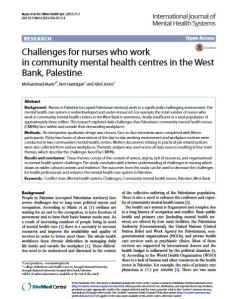
marie-et-al-2017On the publications front, Mohammad Marie has lead authored (with Aled Jones and me in support) this latest paper. It’s all about the challenges faced by Palestinian community mental health nurses, and represents the fourth article emerging from Mohammad’s PhD thesis in something like 18 months. That’s good going indeed. Here’s the abstract:

Background:
Nurses in Palestine (occupied Palestinian territory) work in a significantly challenging environment. The mental health care system is underdeveloped and under-resourced. For example, the total number of nurses who work in community mental health centres in the West Bank is seventeen, clearly insufficient in a total population of approximately three million. This research explored daily challenges that Palestinian community mental health nurses (CMHNs) face within and outside their demanding workplaces.
Methods:
An interpretive qualitative design was chosen. Face-to-face interviews were completed with fifteen participants. Thirty-two hours of observations of the day-to-day working environment and workplace routines were conducted in two communities’ mental health centres. Written documents relating to practical job-related policies were also collected from various workplaces. Thematic analysis was used across all data sources resulting in four main themes, which describe the challenges faced by CMHNs.
Results and conclusion:
These themes consist of the context of unrest, stigma, lack of resources, and organisational or mental health system challenges. The study concludes with a better understanding of challenges in nursing which draws on wider cultural contexts and resilience. The outcomes from this study can be used to decrease the challenges for health professionals and enhance the mental health care system in Palestine.


In with the new

Following a discussion involving the event’s steering committee and Mental Health Nurse Academics UK (MHNAUK), what was the International Network for Psychiatric Nursing Research Conference has now become the International Mental Health Nursing Research Conference. Next year we meet in Cardiff on September 14th and 15th, and early information can be found here. This site will be updated as further plans are made, so it’s worth checking in from time to time. We’ve also updated our conference twitter feed; clicking takes you there. Our hashtag, which is already in use, is #MHNR2017.

For a taster of the conference, here are links to four of last year’s keynote presentations: Steven Pryjmachuk, Elaine Hanzak, Luciana Berger MP and Bryn Lloyd-Evans:

Meanwhile, I’m pleased to have been elected as Vice Chair of MHNAUK. I’ll be working with the Chair, Steven Pryjmachuk, throughout 2017 and 2018 before becoming Chair at the start of 2019 for a further two years. I’m grateful for the opportunity colleagues have given me, and will do my best to lead and represent the group and the wider field. I anticipate having plenty to do, noting changes ahead in the education of nurses, the funding of students and the run-in to the next research excellence framework. More on all these to follow, I’m sure: with time today to draw attention to the decision by the Welsh Government to continue bursary payments in 2017-18 for eligible students of nursing, midwifery and the allied health professionals. As the press release announcing this makes clear, individuals taking this offer up will need to commit ‘in advance to taking up the opportunity to work in Wales, post qualification, for a period of two years’. Entirely unclear are funding arrangements for the period from 2018-19 onwards.

Reflections on #AfterWhitchurch

Further to my last post looking ahead to #AfterWhitchurch, here now are my reflections on the event as it happened as also recorded on the Cardiff University mental health blog. I’ve selected some photos, too.

The closure of Whitchurch Hospital to inpatients in spring 2016 provided the backdrop for #AfterWhitchurch, a collaborative Economic and Social Research Council (ESRC)/Cardiff University Festival of Social Science event focusing on the changing system of mental health care hosted at Cardiff’s Chapter Arts on November 10th 2016.

2016-11-10-17-42-30

Whitchurch Hospital opened as the Cardiff City Mental Hospital in 1908, the image below being the first entry on the first page of the hospital’s visitors book.

2016-11-10-21-40-00

Members of the hospital’s Historical Society were on hand with objects, documents and photographs from their archive. Artist and director Elaine Paton presented and talked about her work with Moment(o)s of Leaving, a multimedia performance produced to mark the occasion of the hospital’s closure. Audiorecorded interviews, created for Momento(s) of Leaving by artist/curator and researcher Julia Thomas, recounted staff members’ reflections on leaving Whitchurch and their thoughts for the future.

Chaired by Norman Young from Cardiff and Vale University Health Board, School of Healthcare Sciences and service user researchers discussed how mental health care has shifted from hospital to the community, and shared reflections from research into the organisation of services, the work and experiences of service users and staff and the provision and evaluation of novel psychological interventions.

2016-11-10-21-47-35

Ben Hannigan talked about using in-depth case methods to understand mental health services at different levels of organisation, and Nicola Evans discussed her research into the mental health of children and young people. Dean Whybrow drew on 18 years of experience in the Royal Navy to describe how mental health support and interventions is provided in the military. Alan Meudell shared his reflections on being a service user researcher, and Bethan Edwards spoke of her dual identity as an occupational therapy researcher investigating care for older people with dementia and as a service user researcher. Stimulating and informed questions from the floor challenged the panel to think about stigma, the impact of research on changing practice and services offering respite and asylum.

Playing our Part

A short post this morning to draw attention to Professor Tony Butterworth’s Playing our Part review, this being something which occupied me towards the start of last week. With the support of the Foundation of Nursing Studies Tony is conducting a review of mental health nursing, by mental health nurses. I made the trip to the (very plush) King’s Fund headquarters in London’s Cavendish Square on Monday, where FoNs is currently in residence, to join an educators’ group discussing responses to a series of questions Tony had set for us in advance. The questions were of a type always easier to ask than to answer (‘how do you prepare students to uniquely become mental health nurses?’, and ‘do you think that students should be exposed to some form of basic psychosocial education skills at undergraduate level?’ being two examples). We talked lots about the interpersonal aspects of nursing, and the enduring importance of relational work, but also about the roles that mental health nurses fulfil in managing the system and coordinating care. I’ll be keeping an eye on the Playing our Part blog over the coming weeks as Tony continues his tour through the UK, meeting groups of nurses to draw out their views and experiences. The final report, as I understand it, is due to appear towards the end of the year. 

Elsewhere I’ve been working with co-conspirators to fine-tune next week’s #AfterWhitchurch ESRC Festival of Social Science event at Chapter in Cardiff. I’ll have to post something uniquely about that once we’re done. 

COCAPP Knowledge Transfer

Last week I joined the rest of the COCAPP team at an all-day event at City University London, designed to help NHS staff, service users and carers make use of what we found. I was pleased to meet Donna Kemp, who has since written about her experiences of the day. I thought it would be a nice idea to reblog this.

donnakemp's avatardonnajkemp

Last week I was fortunate enough to be invited to the COCAPP Knowledge Transfer event held at City University London on 21st July 2016. You can read more about this here.

It was great to meet people face to face, beyond Twitter – particularly Alan Simpson (PI) Ben Hannigan, and Michael Coffey who are leading this important NIHR funded research, #COCAPPimpact.

Whats really good about this piece of research is that it is within my area of interest and that the method used aimed to address care planning on 3 levels – macro (national), meso (organisation) and micro (care delivery, face to face). To achieve this they used a mixed methods approach . The fabulousness of this is that it answered the research question on the 3 levels, perhaps anticipating that tackling one level in isolation would give rise to questions in the other levels. Adding to the credibility is…

View original post 359 more words

Mental health across the life course

NPNR twitter logoThe theme for this year’s Network for Psychiatric Nursing Research conference is Mental health across the life course. We’re convening in Nottingham on September 15th and 16th, and I’m very much looking forward. With help from André Tomlin (of the Mental Elf Service) we’re aiming to organise some pre-conference social media events: watch out for more on this, including via the new @npnrconf Twitter account. We’re also hoping to add some social media to the conference itself, including streaming. Very exciting.
Best of all, of course, is to come along to the conference as a delegate. This is an event which prides itself on its friendliness. Here are the keynote speakers:

  • Luciana Berger MP – Former Shadow Minister (Mental Health)
  • Elaine Hanzak, Inspirational speaker and author on perinatal mental health
  • Professor John Keady – Professor of Older People’s Mental Health Nursing, University of Manchester
  • Professor Steven Pryjmachuk – Professor of Mental Health Nursing Education, University of Manchester
  • Dr Bryn Lloyd-Evans – Lecturer in Mental Health and Social Care/ CORE Programme Manager, University College London


#NPNR2016 review 

I’m back from my annual trip to the International Network for Psychiatric Nursing Research conference, held this year in Nottingham and once again presented as a collaboration between MHNAUK and the RCN

This, the 22nd NPNR gathering, is the second for which I have served as a member of the conference organising and scientific committee. Our theme – trailed well in advance via our dedicated conference twitter account – was mental health across the lifecourse. We had some super keynote speakers: Elaine Hanzak, who spoke with openness about her recovery from postnatal mental illness; Luciana Berger MP, former Shadow Minister for Mental Health and President of the Labour Campaign for Mental Health, who demonstrated knowledge of, and commitment to, the field; John Keady, who spoke with passion about creative, biographical, approaches to researching the needs and experiences of people with dementia, including in his ongoing Neighbourhoods and Dementia programme; Steven Pryjmachuk, who made the case for nursing leadership in children and young people’s mental health research, and along the way gave a mention to the RiSC study; and Bryn Lloyd-Evans, who summarised the state of play in crisis resolution research, drawing (amongst other things) on the CORE programme. Our plenary sessions were expertly chaired by Wendy Cross and Geoff Dickens, and – as a first – this year’s event also included a partnership with André Tomlin from the Mental Elf Service and Mark Brown and Vanessa Garrity from the WeMHNurses community. This meant we had lots of social media and online discussion throughout the conference, recording of plenary sessions and a live-streamed pre-event round table evening discussion chaired by Alan Simpson. Here is a link to the recording, for those who missed it as it happened:

Once I have a link to the recordings of #NPNR2016’s keynote talks I’ll update this post with these, too. 

A note, too, on the conference’s workshops and concurrent sessions. I enjoyed participating in André Tomlin’s critical appraisal workshop, and with Elaine Hanzak writing a contribution during this to the blog post published on The Mental Elf website here. I also enjoyed our follow-up discussion on using social media, convened by André and Vanessa Garrity. I heard Nicky Lambert give two presentations (no less), and listened to talks from Karen Wright, Paula Libberton, Andrew Grundy and Ashlee Charles. There’s some great work going on out there, let it be said. That includes in COCAPP-A, Plan4Recovery and RiSC, all of which were presented in Nottingham.

As soon as we’re able, the conference organising committee will announce details of both dates and venue for #NPNR2017. Watch this space for an update. 

Recovery Colleges

Last month I had the opportunity to visit Gellinudd, the soon-to-be-opened recovery centre in Pontardawe run by the Welsh mental health charity Hafal. I was there with my Cardiff colleague Aled Jones, but also with Shu-Jen Chen (a former PhD student of mine: as an aside, follow this link for a copy of her thesis, which is on self awareness and the therapeutic use of self in Taiwanese community mental health nurses), four of her students from the College of Nursing at the Central Taiwan University of Science and Technology and one of our Cardiff mental health nursing students, Alys Jones.

Following this link takes you to the report of our visit published on the Hafal website, complete with photos. The Gellinudd Recovery Centre is opening at the beginning of 2017, and will be Wales’ first recovery college. Recovery colleges are a relatively new arrival within the mental health system; a useful introduction to them is this Centre for Mental Health briefing. The Gellinudd Recovery Centre buildings used to be an NHS hospital, and the whole is located in very pleasant woodland. Right now, Hafal is recruiting for registered nurses (and others) to work there.

Recovery, it has to be said, can mean different things to different people. This is one of the things we found in COCAPP, as we reported in our main findings paper. No shared understanding was revealed amongst people taking part in our interviews. Hafal write about what they believe ‘recovery’ means in their booklet, Recovery: the way ahead for people with severe mental illness. This is referenced in the job descriptions currently on the Hafal website as part of their current Gellinudd recruitment campaign. They place particular emphasis on empowerment, a whole person approach and progress. The term which will be used in the recovery centre to refer to people in residence is ‘guests’, and plans are in place to make the most of the centre’s green environment.

Elsewhere, #NPNR2016 is now only a few weeks away. We meet in Nottingham, and the conference promises to be an excellent one. I’ll aim to post some more about this at a later point.

Ordinary risks and accepted fictions

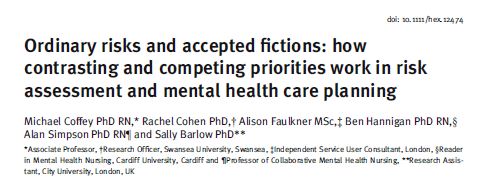
Ordinary risksThis new paper you need to read. You also can, because it is published in gold open access form and is therefore free to download to anyone with an internet connection. Lead authored by Michael Coffey, and arising from the larger COCAPP study (see also here, here and here), it draws on qualitative data to examine in detail what staff, service users and carers say about risk assessment and management. Here’s the abstract:

Background

Communication and information sharing are considered crucial to recovery-focused mental health services. Effective mental health care planning and coordination includes assessment and management of risk and safety.

Objective

Using data from our cross-national mixed-method study of care planning and coordination, we examined what patients, family members and workers say about risk assessment and management and explored the contents of care plans.

Design

Thematic analysis of qualitative research interviews (n = 117) with patients, family members and workers, across four English and two Welsh National Health Service sites. Care plans were reviewed (n = 33) using a structured template.

Findings

Participants have contrasting priorities in relation to risk. Patients see benefit in discussions about risk, but cast the process as a worker priority that may lead to loss of liberty. Relationships with workers are key to family members and patients; however, worker claims of involving people in the care planning process do not extend to risk assessment and management procedures for fear of causing upset. Workers locate risk as coming from the person rather than social or environmental factors, are risk averse and appear to prioritize the procedural aspects of assessment.

Conclusions

Despite limitations, risk assessment is treated as legitimate work by professionals. Risk assessment practice operates as a type of fiction in which poor predictive ability and fear of consequences are accepted in the interests of normative certainty by all parties. As a consequence, risk adverse options are encouraged by workers and patients steered away from opportunities for ordinary risks thereby hindering the mobilization of their strengths and abilities.

Reported here is one of the most important sets of findings arising from the COCAPP study. Diana Rose has written a post on the article, which is scheduled to appear on the inestimable Mental Elf site next week. I’m very much looking forward to reading that.

Resilience of community mental health nurses in Palestine

Earlier this week a new article lead authored by Mohammad Marie, and co-authored by Aled Jones and me, was published in the International Journal of Mental Health Nursing. The title of the article is Resilience of nurses who work in community mental
health workplaces in Palestine
, and is the second paper arising from Mohammad’s completed PhD. As the article appears in gold open access form copies can be directly downloaded from the journal’s website for free: or indeed, by clicking either the hyperlinked title or image above.

The larger part of Mohammad’s qualitative dataset is interviews conducted with CMHNs working in the West Bank. Fifteen practitioners took part, from a total population of 17. For the record, that’s 17 community mental health nurses for a population of some three million people. That’s an astonishingly low number by UK standards; for more on mental health needs and services in Palestine, the place to go is Mohammad’s first paper (Mental health needs and services in the West Bank, Palestine) about which I previously blogged here.

Here is the abstract from this latest paper:

People in Palestine live and work in a significantly challenging environment. As a result of these challenges they have developed resilient responses which are embedded in their cultural context. ‘Sumud’, in particular, is a socio-political concept which refers to ways of surviving in the context of occupation, chronic adversity, lack of resources and limited infrastructure. Nurses’ work in Palestine is an under-researched subject and very little is known about how nurses adjust to such challenging environments. To address this gap in the literature this study aimed to explore the resilience of community mental health nurses (CMHNs) who work in Palestine. An interpretive qualitative design was chosen. Fifteen face-to-face interviews were completed with participants. Thirty-two hours of observations of the day-to-day working environment and workplace routines were conducted in two communities’ mental health centres. Written documents relating to practical job-related policies were also collected from various workplaces. Thematic analysis was used across all data sources resulting in four main themes, which describe the sources of resilience among CMHNs. These sources are ‘Sumud and Islamic cultures’, ‘Supportive relationships’, ‘Making use of the available resources’, and ‘Personal capacity’. The study concludes with a better understanding of resilience in nursing, which draws on wider cultural contexts and social ecological responses. The outcomes from this study will be used to develop the resilience of CMHNs in Palestine.

The idea of ‘Samud’ which is referred to above is an important one in Mohammad’s work, and (as I have learned) for Palestinian people. Drawing on the work of Toine Van Teeffelen, here is what Mohammad says about it in his thesis:

[Samud] is the art of living to survive and thrive on their homeland in spite of hardship and under occupation practices. These skills of how to live are used in different aspects of life such as economic, political and social. They can also be used at many levels: individual, family and within the Palestinian community. Moreover, Sumud has been divided into two types: tangible resources such as the infrastructure supporting basic needs (for example, schools and hospitals) which enable the existence of the Palestinians on their land and help them to be more resilient. In addition intangible sources of Sumud also exist, which include: belief systems, religion and social and family support which help the Palestinians to cope with their chronic daily collective suffering.

For Mohammad, Samud is closely related to the more familiar (to me, at any rate) idea of resilience. Or, more properly put, Samud connects to social ecological variants of resilience which place as much emphasis on the social and cultural as they do on the individual.

I’ll stop here and leave people to download and read this new paper for themselves. For those interested, Mohammad, Aled and I are working on further publications from this doctorate: so more will follow in due course.