Category: Nursing

Opening access

At June 2014’s meeting of the School of Healthcare Sciences’ Research and Innovation Committee there is an agenda item on the UK higher education funding councils’ new policy for open access in the post-2014 Research Excellence Framework. This document contains important information for UK academics with aspirations for future REF return. Here’s a snip from the opening pages, addressing the new requirements for journal articles:

[…] to be eligible for submission to the post-2014 REF, authors’ final peer-reviewed manuscripts must have been deposited in an institutional or subject repository on acceptance for publication. Deposited material should be discoverable, and free to read and download, for anyone with an internet connection. […] The policy applies to research outputs accepted for publication after 1 April 2016, but we would strongly urge institutions to implement it now.

Elsewhere the policy states that publishers’ embargo periods before final versions of papers are deposited can be respected, but with limits. For articles included in submissions to REF Main Panel A (and that includes Nursing), the maximum time period before REF-eligible papers must be made freely available in either green or gold open access format will be 12 months.

There are circumstances in which future REF panels can make exceptions to these rules, but (by the looks of things) not many. In any case, plenty of publishers and individual journals already use copyright transfer agreements which allow authors to comply. It is precisely because of these agreements that I have been able to freely deposit full-text, post-peer review, green open access versions of many of my publications in Cardiff University’s Orca repository and to include links to them on this blog.

But not all journals are currently using copyright transfer agreements which adhere to these new rules. Here’s an example. Nicola Evans’ and my recent paper on critical junctures appears in Social Theory & Health, which is published by Palgrave Macmillan. The journal’s current copyright transfer arrangement (which we signed) allows authors to deposit a post-peer review version of their accepted articles to a repository, but only after an embargo period of 18 months. As things stand, this fails to meet the post-2016 requirement for articles eligible for return to Main Panel A in the next REF. As Palgrave will surely want REF-aspirant nurses (and others) to continue submitting papers to its journals this embargo period will have to be reduced by at least six months.

And then there are the journals published by Wiley Blackwell, including the Journal of Psychiatric and Mental Health Nursing. I’ve published lots in this over the years, most recently on work and roles. The relevant copyright transfer agreement can be viewed here, in which I see that authors retain the right to:

[…] self-archive the peer-reviewed (but not final) version of the Contribution on the Contributor’s personal website, in the Contributor’s company/institutional repository or archive, and in certain not for profit subject-based repositories such as PubMed Central as listed at the following website: http://olabout.wiley.com/WileyCDA/Section/id-820227.html, subject to an embargo period of 12 months for scientific, technical and medical (STM) journals and 24 months for social science and humanities (SSH) journals following publication of the final Contribution.

So peer reviewed, but not ‘final’, versions of accepted papers can be deposited? But it’s the ‘final’ versions which the funding councils specify must be made available. But might ‘final’ mean different things to different people? If Wiley uses ‘final’ to refer to the formatted, pdf, versions of papers identical in every way to the versions appearing in its journals, then authors depositing their word-for-word, post-peer review, author-accepted green open access versions will be compliant. But if ‘final’ for Wiley refers to the accepted, word-for-word (but not necessarily value-added) versions of papers then the inability of authors to make green open access deposits becomes a problem from 2016. So perhaps this all needs some clarification.

Safewards comes to Cardiff

Sadly for me I couldn’t be at Geoff Brennan‘s meet-up today with Cardiff and Value UHB mental health nurses to talk about the Safewards study and its implications. But here’s a message Geoff sent, and a fine photo, to mark the occasion:

Work and roles in the ECT clinic

Last Wednesday (May 14th 2014 ) I had the chance to speak at the 4th National Association of Lead Nurses in ECT (NALNECT) conference. ECT (electro-convulsive therapy) has been around since the 1930s. It’s sparingly used, typically as a treatment for severe depression and only after other interventions have been tried and found wanting. The procedure involves the use of electricity to induce a seizure, and is conducted under anaesthesia. In the UK there are standards for ECT clinics, which place particular emphasis on quality and safety.

I’m no expert in ECT as a treatment, but I do know something about work and roles and it was this that I spoke about at the NALNECT event. I suggested that, rather like the physical holding of patients and other restrictive practices, ECT might be thought of as an example of the mental health system’s ‘dirty work’. It arouses strong views, and may well be an area about which there is more heat than light. A quick pre-conference search on Scopus turned up just 100 articles at the intersection of ‘ECT’ and ‘nursing’, with only 12 citations attributed to authors in the UK. Amongst these I found this paper investigating nurses’ attitudes, and this paper reporting findings from an observational study of the ECT workplace.

At Wednesday’s event I also talked about the ECT clinic’s unusually complex division of labour. Where else do mental health nurses, psychiatrists, anaesthetists, operating department practitioners and health care assistants routinely work together? The main item at the NALNECT conference was a debate on nurse-led clinics, though there seemed to be a number of different versions of what this might actually look like. Large parts of the discussion centred on the technical: who might apply which bit of the machinery, and who might press which button. I pointed out that tasks have forever moved around in the mental health system, and that a bigger question may not be the physical handling and usage of the ECT kit but nursing’s possession of sufficient knowledge to sustain claims to jurisdiction.

Mid-May catch-up post

RiSC front pageWork on the RiSC and COCAPP studies means that, of necessity, I’ve had to let this blog site (and pretty much everything else) take something of a back seat in recent weeks. The picture on the left is a screen shot of the RiSC study final report, which is now perilously close to completion. Once submitted to the funding body (the National Institute for Health Research (NIHR) Health Services and Delivery Research (HS&DR) Programme) it will be peer reviewed, and once accepted for the NIHR Journals Library progress through an editorial process before (hopefully sometime before the end of this year) appearing online.

Elsewhere, I see that the call for abstracts for this year’s NPNR conference remains open for a little while yet, as this tweet from Laura Benfield who works for the RCN Events team indicates:

I’m pleased to say that both the RiSC and COCAPP teams have already submitted abstracts. The conference will again be at Warwick University, and promises to a special affair. Here’s a snip from the event’s website:

This year is the 20th international NPNR conference and it’s going to be a celebration.

We wish to celebrate and promote some of the outstanding mental health nursing research that shapes mental health policy and nursing practice across the world. We will also acknowledge some of the best psychiatric and mental health nursing research that helped create the strong foundation for our work today. And we will invite delegates to look ahead to map out the future for mental health nursing research, education and practice.

Whilst my head has been somewhere else I see that the Department of Health has now published Positive and Proactive Care: reducing the need for restrictive interventions (something which members of Mental Health Nurse Academics contributed to) and that, yesterday, it was announced that NICE is about to step into the debate on nursing numbers. Here’s how The Guardian reported this:

Nurses in hospitals should not have to look after more than eight patients each at any one time, the body that sets NHS standards will urge next week in a move that will add to pressure to end what critics claim is dangerous understaffing.

Responding to concerns about standards of patient care in the aftermath of the Mid Staffs scandal, the National Institute for Health and Care Excellence (Nice) will warn that registered nurses’ workloads should not exceed that number because patients’ safety could be put at risk.

The regulator’s intervention will intensify the pressure on hospitals, growing numbers of which are in financial difficulty, to hire more staff to tackle shortages even though many have little spare money. Campaigners on the subject believe at least 20,000 extra nurses are urgently needed at a cost of about £700m.

This looks to be a very important intervention indeed, with all sorts of potential implications. It will be interesting to see how policymakers respond. I also wonder how this debate will play out in the context of community health care, and whether we might expect some kind of consideration of caseload sizes. This is a fiendishly difficult area, and is far more complex than simply saying that (for example) ‘each community mental health nurse should have a caseload of no more than x‘.

I also see that Community Care has been continuing to highlight the extraordinary pressures facing people working in, and using, the mental health system. Austerity is very harmful, and Community Care is drawing necessary attention to the problems of lack of beds, funding cuts and retractions in community services.

Before I get my head back down into report-writing here’s a final plug, this time to a piece Michael Coffey has written over on the MHNAUK blog:

As we roll up to the end of April and summer is just around the corner the planning of our next meeting is starting to fall into some sort of shape. MHNAUK meetings usually take the form of morning presentations and afternoon group business items. After a meeting devoted to group strategy and plans in Cardiff in the Spring of 2013 we have attempted to get work done in our meetings and be much more strategic in terms of themes for presentations and outputs arising from these. This has meant that in the past year we have focused on dementia care and produced a position paper from this and in subsequent meetings we have discussed restrictive practices and physical health care in mental health which will result in further position papers.
For our coming meeting this June we are currently discussing ideas around the history of mental health nursing as one possible theme alongside plans to further our relationships with the mental health nurse consultants group. In addition we will revisit our plans for future themes so that we keep the focus firmly on supporting education and research in our field. Agendas are never truly fully complete and over the next few weeks new items will arise and suggestions will arrive that members feel we must discuss. This is as it should be and I welcome this as evidence of the vitality of the wider group, anyone fancy discussing yet another review of nurse education for instance?

Michael Coffey
Chair of MHNAUK

Mental health policy for nurses

Congratulations to RCN Mental Health Advisor Ian Hulatt for editing this new book, Mental health policy for nurses. This hits the shelves any day now, and I want to give it a plug via this post. Here is what the publisher is saying:
Policy determines much of what nurses actually do on a daily basis, which means it is essential for nurses to engage with policy if they are to understand their own practice. Mental health nursing in particular has been shaped by a variety of policy factors in the past fifty years. In this new textbook, edited by the mental health advisor to the Royal College of Nursing, a range of experts in their field introduce the essential elements of mental health policy to students and experienced practitioners. The book covers a broad range of areas, including settings for care and the historical context, policy affecting various diagnoses and service user groups, and how policy is translated into action. Clinical examples are drawn on throughout, to help students think about the real-life context of what can be a difficult subject.

It will be essential reading for pre-registration mental health nursing students, and valuable to those working in practice who want to gain an understanding of policy.

There are some nice-looking chapters here, as the contents list suggests:

The History of Mental Health Policy in the United Kingdom Peter Nolan
The European Context Neil Brimblecombe
Community Services Ben Hannigan
Psychosis Norman Young
Older People Elizabeth Collier and Catherine McQuarrie
Dementia Trevor Adams
Personality Disorder Karen M. Wright
Service User Involvement Mick McKeown and Fiona Jones
Equalities in Mental Health Nursing Ann Jackson
Child Mental Health Policy in the UK Tim McDougall
Dual Diagnosis Cheryl Kipping
Policy into Action? Cris Allen

I was pleased to have a chance to contribute, writing a chapter addressing past and present policy for mental health care in the community. I started with an account of historical developments, and worked my way towards an analysis of recent policy including changing roles for nurses and the impact of austerity.


Review fever

Just what we need: another review of nurse education. Yesterday the Nursing Times carried this item reporting a joint Health Education England and Nursing and Midwifery Council plan to investigate standards. The NT says:

Health Education England and the Nursing and Midwifery Council will launch the review in May to specifically investigate the standard of education provided to around 60,000 nursing and midwifery students each year.

The Shape of Caring Review, which will be led by Lord Willis of Knaresborough, will also consider the standard of post-registration training for the NHS nurses once they have qualified. The review is due to produce a final report by early next year.

It follows concerns over the standard of nurse training raised by the Francis report into care failings at Mid Staffordshire Foundation Trust.

As part of its work, the review will examine the controversial pre-nursing experience pilots that have seen around 160 students work as healthcare assistants for a year before starting courses, and which were a key plank of the government’s initial response to the Francis report.

This is the same Lord Willis who chaired the RCN’s review of nursing education which reported in 2012, and about which I wrote a piece on this site here. As I wrote then, there was some scepticism on the timing given that universities and their partners in the NHS were in the throes of reshaping their pre-registration curricula following the publication in 2010 of new NMC standards for pre-registration education. This latest review is going to start before more than a handful of new, post-2010, nurses have registered and certainly before we know anything of the impact of these new regulatory standards on practice. This is exactly a point the NT goes on to make:

But Professor Ieuan Ellis, chair of the Council of Deans of Health, said he was concerned the review would duplicate work already underway by “multiple different projects and working groups”.

“This group needs to reflect on the reviews that have already happened, some quite recently – otherwise there will be a lot of duplication going on,” he added.

Jackie Kelly, head of nursing at the University of Hertfordshire, pointed out that the NMC had already imposed new standards for pre-registration courses in 2010, and stressed 50% of nursing students time was spent in a clinical setting away from the classroom.

She said: “We have already gone a long way and I wouldn’t want the review to move in a direction of travel before we have seen the output from the new standards agreed in 2010.”

Quite so.

#NPNR2014 call for abstracts

Not much time for blog-writing lately, for various reasons, but this morning I want to point readers to the full details and call for abstracts for this September’s International NPNR Conference. The event website can be found by following this link, from where I have lifted this:


20th International Network for Psychiatric Nursing Research conference

  • 18 September 2014 – 19 September 2014
  • The University of Warwick, Coventry, UK CV4 7AL

Event home

This year is the 20th international NPNR conference and it’s going to be a celebration.

We wish to celebrate and promote some of the outstanding mental health nursing research that shapes mental health policy and nursing practice across the world. We will also acknowledge some of the best psychiatric and mental health nursing research that helped create the strong foundation for our work today. And we will invite delegates to look ahead to map out the future for mental health nursing research, education and practice.

**The NPNR steering committee are proud to announce the call for abstract submissions is now open until 30 April 2014**

Conference themes


Programme themes for 2014

Contemporary practice in mental health nursing research

Involving people – where has it got us?

Reflections and reminders

Building new knowledge for effective partnerships

Methodologies, methods and magic

Innovation in teaching, learning and practice

Call for abstracts

Check out the abstract section for full details and to submit an abstract.

Keynote speakers

Understanding Pathways in Mental Health Care | Professor Swaran P Singh, Head of Division, Mental Health and Wellbeing, Warwick Medical School, University of Warwick, Coventry, UK

Mental health and Wellbeing: Books on Prescription | Debbie Hicks, Director of Research, The Reading Agency

Co-production and the future role of Mental Health Nursing | Dr Julie Repper, Recovery LeadNottingham Healthcare Trust, Nottingham, UK

Managing and delivering evidence-based mental health and substance use services | Dr Kevin Ann Huckshorn, State Division Director for the Division of Substance Abuse and Mental Health, Delaware, USA

Quotes from NPNR 2013

” NPNR – Power to the people conference” A service user

“Good key speakers, relevant content and engaging presentations. Excellent concurrent sessions” A delegate

“I’ve found the conference extremely inspiring. This was my very first conference; I enjoyed presenting my research and valued the feedback given. It’s great to see frontline staff carrying out research and being supported by their organisations in doing so. I would like to do further research myself. The keynote lectures were great especially ‘spirit level.” New Researcher

Piece in the Guardian by Helene Mulholland (4 September 2013)

“Charles Walker MP: ‘Mental illness is not a weakness'”
http://www.theguardian.com/society/2013/sep/04/charles-walker-mental-illness-not-weakness

#NPNR2014

Join the pre conference discussions on www.twitter.com now…

Professor Alan Simpson, chair of NPNR steering committee
@cityalan

Dr Michael Coffey, chair of MHNAUK and chair of NPNR scientific committee
@D10Coff


Event contact

Laura Benfield
Conference Organiser
Royal College of Nursing
20 Cavendish Square
London
W1G 0RN

Tel: 020 7647 3591
Email: npnr@rcn.org.uk

Early community mental health nursing

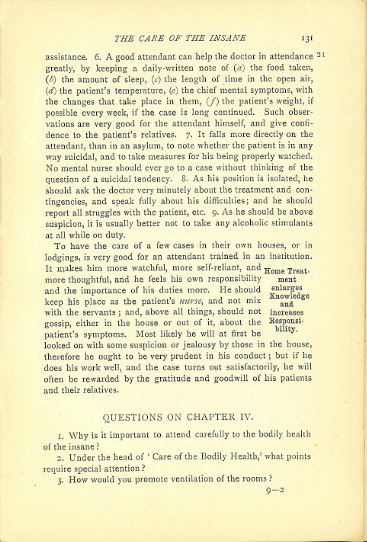
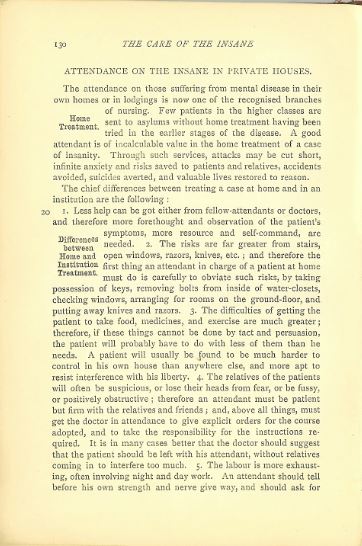
Perusing, for no particular reason, my fourth edition of the Red Handbook (published, I think, just after the start of the last century) I find this early reference to mental health nursing in people’s homes. Here are the relevant pages for those interested:

Note the sections implying that attendance in private houses is for the higher classes only, along with the description of all those things which should be done to reduce risk.

Interesting, too, that attendants are reminded that drinking alcohol on duty might not be the best of ideas. Advice like that never goes out-of-date.

For other posts drawing on this first-ever textbook for mental health nurses, try From ‘The Red Handbook’ to ‘The Art and Science of Mental Health Nursing’ and Exam time.

Identity and education

One of the things I discussed with Swansea University’s Approved Mental Health Professional (AMHP) students today was how the emergence of a system of community mental health care opened up important new sites for the advancement of professional jurisdictional claims. For more on this idea of jurisdiction (which comes from the sociology of work) check out these earlier posts and embedded links to full-text articles here, here, here and here. It implies that in a dynamic division of labour professions engage in a constant jostling to cement and advance their positions, against the claims of others. The appearance of the AMHP role, fulfilled not just by social workers (as was the case with the old ASW role) but also by nurses, occupational therapists and psychologists, shows how the relationships between professions and tasks can change over time.

It is additionally the case that occupational groups are not homogeneous, but are internally segmented. This means that within a single profession differentiated elements can find themselves battling it out to control work and its underpinning knowledge, or to determine what counts as a necessary preparation for new entrants. And nursing, it appears to me, has plenty of form when it comes to internal divisions and disputes of this type.

With all this in mind, two papers caught my eye before heading off to teach this morning. Both are authored by Professor Brenda Happell. In her editorial in the current issue of the International Journal of Mental Health Nursing, titled Let the buyer beware! Loss of professional identity in mental health nursing, Brenda says (amongst other things):

Most of the time, I feel eternally grateful for my decision to pursue a career in mental health nursing […] At other times, I despair and wonder about the future of our profession, and the care of people experiencing mental health challenges.

I’ll quote some more, as the full text of the editorial is behind a subscription paywall. Writing about the Australian context in particular (this being a part of the world where nurses are trained as generalists rather than, as here in the UK, for a specific field of practice), Brenda adds:

Some of my concern can be traced back to the professional identity of mental health nursing. Identity is such an important part of being professional, and how we consider and present ourselves both individually and collectively.

[…]

Mental health nursing is becoming integrated into other content, in the absence of any evidence to suggest this is an effective means of education and plenty of anecdotal evidence to suggest it isn’t. Nurses without any specialist qualifications,
and often without experience in mental health, are increasingly teaching the content, medical-surgical wards are being considered suitable places to gain clinical experience in mental health, and nurses who work in mental health for more than 5 minutes are referred to as mental health nurses, despite not having the appropriate qualifications.

That’s a dismal picture indeed. Through a ‘jurisdictions’ prism it might be thought of as a case of one segment within a highly differentiated profession claiming possession of sufficient knowledge to capture the work previously done by another, and to reframe what counts as adequate educational preparation.

Brenda and colleagues’ second paper has just appeared in early online form in Perspectives in Psychiatric Care. Majors in Mental Health Nursing: Issues of Sustainability and Commitment reports findings from an interview study involving representatives of Australian universities which had committed to (or actually implemented) mental health ‘majors’ within their comprehensive undergraduate nursing curricula, but which then discontinued them. Noting the lack of sustainability of embedded mental health nursing options within larger courses of generalist pre-registration education, Brenda and her team conclude:

[…] these experiences suggest that the current comprehensive nursing education programs are not well suited to promoting mental health nursing education as a positive future career destination. While such apparent attitudes prevail, the workforce problems in mental health nursing are likely to persist and indeed worsen.

A dismal conclusion again, linked once more in Brenda’s analysis to a shift away from a pre-qualification route to specialist mental health nursing practice.

Arguments for comprehensive, generalist, nurse education and thus for greater homogeneity in the workforce are frequently made here in the UK. When the Nursing and Midwifery Council opened a consultation on proposed new standards for pre-registration nursing in 2007 it specifically asked people to give a view on whether the branches (Mental Health, Adult, Children and Learning Disabilities) should remain. Mental Health Nurse Academics UK (drawing in part on Sarah Robinson and Peter Griffiths’ National Nursing Research Unit international comparison of approaches to specialist training at pre-registration level) submitted this in its 2008 response:

Experiences from other countries that have gone down the generalist pre-qualifying nursing education route show that this leads to a lack of skilled MHN workforce, difficulties in recruiting to post-registration MHN training and a reduction in the quality of care and service provision for those with MH problems […] In attempting to achieve some unitary, generalist view of nursing to fit with other countries, many of whom are envious of our branch specific pre-registration model, we run the very real and significant risk of simply repeating the errors of others for no gain.

We’ve had changes in formal interprofessional divisions of work (which takes me back to this morning’s AMHP students, notwithstanding that all in this class happened to be social workers). But we’ve hung on to branches (or ‘fields’, to use the current nomenclature) in UK nursing, and continue to prepare nurses to exclusively do mental health work from pre-registration level onwards. Six years on, Brenda Happell’s cautionary tales from Australia remind us of what might have been had decisions been made differently.

More, and more educated, nurses make a difference

Whilst I was wandering around Cornwall last week (see photograph for evidence), The Lancet was busy publishing the latest paper from Professor Linda Aiken and her colleagues in the RN4CAST consortium. Nurse staffing and education and hospital mortality in nine European countries: a retrospective observational study uses discharge data for 422,730 surgical patients in 300 hospitals in nine countries along with survey data from 26,516 practising nurses. That’s one big study. The abstract goes on to say:

Finding
An increase in a nurses’ workload by one patient increased the likelihood of an inpatient dying within 30 days of admission by 7% (odds ratio 1·068, 95% CI 1·031—1·106), and every 10% increase in bachelor’s degree nurses was associated with a decrease in this likelihood by 7% (0·929, 0·886—0·973). These associations imply that patients in hospitals in which 60% of nurses had bachelor’s degrees and nurses cared for an average of six patients would have almost 30% lower mortality than patients in hospitals in which only 30% of nurses had bachelor’s degrees and nurses cared for an average of eight patients.
Interpretation
Nurse staffing cuts to save money might adversely affect patient outcomes. An increased emphasis on bachelor’s education for nurses could reduce preventable hospital deaths.

[NB: Not sure about odds ratio? Check out the relevant Wikipedia entry here.]

On the day the article was published in early online form the Council of Deans of Health here in the UK ran with this, The Conversation ran with this and The Guardian ran with this. The Lancet supplemented its article with this podcast.

The media interest reflects the scale of the study and the importance of its findings, which make a strong case for investment in nursing. A year ago, the International Journal of Nursing Studies published this special issue on the nursing workforce and outcomes, carrying a series of open access papers from the same RN4CAST team. There are other papers published elsewhere arising from this same study, and no doubt more to come.

What the RN4CAST researchers have not done is to have generated any data in psychiatric hospitals or involving mental health nurses. This is very reasonable, as theirs has been a complex-enough study ‘focused on general acute hospitals’, to quote from its published protocol. But it would be good to know more of the relationships across Europe between mental health nurse staffing and practitioner characteristics, organisational and management features and service user outcomes. Now there’s a challenge for someone.