Category: Nursing

Research in mental health nursing

At 8pm on Monday October 27th I’ll be hosting a #WeMHNs tweet chat on Research in mental health nursing:

Here’s the pre-chat post from the @WeMHNurses blog, which as you’ll see links this chat to a second scheduled for December which will be hosted by André Tomlin (who runs the excellent Mental Elf website):

Research in mental health nursing
Research is about creating new knowledge. In practitioner fields like nursing, research findings can aid decisions on the provision of care or treatments, and on ways of organising services. Research uncovering the views and experiences of people using, or working in, services can be used to inform improvements.

This is the first of two linked chat s about research, and is about involvement and engagement . The second, on keeping up to date with the evidence, will be facilitated by André Tomlin (who runs The Mental Elf website at www.thementalelf.net/ and who tweets at @Mental_Elf) on Thursday December 11th between 8:30 and 9:30pm. A ll are welcome to both chats : practitioners, students, service users, carers, managers, policymakers, researchers. No particular knowledge of research methods, or direct experience of involvement in research, is needed.

In this first chat we’re interested in hearing (and talking about):

•  What (if any) are people’s experiences of research, along a continuum of doing research, to taking part in research to using (or being otherwise affected by) the research findings produced by others?

•  How has research made a difference to people working in mental health services?

•  How has research made a difference to people using mental health services?

•  What are the opportunities for embedding research into mental health nursing policy, services and practice?

•  What are the challenges facing efforts to embed research into mental health nursing policy, services and practice?

•  What research is currently happening, how is it being done, and by whom?

•  What are the research priorities for mental health nursing?

People wanting to know more about research in mental health nursing ahead of this chat may wish to follow links to individuals and organisations accessible from the website of Mental Health Nurse Academics UK (@MHNAUK), which is at http://mhnauk.swan.ac.uk/main.htm . MHNAUK is a group existing to influence and promote education, research and values-based mental health nursing practice for the benefit of people using services and their families.

People wanting to know more about recent and ongoing research projects led by mental health nurses may be interested to follow some of these links:

•  Safewards, led by Professor Len Bowers: http://www.safewards.net/

•  Cross-national comparative study of recovery-focused mental health care planning and coordination (COCAPP), led by Professor Alan Simpson: http://www.nets.nihr.ac.uk/projects/hsdr/11200412

•  Cross-national comparative study of recovery-focused mental health care planning in acute inpatient mental health settings (COCAPP-A), led by Professor Alan Simpson: http://www.nets.nihr.ac.uk/projects/hsdr/131075

•  An evidence synthesis of risk identification, assessment and management for young people using tier 4 inpatient child and adolescent mental health services (RiSC), led by Dr Ben Hannigan: http://www.nets.nihr.ac.uk/projects/hsdr/11102408

•  Plan4Recovery, led by Dr Michael Coffey: http://plan4recovery.org.uk

•  Enhancing the quality of user involved care planning in mental health services (EQUIP), led by Professor Karina Lovell: http://www.nursing.manchester.ac.uk/equip

So, there it is: please spread the word!
Research away day and MHNAUK meet-up

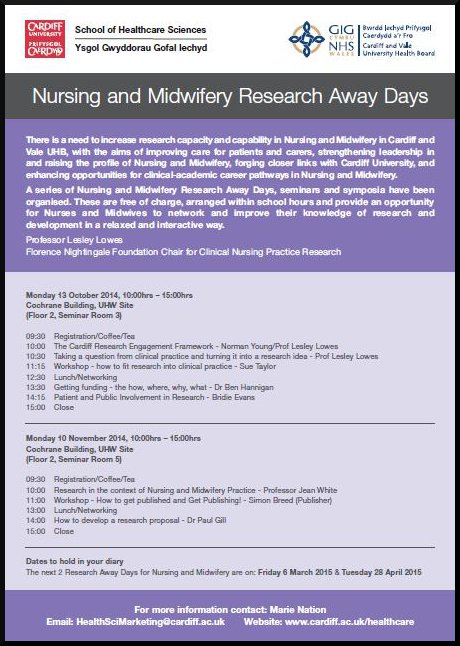
Lots of interesting things to report from a packed week. Monday took me to a meet-up with research-minded nurses from Cardiff and Vale UHB, the first of a series of events organised by Professor Lesley Lowes aimed at supporting research capacity and engagement amongst practitioners. Here’s the flyer:

Lesley's event

In her presentation, Bridie Evans made use of a segment from a NISCHR CRC video introducing the work of Involving People. This has been uploaded to the NISCHR CRC YouTube channel, where the part Bridie used begins at around the 1:53 mark:

Yesterday was the first Mental Health Nurse Academics UK meeting of the 2014-15 academic year. We convened in Manchester, with public involvement and engagement in mental health research and education the theme for the pre-business part of the day. Lauren Walker and Lindsey Cree led with an excellent presentation drawing on their service user and carer researcher experiences working on the Enhancing the Quality of User Involved Care Planning in Mental Health Services (EQUIP) study. Steven Pryjmachuk and I talked about our experiences of involving young people in research, drawing on Steven’s self-care project and our shared RiSC study. John Baker closed this part of the day with an impressive University of Manchester case study of how public and patient involvement in research and education can be embedded at institutional level.

Elsewhere in yesterday’s MHNAUK meeting there was a lively discussion around the promotion of physical health and well-being in people using mental health services, and a review of this year’s NPNR conference. Plans are also being laid for next year’s event, with opportunities about to be notified for people interested in becoming more involved via membership of the conference organising committee.

NPNR 2014 reflections

For those not at the 20th International Network for Psychiatric Research Conference, which took place yesterday and the day before at Warwick University, here are links to the conference brochure and the book of abstracts. Following this link takes you to Laura Benfield’s aggregation of #NPNR2014-tagged tweets. Laura, I hear, is moving on from the RCN Events team: many thanks to her for all the behind-the-scenes work at this, and previous, conferences.

This was another high-quality NPNR gathering. Brendan McCormack gave an impassioned keynote on person-centred care, emphasising the absolute importance of values and culture, and Julie Repper spoke eloquently on co-production and the vital work that mental health nurses can do to promote this. Debbie Hicks talked of the work of The Reading Agency in using books to promote mental health and wellbeing. In his Friday morning keynote Swaran Singh gave a presentation which had, at its heart, the idea that higher recorded rates of mental illness in migrant groups are better explained by experiences of social adversity than they are by institutionalised racism. Kevin Ann Huckshorn delivered a final keynote centring on leadership and the implementation of recovery and coercion-reducing approaches.

I also sat in on, and chaired, some excellent concurrent sessions. From speaking with fellow delegates I know that I missed plenty of others of equal quality. From Fiona Nolan and colleagues I learned of the latest in the development and evaluation of protected engagement time initiatives, and from Hilary Ford of the use of a lifecourse approach in pre-registration mental health nurse education. I always appreciate what Mick McKeown has to say, and this year heard Fiona Jones and him talking about the opportunities (and challenges) of introducing recovery ideas in a secure hospital. I heard Brenda Happell deliver two papers: on the relationships between clinical experiences in mental health settings and nursing students’ attitudes to mental health as a field of practice, and on the introduction and evaluation of a service user-led module. Iain Hepworth and Peter Martin both gave talks touching on the work of liaison mental health nurses, and Alan Finnegan presented findings from a grounded theory study of military mental health nurses. Hilary Wareing shared experiences in introducing smoke-free mental health services, Hannah Walsh and colleagues talked of education and training for clinical support workers, and last (but certainly not least) Len Bowers shared his thoughts on (and experiences of) online suicide prevention education for mental health nurses.

I was also mightily pleased to have had the chance to be involved in four papers, each arising from funded research ongoing or recently completed and drawing on the talents and experiences of the fine people variously associated with COCAPP, Plan4Recovery and RiSC. We were there in force in Warwick: Alan Simpson, Michael Coffey, Sally Barlow, Jitka Všetečková, Bethan Edwards, Alan Meudell, Julian Hunt, Nicola Evans and Steven Pryjmachuk. Many thanks to those who came along to listen to, and discuss, our project experiences and our findings.

The NPNR conference is also the place where the following year’s JPMHN Lifetime Achievement Award winner and Skellern lecturer are announced. Very big congratulations to Ian Norman (who, as it happens, was one of my PhD examiners) and to Marion Janner, both of whom will be delivering their addresses at Nottingham University on June 11th 2015.

It’s worth mentioning, too, that the annual NPNR conference has a deserved reputation for informal collegiality and friendliness, and this year was no exception. I enjoyed meeting up with friends old and new.

Looking ahead, I see that an early call for suggested themes for NPNR 2015 has already gone out:

I, for one, plan to be there.

NPNR 2014

I’m off to Warwick University tomorrow, leaving on a too-early train, for this year’s International Network for Psychiatric Nursing Research Conference. This is the NPNR’s 20th edition, and here (lifted shamelessly from the event website, accessible by following the link directly above) is a taster of what’s on offer:

Themes for 2014

Contemporary practice in mental health nursing research

Involving people – where has it got us?

Reflections and reminders

Building new knowledge for effective partnerships

Methodologies, methods and magic

Innovation in teaching, learning and practice

Keynote speakers

Thursday 18 September

Person-Centre Care: Collaborative practice and research

Professor Brendan McCormack, Head of Nursing at Queen Margaret University, Edinburgh

Co-production and the future role of Mental Health Nursing  

Dr  Julie Repper, Recovery LeadNottingham Healthcare Trust, Nottingham, UK

Mental health and Wellbeing: Books on Prescription

Debbie Hicks, Director of Research, The Reading Agency

Friday 19 September

Understanding Pathways to Care in Early  Psychosis                         

Professor Swaran P Singh, Head of Division, Mental Health and Wellbeing, Warwick Medical School, University of Warwick, Coventry, UK

The Role of Leaders in Designing Recovery Oriented Systems of Care: Upsetting the Historical Applecart

Dr Kevin Ann Huckshorn, State Division, Director for the Division of Substance Abuse and Mental Health, Delaware, USA

I’ll aim to tweet from Warwick whilst I’m there. To join in the conference-wide discussion, here’s some info from the @MHNAUK Twitter feed:

Building research capacity

Last night I enjoyed an evening event in Cardiff with other past, and present, members of the RCBC (Research Capacity Building Collaboration) Wales Community of Scholars. This is a collaborative venture supported by higher education institutions, with funds now coming from NISCHR. Since coming into being in 2006 the RCBC programme has sought to develop research capacity across nursing, midwifery and the allied health professions. I’ve written about the scheme on this blog before (see here and here), and am personally grateful for the support I received as an RCBC Post-Doctoral Fellow which enabled me to complete my study into the work and system impact of crisis resolution and home treatment teams. For more on what I found in that project, check out these green open access articles saved in Cardiff University’s ORCA repository:

Hannigan B. and Coffey M. (2011) Where the wicked problems are: the case of mental health. Health Policy 101 (3) 220-227

Hannigan B. (2014) ‘There’s a lot of tasks that can be done by any’: findings from an ethnographic study into work and organisation in UK community crisis resolution and home treatment services. Health: an Interdisciplinary Journal for the Social Study of Health, Illness and Medicine 18 (4) 406-421

Hannigan B. and Evans N. (2013) Critical junctures in health and social care: service user experiences, work and system connections. Social Theory & Health 11 (4) 428-444

Hannigan B. (2013) Connections and consequences in complex systems: insights from a case study of the emergence and local impact of crisis resolution and home treatment services. Social Science & Medicine 93 212-219

Last night began with a talk from Tina Donnelly, Director of RCN Wales and Commanding Officer of the 203 Welsh Field Hospital. In introducing Tina, RCBC Grant Holder Professor Donna Mead (from the University of South Wales) shared the news that the RCBC scheme has received confirmation from NISCHR of continued funding. That’s good, and means we can look forward to more doctoral (and hopefully, post-doctoral) opportunities in the coming months and years.


New academic year post

University departments for the health professions, like Cardiff University’s School of Healthcare Sciences, have long academic years. We welcome intakes of new pre-registration undergraduate nurses every September, which is a time when students of many other disciplines are still enjoying the tail end of their summer holidays. In September we also welcome back existing students, and this afternoon – assuming I can navigate across Cardiff and its NATO summit-encircling ring of steel – I’m off to the School’s University Hospital of Wales (UHW) campus to meet a group of third year undergraduates to talk about the ethical aspects of nursing and healthcare research.

More generally, I start the 2014-15 academic year as incoming Co-Director of Postgraduate Research in the School, sharing this work with my esteemed colleague Dr Tina Gambling. Currently in the School of Healthcare Sciences we have almost 80 students studying for either the degree of PhD or the Professional Doctorate in Advanced Healthcare Practice (DAHP). The student group is a rich and varied one, and includes many who have made significant commitments to leave their homes (and often, their families) in other parts of the world to live and study in Cardiff. An example is Mohammad Marie, who I have written about on this site before.

In the case of new, or intending, postgraduate research students in the School some helpful advice is: keep an eye on the School’s website. We’re in the process of launching a new research strategy with distinct themes, and our aim is to recruit new PhD and Professional Doctorate students whose interests are clearly aligned with these. Research theme groups will, we’re all hoping, become communities of scholars drawing in researchers with all levels of experience: including those just starting out, and those who are internationally regarded.

Summer research catch-up

Some time away and pressure of work explain the absence of recent posts on this site. So here’s a catch-up. In COCAPP, data generation and analysis are pressing ahead, whilst COCAPP-A (which is asking questions about care planning in acute mental health hospitals) has officially commenced. Plan4Recovery (which is concerned with shared decision-making and social connections for people using mental health services) is generating data. The draft final report from the RiSC study has now been peer reviewed and is back with us, the research team, for revisions. Methods and findings from this project (an evidence synthesis in the area of risk for young people moving into, through and out of inpatient mental health hospital) were also presented last month at the CAMHS conference at the University of Northampton. Many thanks to Steven Pryjmachuk for doing this.

Further conference presentations, from all but COCAPP-A, will also be delivered at this year’s NPNR conference. And, for the first time, I’m off to an event organised by Horatio: European Psychiatric Nurses. Horatio is a member of ESNO: European Specialist Nurses Organisations, and the event I’m speaking at in November is the 3rd European Festival of Psychiatric Nursing. One of the papers I’m delivering is titled, ‘Mental health nursing, complexity and change’. Here’s my abstract:

In this presentation I principally draw on two studies conducted in the UK to share some cumulative insights into the interconnected worlds of mental health policy, services, work (including that of nurses) and the experiences of users. I first set the scene with a brief review of the historic system-wide shift away from hospitals in favour of care being increasingly provided to people in their own homes. I emphasise the importance of this development for the mental health professions, and show how community care opened up new jurisdictional opportunities for nurses, social workers and others. I then draw on data from a project using a comparative case study design and ethnographic methods to show how the everyday work of mental health nurses (and others) is shaped both by larger jurisdictional claims and the contextual peculiarities of the workplace. From this same project I also show how the detailed, prospective, study of unfolding service user trajectories can lay bare true divisions of labour, including the contributions made by people other than mental health professionals (including support staff without professional accreditation, community pharmacists and lay carers) and by users themselves. I then introduce the second study, an investigation into crisis resolution and home treatment (CRHT) services, with an opening account of the unprecedented policymaking interest shown in the mental health system from the end of the 1990s. CRHT services appeared in this context, alongside other new types of community team, and I draw on detailed ethnographic case study data to examine crisis work, the wider system impact of setting up new CRHT services and the experiences of users. I close the presentation overall with some reflections on the cumulative lessons learned from these linked studies, and with some speculative ideas (on which I invite discussion) on the continued reshaping of the mental health system at a time of economic constraint, health policy contestation and political devolution.

I’ve given myself something of a challenge in attempting all this in a single concurrent session, but I’ll do my best and can signpost interested participants to papers I have published in these areas. One of my reasons for heading off to the Horatio event (in Malta, as it happens) is to make connections with international colleagues, with whom I might usefully share my projects, interests and ideas and perhaps find common ground.

Prospects and challenges: revisited

In 1999 I wrote a paper for the journal Health and Social Care in the Community titled Joint working in community mental health: prospects and challenges. The back story is that the work for this article was mostly done during my first year of part-time study for an MA in Health and Social Policy, during my time working as a community mental health nurse in East London.

Frustratingly, I can’t find my original wordprocessed copy of this paper from which to create a green open access version for uploading to the Orca repository and for embedding a link to here. But not to worry. The abstract, at least, is a freebie:

This paper reviews the opportunities for, and the challenges facing, joint working in the provision of community mental health care. At a strategic level the organization of contemporary mental health services is marked by fragmentation, competing priorities, arbitrary divisions of responsibility, inconsistent policy, unpooled resources and unshared boundaries. At the level of localities and teams, these barriers to effective and efficient joint working reverberate within multi-disciplinary and multi-agency community mental health teams (CMHTs). To meet this challenge, CMHT operational policies need to include multiagency agreement on: professional roles and responsibilities; target client groups; eligibility criteria for access to services; client pathways to and from care; unified systems of case management; documentation and use of information technology; and management and accountability arrangements. At the level of practitioners, community mental health care is provided by professional groups who may have limited mutual understanding of differing values, education, roles and responsibilities. The prospect of overcoming these barriers in multidisciplinary CMHTs is afforded by increased opportunities for interprofessional ‘seepage’ and a sharing of complementary perspectives, and for joint education and training. This review suggests that policy-driven solutions to the challenges facing integrated community mental health care may be needed and concludes with an overview of the prospects for change contained in the previous UK government’s Green Paper, ‘Developing Partnerships in Mental Health’.

Fifteen years on the structural divisions remain. As with other areas, community mental health care continues to be funded and provided by a multiplicity of agencies, with ‘health care’ and ‘social care’ distinctions still very much in place. This year’s Report of the Independent Commission on Whole Person Care for the Labour Party and the King’s Fund’s work on integrated care are examples of recent initiatives aimed at closing these gaps. Labour’s Independent Commission recommends the creation of a new national body, Care England, bringing together NHS and local authority representatives at the highest level. Note, of course, that these proposals are for England only: these are ideas for health and social care in one part of a devolved UK.

In my article I drew attention to the problem of competing policies and priorities for NHS and local authority organisations, the lack of shared organisational boundaries, non-integrated information technology systems and separate pathways bringing service users into, through and out of the system. An illustrative example I gave was the parallel introduction, in the early 1990s, of the care programme approach (CPA) and care management. Here in Wales, with the introduction of the Mental Health (Wales) Measure there is now, at least, a single care and treatment plan (CTP) to be used with all people using secondary mental health services. But how many health and social care organisations in Wales and beyond have managed to integrate their information systems? This, I suspect, remains an idea for the future.

And then there are the distinctions, and the relationships, between the various occupational groups involved in community mental health care. In my Joint working paper I emphasised the differences in values, education and practice between (for example) nurses and social workers, and (perhaps rather glibly) suggested that the route to better interprofessional practice lay through clearer operational policies at team level. Getting mental health professionals to work differently together became, for a time at least, something of a policymakers’ priority in the years following my article’s appearance. Here I’m thinking of the idea of distributed responsibility, and ‘new ways of working’ more generally, of which more can be found in this post and in this analysis of recent mental health policy trends (for green open access papers associated with both these earlier posts, follow this link and this link).

Two other things strike me when I look back on this 1999 article and reflect on events in the time elapsing. First is how much I underemphasised, then, the importance and influence of the service user movement. Over 15 years much looks to have been gained on this front, and I detect improved opportunities now for people using services to be involved in decisions about their care. Services have oriented to the idea of promoting recovery, as opposed to responding solely to people’s difficulties and deficits. This all takes me neatly to COCAPP and Plan4Recovery, two current studies in which I am involved which are investigating these very things in everyday practice. Second, I realise how little I foresaw in the late 1990s the changes then about to happen in the organisation of community mental health teams. Not long after my paper appeared crisis resolution, early intervention, assertive outreach and primary care mental health teams sprung into being across large parts of the country. More recent evidence suggests a rolling back of some of these developments in a new era of austerity.

And what of the community mental health system’s opportunities and challenges for the fifteen years which lie ahead? Perhaps there’s space here for an informed, speculative, paper picking up on some of the threads identified in my Joint working piece and in this revisiting blog. But that’s for another day.

2014 Skellern Lecture, JMPHN Lifetime Achievement Award and MHNAUK meet-up

Last week brought a trip to London for a series of events: a COCAPP update on framework analysis; a COCAPP project advisory group meeting; the 2014 Skellern Lecture and the Journal of Psychiatric and Mental Health Nursing Lifetime Achievement Award; and this term’s meeting of Mental Health Nurse Academics UK.

Gary Winship, who does an excellent job organising the Skellern and JPMHN events, wrote this piece on the MHNAUK blog ahead of the lectures taking place at the Institute of Psychiatry. He wrote how Professor Joy Duxbury in her Skellern Lecture:

…will endeavour to balance the evident need for improved compassionate based care against a backdrop of risk aversion [and will place] a particular focus on coercive practices, more specifically restraint in mental health settings.

And that was exactly what Joy did on the night. She lined up, and tackled, the reasons mental health nurses give for using physical restraint and using video evidence drew her audience’s attention to what can go wrong. This includes patient deaths, something which the national charity Mind has been campaigning about since last year (see this post from June 2013) and which has helped drive the Department of Health’s guidance on positive and proactive care.

Professor Hugh McKenna took a break from his REF duties as Chair of the Allied Health Professions, Dentistry, Nursing and Pharmacy sub-panel to receive this year’s JPMHN Lifetime Achievement Award. Here’s Gary Winship’s preamble from the MHNAUK site:

Professor McKenna has a long and illustrious career. He was appointed an International Fellow of the American Academy of Nursing in 2013 which is an accolade accorded to very few people outside the USA. He was made an Honorary Fellow of the Royal College of Surgeons in Ireland (1999), Fellow of the Royal College of Nursing (2003) and Fellow of the European Academy of Nursing Science (2003). In 2008, Professor McKenna received a CBE for contributions to health care and the community, and in the same year he was appointed to Chair the Nursing Panel in the 2008 Research Assessment Exercise.

Hugh delivered a personable, good-humoured, lecture which also contained some important messages for nurses aiming to build programmes of research. These included the importance of working collaboratively and across disciplinary boundaries, aiming high, and getting funding. These are all things which Hugh has excelled at in his own career, though he was far too modest to draw explicit attention to this himself. Many congratulations both to him and to Joy: two recipients very worthy of their awards.

Following events on June 11th, the 12th brought the final meet-up in the current academic year of Mental Health Nurse Academics UK, convened on this occasion at London South Bank University. The morning was devoted to these presentations:

Colin Gale, Archivist, Bethlem Museum of the Mind
As if to, drive me mad: an Edwardian’s experience of sedatives and the asylum

Tony Leiba, Emeritus Professor, LSBU
Lessons of social inclusion through policy

Tommy Dickinson, Lecturer, Manchester University
‘Curing Queers’: giving a voice to former patients who received treatments for their ‘sexual deviations’, 1935-1974

The afternoon saw MHNAUK members get down to business. This included a discussion, led by Andy Mercer, on how best to influence the latest round of nursing reviews including the Shape of Caring and The Lancet Commission on UK Nursing. Elsewhere on the agenda were updates on this year’s Network for Psychiatric Nursing Research conference, MHNAUK’s in-progress position paper on physical health and well-being (led by Patricia Ryan-Allen and Jacquie White) and possible journal affiliations.


London calling

Time this evening to note tomorrow’s COCAPP project advisory group meeting (to be held at City University London), to be followed by a trip to the Institute of Psychiatry to hear the delivery of this year’s Eileen Skellern Lecture by Professor Joy Duxbury and Professor Hugh McKenna’s acceptance of the JPMHN Lifetime Achievement award. Time, too, to note Thursday’s meeting of Mental Health Nurse Academics UK at London South Bank University.

So, lots to talk about and listen to.

