Category: Education

Out of the Asylum

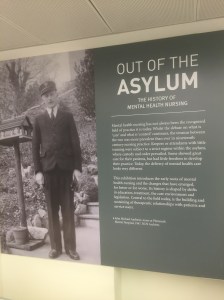
Belated happy new year. Visiting the Royal College of Nursing headquarters in London last Friday ahead of a meeting of the Network for Psychiatric Nursing Research (NPNR) conference committee (more on that below) gave me an opportunity to pop into the ‘Out of the Asylum’ exhibition. I’m glad I did. Texts, photographs and other artefacts illustrate the history of mental health nursing.

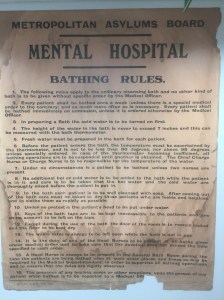
2016-01-08 11.25.57Here are some of the pictures I took. These include a photo of the RCN’s copy of a sixth edition of the Red Handbook, displayed alongside nurses’ badges, a Bethlem Royal Hospital pamphlet, a syringe and other items of interest. For more on the Red Handbook see this earlier post, along with this post which includes material from my copy of a fourth edition of the same. Another picture relates a set of regulations for the bathing of patients. 
One of the display boards makes the observation that ‘few mental health nurses now wear uniforms’. As an unfortunate aside, this may need some future updating. From what I’m hearing, the historic trend towards mental health nurses wearing everyday clothes at work is reversing, with numbers of NHS trusts and health boards contemplating a return to uniforms. I regret that. But sticking with the exhibition…

…a final photograph I’m reproducing here is the front sheet of an early 1930s examination paper. Look hard and you’ll see questions on bones, asphyxia and antiseptics (amongst other things).

The NPNR planning meeting, this being the purpose of my trip,  was a productive one. This year’s event (the 22nd) will be taking place in Nottingham on September 15th and 16th. I’ll add more on this when I can, and include some regular updates on this site.


Community Gateway 

Yesterday I spent the morning at the Grange Gardens Bowls Pavilion in Cardiff at a Community Gateway event. This was an opportunity to hear about mental health and wellbeing, and to learn how local services are set up. The day was organised by my School of Healthcare Sciences colleagues Alicia Stringfellow and Gemma Stacey-Emile, working with members of the community. I appreciated the update on the activities of the community mental health team (CMHT) based in the Hamadryad Centre, and learnt more about what local Hafal and CAVAMH services are doing. It will be interesting to see how mental health, and health more generally, feature in the Community Gateway in the future.

Community mental health teams are often described as the cornerstone of locally accessible, specialist, mental health services. Working with its two local authority partners, Cardiff and Vale University Health Board currently provides eight CMHTS for adults of working age. The team based at the Hamadryad, I was reminded yesterday, covers the south west of the city taking in the Bay, Butetown, Grangetown, Riverside, Canton and Pontcanna. Speaking in the Bowls Pavilion, CMHT manager Phil Ball did a good job in separating out the work of his team from that of the primary mental health support service (which happens to share use of the Hamadryad building).

Meanwhile…

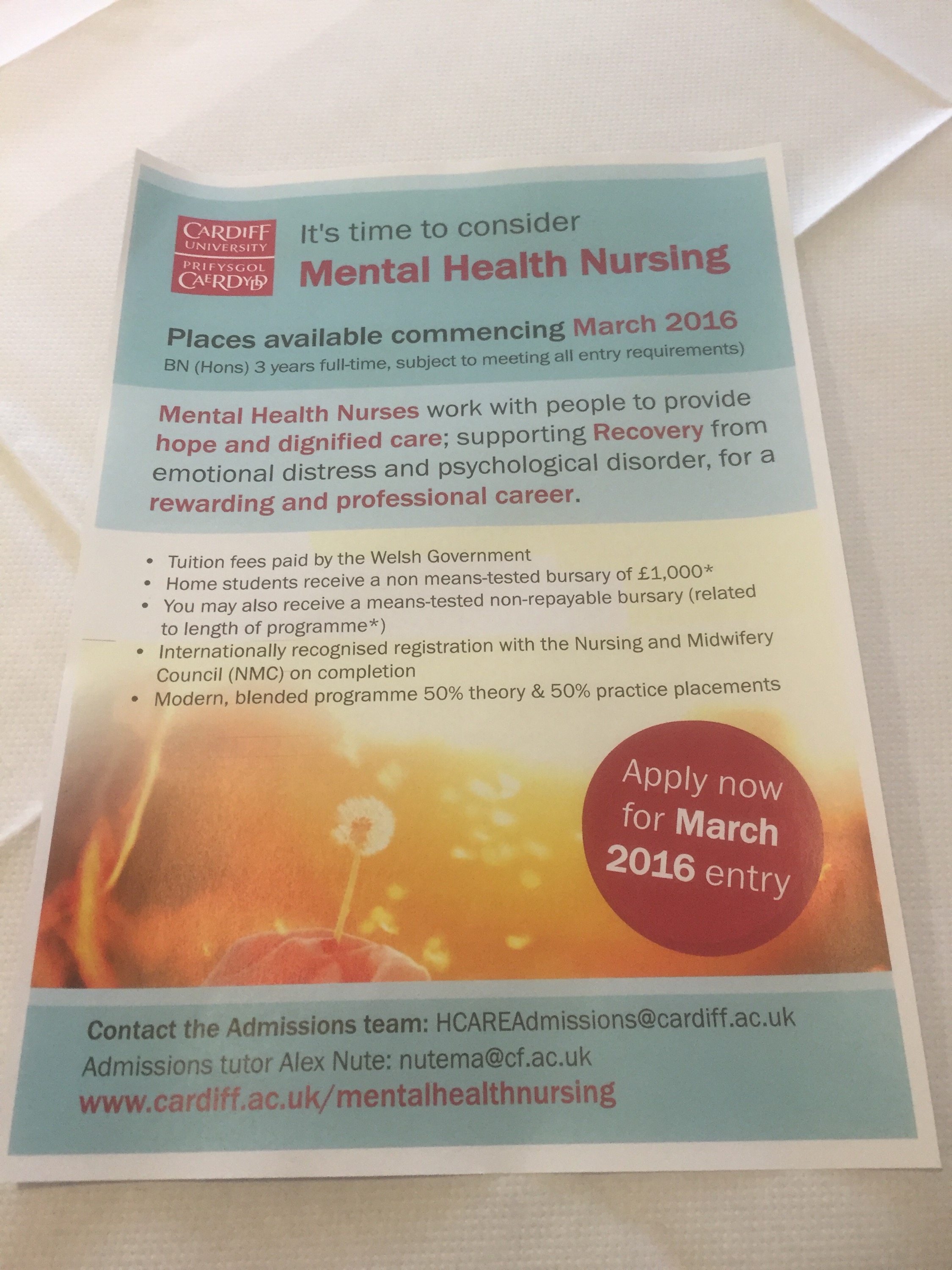
…for anyone wanting to become a mental health nurse, worth noting is that the School of Healthcare Sciences still has some places available for the BN Hons programme commencing in March 2016. The photo here, of a flyer brought to yesterday’s event, gives more information.

Fees, theses and project updates

Last week brought the news that, in England, people beginning nursing degrees from the 2017-18 academic year will need to take out student loans to cover the cost of their tuition fees. The cap on student numbers will also be removed. The Council of Deans of Health broadly supports this move, having previously argued for change. One of the things it points out is that current funding for students (via the agreement of the benchmark price) does not cover the real costs of educating new nurses. The Royal College of Nursing, on the other hand, is concerned that last week’s announcement prepares to break the connection between the NHS and financial support for student nurses, and simultaneously risks making nursing a less attractive career option. This concern particularly relates to mature students and those contemplating a second degree, for some of whom the prospect of additional debt may be exceptionally unappealing. As a nurse academic in Wales I wait with interest to see what policy on fees will emerge from the Welsh Government.

In other news, I find myself engaged in a prolonged period of doctoral student activity. I’ve examined a number of theses in and out of Cardiff in recent months, and have sat with students during their vivas as either supervisor or independent chair. This term has been particularly packed. Plenty of writing has also been taking place: papers and reports are being written from COCAPP, RiSC and Plan4Recovery, and from completed theses I have helped to supervise. Data generation in COCAPP-A has almost concluded, and new research ideas are taking shape. Exciting times, if a little frenetic. 

Higher education Green Paper

The much-trailed higher education Green Paper appeared last week. For the full document, the place to go is here and for a Times Higher summary the link is here. Immediately worth bearing in mind is that higher education in the UK is a matter for devolved government, meaning that most of what the Green Paper says relates to English universities. I say ‘most’ because, as is noted towards the beginning of the document, the Research Councils (like the MRC and the ESRC) have UK-wide remits, whilst the REF and the various editions of the RAE preceding it were carried out on a four-country basis. It would also be naive in the extreme to suggest that universities and policymakers here in Wales can ignore the England-only bits of what the Green Paper has to say; for a nice piece on the Green Paper and devolution, follow this link. And, for an insight into work ongoing in Wales on matters higher education-related, here’s a link to a current review of funding arrangements.

Fulfilling our potential: teaching excellence, social mobility and student choice, to give the Green Paper its full title, proposes plenty of change. It also leaves much of the detail unfilled, and (in at least one analysis) contributes to an emerging higher education policy framework which is both vague and contradictory. One idea is for the Higher Education Funding Council for England and the Office for Fair Access to combine functions within a new Office for Students. Plans for a Teaching Excellence Framework are outlined, along with variable rates of tuition fees. Ahead of the publication of the document there was some talk that REF2014 might have been the last of its kind. What the Green Paper actually says (briefly) is that dual support for research should remain, and that some version of the research excellence framework should continue and be used as the basis for the allocation of government block funding. The next REF, it is suggested, will take place by 2021. But there is obviously more to follow in this context, with sections in the document referring to the administrative burden and cost of the REF and the possible use of metrics to ‘refresh’ quality assessments in between full cycles of peer review. There is also the small matter of having to determine, if the Higher Education Funding Council for England disappears, which body should in the future assume the task of allocating quality-related funding to English universities.

Meanwhile, the sole nurse to get a mention in the Green Paper and its surrounding commentary is Sir Paul Nurse, Nobel Laureate, President of the Royal Society and chair of the review into the UK’s research councils. Nurses, of the type of which I am one, have to look elsewhere for the specifics on possible future arrangements for the organisation and funding of health care professional education and for debates in this area.

Public Uni

After finishing work next Thursday (October 15th 2015) I’ll be heading off to Chapter to take part in the 7th Public Uni. At Public Uni, which is organised by Marco Hauptmeier in the Cardiff Business School, academics get a ten minute opportunity to present their research to an assembled audience. I gather there is some retiring to the bar at some point in the evening, which seems very sensible.
Here’s the flyer for next week’s event: and what an eclectic bunch us five speakers are! In my slot the aim is to compress a history of mental health care, and a summary of where we are now, into 600 seconds of talking. What fun! For a taster of what I’m planning to say, here’s my summary:

Changing landscapeUntil the middle of the last century most formal mental health care was provided in hospitals. This changed with the emergence of community care. Dr Ben Hannigan, Reader in Mental Health Nursing in the School of Healthcare Sciences, explains how this change came about and discusses the people, policies and practices found within the system now.

Mental Health Nurse Academics UK meets in Preston

Here’s a quick blog post sent from a train, en route from Preston to Cardiff following the Autumn term meeting of MHNAUK. We met at UCLAN, hosted by Joy Duxbury, Mick McKeown and Karen Wright. On the agenda were presentations from Nadeem Gire on tackling digital exclusion, and from Mick McKeown on ‘Democracy and Legitimacy in Mental Health Care’. Mick, as always, was thought-provoking and challenging: follow this link to access downloadable copies of many of his articles.

Sabine Hahn, Peter Wolfensberger and Swiss colleagues were present, with Sabine and Peter giving an overview of the development of mental health nursing and the establishment of the Swiss Academic Society of Psychiatric and Mental Health Nursing. Seamus Watson spoke about public mental health, and what role nurses might play.

In the post-lunch business section of the meeting there were discussions on (amongst other things) the Shape of Caring review, this year’s NPNR conference and plans for 2016, and on a future student mental health nursing conference.

Studying for a PhD in the School of Healthcare Sciences

PhD2Here in the School of Healthcare Sciences at Cardiff University we’ve continued to think about how best to appeal to potential PhD students, and to simultaneously develop research capacity across nursing, midwifery and the allied health professions. A change which we’ve recently made is to invite applicants for postgraduate research study to make clear how their developing plans fit with the research already going on in at least one of the School’s research themes. To help in this process we’re now advertising areas for future PhD study, closely aligned to the substantive and methodological expertise already found in the School. This makes lots of sense, and will help us to grow research in programmatic fashion and ensure students are appropriately supervised.

The place to go for the current list of topics/areas is here, where under the Workforce, Innovation and Improvement theme you’ll find this:

The use of in-depth qualitative methods to examine mental health systems. Specifically, projects investigating aspects of policy; service organisation and delivery; work, roles and values and user and carer experiences.

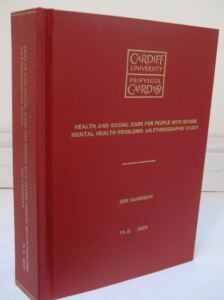
That’s the kind of PhD I’m primarily interested in supervising. For an example of what a completed one looks like, then follow this link to the full text of Dr Mohammad Marie’s freshly minted thesis titled, Resilience of Nurses who work in Community Mental Health Workplaces in West Bank-Palestine.

Research in the School of Healthcare Sciences

In February 2015, in the School of Healthcare Sciences at Cardiff University we launched our new research strategy. The School’s main research webpage can be found here, and for the nuts-and-bolts of our four research themes the links to follow are these:

Meanwhile, in the very near future the School (including its researchers) will be occupying additional floors at our base in Eastgate House. This, for those who know Cardiff, is a building situated at the junction of Newport and City Roads. My office, I think, will move: giving me fine views over the city and beyond.

Here are some photos of the 12th floor, as previously shared via a Tweet:

It is very welcome that we will soon have these new facilities available to us, with the rooms in the photos being used mainly by PhD and Professional Doctorate students.

Which brings me neatly to…

Other interesting developments in the School on the postgraduate research student front are plans to recruit very pro-actively. Research theme members have been busy generating topics for doctoral study, which reflect existing areas of substantive and methodological expertise and where capacity to supervise is known to exist. We’ll be advertising these soon, and inviting potential students to tell us how their plans align. The aim, obviously, is that we grow research in programmatic style by building on established and emerging lines of enquiry. For anyone interested, I’m looking to supervise people who want to use in-depth qualitative methods to examine mental health systems (no surprises there, then!). Specifically, this means projects investigating aspects of: policy; service organisation and delivery; work, roles and values; and user and carer experiences.

Other postdoctoral news includes Mohammad Marie‘s (that’s Dr Mohammad Marie’s) successful defence of his thesis at viva last month. Well done! Mohammad has been supervised by Aled Jones and me, and the title of his thesis is Resilience of nurses who work in community mental health workplaces in West Bank, Palestine. Next up for him are papers for publication: and jolly interesting they’ll be, too.

The shape of nursing (reprise)

York, March 10th 2015
Yesterday I joined other members of Mental Health Nurse Academics UK at the University of York, for what turned out to be a particularly lively spring term meeting. 

We were treated to two high-quality local presentations in the morning: from Simon Gilbody on smoking cessation interventions for people using mental health services, and from Jerome Wright on developing community mental health in Malawi. 

In the early afternoon David Sallah from Health Education England (HEE) took the floor to talk about the Shape of Caring review, the final report from which is due to be published later this week. From David’s presentation it is evident that HEE will be making a case for a significant shake-up to the way nurses are prepared. 

MHNAUK members in York were concerned with what they heard. Uppermost for many was a concern that HEE’s wish for future student nurses to commence their courses with two years of Project 2000-style generalist preparation will erode the time available for mental health-specific learning. People were also struck by the apparent lack of a clear evidence base for change. It is, after all, only a handful of years since the Nursing and Midwifery Council introduced its current standards for education, and curricula up and down the country were rewritten in response. In the absence of robust evaluations of what we already have, are we really sure we know what needs fixing in nurse preparation? 

The Shape of Caring review is sponsored by a body with authority in England only, but I am under no illusions that any changes flowing from it will be felt equally here in Wales. David Sallah mentioned cross-UK talks as having already opened. As people observed yesterday, however, any changes to nursing education recommended at this point may be lost following a general election where greater priorities occupy the time of a newly formed government. 

Meanwhile, and with a firm eye on the forthcoming election, the Council of Deans of Health has been busy making a case for health higher education and research in its new publication Beyond Crisis. This has three main messages, addressing: workforce planning; building on the talents of the current workforce; and investing in research. Amongst other things the Council is asking for proper forward planning to avoid cycles of boom and bust, opening up opportunities for continuous professional development and protecting and advancing research. It is also suggesting that new ways of financially supporting health professional education should be looked at, including models where contributions are made by students and employers.

The shape of nursing?

Congratulations to Steven Pryjmachuk on his pre-Christmas election as Vice Chair, and Chair-elect, for Mental Health Nurse Academics UK. Steven works with Joy Duxbury throughout 2015 and 2016, and becomes Chair for the two years following.

During the December 2014 MHNAUK election, for which I acted as returning officer, news seeped out that Health Education England’s Shape of Caring review (led by Lord Willis) was weighing up the future of UK nursing’s four fields (mental health, adult, child, learning disability). Michael Coffey, in his last month as MHNAUK Chair, led this response sent to the Health Service Journal:

Michael Coffey
Chair of MHNAUK

11th December 2014

Dear Sir

Shaun Lintern writes in the Health Service Journal (11th December 2015) that Lord Willis, chair of the Shape of Caring review envisages changes to nurse education that would see the loss of the current branches of nursing. One of those fields is mental health nursing. Those who practise in this area provide skilled compassionate care to some of the most marginalised and stigmatised people in society. We write on behalf of Mental Health Nurse Academics UK a group consisting of representatives of 65 Higher Education Institutions providing education and research in mental health nursing. As people long experienced in this field we are disappointed though not surprised to read your article presenting these views on the future of nurse education. We are disappointed because the evidence for the changes that Lord Willis claims are needed is largely non-existent. We are not surprised because we have been here before and can see that despite claims to the contrary, there is no evidence that this future for nurse education will deliver what it promises.

Nurses account for the highest number of professionals providing mental health care; the median average number of nurses per 100,000 of the population working in mental health is 5.8, more than all other professionals combined (WHO, 2011), making mental health nurses pivotal to the delivery of the WHO action plan. None of this is likely with a generic curriculum.

To be clear “the greater element of generalism” (which presumably means adult nursing) has been tried previously in the UK and found wanting. Internationally generalism has failed to deliver better care for people with mental health problems. The effect will be to dilute mental health nursing when there is increasing evidence that specialist knowledge, values and skills are required in the care of people with a range of long-term conditions and dementia. We remain unclear from your article what precisely is being proposed though our favoured suggestion would be for nurses to spend two years rigorously learning how to interact with people in compassionate ways that promote dignity and respect (core mental health nursing skills if you will) before launching themselves into the cold clinical world of high technology nursing.

The evidence from abroad and from evaluations here in the UK of the previous version of generalist frontloaded training (Project 2000; Robinson and Griffith 2007) show clearly that mental health nursing as a specialism suffered from a minimal focus on mental health in curricula and a depletion of mental health skills across the workforce. The strengthening of the mental health ‘field specific’ elements within the 2010 NMC standards reflected positive differences in areas such as language, the co–production of care and inter–professional practice. Any move to generic, or general (adult?) nurse ‘training’ as a start point for all will inevitably lead to a different set of values underpinning mental health nursing practice over time.

The expectation that the training of mental health nursing skills will be picked up and delivered in the workplace is without foundation despite the numerous examples to do this. The result will be that in an era of claims of parity of esteem people who use services will effectively be deprived of specialist trained nurses. Moreover, there is no evidence that current models of training are not fit for purpose or that a focus on generalist nursing skills will adequately address the needs of people with complex and enduring mental health difficulties.

The longer term effect of this approach is clear to see from countries who have moved down this road ahead of us, depleted services provided by unskilled workers, extra costs for employers in re-training and educating a workforce not fit for practice, difficulty in securing sufficient qualified staff to provide evidence based mental health care and longer term the stripping away of a set of skills in higher education that are unlikely to be replaced.

We don’t know what advice Lord Willis has taken to come to his view. Our worry though is that already the language being used here is designed to undermine professional skills that have been long in the making. For example, the unhelpful rhetoric embodied in the use of the term “silo” downplays specialist skills for the purposes of promoting something far less specific like “flexibility”. It is a largely hollow rhetoric and is never heard in relation to cardiologists, neurosurgeons or diabetes nurses. It seems that the pressure for change then is not one premised on the needs of people using healthcare services nor one based on the evidence of what works but driven by other factors that choose to position specialist nursing skills (and by corollary those who need these skills) as having little value.

We also note that any modification to the NMC’s standards for pre-registration nursing education and to the four fields driven by the Shape of Caring review will be felt across all parts of the UK. As an HEE-sponsored Review we are concerned that voices from parts of the UK other than England will not have opportunities to be heard.

We readily acknowledge that the full report is not yet due but wish to advance the notion of such a review democratically reflecting the voices of nurses and the people who use their services. In this regard we have been disappointed at the absence of any real attempt by the review to engage with our group specifically and have questions about the level of engagement with mental health service users more generally.

Yours Sincerely

Dr Michael Coffey
Chair of Mental Health Nurse Academics UK
Swansea University

Professor Joy Duxbury
Chair-elect of Mental Health Nurse Academics UK
University of Central Lancashire

Professor Len Bowers
Institute of Psychiatry
Kings College London

Professor Patrick Callaghan
Nottingham University

Professor Alan Simpson
City University London

Professor John Playle
University of Huddersfield

Professor Steven Pryjmachuk
University of Manchester

Professor Hugh McKenna
University of Ulster

Professor Doug Macinnes
University of Canterbury

Professor Karina Lovell
University of Manchester

Professor Geoff Dickens
Abertay University

Dr Ben Hannigan
Cardiff University

Dr Liz Hughes
University of York

Dr John Baker
University of Manchester

Dr Mick McKeown and Dr Karen Wright
University of Central Lancashire

Dr Robin Ion and Emma Lamont
Abertay University

Dr Sue McAndrew
University of Salford

Dr Andy Mercer
Bournemouth University

Dr Naomi Sharples
University of Chester

Dr Majorie Lloyd
Bangor University

Around this time there was some debate, via email, amongst MHNAUK members centring on the kind of nurses people felt were needed for the future and how they might best be prepared for practice. Important differences in view were freely expressed. Not all who are associated with MNHAUK are in favour of the retention of mental health nursing as a pre-registration field, for example, though my reading of the flow of pre-Christmas exchanges is that most are. Joy Duxbury and Steven Pryjmachuk, I suspect, will be returning to some of this debate during their tenures.