Category: Education

Learning how to see: industrial action in universities and the nursing workforce

5ef34afb-e2b4-47ec-ad34-be229c7b135c
Photo by @sarawhittam

I take the view that ‘everything is connected to everything else’, to use a phrase I recently learn is attributed to Leonardo da Vinci. More on him later.

Over the past week I’ve been involved in industrial action as part of #UCUStrikesBack. What I’m not going to do in this post is to explain why university staff are currently on strike, largely because this has already been adequately covered elsewhere (for example, see here and here). Instead, I want to share some picket-line reflections linking what happens in universities with what happens in the health service. These are connections which are not being made frequently enough, including by some who should know better.

As a mental health nurse academic I am acutely aware of the perilous position occupied by my profession in the NHS, with reports from earlier in 2019 pointing to a loss of 6,000 mental health nurses in NHS England since 2009. Below is a graph, created using NHS Digital data, which starkly reveals the current situation:
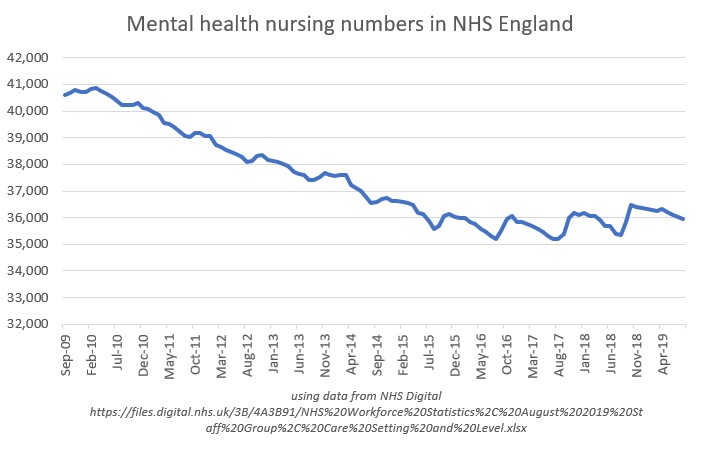
MHN numbers 2019As an aside, data of this type are not published here in Wales. They should be. In any event, quite correctly much concern has been expressed about this startling decline in the workforce, with mental health nursing now singled out as a group needing particular help to improve both recruitment and retention.

Reflecting my position as a health professional academic I hold joint membership of the University and College Union (UCU) and the Royal College of Nursing (RCN). The RCN, along with other health service unions like Unite and Unison, is trying to reverse the crisis facing the nursing workforce. It is campaigning on safe staffing, has published a manifesto to assist nurses wanting to interrogate prospective parliamentary candidates ahead of the December 2019 general election, and through its Fund our Future campaign is lobbying government to reverse the removal of tuition fee and living cost support for students of nursing in England.

These campaigns are important. So far, however, in its public pronouncements the RCN has failed to make the necessary connections between working conditions in universities and the present and future education of student nurses. Put simply, an adequate supply of educated, evidence-minded, person-centred nurses demands an adequate supply of secure, well-supported, fairly paid nurse educators and researchers. Nurse academics typically have career trajectories which are significantly different from those in other fields, with implications for their recruitment, retention and development. The modern norm for historians, physicists and sociologists seems to involve years of precarious, post-doctoral, employment characterised by repeated short-term contracts before landing (if ever) much sought-after full-time academic posts. In contrast, with some exceptions nurses are generally recruited into higher education by dint of their practitioner expertise, their posts linked to the servicing of courses of professional study. This was certainly how it was for me: my academic career commenced with an initial series of short-term employment contracts associated with the leading of a post-qualification course for community mental health nurses. In all universities, nurse academics can soon find themselves carrying major teaching and course management responsibilities, often for programmes and modules of study which run more than once across a single year. Demanding education and education-related workloads can squeeze out time for research, scholarship and wider engagement, in workplaces which traditionally value productivity in these areas for the purposes of career progression.

Expanding the number of nurses to fill the gaps which now exist, for which the RCN and others are rightly campaigning, requires thought and careful planning. In the run-up to the general election both are in short supply as nursing numbers become reduced to political soundbites. More student nurses must mean more nurse academics, but in any future rounds of staff recruitment potential entrants will have their eyes wide open. The erosion of university pensions relative to pensions in the NHS does nothing to encourage those contemplating the leap from health care into higher education (or, at least, into that part of the sector in which the Universities Superannuation Scheme predominates). Very reasonably, those considering future careers as nurse academics will also want to weigh up the appeal of doing work which is undoubtedly creative and rewarding with what they will hear about workloads, developmental opportunities and work/life balance.

I also learn, this week, that Leonardo da Vinci saw the making of connections as necessary in order that we might see the world as it truly is. In my working world, education, research and practice are intimately intertwined. It is disappointing that these connections are being missed by organisations which campaign on the state of nursing and the NHS, but which do not (as a minimum) also openly acknowledge the concerns that nursing and other academics have regarding the state of universities. Right now, some words of solidarity and support would not go amiss.

October review

Over on the website of Mental Health Nurse Academics UK (MHNAUK) I’ve written this brief review of MHNAUK’s last meeting, which took place at Unite the Union’s offices in Glasgow on October 11th 2019. This was a good meeting, with two guest speakers: Lawrie Elliott, Editor of the Journal of Psychiatric and Mental Health Nursing and David Thomson, Chair of the Mental Health Nursing Forum Scotland. I learned lots from both, and amongst other things ended up thinking how organised mental health nurses in Scotland look to be.

As it happens, MHNAUK is also about to embark on something new: next week we’re inviting nominations for people to lead our Education, Research, and Policy and Practice Standing Groups. Standing Groups are the engines of MHNAUK, and have been led thus far by Anne Felton, Mary Chambers and Neil Brimblecombe (and previously, John Baker) respectively. Big thanks to them for their work: the more that members become involved, the better.

Back in Cardiff, with esteemed co-investigators I’ve again (as I mentioned last month) been pressing on with the NIHR HS&DR-funded MENLOC evidence synthesis into end of life care for people with severe mental illnesses. This is proving to be a big piece of work, but we’re on track to submit our report in spring next year. As a team we’re also thinking carefully about future lines of enquiry, as there is lots still to do in this field.

A final thing to note in this catch-up: I’ve been thinking about what to say at next month’s Making a difference in Wales conference, which is all about taking the Framework for Mental Health Nursing forward. I think there is lots which is distinct about health policy and services in this part of the world, but also recognise the existence of gaps between policy and strategy aspirations, and workplace realities. One to mull over.

May review

2019-05-20 18.41.32.jpgEarlier this month I joined colleagues at the main meeting of the #MHNR2019 scientific committee, held (as the conference itself will be) at the RCN in London. We had a good number of abstracts to work through, submitted by people from the UK, the US, Australia and elsewhere. The programme is being worked on now, and people will not have long to wait before learning the outcomes of the panel’s deliberations. As an aside, whilst the conference committee always welcomes proposals for workshops as well as for concurrent sessions, posters and symposia we were reminded, when we met, of the importance of workshops promising to make delegates work. This is doubly important given that a workshop typically occupies the same amount of time on the conference programme as do three concurrent talks: so they have to sound engaging, and interactive, and not read like a plan for a 90 minute lecture.
For me this month also included a trip to St Angela’s College in Sligo for a stint of external examining for the College’s Postgraduate Diploma in Community Mental Health Nursing. It’s a good course, attracting applicants from all around Ireland, in which students learn about recovery-focused practice, therapeutic relationships, formal therapies, the context for care and care coordination, and more besides. It’s complex work being a registered nurse, and that’s why in all parts of the world the profession is (or is becoming) a graduate one for new registrants, with specialist courses like this one in Sligo being offered at post-registration level. I mention this as, tediously, nurses (and their friends) are once again having to defend the value of an education which involves time in practice but also, crucially, study for a degree.

Finally, this is my 16th unbroken annual trip to the Hay Festival. When I was first here the event was a relatively small-scale affair, held in the town’s primary school. It’s a much bigger enterprise now, located on a site some half a mile out of town to which many thousands of visitors arrive each day. This year I’ve listened to talks and round table discussions on the interminable horror that is Brexit, the making of (and the intentions behind) Our Planet, the invasions first of the Vikings and then on D-Day, and more.

#ACMHN2018

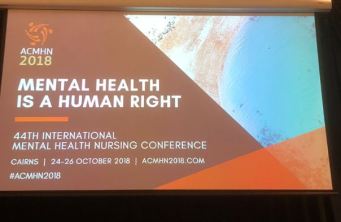
Big thanks to the Board of Directors of the Australian College of Mental Health Nurses (ACMHN) for inviting me to speak at the 44th International Mental Health Nursing Conference, or #ACMHN2018, which took place in Cairns between 24th-26th October 2018. Never having been to Australia before, and indeed having never before left Europe, this was a big deal and I was grateful for the opportunity.

The theme for the conference was ‘mental health as a human right’, and the three days opened with a memorable welcome to country given by Yidinji tribal elder Henrietta Marrie followed by music and dance. Keynote speakers reflected well the conference theme in their talks, variously focusing on tackling health inequalities (including amongst Aboriginal people), suicide prevention in LGBQTI communities, rural mental health, human rights progress in Ireland (and more). Concurrent presentations were also very high-quality. Worth noting, too, is how the ACMHN used its conference to raise awareness of its campaign, being run in concert with other health care organisations, to demand that children and families seeking asylum and currently being held on the island of Nauru be brought to Australia.

In my keynote I elected to speak about mental health policy, services and nursing in Wales and made the point that the Welsh approach to health care is different from that found elsewhere in the UK, or in other parts of the world. To illustrate this I spoke about the Mental Health (Wales) Measure, the introduction of both future generations and safe staffing legislation and the imminent appearance of a Framework for Mental Health Nursing prepared through the All Wales Senior Nurse Advisory Group for Mental Health.

I realise that in the UK we have nothing quite like the ACMHN: a professional organisation comprised of subscribing members, which represents its field, acts as a credentialing body (nursing education in Australia being a generalist one) and which lobbies for better services and higher standards. The College has a Board and an elected president, the current incumbent being Eimear Muir-Cochrane, and employs a team including Kim Ryan as salaried chief executive officer. The ACMHN performs no trade union function (like the RCN, Unite the Union, and Unison in the UK), and does not register or regulate nurses (as the NMC does). Australia looks to have a number of colleges and associations organised along the same lines as the ACMHN, and I’ve found this site which lists bodies advancing practice and representing members in the fields of critical care, midwifery, children and young people’s nursing, and more.

#ACMHN2018 was an excellent experience, and I was pleased to meet roomfuls of fine and interesting people. For the record, #ACMHN2019 takes place in Sydney between 8th-10th October 2019, with the theme of ‘integrated care’.

Skellern Lecture, JPMHN Lifetime Achievement Award and MHNAUK meeting

2018-06-14 18.33.42
Geoff Brennan begins his lecture

Earlier this month I made the trip to the University of Greenwich to celebrate this year’s Skellern Lecture and Journal of Psychiatric and Mental Health Nursing (JPMHN) Lifetime Achievement Award. First up was Geoff Brennan, whose lecture was titled The dark art of influencing inpatient mental health nurses. Over his career Geoff has worked as a consultant nurse, and has edited (with Cath Gamble) the textbook Working with serious mental illness. He now serves as Executive Director of Star Wards, and in his talk gave an energetic account of hospital mental health nursing now and in the past, and the skills and qualities which underpin this work. Geoff has long been a champion for inpatient nursing, but in his talk he was generous, too, in acknowledging the contribution made by others in this field. Special mention went to Len Bowers, who led the Safewards trial and who (until his retirement) oversaw the dissemination of findings and the work of promoting the uptake of these around the world.

2018-06-14 20.55.06
Michael Coffey presents the JPMHN Award to Philip Burnard

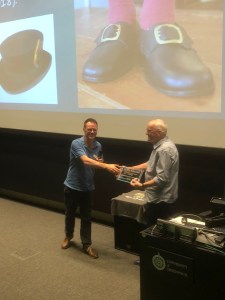
This year’s JPMHN Lifetime Achievement Award went to Philip Burnard, Emeritus Professor in the School of Healthcare Sciences at Cardiff University, and I was very pleased to have the opportunity to introduce Phil to those present. Phil’s oeuvre is a remarkable one, comprising books and papers on interpersonal and communication skills, research methods, ethics, culture, stress and burnout, and much more. The Scopus database lists 181 articles which Phil has authored, including one (A method of analysing interview transcripts in qualitative research) which has been cited well over 1,000 times. Phil gave a frank, and drily humorous, account of his early life, his career in nursing practice and academia, and his experiences of depression. I enjoyed hearing Phil speak, too, of his attachments to shoes and hats (as the photo in this post confirms).

Big congratulations indeed to Geoff and Phil, and worth noting that information on nominations for future Skellern Lecturers and JPMHN Achievement Awards can be found here. The day following this year’s event involved a return to the University of Greenwich, hosted by Deborah Watkins, John Crowley and colleagues, for the summer meeting of Mental Health Nurse Academics UK. Our surroundings were, surely, the grandest in which we’ve ever gathered as a group, being within the Maritime Greenwich World Heritage Site. Our meeting was particularly well-attended, with people making the journey from all four countries of the UK. Guest speaker was Dave Munday from Unite the Union, who gave an update on the #MHnursingFuture campaign. Also discussed were the new NMC standards and the assessment of mental health nursing students’ practice, MHNAUK’s recent responses to consultations and position papers, and (via a presentation from Mary Chambers) research impact. We meet again at the University of Essex in the Autumn.

Joining mental health nursing

Mental health nursing is important and fulfilling work, and offers a fine and rewarding career. More people also need to be doing it. By way of background, last month Mental Health Nurse Academics UK (MHNAUK) submitted a response to Health Education England (HEE)’s Facing the Facts, Shaping the Future draft health and care workforce strategy for England to 2027. Contained in this HEE draft are figures on trends in the numbers of nurses, by field of practice, employed in NHS England over the period 2012 to 2017.
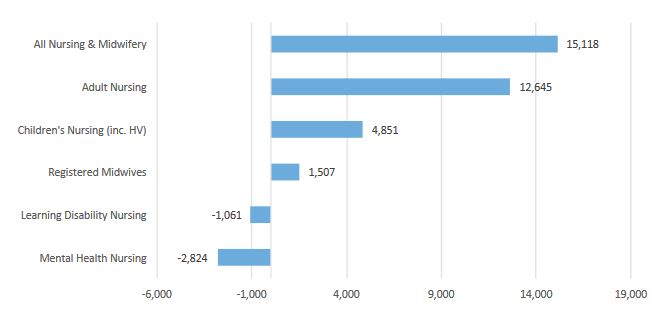
Growth/reduction in NHS employed nurses and midwives by field, 2012 to 2017 (extracted from Facing the Facts, Shaping the Future)

Obvious at a glance from this figure is the decline in both mental health and learning disability nursing numbers over time. Elsewhere HEE also describes a 14% mental health nursing vacancy rate.

Now, the Nursing Times reports a reduction for the second year in a row (£) in the numbers of applications for nursing degrees received via the Universities and Colleges Admissions Service (UCAS). Declining applications need to be viewed in the context of the removal of bursaries for students of nursing enrolling at English universities. In MHNAUK we have said, more than once, that we fear the loss of bursary support poses a particular threat to our field of practice. The same applies to learning disability nursing, where at least one degree programme closed last year (£).

Evidence like this is why initiatives like #MHnursingFuture (see also here, for the Twitter account) are important. Initiated by Dave Munday from Unite the Union, this is all about celebrating the work of mental health nurses and encouraging others to join us. As an occupational group we haven’t always been good at describing what we do, and why what we do is valuable (£). This needs to change, now more than ever.

With all this in mind this may be a good time to remind people of this useful page, hosted on the MHNAUK website, on joining the profession. As this says:

Forget all the stereotypes about straitjackets and Victorian asylums; modern mental health nursing focuses on helping and supporting people from all walks of life with a variety of ‘common’ mental health disorders (such as anxiety and depression) as well as more serious disorders such as drug and alcohol problems, suicidal feelings, psychosis, bipolar disorder and dementia. They also play a key role in promoting mental health and well-being among the public and preventing mental health problems occurring in the first place.

This helpful MHNAUK resource also includes suggestions for further reading, included in which are texts describing in detail many of the skills that mental health nurses routinely use and the context in which they go about their work. And, for any reader contemplating applying to any of the 60+ mental health nursing degree courses offered throughout the UK, do give some thought to our undergraduate nursing programmes here in the School of Healthcare Sciences at Cardiff University.

Why I’m on strike

2018-02-22 13.06.38
Paul Brown, me, Graeme Paul-Taylor: thanks to Kerry Hood for the photo.

I have a fantastic job, which I enjoy very much. But today I haven’t been doing it. I came into it in 1997, leaving a post as a community mental health nurse in East London to relocate to South Wales as a Lecturer in Community Nursing at what was then the University of Wales College of Medicine (UWCM). As a family we made this move even though my initial contract was fixed for a two year term. It was renewed for a further two years, and only then did I become a permanent member of staff. As part of making my transition from the NHS into higher education I transferred my health service pension into the Universities Superannuation Scheme (USS).

I was recruited into UWCM with the chief responsibility of leading a full-time, post-registration, course preparing nurses to work in community mental health settings. I led that programme for 14 years, and over that time taught many hundreds of registered nurses and helped them on their way towards specialist, regulatory body-approved, qualifications. I have continued to contribute to, and to lead, modules involving many other groups of health care professional students, all the way from pre-registration undergraduate through to post-registration postgraduate. I have supervised and assessed umpteen student dissertations, and have supervised and examined many postgraduate researchers. I very much value my work with students, and think that I’m reasonably good at it.

Then there are the other bits of my job, which nowadays occupy as much, or more, of my time as teaching and teaching-related activities. Over the years I have become a researcher, working with excellent colleagues here and elsewhere on projects examining features of the mental health system. I help with the running of the School of Healthcare Sciences as a manager and mentor of valued colleagues, and contribute to the work of a large number of committees and groups. I do work external to Cardiff University, including with Mental Health Nurse Academics UK, at other higher education institutions as an external examiner, and for journals and funding bodies as a reviewer of manuscripts and grants.

Like all the academics I know I work long hours, and accept that my job comes with high expectations. These include securing research income and publishing excellent research papers. For me, 10 to 12 hour working days are exceptionally usual, with far fewer (but certainly not non-existent) hours spent working at weekends. It is easy to become absorbed in what I do. I respond quickly to requests for help and feedback from students and colleagues, and if I’m chipping away at a grant application or a paper for publication can soon become engrossed in the task at hand. Oddly, whilst the hours are long it doesn’t always feel that way, and I appreciate the benefits of being able to work away from the office and to have control over my diary. All in all, I do my best across the full range of activities associated with being an academic. And, as I wrote at the outset of this post I enjoy what I do, and enjoy doing it in Cardiff.

Having committed myself to university life for over two decades I conclude that it suits me well, and find it hard to imagine doing anything else until I retire. Which brings me to today. I’m far from being the most active of Union members, and from time-to-time have had my gripes about the University and College Union (UCU). But today I downed tools to join colleagues up and down the country on strike, as a protest against threats to dismantle our pensions. At the heart of the dispute is a highly contested valuation of the USS fund, and a proposal to move from a defined benefits to a defined contribution scheme. This means a potential loss in retirement of up to £10,000 per year for USS members. Here’s a useful leaflet explaining this in a little more detail:

And for those wanting more on the technical front, there’s this blogpost which I personally found very informative.

Academics are paid modestly considering the qualifications and transferable skills they have, and as I have demonstrated here put the hours in to get the job done. Many, as I did, put up with time-limited contracts in the earlier parts of their careers. We care about our students and our research. We take additional satisfaction when our work makes a contribution to society. In my field this is through the preparation of future health care professionals, and via generating an evidence base for the improvement of practice and services. In return, having a decent pension – of the kind I and others signed up for when we first came into the university sector – does not seem like much of an ask.

I also remain acutely aware of how much more precarious the position is of younger academics. If proposed pension changes go through, people in the future will enter university employment with only defined contribution USS pension arrangements as preparation for their eventual retirements. First saddled with student debt, these are talented individuals who will be employed in their early working years on fixed-term contracts, ahead of settling into careers characterised by working weeks of 60 hours or more for salaries falling far short of a king’s ransom. A working life over, they (and not their employers) will have carried all the risk to secure pensions the value of which will reflect, quite terrifyingly, the fluctuations of the stock market. It isn’t right.

New year

Happy new year. In December 2017, I was pleased to see Values in Health and Social Care: an Introductory Workbook published, co-written with Ray Samuriwo, Stephen Pattison and Andrew Todd. It is a product of the Cardiff Values group, which began life over 15 years ago, and is the third book of its type that I’ve been involved in. The first was Values in Professional Practice: Lessons for Health, Social Care and other Professionals and the second was Emerging Values in Health Care: the Challenge for Professionals. This latest outing is very hands-on, and is packed with exercises for students and their teachers. I hope people find it stimulating and useful.
SamudIn previous posts (see here and here) I’ve written about Mohammad Marie’s PhD, which investigated resilience in Palestinian community mental health nurses. A fourth paper derived from this study has just been assigned to the January 2018 issue of the journal Health. This is a review of literature, and addresses (amongst other things) the connections between resilience and the idea of ‘Samud’. By following this link a gold open access version of the paper can be downloaded for free.

Elsewhere, I realise I have neglected to add any recent updates on this site about the work of Mental Health Nurse Academics UK. Last year was an active one. In addition to our usual three meetings we exercised our responsibilities as a Research Excellence Framework nominating body, and responded to a variety of consultations and calls for evidence: a nursing workforce inquiry initiated by the House of Commons Health Select Committee; the Nursing and Midwifery Council‘s proposed standards for education; both NHS Improvement and Centre for Mental Health reports on the mental health workforce; and more besides. Our meetings for this year are all scheduled, and it will be good to catch up in Birmingham in February, Greenwich in June and Essex in October.


Conferences and meetings catch-up

October has been a month of external events. These began with the inaugural All Wales Mental Health Nursing and the #FutureMHN conferences, in Cardiff and Birmingham respectively. The former was organised through the All Wales Senior Nurse Advisory Group for Mental Health with support from Public Health Wales. The latter was the third such event of its kind, ably organised by a student-committee led. I’ve since been to Derry for the Autumn term meeting of Mental Health Nurse Academics UK and for Ulster University’s 14th annual mental health conference, the latter organised under the theme of Quality and Compassion: Challenges and Opportunities for Mental Health

At the MHNAUK meeting Professor Hugh McKenna, who chaired the #REF2014 Allied Health Professions, Dentistry, Nursing and Pharmacy Panel, gave a talk on #REF2021. We livestreamed this, and have embedded a link in the MHNAUK website. Scrolling to the bottom of this page takes you there.

Recruiting to mental health nursing degrees

Huge congratulations to all who, earlier this month, secured the necessary qualifications to begin their mental health nurse education in the coming academic year. Welcome to the profession, and to the start of a rewarding career.

Following the publication of A level results on August 17th, as John Baker was first to point out, over 50 UK higher education institutions (HEIs) went to clearing to recruit new mental health nursing students:

That, as John suggested, seemed a large number by any measure: worth noting is that Mental Health Nurse Academics UK counts representatives from just over 60 HEIs. Also worth noting is that this is the first year of recruitment to nursing degrees to follow bursary reform in England: a policy the Department of Health explicitly linked to an expansion in student places. So have universities been to clearing to recruit increased numbers of students – assuming they wanted, and were able, to accept more? Shaun Lintern from the Health Service Journal has been tweeting extracts from the Universities and Colleges Admissions Service (UCAS) data analysis service, comparing the numbers of students placed with previous years. Here’s an example from three days ago:

Between now and September 1st 2017 UCAS is publishing daily updates, and as it happens is paying particular attention to nursing: these are in the separate files marked as ‘B7 reporting’. The most recent report, published on August 24th, still shows a fall in the number of people placed on nursing courses compared to 2016:

Source: UCAS, https://www.ucas.com/file/122081/download?token=7aEZplYE
This is important, but what UCAS is not displaying is data on the numbers of applicants placed to nursing degrees broken down by field (mental health, learning disability, child and adult). Data on the age of placed applicants is available, and as Steven Pryjmachuk points out shows a reduction (compared to 2016) amongst mature students:

Mental health nursing courses attract older applicants, and so may have experienced a disproportionate reduction in the number of new students compared to other fields. But we can’t know for sure, in the absence of having the data. What we do know, though, is that the evidence so far on overall placements to nursing degrees commencing in the 2017-18 academic year suggests that recruitment will be doing little to plug the hole in nursing vacancies.