Tag: Royal College of Nursing

Catching up post

Plenty going on in the last week or so. I had the chance to join pre-registration mental health nurses and occupational therapists for a second day as they made preparations for an interprofessional event scheduled for early December. Some of these students have also been giving me drafts of assessed work to comment on, but as the deadline for receipt of these is first thing next week I expect a deluge then. ’twas ever thus.

Elsewhere there has been RiSC reviewing to crack on with, assignment marking, and peer review reports to both consider and write. I’ve also put myself in the frame to act as a reviewer for another university’s proposed new MSc mental health programme, this being the kind of curriculum work I haven’t had the chance to do for a while.

I’m not normally one for formal, suit-and-boot, events, but made an exception last Wednesday (November 27th) to join a posse of colleagues from the School of Healthcare Sciences at the RCN Wales Nurse of the Year awards. These took place at Cardiff City Hall, and the overall winner was Cardiff and Vale UHB ward sister Ruth Owens. Congratulations, Ruth. Congratulations, too, to the individual category winners: including Andy Lodwick (also from Cardiff and Vale) for picking up the Mental Health and Learning Disabilities award and Dr Carolyn Middleton, doctoral graduate from what was the Cardiff School of Nursing and Midwifery Studies, for winning the Research in Nursing award.

This week also brought me to a meeting of the MHRNC Service User and Carer Partnership Research Development Group and, yesterday morning, to the Cardiff City Stadium for an open meeting to discuss NISCHR’s infrastructure and programme funding review. Both were lively events, and on the NISCHR front I see big changes ahead from 2015.

And to close this summary post: via the twitter grapevine I see that the RCN is now giving early notification of the Network for Psychiatric Nursing Research 2014 conference. This will take place at Warwick University on the 18th and 19th of September. I’ll post a link to the call for abstracts once this appears, but for now will reproduce this extract from the event website:

This year [2014] is the 20th international NPNR conference and it’s going to be a celebration.

We wish to celebrate and promote some of the outstanding mental health nursing research that shapes mental health policy and nursing practice across the world. We will also acknowledge some of the best psychiatric and mental health nursing research that helped create the strong foundation for our work today. And we will invite delegates to look ahead to map out the future for mental health nursing research, education and practice.
Nursing stress (2)

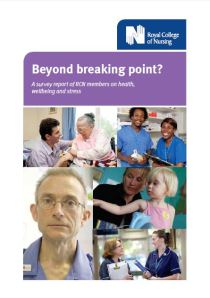
Further to my last post on nurses and stress: an email to the RCN has produced this link to the full Beyond breaking point report.

For those interested, here’s what the conclusion from the Executive Summary says:

The 2012 survey findings highlight the high levels of stress among the nursing workforce. Stress can be a causal factor for health problems, physical injuries, psychological effects and burnout. In addition to the high personal toll, stress is a major cause of both sickness absence and presenteeism and affects the ability of workers to be effective.
The survey reveals that the main causes of stress are high workloads, long hours, unrealistic expectations, lack of job control, conflicting roles, bullying and violence, poor working relationships and a lack of engagement in workplace change. Addressing these problems is an obvious way to improve nurses’ working experience, and in turn improve the safety and quality of care for patients.

Issues of workload, stress and working life are, however, often symptomatic of systemic organisational problems. Poor work environments and working relationships damage the ability of nursing staff to provide safe care and there is a direct correlation between job satisfaction and patient satisfaction.

Nursing stress

Today The Guardian reports on a Royal College of Nursing survey into levels of stress amongst 2,000 NHS and private sector nurses. Some of the nurses participating give dire accounts of their working lives when it comes to sickness and time off due to ill-health. Here is a snip from today’s paper:

The RCN said many of the nurses questioned reported that sickness absence policies at their place of work were so punitive that they had no alternative but to attend work despite feeling unwell.

One of the nurses told the RCN: “I’ve been told that if I don’t meet the 100% attendance at work I will be up for a capability hearing. I had three admissions into hospital due to a cardiac problem, so if I get chest pain I have to ignore it because I have to go to work.”

Another said: “I am currently off work following breast cancer. A senior manager called three weeks after my surgery and asked if I was coming back as people with cancer often don’t return and they wanted to fill my post.”

As someone who has investigated stress and burnout in nurses in the past I am interested to know more of this survey (or ‘poll’, as it is described). I can’t find anything in the Guardian‘s news report on the type of study which has been conducted, and I’m turning up a blank when I navigate to the RCN website for a full report. Perhaps I’m missing something?

Ten good reasons to come to this year’s NPNR conference

This year’s International Network for Psychiatric Nursing Research Conference takes place on the 5th and 6th of September at Warwick University. Here are ten reasons to come along and participate:

  1. to learn from Professor Kate Pickett (co-author of The Spirit Level) talking about global inequalities in mental health;
  2. to hear Professor Len Bowers presenting new findings from his Safewards trial;
  3. to listen to Charles Walker MP, who has talked publicly about his personal experience of mental health difficulties, speaking on the topic of making the personal political;
  4. to hear Dr Simon Duffy from the Centre for Welfare Reform talking about personal responsibility and social justice;
  5. to listen to Dr Fiona Nolan from UCL/Camden and Islington NHS Foundation Trust discussing protected engagement time in acute mental health inpatient wards;
  6. in a packed programme of concurrent sessions, to learn from delegates (from the UK and beyond) talking about their research studies large and small;
  7. to renew existing friendships within the mental health nursing research field, and to make new ones;
  8. because I defy you to tell me you have anything more interesting to be doing over the two days the conference is taking place;
  9. because if (like me) you’re a regular at this conference, being there is the only way to find out how the NPNR at Warwick compares with the NPNR at Oxford;
  10. because you will, undoubtedly, enjoy yourself.

Teaching preparation and bursaries

The formal academic year for students of the health professions (and therefore for their teachers, too) tends to be on the long side. Whilst many UK university students will have ended their studies until the autumn there are plenty of nurses, midwives and others with work to do before they can knock off for the summer. In September I’ll be working with pre-registration, second year, students of mental health nursing in a module assessed through the critiquing of published research. Before then I have a short, intensive, module to lead which is part of the taught component within the School’s professional doctorate.

This doctoral level module is all about ‘complexity’ and ‘systems’ and starts next month, and today I’ve been putting the finishing touches to some of the materials I’ll be using. As befits the student group and their thesis-producing aspirations I have opted to draw heavily on colleagues’ and my research experiences as far as is possible. I’m also hoping to foster a spirit of studying and learning together, and want to avoid being didactic.

Elsewhere today, in addition to research project-related work, I have had the opportunity to be part of a panel considering applications for RCN Foundation bursaries. There were some strong candidates, and well done to all who are about to get letters confirming their success. Others will be invited to interview (which I personally am unable to take part in). My commiserations, too, to those dropping out at this stage. I know how it feels to apply for support and not to get it, but there are always other opportunities. As I once heard someone, somewhere, say: if you’re not getting funding bids rejected you’re not applying enough!