Tag: open access

More unwanted invitations

In a post I wrote in May I complained about academic spam, and particularly the endless receipt in my email inbox of unwanted invitations to write papers for unknown journals specialising in areas I know absolutely nothing about. Emails of this type keep on coming, and I thought I’d share one directly with readers who may be interested. Remember, the additional sting in the tail is that if I ever do take one of these offers up I’ll probably then be asked to pay an author processing charge.

Today, the OMICS publishing group sent me this:

Dear Dr.Ben Hannigan,

Greetings from OMICS!
We are really happy to connect with an expert like you in the field of Journal of Civil and Legal Sciences which is a very important area of publication in our Journal of Civil and Legal Sciences.
We believe your potential in submitting a manuscript towards our journal and please let us know your response regarding this.
In the context of your busy timings or other professional commitments if you cannot agree to this, we expect you to suggest any other expert like you for this.
Hope to hear from you soon.

Nice to know that civil and legal sciences are an important area for OMICS to publish in their Journal of Civil and Legal Sciences. Who’d have thought it? I’ve actually hidden my personal expertise in this area very well, pretending instead to be an academic mental health nurse who knows something about systems, services, work and roles.

OMICS, you won’t be hearing from me.
Doing crisis work

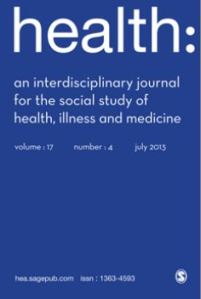
Here’s a new paper just accepted for publication, and about to appear in early online publication form. Titled ‘There’s a lot of tasks that can be done by any’: findings from an ethnographic study into work and organisation in UK community crisis resolution and home treatment services this will be appearing in Health: an Interdisciplinary Journal for the Social Study of Health, Illness and Medicine. Health is published by SAGE, and the copyright agreement I have signed allows me to deposit a post-peer review version of the accepted manuscript in my employing university’s digital repository. So, for a green open access version of this paper which is almost identical to the version which will appear in the journal, follow this link.

For a quick summary, here’s the abstract:

Across the United Kingdom (UK) large numbers of crisis resolution and home treatment (CRHT) services have been established with the aim of providing intensive, short-term, care to people who would otherwise be admitted to mental health hospital. Despite their widespread appearance little is known about how CRHT services are organised or how crisis work is done. This article arises from a larger ethnographic study (in which 34 interviews were conducted with practitioners, managers and service users) designed to generate data in these and related areas. Underpinned by systems thinking and sociological theories of the division of labour, the article examines the workplace contributions of mental health professionals and support staff. In a fast-moving environment the work which was done, how and by whom reflected wider professional jurisdictions and a recognisable patterning by organisational forces. System characteristics including variable shift-by-shift team composition and requirements to undertake assessments of new referrals whilst simultaneously providing home treatment shaped the work of some, but not all, professionals. Implications of these findings for larger systems of work are considered.

I’ll be adding this post, with its embedded link to the open access version of this article, to my ‘enduring posts’ page. I’ll group it with other posts and publications addressing the theme of ‘work and roles’.

Thoughts on the occasion of having written 100 posts

My first post was written and uploaded to this site on November 24th last year. I wrote about my interest in exploring the mental health system’s ‘wicked problems’, and drew attention to an article Michael Coffey and I had recently published in this area. In this, my 100th post, I want to think a little about what I have learned using a blog as a medium of communication.

As a mental health nurse academic my job involves researching and writing. I have wanted this site to be a vehicle for bringing some of this work to a wider audience. The main way I have gone about doing this has been to write posts to surround published articles, and where copyright makes this possible to add links to full-text green open access versions of papers stored on Cardiff University’s ORCA digital repository. The link above to Michael’s and my paper on wicked problems is an example. I’d like to think that this strategy has had some effect. As I wrote in this post last month, copies of papers I have deposited and then blogged about have been downloaded. By whom I cannot know. Nor can I be sure what use, if any, people have made of what they’ve read. If anyone wants to let me know, then that would be all to the good.

Over the last eight to nine months I have also learned that a blog needs looking after. So in addition to writing about research I have taken the opportunity to write generally about other things I do at work or am interested in, or about stuff which has simply caught my eye. My approach has been to write little, but to write often. I reflect that adding small pieces here and there has helped me in my teaching, as I noted earlier here. I also realise that in blogging beyond research I have blurred my boundaries somewhat, having added notes along the way about (for example) the simple pleasures of running. As an aside, I’ve been plagued by minor, but annoying, running-related injuries over the last few months and am missing my forest jaunts very much.

Just as a peer reviewed, published, article can be given a leg-up by a post on a blog, so too can a new blog be supported by a tweet. I have taken to using Twitter to draw attention to newly published posts, and indeed have started using this (sporadically, it has to be said) as another, independent, way of exchanging ideas.

That’ll do, for now. But I conclude that I’ll maintain this site in its small niche for a while longer yet.

Critical junctures (reprise)

This morning Nicola Evans’ and my paper on Critical junctures has appeared in advance online publication form on the Social Theory & Health website. This is very pleasing, though as I noted in my original post the terms of Palgrave’s copyright agreement mean that we have to wait for a period of 18 months from now before depositing a green open access version of the full text to accompany the article’s ORCA entry.

In the meantime, here again is the article’s abstract, which I hope at least whets readers’ appetites:

This article makes an original contribution through the revitalisation, refinement and exemplification of the idea of the ‘critical juncture’. In the health and illness context, a critical juncture is a temporally bounded sequence of events and interactions which alters, significantly and in a lasting way, both the experience of the person most directly affected and the caring work which is done. It is a punctuating moment initiating or embedded within a longer trajectory and is characterised by uncertainty. As contingencies come to the fore, individual actions have a higher-than-usual chance of affecting future, enduring, arrangements. These ideas we illustrate with detailed qualitative data relating to one individual’s journey through an interconnected system of mental health care. We then draw on observations made in a second study, concerned with the improvement of mental health services, to show how micro-level critical junctures can be purposefully used to introduce instability at the meso-level in the pursuit of larger organisational change. In addition to demonstrating why scholars and practitioners should pay closer attention to understanding and responding to critical junctures we are, therefore, also able to demonstrate how their emergence and impact can be examined vertically, as well as horizontally.

Writing an undergraduate dissertation

Here’s a link to a full-text green open access version of a paper called Preparing and writing an undergraduate dissertation. Philip Burnard and I published this in Nurse Education in Practice in 2001. Our aim was to produce something of practical use to students working on what is, typically, their single biggest piece of written work.

I appreciate that my timing here is very poor. Right now most students will be on, or planning for, their summer holidays. So I’ll draw attention to this paper again once the new academic year has started.

Academic networking

There are plenty of places where academics can tell the world about their interests and expertise, and generally show off their publication records, ‘h’ indices and all the rest. Blogs, like this one, are an example. Then there are services like ResearcherID, ResearchGate, Academia.edu and so on. These often have a networking function to allow people to get in touch and develop collaborations. Some also have space to store open access papers, in much the same way that university-based digital repositories (like Cardiff University’s ORCA) do.

Yesterday I published my Google Scholar profile. This may be just another way of promoting and networking, but I’ve also spotted a button titled, ‘My updates’. Here it is, pointed to with a big red arrow:

And, here’s a description from the Google Scholar blog of what this new(ish) function does:

We analyze your articles (as identified in your Scholar profile), scan the entire web looking for new articles relevant to your research, and then show you the most relevant articles when you visit Scholar. We determine relevance using a statistical model that incorporates what your work is about, the citation graph between articles, the fact that interests can change over time, and the authors you work with and cite. You don’t need to configure updates or enter any queries. We’ll notify you about new updates by displaying a preview on the homepage and highlighting a bell icon on search results pages.

This service looks very useful, not least because it appears to actually work. When I’m logged into Scholar and click on the ‘My updates’ link today I get interesting references to crisis resolution and home treatment research, continuity of mental health care and interprofessional community mental health work (amongst others). All very much up my street.

Increasing the visibility of research

Where publishers’ copyright rules permit, since last year I have been uploading green open access versions of peer reviewed research papers I have written or co-written to ORCA, Cardiff University’s digital repository. I have then been adding hyperlinks to these papers to research-related posts on this blog. To round this all off I’ve been using Twitter to draw attention to what I’ve been up to.

Having a WordPress blog means that I get to see which hyperlinks anonymous readers are following, and I know that some onward clicks are taking people to my open access articles. At the end of last week I asked colleagues managing ORCA if any tools existed to help me find out which of my papers have been downloaded, and when.

What I now have is access to an application allowing me to interrogate ORCA in all sorts of ways. So I know, for example, that full-text papers I have authored and saved to the repository have been downloaded 360 times between January 1st 2005 (the earliest date I can select) and today, July 3rd 2013. Two hundred and eighty eight of these downloads have taken place since November 24th 2012, this being the date I created this blog and first posted.

Here is a summary of my ORCA ‘eprints’ and the number of times each has been downloaded up to today:

Eprint Fulltext Downloads
Hannigan, Ben and Allen, Davina Ann 2013. Complex caring trajectories in community mental health: contingencies, divisions of labor and care coordination. Community Mental Health Journal 10.1007/s10597-011-9467-9
file
150
Hannigan, Ben and Coffey, Michael 2011. Where the wicked problems are: the case of mental health. Health Policy 101 (3) , pp. 220-227. 10.1016/j.healthpol.2010.11.002
file
70
Coffey, Michael and Hannigan, Ben 2013. New roles for nurses as approved mental health professionals in England and Wales: A discussion paper. International Journal of Nursing Studies 10.1016/j.ijnurstu.2013.02.014
file
65
Hannigan, Ben and Allen, Davina Ann 2011. Giving a fig about roles: Policy, context and work in community mental health care. Journal of Psychiatric and Mental Health Nursing 18 (1) , pp. 1-8. 10.1111/j.1365-2850.2010.01631.x
file
24
Hannigan, Ben 2013. Connections and consequences in complex systems: insights from a case study of the emergence and local impact of crisis resolution and home treatment services. Social Science & Medicine 10.1016/j.socscimed.2011.12.044
file
20
Hannigan, Ben and Allen, Davina Ann 2006. Complexity and Change in the United Kingdom’s System of Mental Health Care. Social Theory & Health 4 (3) , pp. 244-263. 10.1057/palgrave.sth.8700073
file
18
Hannigan, Ben and Allen, Davina Ann 2003. A tale of two studies: research governance issues arising from two ethnographic investigations into the organisation of health and social care. International Journal of Nursing Studies. 40 (7) , pp. 685-695. 10.1016/S0020-7489(02)00111-6
file
13

All are papers I have specifically blogged about, and have subsequently flagged up on my Enduring posts page. I am therefore going to tentatively conclude that the approach I have taken to increase the visibility of my research is having an effect.

What I do not know is who has been downloading (and hopefully reading!) these articles, and for what purposes. I would like to think it has been a mixture of researchers, practitioners, managers, policymakers and service users. I also hope they have found what they have read to have been both interesting and useful.

Unwanted invitations

A brief, early morning, rant. I’m all for open access, but this morning – and most certainly not for the first time – I received an unsolicited and entirely unwanted email inviting me to submit a paper to an open access journal. The editor asked me to write in an area I know nothing about, and informed me that if my manuscript is accepted for publication I shall have to pay an author processing charge (APC). I did the only thing possible in the circumstances, which was to delete the email.

I don’t mind a bit of academic spam, but I despair at the poor targeting and am a little affronted at the invitation being so baldly attached to a fee. I still don’t get why APCs are (often, but admittedly not always) as high as they are. Had I bitten at this morning’s ‘opportunity’, having done all the hard graft I would have needed to part with around £950 (so my online currency converter tells me). Where’s that going, then? Not to the peer reviewers, who like authors are not paid directly for their efforts.

Critical junctures

How pleasing it is to report that the paper I blogged about in this earlier post has now been accepted for publication. Co-written with Nicola Evans this (re)introduces the idea of ‘critical junctures’ and will appear in Social Theory & Health. We draw on two project datasets and show how action at pivotal moments can set individual service user trajectories on directions which are hard to reverse. We also show how, in certain circumstances, small-scale critical junctures can trigger (or be used to lever) larger organisational change.

Next up will be the checking of page proofs, and advance online publication via the journal’s website. What we won’t be able to do for another 18 months is upload a PDF of the post-peer review manuscript to ORCA. This is something Palgrave’s copyright rules are very clear about. In the meantime here’s the abstract which will, of course, be freely available:

Hannigan B. and Evans N. (in press) Critical junctures in health and social care: service user experiences, work and system connections. Social Theory & Health

This article makes an original contribution through the revitalisation, refinement and exemplification of the idea of the ‘critical juncture’. In the health and illness context, a critical juncture is a temporally bounded sequence of events and interactions which alters, significantly and in a lasting way, both the experience of the person most directly affected and the caring work which is done. It is a punctuating moment initiating or embedded within a longer trajectory and is characterised by uncertainty. As contingencies come to the fore, individual actions have a higher-than-usual chance of affecting future, enduring, arrangements. These ideas we illustrate with detailed qualitative data relating to one individual’s journey through an interconnected system of mental health care. We then draw on observations made in a second study, concerned with the improvement of mental health services, to show how micro-level critical junctures can be purposefully used to introduce instability at the meso-level in the pursuit of larger organisational change. In addition to demonstrating why scholars and practitioners should pay closer attention to understanding and responding to critical junctures we are, therefore, also able to demonstrate how their emergence and impact can be examined vertically, as well as horizontally.

Gold and green

Further to my earlier open access blogs, here and here, having finally worked my way through the unexpectedly heavy traffic around the University Hospital of Wales I spent the first part of today in an open access workshop, facilitated by colleagues from Cardiff University’s library and information services. I was struck by the speed with which things are changing. I learned that Cardiff researchers now have a good chance of securing University funding to support the open access publication of papers arising from RCUK-funded studies. Whether this applies to all papers submitted to all journals with all varieties of open access (‘gold’, ‘green’ or ‘hybrid’) I’m not sure about. I hope it does, because I’d hate to think that researchers end up making decisions on where to publish based solely on their need for financial support to cover their APCs.

I also learned that, as things stand, there is no University financial support for the open access publication of papers from projects completed with funding from the NIHR or NISCHR. This is because neither is a Research Council, even though both run highly competitive funding schemes of particular interest to health and social care researchers. Bids to both bodies can include requests for funds to cover APCs, but this is a cost which can quickly add up. If everyone adds APC fees to their grant proposals then fewer studies will be funded, as the money to support paid-for ‘gold’ open access publication has to come from somewhere. The cost-free ‘green’ open access model, using institutional repositories, is an option here: but generally I am, again, driven to the conclusion that APC tariffs urgently need to come down.