Tag: COCAPP

Spring election, and the politics of mental health

It hasn’t always been like this, but mental health is something which politicians now talk about. In the run-up to next week’s general election mental health has even featured in public appeals to voters. The Liberal Democrats have particularly campaigned in this area, and in their manifesto promise £500 million per year for better mental health, and specifically make a case for investing in research. Labour talk about giving mental health the same priority as physical health, and the Conservatives say pretty much the same. Reviewing all the main parties’ manifesto promises for evidence of concrete plans for post-election improvements to mental health care, over on his blogsite the Psychodiagnosticator observes ‘that many of them were so vague as to amount to no promise at all‘. I think he has a point.

Possibly the broad manifestos produced in the run-up to a general election are not the places to look for fully worked-up blueprints of what future mental health policy across the UK might look like. Perhaps, more accurately, we should not think about ‘UK policy’ in this context at all. Members of Parliament elected to Westminster next week, from amongst whom a new government will be formed, will have authority to directly shape services in England only. Health and social care remain areas over which devolved authorities have jurisdiction, and for a ballot delivering a government with the power to pronounce on mental health care here in Wales we must look to the National Assembly elections to be held in 2016. I’ve indicated before that mental health policy here is different from that in England, and indeed from other countries in the UK. Consider again the case of the Mental Health (Wales) Measure. This is a piece of legislation for Wales alone, mandating for care and treatment plans, care coordinators, access to advocates in hospital and the right of reassessment within secondary mental health services following discharge. It was introduced in the face of some strong, pre-legislative, criticism from at least one senior law academic (Phil Fennell) who in 2010 began his submission to the National Assembly by saying,

The gist of my submission to the Committee is that this measure, although well-intentioned, is cumbersome, unduly complex, and will lead to a delay in providing services which ought to have been available already to service users and their families in Wales under the National Service Framework for Adult Mental Health and the Care Programme Approach.

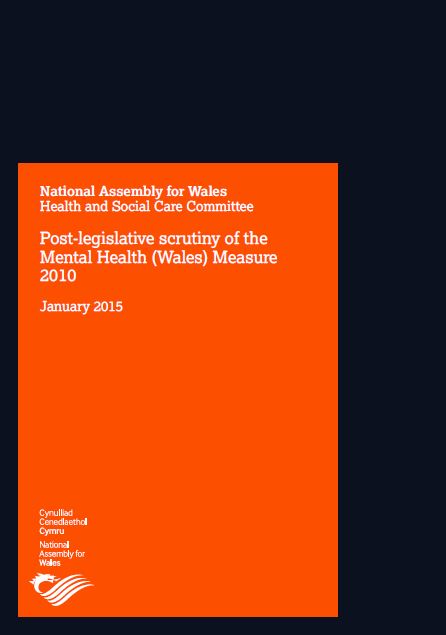
Five years on the Measure has not only passed into law, but been subjected to a round of post-legislative scrutiny by the National Assembly’s Health and Social Care Committee (see my post here), to which the Welsh Government has now responded. With data from across both England and Wales, COCAPP (and in the future, COCAPP-A) will have something to say about how care planning and care coordination are actually being done, and readers will be able to draw their own conclusions on the extent to which changes in the law trigger changes to everyday practice. And, whilst we’re in policy comparison mode, for a view from Scotland try Paul Cairney. He argues that divergence in mental health policy across the UK, exemplified by contrasting English and Scottish experiences of reforming the law, reflect differences in both the substance of policy and in policymaking style.

In all of this I am, again, reminded of the wicked problems facing all policymakers who seek to intervene in the mental health field. Whatever direction it takes, future policy will be open to contest and will surely trigger waves of consequences.

Taking Measure

Here in Wales we have the Mental Health Measure. This is a piece of legislation passed in 2010 and implemented in phases in 2012, and which is intended to improve the quality and timeliness of mental health services. Specifically, it provides for:

  • primary mental health care;
  • care and treatment planning and care coordination;
  • the right for an automatic reassessment of needs in secondary mental health services for people discharged within the previous three years;
  • advocacy in hospital.

This month the National Assembly for Wales Health and Social Care Committee has reported on its post-legislative scrutiny of the Measure. The Welsh Government has already committed to conduct a formal evaluation of the legislation through a duty to review, built in as the Measure passed into law. In pursuit of this an inception and an interim report have already appeared, with a final document due in 2016. With the Health and Social Care Committee’s report appearing this month it is clear that the Mental Health Measure is becoming seriously scrutinised.

When the Committee published its call for evidence last year the COCAPP research team submitted a response alerting Assembly Members to our ongoing study. It would have been ideal had we been able to report key findings, given that COCAPP is an examination of care planning and care coordination and is, therefore, of interest to anyone wanting to know how part 2 of the Measure (dealing with care and treatment planning) is being experienced. But the Health and Social Care Committee’s timescales and those of COCAPP were not aligned, meaning the best we could do was to draw attention to our project.

This month the Committee praises many aspects of the Measure but also makes ten recommendations. They address:

  1. meeting demands for primary mental health care, particularly in the case of children and young people;
  2. improving the collection of data to better support the evaluation of primary mental health services;
  3. taking action to improve the form, content and quality of care and treatment plans, with a view to increasing service user involvement and spreading best practice through training;
  4. making sure that rights to self-refer for reassessment are properly understood and communicated to all;
  5. improving staff awareness of service users’ eligibility for independent mental health advocacy in hospital;
  6. setting timescales for new task and finish groups reviewing the Measure, and setting out plans to respond to their recommendations;
  7. during evaluations of the legislation, consulting with as wide a range of people as possible using traditional and novel approaches;
  8. ensuring that information is available in a variety of formats, so that all groups of people are able to access this and to understand;
  9. following the publishing of new plans for the improvement of child and adolescent mental health services, making clear how these will be realised;
  10. carrying out a cost benefit analysis of the Measure.

Clearly, Assembly Members have detected evidence of an uneven pace in the development of primary mental health care across Wales, and are particularly concerned to make sure that the mental health needs of children and young people are properly identified and met in timely fashion. As a COCAPP-er, I am interested to read that the Committee thinks care and treatment planning for everyone can be improved, informed by examples of best practice and through investment in staff training. I also pick out the recommendations on improving service user collaboration, and estimating the costs and benefits of the Measure. These resonate, to me, with current concerns in Wales with prudent health care and co-production.

And as for COCAPP’s findings? Suffice to say our draft final report is now under review with the National Institute for Health Research (NIHR) Health Services and Delivery Research (HS&DR) Programme. More to follow in due course…

REF results out, COCAPP in

The publication of results from the Research Excellence Framework 2014 (#REF2014) has made this a big week for universities. REF is important for lots of reasons. First, it is assumed that recurring, quality-related (QR), research funding from the UK’s four higher education funding councils will be weighted to the REF results (I say ‘assumed’ here in the light of reports, today, on possible changes to the dual support system: see below for more). Second, universities and the departments within them are ranked based on REF outcomes, making the exercise a crucial one for relative reputations. Third, for governments the REF (like the various research assessment exercises (RAEs) before it) is a way of showcasing the value of research investment and the wider benefits this brings.

Universities will have followed different strategies in managing their REF submissions. In Cardiff a selective return produced a result comfortably better than had been aimed for with the University now ranked in the top five based on research quality. Check out this short video for an overview:

As I hinted above there are, already, questions being asked of how the REF results will (or will not?) be converted into future funding. A report in today’s Observer suggests that changes may be afoot to the dual support (QR and programme/project-related) system. Here’s an early morning tweet from Phil Baty at the Times Higher Education:

So that’s an evolving story which deserves to be closely watched.

Meanwhile…

…moving from research in the round to research projects specifically, this has also been the week that our draft final report from COCAPP has been submitted for peer review to the NIHR Health Services and Delivery Research Programme:

COCAPP has been an investigation into care planning and care coordination in mental health services, and has already been partnered by COCAPP-A. This related study is asking questions in the hospital setting similar to those asked by COCAPP in the community. The coming year sees COCAPP-A getting into full swing, with qualitative and quantitative data being generated across multiple NHS sites in England and Wales.

December catch-up

Competing priorities have kept me away from this site in recent weeks. There’s been work to do on COCAPP, which is close to the finish line, and doctoral students’ drafts to read and comment on (before imminent thesis submission, in one case). I’ve also been reading a thesis ahead of a PhD examination I’m involved in at the end of the coming week. So if this catch-up post feels a little bitty, then that’s because it is: there’s been lots happening that I want to comment on.

First up is the RiSC study, which I’ve mentioned here plenty of times before. In the last ten or so days the NIHR has published a first look summary of our aims, methods and findings. This is a precursor to the publication of our whole report, which is now post-peer review. Sometime in the new year we’ll be reconvening as a research team to plan our next project.

In October I made the short trip to the University of South Wales to hear Professor Linda Aiken from the University of Pennsylvania deliver this year’s RCN Winifred Raphael Lecture. Professor Aiken spoke on Quality nursing care: what makes a difference?, drawing on findings from the RN4Cast study and more. As promised, the RCN Research Society has now uploaded its video of the event for the world to see. It’s well worth watching.

News on the Mental Health Nurse Academics UK front includes an election, which we are now midway through, for the group’s next Vice Chair and Chair Elect. I’m overseeing this process (as I’ve done twice before), and will be in a position to announce the successful nominee on December 15th. One of the things that MHNAUK does is to work with the RCN to run the annual NPNR conference, and I’m very pleased to have had the chance to join the NPNR scientific and organising committee for a three year stint. More to follow on that front in the future, including details of next year’s event as they emerge.

Elsewhere I read that the Shape of Caring review, chaired by Lord Willis, is looking at the UK practice of preparing new nurses, at the point of registration, for work in one of four fields (mental health, adult, child and learning disability). This is something to keep a close eye on, with reports from last month’s Chief Nursing Officer Summit in England suggesting that the fields may be on their way out. For a useful, balanced, review in this area I refer the reader to the 2008 King’s College London Policy+ paper Educating students for mental health nursing practice: has the UK got it right? and, for a longer read, to Approaches to specialist training at pre-registration level: an international comparison.

NPNR 2014 reflections

For those not at the 20th International Network for Psychiatric Research Conference, which took place yesterday and the day before at Warwick University, here are links to the conference brochure and the book of abstracts. Following this link takes you to Laura Benfield’s aggregation of #NPNR2014-tagged tweets. Laura, I hear, is moving on from the RCN Events team: many thanks to her for all the behind-the-scenes work at this, and previous, conferences.

This was another high-quality NPNR gathering. Brendan McCormack gave an impassioned keynote on person-centred care, emphasising the absolute importance of values and culture, and Julie Repper spoke eloquently on co-production and the vital work that mental health nurses can do to promote this. Debbie Hicks talked of the work of The Reading Agency in using books to promote mental health and wellbeing. In his Friday morning keynote Swaran Singh gave a presentation which had, at its heart, the idea that higher recorded rates of mental illness in migrant groups are better explained by experiences of social adversity than they are by institutionalised racism. Kevin Ann Huckshorn delivered a final keynote centring on leadership and the implementation of recovery and coercion-reducing approaches.

I also sat in on, and chaired, some excellent concurrent sessions. From speaking with fellow delegates I know that I missed plenty of others of equal quality. From Fiona Nolan and colleagues I learned of the latest in the development and evaluation of protected engagement time initiatives, and from Hilary Ford of the use of a lifecourse approach in pre-registration mental health nurse education. I always appreciate what Mick McKeown has to say, and this year heard Fiona Jones and him talking about the opportunities (and challenges) of introducing recovery ideas in a secure hospital. I heard Brenda Happell deliver two papers: on the relationships between clinical experiences in mental health settings and nursing students’ attitudes to mental health as a field of practice, and on the introduction and evaluation of a service user-led module. Iain Hepworth and Peter Martin both gave talks touching on the work of liaison mental health nurses, and Alan Finnegan presented findings from a grounded theory study of military mental health nurses. Hilary Wareing shared experiences in introducing smoke-free mental health services, Hannah Walsh and colleagues talked of education and training for clinical support workers, and last (but certainly not least) Len Bowers shared his thoughts on (and experiences of) online suicide prevention education for mental health nurses.

I was also mightily pleased to have had the chance to be involved in four papers, each arising from funded research ongoing or recently completed and drawing on the talents and experiences of the fine people variously associated with COCAPP, Plan4Recovery and RiSC. We were there in force in Warwick: Alan Simpson, Michael Coffey, Sally Barlow, Jitka Všetečková, Bethan Edwards, Alan Meudell, Julian Hunt, Nicola Evans and Steven Pryjmachuk. Many thanks to those who came along to listen to, and discuss, our project experiences and our findings.

The NPNR conference is also the place where the following year’s JPMHN Lifetime Achievement Award winner and Skellern lecturer are announced. Very big congratulations to Ian Norman (who, as it happens, was one of my PhD examiners) and to Marion Janner, both of whom will be delivering their addresses at Nottingham University on June 11th 2015.

It’s worth mentioning, too, that the annual NPNR conference has a deserved reputation for informal collegiality and friendliness, and this year was no exception. I enjoyed meeting up with friends old and new.

Looking ahead, I see that an early call for suggested themes for NPNR 2015 has already gone out:

I, for one, plan to be there.

Summer research catch-up

Some time away and pressure of work explain the absence of recent posts on this site. So here’s a catch-up. In COCAPP, data generation and analysis are pressing ahead, whilst COCAPP-A (which is asking questions about care planning in acute mental health hospitals) has officially commenced. Plan4Recovery (which is concerned with shared decision-making and social connections for people using mental health services) is generating data. The draft final report from the RiSC study has now been peer reviewed and is back with us, the research team, for revisions. Methods and findings from this project (an evidence synthesis in the area of risk for young people moving into, through and out of inpatient mental health hospital) were also presented last month at the CAMHS conference at the University of Northampton. Many thanks to Steven Pryjmachuk for doing this.

Further conference presentations, from all but COCAPP-A, will also be delivered at this year’s NPNR conference. And, for the first time, I’m off to an event organised by Horatio: European Psychiatric Nurses. Horatio is a member of ESNO: European Specialist Nurses Organisations, and the event I’m speaking at in November is the 3rd European Festival of Psychiatric Nursing. One of the papers I’m delivering is titled, ‘Mental health nursing, complexity and change’. Here’s my abstract:

In this presentation I principally draw on two studies conducted in the UK to share some cumulative insights into the interconnected worlds of mental health policy, services, work (including that of nurses) and the experiences of users. I first set the scene with a brief review of the historic system-wide shift away from hospitals in favour of care being increasingly provided to people in their own homes. I emphasise the importance of this development for the mental health professions, and show how community care opened up new jurisdictional opportunities for nurses, social workers and others. I then draw on data from a project using a comparative case study design and ethnographic methods to show how the everyday work of mental health nurses (and others) is shaped both by larger jurisdictional claims and the contextual peculiarities of the workplace. From this same project I also show how the detailed, prospective, study of unfolding service user trajectories can lay bare true divisions of labour, including the contributions made by people other than mental health professionals (including support staff without professional accreditation, community pharmacists and lay carers) and by users themselves. I then introduce the second study, an investigation into crisis resolution and home treatment (CRHT) services, with an opening account of the unprecedented policymaking interest shown in the mental health system from the end of the 1990s. CRHT services appeared in this context, alongside other new types of community team, and I draw on detailed ethnographic case study data to examine crisis work, the wider system impact of setting up new CRHT services and the experiences of users. I close the presentation overall with some reflections on the cumulative lessons learned from these linked studies, and with some speculative ideas (on which I invite discussion) on the continued reshaping of the mental health system at a time of economic constraint, health policy contestation and political devolution.

I’ve given myself something of a challenge in attempting all this in a single concurrent session, but I’ll do my best and can signpost interested participants to papers I have published in these areas. One of my reasons for heading off to the Horatio event (in Malta, as it happens) is to make connections with international colleagues, with whom I might usefully share my projects, interests and ideas and perhaps find common ground.

Prospects and challenges: revisited

In 1999 I wrote a paper for the journal Health and Social Care in the Community titled Joint working in community mental health: prospects and challenges. The back story is that the work for this article was mostly done during my first year of part-time study for an MA in Health and Social Policy, during my time working as a community mental health nurse in East London.

Frustratingly, I can’t find my original wordprocessed copy of this paper from which to create a green open access version for uploading to the Orca repository and for embedding a link to here. But not to worry. The abstract, at least, is a freebie:

This paper reviews the opportunities for, and the challenges facing, joint working in the provision of community mental health care. At a strategic level the organization of contemporary mental health services is marked by fragmentation, competing priorities, arbitrary divisions of responsibility, inconsistent policy, unpooled resources and unshared boundaries. At the level of localities and teams, these barriers to effective and efficient joint working reverberate within multi-disciplinary and multi-agency community mental health teams (CMHTs). To meet this challenge, CMHT operational policies need to include multiagency agreement on: professional roles and responsibilities; target client groups; eligibility criteria for access to services; client pathways to and from care; unified systems of case management; documentation and use of information technology; and management and accountability arrangements. At the level of practitioners, community mental health care is provided by professional groups who may have limited mutual understanding of differing values, education, roles and responsibilities. The prospect of overcoming these barriers in multidisciplinary CMHTs is afforded by increased opportunities for interprofessional ‘seepage’ and a sharing of complementary perspectives, and for joint education and training. This review suggests that policy-driven solutions to the challenges facing integrated community mental health care may be needed and concludes with an overview of the prospects for change contained in the previous UK government’s Green Paper, ‘Developing Partnerships in Mental Health’.

Fifteen years on the structural divisions remain. As with other areas, community mental health care continues to be funded and provided by a multiplicity of agencies, with ‘health care’ and ‘social care’ distinctions still very much in place. This year’s Report of the Independent Commission on Whole Person Care for the Labour Party and the King’s Fund’s work on integrated care are examples of recent initiatives aimed at closing these gaps. Labour’s Independent Commission recommends the creation of a new national body, Care England, bringing together NHS and local authority representatives at the highest level. Note, of course, that these proposals are for England only: these are ideas for health and social care in one part of a devolved UK.

In my article I drew attention to the problem of competing policies and priorities for NHS and local authority organisations, the lack of shared organisational boundaries, non-integrated information technology systems and separate pathways bringing service users into, through and out of the system. An illustrative example I gave was the parallel introduction, in the early 1990s, of the care programme approach (CPA) and care management. Here in Wales, with the introduction of the Mental Health (Wales) Measure there is now, at least, a single care and treatment plan (CTP) to be used with all people using secondary mental health services. But how many health and social care organisations in Wales and beyond have managed to integrate their information systems? This, I suspect, remains an idea for the future.

And then there are the distinctions, and the relationships, between the various occupational groups involved in community mental health care. In my Joint working paper I emphasised the differences in values, education and practice between (for example) nurses and social workers, and (perhaps rather glibly) suggested that the route to better interprofessional practice lay through clearer operational policies at team level. Getting mental health professionals to work differently together became, for a time at least, something of a policymakers’ priority in the years following my article’s appearance. Here I’m thinking of the idea of distributed responsibility, and ‘new ways of working’ more generally, of which more can be found in this post and in this analysis of recent mental health policy trends (for green open access papers associated with both these earlier posts, follow this link and this link).

Two other things strike me when I look back on this 1999 article and reflect on events in the time elapsing. First is how much I underemphasised, then, the importance and influence of the service user movement. Over 15 years much looks to have been gained on this front, and I detect improved opportunities now for people using services to be involved in decisions about their care. Services have oriented to the idea of promoting recovery, as opposed to responding solely to people’s difficulties and deficits. This all takes me neatly to COCAPP and Plan4Recovery, two current studies in which I am involved which are investigating these very things in everyday practice. Second, I realise how little I foresaw in the late 1990s the changes then about to happen in the organisation of community mental health teams. Not long after my paper appeared crisis resolution, early intervention, assertive outreach and primary care mental health teams sprung into being across large parts of the country. More recent evidence suggests a rolling back of some of these developments in a new era of austerity.

And what of the community mental health system’s opportunities and challenges for the fifteen years which lie ahead? Perhaps there’s space here for an informed, speculative, paper picking up on some of the threads identified in my Joint working piece and in this revisiting blog. But that’s for another day.

Mid-May catch-up post

RiSC front pageWork on the RiSC and COCAPP studies means that, of necessity, I’ve had to let this blog site (and pretty much everything else) take something of a back seat in recent weeks. The picture on the left is a screen shot of the RiSC study final report, which is now perilously close to completion. Once submitted to the funding body (the National Institute for Health Research (NIHR) Health Services and Delivery Research (HS&DR) Programme) it will be peer reviewed, and once accepted for the NIHR Journals Library progress through an editorial process before (hopefully sometime before the end of this year) appearing online.

Elsewhere, I see that the call for abstracts for this year’s NPNR conference remains open for a little while yet, as this tweet from Laura Benfield who works for the RCN Events team indicates:

I’m pleased to say that both the RiSC and COCAPP teams have already submitted abstracts. The conference will again be at Warwick University, and promises to a special affair. Here’s a snip from the event’s website:

This year is the 20th international NPNR conference and it’s going to be a celebration.

We wish to celebrate and promote some of the outstanding mental health nursing research that shapes mental health policy and nursing practice across the world. We will also acknowledge some of the best psychiatric and mental health nursing research that helped create the strong foundation for our work today. And we will invite delegates to look ahead to map out the future for mental health nursing research, education and practice.

Whilst my head has been somewhere else I see that the Department of Health has now published Positive and Proactive Care: reducing the need for restrictive interventions (something which members of Mental Health Nurse Academics contributed to) and that, yesterday, it was announced that NICE is about to step into the debate on nursing numbers. Here’s how The Guardian reported this:

Nurses in hospitals should not have to look after more than eight patients each at any one time, the body that sets NHS standards will urge next week in a move that will add to pressure to end what critics claim is dangerous understaffing.

Responding to concerns about standards of patient care in the aftermath of the Mid Staffs scandal, the National Institute for Health and Care Excellence (Nice) will warn that registered nurses’ workloads should not exceed that number because patients’ safety could be put at risk.

The regulator’s intervention will intensify the pressure on hospitals, growing numbers of which are in financial difficulty, to hire more staff to tackle shortages even though many have little spare money. Campaigners on the subject believe at least 20,000 extra nurses are urgently needed at a cost of about £700m.

This looks to be a very important intervention indeed, with all sorts of potential implications. It will be interesting to see how policymakers respond. I also wonder how this debate will play out in the context of community health care, and whether we might expect some kind of consideration of caseload sizes. This is a fiendishly difficult area, and is far more complex than simply saying that (for example) ‘each community mental health nurse should have a caseload of no more than x‘.

I also see that Community Care has been continuing to highlight the extraordinary pressures facing people working in, and using, the mental health system. Austerity is very harmful, and Community Care is drawing necessary attention to the problems of lack of beds, funding cuts and retractions in community services.

Before I get my head back down into report-writing here’s a final plug, this time to a piece Michael Coffey has written over on the MHNAUK blog:

As we roll up to the end of April and summer is just around the corner the planning of our next meeting is starting to fall into some sort of shape. MHNAUK meetings usually take the form of morning presentations and afternoon group business items. After a meeting devoted to group strategy and plans in Cardiff in the Spring of 2013 we have attempted to get work done in our meetings and be much more strategic in terms of themes for presentations and outputs arising from these. This has meant that in the past year we have focused on dementia care and produced a position paper from this and in subsequent meetings we have discussed restrictive practices and physical health care in mental health which will result in further position papers.
For our coming meeting this June we are currently discussing ideas around the history of mental health nursing as one possible theme alongside plans to further our relationships with the mental health nurse consultants group. In addition we will revisit our plans for future themes so that we keep the focus firmly on supporting education and research in our field. Agendas are never truly fully complete and over the next few weeks new items will arise and suggestions will arrive that members feel we must discuss. This is as it should be and I welcome this as evidence of the vitality of the wider group, anyone fancy discussing yet another review of nurse education for instance?

Michael Coffey
Chair of MHNAUK

Synthesising evidence

evidenceToday, returning to this blog after something of a gap, I find reason to reflect on the many flavours of evidence review which now exist.

In the RiSC project we’ve been using the EPPI-Centre approach, developed by people working at the Institute of Education in London. This framework has a number of desirable features, including the combination of a phase 1 mapping with a more in-depth phase 2 involving quality appraisal. Deciding the focus of phase 2 in an EPPI-Centre review involves discussion with stakeholding collaborators. That’s all to the good, proving that in evidence syntheses, as in primary data-generating studies, it is possible for researchers to work jointly with service user, carer and practitioner colleagues.

Last week, with other members of the Wales chapter of the COCAPP team, I spoke on our meta-narrative mapping of care planning and care coordination at a Swansea University seminar. Amongst other things meta-narrative mapping traces the different research traditions found within a given field. And, today, I mock-examined a delightful doctoral thesis containing a scoping review, which lays out what’s there but does not include formal quality appraisal. Then there are realist syntheses, where reviewers look across multiple studies for evidence of the generative mechanisms underpinning change in policy, services or practice. The list goes on, encompassing thematic literature reviews and, of course, Cochrane-style systematic reviews. This latter approach has been very important in driving the evidence-based practice movement, but personally I’ve always been a little disappointed at its insistence on hierarchies with randomised trials as the gold standard.

So how might decisions be made on selecting one approach over another? Practical considerations have a bearing, but perhaps more important are commitments to certain intellectual or other principles. We chose the EPPI-Centre approach in RiSC because we valued user, carer, practitioner and manager perspectives and wanted a way of hearing these and using them to inform our project. Realist reviewers sign up to particular sets of ideas on how programmes work, and meta-narrative mappers embrace the idea, and seek out examples, of paradigmatic differerence. Perhaps the key thing is to be aware of, and articulate, these in justifying the choices which inevitably have to be made.

End of week catch-up

This week I learnt a whole lot more about framework analysis, having made the trip to City University London to join others in the COCAPP team for a NatCen training event. This was also my first introduction to the use of NVivo (a computer-assisted qualitative data analysis software package), my experience having previously been with Atlas.ti.

Elsewhere the RiSC project team convened, via teleconference, for an important decision-making meeting. We’re entering the closing stages of this study, and it’s interesting stuff: about which I’ll be able to say more in time.

And, as planned, this was also the week I made the short hop to Cardiff Met (at the invitation of Lynette Summers in the University’s Library and Information Services) to meet with folk there to talk about my experiences in using this blog, and other things, to bring my research and writing to a wider audience. That was fun, and I hope useful, too.

Along with some classroom teaching, marking, a committee meeting and reading a nearly-there doctoral thesis that just about sums up my recent workplace activities. Varied, as always. Looking ahead, I realise that (unusually) I’ll be missing the next meeting of Mental Health Nurse Academics UK due to take place at Lincoln University on February 18th. Other commitments have won out on this occasion.