Category: Services

Work and roles in the ECT clinic

Last Wednesday (May 14th 2014 ) I had the chance to speak at the 4th National Association of Lead Nurses in ECT (NALNECT) conference. ECT (electro-convulsive therapy) has been around since the 1930s. It’s sparingly used, typically as a treatment for severe depression and only after other interventions have been tried and found wanting. The procedure involves the use of electricity to induce a seizure, and is conducted under anaesthesia. In the UK there are standards for ECT clinics, which place particular emphasis on quality and safety.

I’m no expert in ECT as a treatment, but I do know something about work and roles and it was this that I spoke about at the NALNECT event. I suggested that, rather like the physical holding of patients and other restrictive practices, ECT might be thought of as an example of the mental health system’s ‘dirty work’. It arouses strong views, and may well be an area about which there is more heat than light. A quick pre-conference search on Scopus turned up just 100 articles at the intersection of ‘ECT’ and ‘nursing’, with only 12 citations attributed to authors in the UK. Amongst these I found this paper investigating nurses’ attitudes, and this paper reporting findings from an observational study of the ECT workplace.

At Wednesday’s event I also talked about the ECT clinic’s unusually complex division of labour. Where else do mental health nurses, psychiatrists, anaesthetists, operating department practitioners and health care assistants routinely work together? The main item at the NALNECT conference was a debate on nurse-led clinics, though there seemed to be a number of different versions of what this might actually look like. Large parts of the discussion centred on the technical: who might apply which bit of the machinery, and who might press which button. I pointed out that tasks have forever moved around in the mental health system, and that a bigger question may not be the physical handling and usage of the ECT kit but nursing’s possession of sufficient knowledge to sustain claims to jurisdiction.

More, and more educated, nurses make a difference

Whilst I was wandering around Cornwall last week (see photograph for evidence), The Lancet was busy publishing the latest paper from Professor Linda Aiken and her colleagues in the RN4CAST consortium. Nurse staffing and education and hospital mortality in nine European countries: a retrospective observational study uses discharge data for 422,730 surgical patients in 300 hospitals in nine countries along with survey data from 26,516 practising nurses. That’s one big study. The abstract goes on to say:

Finding
An increase in a nurses’ workload by one patient increased the likelihood of an inpatient dying within 30 days of admission by 7% (odds ratio 1·068, 95% CI 1·031—1·106), and every 10% increase in bachelor’s degree nurses was associated with a decrease in this likelihood by 7% (0·929, 0·886—0·973). These associations imply that patients in hospitals in which 60% of nurses had bachelor’s degrees and nurses cared for an average of six patients would have almost 30% lower mortality than patients in hospitals in which only 30% of nurses had bachelor’s degrees and nurses cared for an average of eight patients.
Interpretation
Nurse staffing cuts to save money might adversely affect patient outcomes. An increased emphasis on bachelor’s education for nurses could reduce preventable hospital deaths.

[NB: Not sure about odds ratio? Check out the relevant Wikipedia entry here.]

On the day the article was published in early online form the Council of Deans of Health here in the UK ran with this, The Conversation ran with this and The Guardian ran with this. The Lancet supplemented its article with this podcast.

The media interest reflects the scale of the study and the importance of its findings, which make a strong case for investment in nursing. A year ago, the International Journal of Nursing Studies published this special issue on the nursing workforce and outcomes, carrying a series of open access papers from the same RN4CAST team. There are other papers published elsewhere arising from this same study, and no doubt more to come.

What the RN4CAST researchers have not done is to have generated any data in psychiatric hospitals or involving mental health nurses. This is very reasonable, as theirs has been a complex-enough study ‘focused on general acute hospitals’, to quote from its published protocol. But it would be good to know more of the relationships across Europe between mental health nurse staffing and practitioner characteristics, organisational and management features and service user outcomes. Now there’s a challenge for someone.

Making psychiatric wards safer and more peaceful

Safewards, led by Professor Len Bowers, has been funded through a National Institute for Health Research (NIHR) Programme Grant for Applied Research and aims to make psychiatric hospitals more peaceful, safer and therapeutic.Twice in the last year I have had the opportunity to hear Len present the thinking behind the Safewards model, outline the design and methods of the Safewards randomised controlled trial and talk through its main findings.

Following the link from the Safewards logo above takes you to the project’s website. This is packed full of useful information, including the detail of the simple nursing practices which Len and his team found reduced rates of conflict and containment in the hospital wards participating in their study. For an accessible introduction to what Safewards is all about, there is also this video in which Len presents his work to an audience in Melbourne in October 2013:

As I suggested in a meeting yesterday with esteemed Cardiff and Vale University Health Board colleagues, this really is exceptionally important new knowledge for mental health nurses. Now that the main trial is complete Len and his collaborators look to be devoting much of their energies to helping inpatient mental health staff and managers make use of the Safewards interventions in their everyday practice. I wish them every success, and am encouraging people to find out more and to spread the word.

Restrictive practices

Today is the closing date for responses to the RCN’s consultation on the use of restrictive practices in health and adult social care and special schools. Michael Coffey has solicited views from members of Mental Health Nurse Academics UK, and has used these to inform the group’s formal submission. You can see what MHNAUK has contributed by following this link.

Monitoring the Mental Health Act: what’s happening in Wales?

Just enough time this morning to note this week’s publication of the Care Quality Commission’s annual report into the use of the Mental Health Act in England, and to pose a question. Here are word-for-word snips taken from the CQC report’s summary, covering the year 2012/13:

Our findings on the experience of people detained under the MHA are in the context of a system where:

  • The number of people subject to the MHA continues to rise.

  • There are nationally recognised problems with access to care during a mental health crisis. There is evidence that pressure on services continues to obstruct timely access to less restrictive crisis treatment. Service commissioners in local authorities and clinical commissioning groups need to give a higher priority to translating local needs assessments into evidence-based commissioning of services.

And:

  • On almost all wards, patients had access to independent advocacy services. This is a considerable improvement.

  • We saw improvements in helping patients draw up advance statements of their preferences for care and treatment.

  • But more than a quarter (27%) of care plans showed no evidence of patients being involved in creating them. More than a fifth (22%) showed no evidence of patients’ views being taken into account. This is no improvement on the previous year, and is unacceptable. Services who do not demonstrate good practice in this area should learn from areas who are demonstrating that it is possible to deliver best practice.

  • We continue to see widespread use of blanket rules including access to the internet, outside areas, room access, and rigid visiting times. Some type of blanket rule was in place in more than three quarters of the wards we visited. Such practices have no basis in law or national guidance on good practice and are unacceptable.We continue to hear accounts of patients’ experiences of being restrained. In this report we promote examples of good practice where providers of inpatient mental health services have taken positive steps to reduce the use of restraint.

  • Health-based places of safety, for people experiencing a mental health crisis, are often not staffed at all times. Some have lain empty while a patient has been taken to police custody.

  • Only 17% of recorded uses of hospital-based places of safety under section 136 resulted in further detention, following assessment by mental health professionals.

  • Carers have told us they are not always provided with enough information on how to get help in a crisis.

  • In one area police told us that 41 young people had been detained in police cells over the previous year; the youngest was 11. This is unacceptable.

  • In 2011/12 and 2012/13 we were notified of 595 deaths of people subject to the Act. There were 511 deaths of detained patients, and 84 deaths of patients subject to CTOs. The majority of deaths reported to us were natural causes with a third of those taking place before the person reached the age of 60. Attendance to the physical health needs of people with mental illness must be a priority for all services. We will be working with partner organisations to review national data on all deaths and how this can be combined and shared to improve scrutiny and embed learning.

There’s plenty here to think about and act upon, but as a COCAPP researcher I immediately spot the CQC’s observation on the general lack of service user involvement in care planning. In its coverage, The Guardian emphasised the rise in numbers of detained patients, whilst Community Care ran with the headline, ‘Mental health system failings breaching patient rights and damaging care’.

In this part of the UK the work of monitoring the Mental Health Act falls to the Healthcare Inspectorate Wales. In addition, statistics on admissions in psychiatric hospital in Wales are published here, from which data from 2012/13 can be downloaded. Back on the HIW site I see a Mental Health Act monitoring report for the year 2010/11, which states in its summary:

We generally found detained patients to be cared for and treated by staff who have the necessary knowledge and skills, however, there were gaps in provision. We are particularly concerned that record keeping in relation to consent to treatment was not always appropriately followed. As the Act allows for some medical treatment for mental disorder to be given without an individual’s consent it is important the correct procedures are followed by organisations. We are also concerned that patients were not always being made aware of their rights in a timely manner.

The lack of activities and therapeutic input that was evident in many settings needs to be addressed and we will continue to focus on this matter in the year ahead. Access to therapies including psychologists was found to be variable between organisations. This is concerning as such therapeutic input can assist in recovery and lead to shorter periods of detention.

The HIW states in this document that it has responsibilities to publish its Mental Health Act monitoring findings on an annual basis. It is entirely possible that I’m looking in the wrong place, but I find it odd that the last report available online appears to be that covering the year 2010/11. Am I missing something?

Closing the Gap?

Earlier this week, over the border in England Deputy Prime Minister Nick Clegg put his name to a new policy document titled Closing the Gap: Priorities for essential change in mental health. The foreword to this includes the line that ‘Mental health is moving up the policy agenda across government’. This is a welcome assertion. It is also one which deserves to be examined alongside evidence of recent cuts in funding and retractions in services at a time of rising demand (see here and here for my earlier posts on mental health in an era of austerity).

This is a document listing 25 areas for change in four areas: increasing access to mental health services; integrating physical and mental health care; starting early to promote mental wellbeing and prevent mental health problems; and improving the quality of life of people with mental health problems. It closes with the maxim that mental health is everybody’s business. Initial coverage in The Guardian included a fairly straightforward description of the document’s content, and particularly its promise of increased choice for people using services and the introduction of waiting time targets. In The Independent, Paul Jenkins (from the organisation Rethink Mental Illness) was more searching, contrasting Closing the Gap‘s aspiration with what we know about frontline services:

[…] historically, mental health has always had a raw deal when it comes to NHS spending and accounts for 22% of illness in this country, but only gets 11% of the NHS budget. On top of this, over the last two years, we’ve seen a 2% cut in mental health spending despite increasing demand. Services which were already struggling are being squeezed even further. So how can the Government now make real inroads into significantly improving care and introducing choice when the services simply aren’t there? People are waiting months, even years for treatment.

If politicians really want to improve the lives of people with mental illness, we need to see investment in mental health services – in the very least services should not be cut. We should also be making sure that people who are too ill to work are properly supported with the benefits there are entitled to and with services that respond when and where they are needed. And when we see an action plan, it needs to set out specific commitments on how things are going to change and by when.

Well said. Personally I am minded to think, again, about the mental health field’s wicked problems, and how large-scale policy always contains just one version of what a system’s most pressing challenges (and their solutions) might be. Closing the Gap has plenty to say on what ought to be happening at local level (better preparation of commissioners of mental health services, more mental health training for primary care workers, more psychological therapies, and so on). What it does not unequivocally say is that ‘the problem’ may also be one of underfunding relative to levels of need.

I am also reminded of how local service change in response to national policy can lead to unintended consequences (something I have written about at length here). Here’s a speculative example to illustrate this point. Typically, mental health teams have responsibilities to respond in timely fashion to new requests for help (from colleagues in primary care, for example) whilst simultaneously providing care to people already using their services. Who knows, then, what the wider system effects might be when waiting limits for mental health services are introduced next year, as Closing the Gap promises they will? At local level, will redoubled efforts to respond to new referrals mean that the delivery of ongoing care and treatment will suffer? Will NHS organisations be tempted to establish new types of service specifically to reduce waiting times? If so, how will these find their feet in systems which are already organisationally complex? None of this is to say, of course, that waiting periods are problems which do not deserve to be tackled, but it is to say that actions to address perceived deficiencies always reverberate.

‘Psychiatric Ideologies and Institutions’: 50 years and counting

Happy new year. In the midst of a series of holiday period email exchanges Michael Coffey happened to mention that 2014 marks the 50th anniversary of the publication of Anselm Strauss and colleagues’ Psychiatric Ideologies and Institutions.
This is a fine book indeed, which during my time as a PhD student concerned with work and roles in mental health care was an absolute essential. In it, Strauss and his collaborators reported findings from prolonged and intensive fieldwork conducted in two North American psychiatric hospitals. Whilst today’s qualitative research reports will typically include lashings of direct data extracts, Psychiatric Ideologies and Institutions has little in the way of what Strauss et al referred to as ‘illustration and quotation’. Yet I never once recall, as a reader, doubting that Strauss and his team were truly there, participating in and recording everyday hospital life and its organisation.

It is at this descriptive level that the book initially works: as a meticulous account of the interplay between ideas, professions and practices in an area of health care which (both then, and to this day) happens to be particularly contested. One part of the dataset drawn on in the book comes from a questionnaire, designed to capture information about affiliations to particular treatment ideologies. From this nurses emerge as being ‘ideologically uncommitted’. In a later, detailed, section Strauss et al wrote of the problems faced by nurses in reconciling their managerial, administrative and therapeutic tasks and in answering the still-pertinent question:

…at the heart of her professional identity: What does therapeutic action toward patients actually involve for a psychiatric nurse?

My copy of Psychiatric Ideologies and Institutions is the edition published in 1981, for which a new introduction was added. In this, Strauss and his collaborators wrote of their original ambition to produce a book which was not only descriptive, no matter how detailed or accurate, but which was also theorised. It was the fieldwork and the findings reported most completely in this monograph that gave rise to the idea of the negotiated order. This is a sociological theory of importance which, in the decades following its introduction, went on to develop a life of its own. As Strauss et al wrote in their 1981 introduction, their original observation that theory might emerge from data represented a considerable methodological departure, more fully articulated at a later point with the introduction of grounded theory. Here, then, is a second way in which Psychiatric Ideologies and Institutions works, and remains of interest to people unconcerned with research into the world of mental health care: as an exemplar of how data and theory can dance together.

Today I’ve turned up this review of the book, which appeared in 1965 in the journal now called Psychiatric Services. In it the reviewer sums up with the recommendation that:

All in all, most professionals will find this book profitable to read, study and think about.

I concur, and commend this classic text to professionals and others alike. And as an aside, perhaps this short celebratory post can help persuade students (usually undergraduates, in my experience) that books and articles which happen to be more than five years old can still be worth reading.

More on mental health services at a time of austerity

For the second time in two months the BBC and Community Care have collaborated to establish the extent of funding cuts to mental health services in England. Freedom of Information requests were sent to 51 NHS trusts, of whom 43 responded. Summaries of this investigation, and headline findings, can be found on the BBC website here and on the Community Care website here. Community Care says:

Data returned by over two-thirds of the mental health trusts, obtained in two separate Freedom of Information requests, showed that:

  • Overall trust budgets for 2013/14 had shrunk by 2.3% in real terms from 2011/12. Ten out of 13 trusts that provided forecast budgets for 2014/15 are projecting further cuts next year.
  • Budgets for ‘crisis resolution teams’ fell 1.7% in real terms compared to 2011/12 while the average monthly referrals to these teams rose 16%. The teams provide intensive home treatment in a bid to prevent acutely unwell people being hospitalised.
  • Budgets for community mental health teams flatlined in real terms but referrals rose 13.3%. These services provide ongoing support in a bid to prevent people’s mental health deteriorating to crisis point.

Community Care also lists 10 ways this underfunding is damaging care.

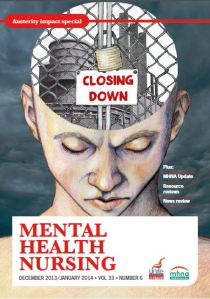
This is also the month that a special, free-to-download, ‘impact of austerity’ edition of Mental Health Nursing journal has appeared. In an email forwarded to all members of Mental Health Nurse Academics UK by Steve Hemingway (who is both an MHNA member and a member of the MHN editorial board), Dave Munday at Unite the Union (which publishes the journal) says:

This month the Mental Health Nursing journal is focused on austerity and mental health. I hope you’ll agree with me that this is a vitally important topic that not only every mental health nurse should know about, but every citizen. We hope that the journal will help to trigger some thoughts and debates that you can have locally in your workplaces but also outside of work. To this end we’re making the journal free to access even if you’re not a MHNA member or MHN subscriber.

Catching up post

Plenty going on in the last week or so. I had the chance to join pre-registration mental health nurses and occupational therapists for a second day as they made preparations for an interprofessional event scheduled for early December. Some of these students have also been giving me drafts of assessed work to comment on, but as the deadline for receipt of these is first thing next week I expect a deluge then. ’twas ever thus.

Elsewhere there has been RiSC reviewing to crack on with, assignment marking, and peer review reports to both consider and write. I’ve also put myself in the frame to act as a reviewer for another university’s proposed new MSc mental health programme, this being the kind of curriculum work I haven’t had the chance to do for a while.

I’m not normally one for formal, suit-and-boot, events, but made an exception last Wednesday (November 27th) to join a posse of colleagues from the School of Healthcare Sciences at the RCN Wales Nurse of the Year awards. These took place at Cardiff City Hall, and the overall winner was Cardiff and Vale UHB ward sister Ruth Owens. Congratulations, Ruth. Congratulations, too, to the individual category winners: including Andy Lodwick (also from Cardiff and Vale) for picking up the Mental Health and Learning Disabilities award and Dr Carolyn Middleton, doctoral graduate from what was the Cardiff School of Nursing and Midwifery Studies, for winning the Research in Nursing award.

This week also brought me to a meeting of the MHRNC Service User and Carer Partnership Research Development Group and, yesterday morning, to the Cardiff City Stadium for an open meeting to discuss NISCHR’s infrastructure and programme funding review. Both were lively events, and on the NISCHR front I see big changes ahead from 2015.

And to close this summary post: via the twitter grapevine I see that the RCN is now giving early notification of the Network for Psychiatric Nursing Research 2014 conference. This will take place at Warwick University on the 18th and 19th of September. I’ll post a link to the call for abstracts once this appears, but for now will reproduce this extract from the event website:

This year [2014] is the 20th international NPNR conference and it’s going to be a celebration.

We wish to celebrate and promote some of the outstanding mental health nursing research that shapes mental health policy and nursing practice across the world. We will also acknowledge some of the best psychiatric and mental health nursing research that helped create the strong foundation for our work today. And we will invite delegates to look ahead to map out the future for mental health nursing research, education and practice.

Reviewing health and social care research in Wales

Here in Wales, a month or so ago the National Institute for Social Care and Health Research (NISCHR) published a document outlining ideas for its restructuring, and opened a discussion on how research should be prioritised, organised and supported in the future. NISCHR says that it:

[…] proposes to engage its stakeholders, including patients, the public, the NHS, social care organisations, universities, industry, the third sector and other government departments to review the infrastructure and programmes it currently funds and help determine what changes should be made.

Now, details of a series of open meetings have appeared. I’ve registered for the November 29th meeting taking place at the Cardiff City Stadium. I will also be offering up some ideas for the School of Healthcare Sciences’ collective response.

A number of things are currently brought together under the NISCHR umbrella. Funding is provided for national-level registered research groups (RRGs), regionally based academic health science collaborations (or partnerships) and a biomedical research centre and series of biomedical research units. Social care research is assisted through capacity-building funding. Support is also provided for Involving People, and for all-Wales training in research governance and related matters. Studies on the NISCHR portfolio are eligible for funded, in-the-field, help via a network of clinical studies officers and research nurses. NISCHR also oversees approval processes for NHS research, funds a number of trials units and has (this year) launched a faculty. There is also the small matter of NISCHR’s competitive funding schemes, which provide project-by-project support for high-quality studies of importance to health and social care in Wales.

Given all of this, NISCHR’s review is, I think, an important process to be contributing to. One of the NISCHR schemes mentioned in the review document is the Research Capacity Building Collaboration for Nursing and Allied Health Professionals (RCBC Wales). This has been an excellent initiative, entirely delivering (so far as I can tell) on its ambitions to develop capacity. As such, it deserves to be continued (and better still, expanded). I have to declare an interest here, of course, being an alumni of the RCBC Wales scheme having secured a postdoctoral fellowship in 2006. This was the funding which allowed me to investigate the establishment, work and wider system impact of crisis resolution and home treatment services, as I’ve variously blogged about in the past here, here and here.

The NISCHR document also draws attention to the use of Welsh health and social care research funds to support NIHR NETSCC Programmes. This paves the way for researchers in Wales to apply, on an equal footing to colleagues in England, for support from the HS&DR Programme, the HTA Programme and others. This mechanism facilitates cross-UK collaboration, which has to be a good thing. It is only through this support that Wales-based colleagues and I have been able to work on the COCAPP and RiSC projects.

I also see mention by NISCHR of an ongoing review of the operation of R&D offices, and in this regard I hope that a way is found to further rationalise approval and governance processes. The NHS research passport system could be better (it’s not really much of a ‘passport’ at all), and there are variations still in the ways different R&D offices process applications.

It is also clear that NISCHR is considering the level and type of support it offers to its all-Wales RRGs, and the connections these might have with biomedical research centres and biomedical research units working in overlapping areas. NISCHR is, if I understand this correctly, thinking through how organisations like the Mental Health Research Network Cymru and the National Centre for Mental Health might relate.

So, there we have it: evidence that changes to health and social care research organisation and funding in Wales are on the cards, with plenty of time remaining for people with an interest to get involved in shaping future arrangements.