Category: Services

Care coordination as imagined, care coordination as done

IJIC aIn July 2018, in the context of writing about the COCAPP team’s newly published meta-narrative review of care planning and coordination in community mental health, I mentioned a further article which had just been accepted for publication. Today this paper has appeared online in the International Journal of Integrated Care. As with all outputs from the COCAPP study this new article is available in gold open access form, meaning that copies can be read and downloaded by anyone with an internet connection.

The paper is titled Care coordination as imagined, care coordination as done: findings from a cross-national mental health systems study. For a taster, here’s the abstract:

Introduction: Care coordination is intended to ensure needs are met and integrated services are provided. Formalised processes for the coordination of mental health care arrived in the UK with the introduction of the care programme approach in the early 1990s. Since then the care coordinator role has become a central one within mental health systems.
Theory and methods: This paper contrasts care coordination as work that is imagined with care coordination as work that is done. This is achieved via a critical review of policy followed by a qualitative analysis of interviews, focusing on day-to-day work, conducted with 28 care coordinators employed in four NHS organisations in England and two in Wales.
Findings: Care coordination is imagined as a vehicle for the provision of collaborative, recovery-focused, care. Those who practise care coordination are concerned with the quality of their relationships with service users and the tailoring of services, but limits exist to collaboration and open discussion. Care coordinators describe doing necessary work connecting people and the system of care. However, this work also brings significant administrative demands, is subject to performance management which distorts its primary purpose, and in a context of scarce resources promotes generic professional roles.
Conclusion: Care coordination must be done. However, it is not consistently being done in the way policymakers imagine, and in the real world of work can be done differently.

 

Joining mental health nursing

Mental health nursing is important and fulfilling work, and offers a fine and rewarding career. More people also need to be doing it. By way of background, last month Mental Health Nurse Academics UK (MHNAUK) submitted a response to Health Education England (HEE)’s Facing the Facts, Shaping the Future draft health and care workforce strategy for England to 2027. Contained in this HEE draft are figures on trends in the numbers of nurses, by field of practice, employed in NHS England over the period 2012 to 2017.
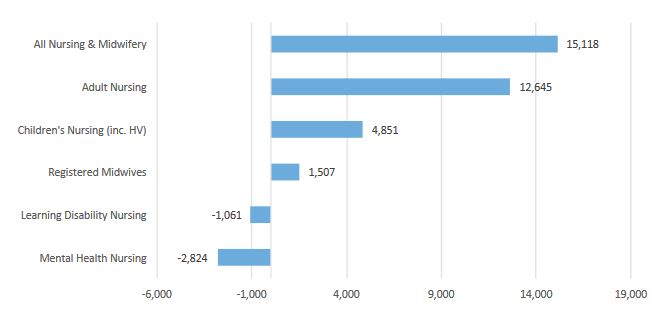
Growth/reduction in NHS employed nurses and midwives by field, 2012 to 2017 (extracted from Facing the Facts, Shaping the Future)

Obvious at a glance from this figure is the decline in both mental health and learning disability nursing numbers over time. Elsewhere HEE also describes a 14% mental health nursing vacancy rate.

Now, the Nursing Times reports a reduction for the second year in a row (£) in the numbers of applications for nursing degrees received via the Universities and Colleges Admissions Service (UCAS). Declining applications need to be viewed in the context of the removal of bursaries for students of nursing enrolling at English universities. In MHNAUK we have said, more than once, that we fear the loss of bursary support poses a particular threat to our field of practice. The same applies to learning disability nursing, where at least one degree programme closed last year (£).

Evidence like this is why initiatives like #MHnursingFuture (see also here, for the Twitter account) are important. Initiated by Dave Munday from Unite the Union, this is all about celebrating the work of mental health nurses and encouraging others to join us. As an occupational group we haven’t always been good at describing what we do, and why what we do is valuable (£). This needs to change, now more than ever.

With all this in mind this may be a good time to remind people of this useful page, hosted on the MHNAUK website, on joining the profession. As this says:

Forget all the stereotypes about straitjackets and Victorian asylums; modern mental health nursing focuses on helping and supporting people from all walks of life with a variety of ‘common’ mental health disorders (such as anxiety and depression) as well as more serious disorders such as drug and alcohol problems, suicidal feelings, psychosis, bipolar disorder and dementia. They also play a key role in promoting mental health and well-being among the public and preventing mental health problems occurring in the first place.

This helpful MHNAUK resource also includes suggestions for further reading, included in which are texts describing in detail many of the skills that mental health nurses routinely use and the context in which they go about their work. And, for any reader contemplating applying to any of the 60+ mental health nursing degree courses offered throughout the UK, do give some thought to our undergraduate nursing programmes here in the School of Healthcare Sciences at Cardiff University.

HCARE welcomes Alan Simpson

Alan's seminarOn November 6th 2017 the School of Healthcare Sciences welcomed Alan Simpson from City, University of London to give a talk titled, Full-steam ahead or treading carefully? Reflections on public and patient involvement in health services research.

In warm and engaging style Alan drew on a whole programme of mental health research (including the City 128 study, Safewards, COCAPP, COCAPP-A and ENRICH) to share his experiences of involving service users at every step. Alan began with an exploration of the reasons for involving patients and the public in research, and drew on his case studies to provide examples of different methods and approaches in action. He closed with lessons learned, emphasising the importance of time, resources, flexibility, training and support, and having funds to pay people for their time and expertise.

The event was livestreamed via the twitter account of the Cardiff University mental health nursing lecturing team. For those who missed Alan and want to catch up, the saved video can still be viewed here:

COCAPP-A full report published

COCAPP-A front pageThe full and final report from COCAPP-A has been published, and can be downloaded here. Led by Alan Simpson, this cross-national comparative case study investigated inpatient mental health care planning and coordination and their relationships to recovery and personalised care in six NHS organisations in England and Wales. COCAPP-A is the partner project to COCAPP, which asked similar questions about community mental health care in the same six sites.
The full COCAPP-A report is a substantial document, but also comes with summaries. Here’s the plain English one to give people a flavour:

Care planning processes in mental health wards should be personalised, conducted in collaboration with service users and focused on recovery.

We conducted a study on 19 wards in six NHS mental health hospitals in England and Wales. Over 330 service users, 320 staff and some carers completed questionnaires and took part in interviews. We also reviewed care plans and care review meetings.

We aimed to identify factors that helped staff in, or prevented staff from, providing care that was discussed with service users and that supported recovery.

When the ward seemed more recovery focused, service users rated the quality of care and the quality of therapeutic relationships highly. Staff rated the quality of relationships with service users better than did service users.

Staff spoke of the importance of involving service users in care planning, but from both interviews and care plan reviews it appeared that, often, this did not happen. Staff were trying to work with people to help their recovery, but they were sometimes unsure how to achieve this when service users were very distressed or had been detained under the law. Service users and carers often said that care was good and provided in an individualised way. Keeping people safe was important to staff, and service users were aware of measures taken to keep them safe, although these were not always discussed with them.

Our results suggest that there is widespread commitment to safe, respectful, compassionate care. The results also support the need for research to investigate how staff can increase their time with service users and carers, and how they can involve people more in discussions about their own care and safety.

There’s plenty of work ahead with journal articles to be produced, derived from the larger document. As the COCAPP and COCAPP-A teams now have community and hospital data relating to the same organisations we also have the opportunity to draw conclusions from both studies. This work has already commenced: Michael Coffey and Sally Barlow have taken a paper titled, ‘Barriers to, and facilitators of, recovery-focused care planning and coordination in UK mental health services: findings from COCAPP and COCAPPA’ to this year’s #MHNR2017, Refocus on Recovery and ENMESH conferences.

Nominal group technique

Time this morning for a quick post drawing attention to this new paper published in Research Involvement and Engagement reporting on our use of the nominal group technique in the now-completed RiSC study.

In this project we were interested in risk, broadly defined, for young people in inpatient mental health settings. We used a two-stage evidence synthesis, convening a stakeholder group midway through to guide us in our focus. This new article gives the detail on the process we used when the group met.

As it happens, the stakeholder meeting was a pivotal event in the life of this study, during which we were directed to find evidence on a whole range of risks which are very rarely considered in mental health services. Examples include the risks of losing contact with education, family and friends. The next step in this programme of research is a KESS2 PhD studentship which will bring to the surface all the things that child and adolescent mental health practitioners do to help young people in hospital to keep in touch. In the meantime, anyone wanting to know more about the RiSC study (should their appetite have been whetted following a read of this new article) might want to follow this link for our main findings paper and this link for our accessible summary.

Nurses needed

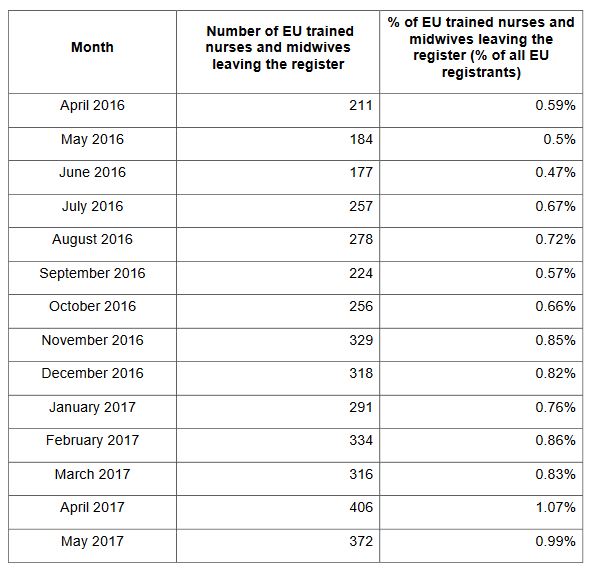
Yesterday the Nursing and Midwifery Council issued a press release reporting on a continued decline in the number of EU-qualified nurses and midwives joining the register, and a simultaneous increase in the number of EU-qualified nurses and midwives leaving. Behind the press release is a longer report, from which I have extracted two tables:

EU trained nurses and midwives joining the NMC register for the first time. Extracted from: https://www.nmc.org.uk/globalassets/sitedocuments/special-reports/nmc-eu-report-june-2017.pdf
EU trained nurses and midwives leaving the NMC register. Extracted from: https://www.nmc.org.uk/globalassets/sitedocuments/special-reports/nmc-eu-report-june-2017.pdf
 Judged on these figures the number of EU nurses coming to the UK looks to have slowed to a trickle. Elsewhere, in its report In short supply: pay policy and nurse numbers The Health Foundation points out that in 2015 NHS England had 22,000 too few nurses specialising in the care of adult patients. The mental health field, The Health Foundation adds, is one where (for the present) tools to calculate safe staffing are virtually non-existent.

Meanwhile, UCAS (the Universities and Colleges Admissions Service) reports that applications for higher education programmes commencing in the 2017-18 academic year have declined across the board, but that it is nursing courses which have seen the sharpest fall. Applicants from England making at least one choice to study nursing dropped by 23% (to 33,810) in 2017.

The RCN, amongst others, has long been campaigning against persistent low pay for NHS nurses, arguing that a career which is so obviously poorly remunerated is no incentive to potential new recruits. Nor, for that matter, does it help efforts to retain existing staff. Previous reports from the RCN tell us that the UK’s nursing workforce is an ageing one

Taken together, the loss of European nurses in the context of last year’s EU referendum, chronically poor workforce planning, a nursing profession which is getting older (and will therefore lose members to retirement), the loss of bursaries in England and continued low pay make for a toxic combination. But things can be done. Agreeing the future security of EU citizens in the UK would be a start, along with removing the NHS pay cap. Reintroducing bursaries might help rekindle UCAS applications. Better planning of future NHS staffing needs is long overdue. Nursing, of course, remains a mightily fulfilling career and I would hate to think that this (admittedly rather negative) post puts off anyone contemplating a move in this direction. But it also serves to highlight some of the serious challenges which lie ahead.


Mental health awareness week

Mental Health Awareness Week 2017 has the theme of ‘surviving or thriving’, this also being the title of a new report from the Mental Health Foundation. Included in this document is a summary of research completed by NatCen, on behalf of the Mental Health Foundation, into the prevalence of mental health problems across the population and into the activities that people do to manage these.

Here’s a snip from the report, summarising the self-reported difficulties experienced by the 2,290 people who took part:

MHF thriving
Extracted from Surviving or thriving

Using their NatCen data the Mental Health Foundation goes on to highlight major health inequalities. Almost three quarters of those on the lowest household income report experience of mental health difficulties, compared to six in ten of the wealthiest. A large majority of unemployed people responding reported experience of mental health problems, with women and younger people also particularly affected.

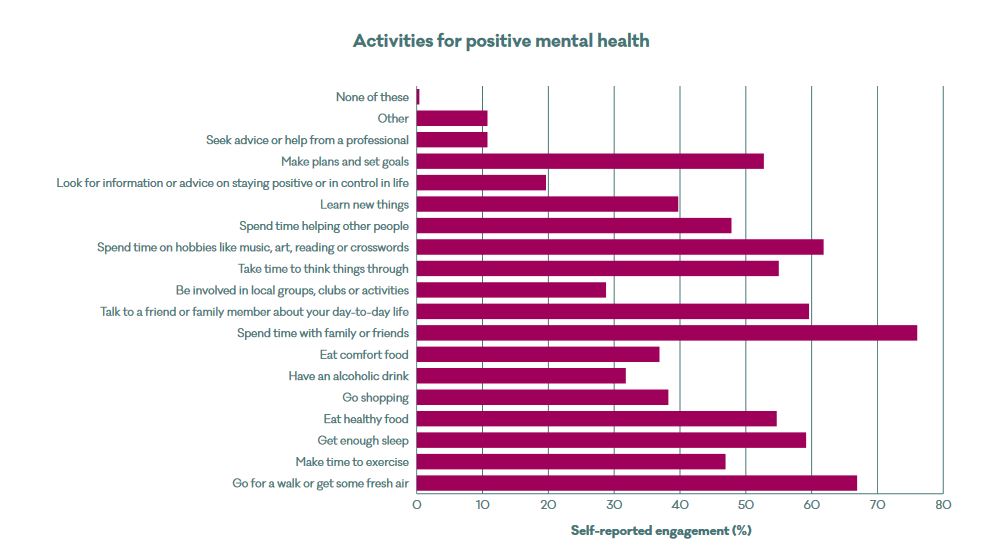
These findings are broadly in line with those reported in the most recent Mental Health and Wellbeing in England Adult Psychiatric Morbidity Survey, the data for which was collected in 2014. This is the latest in a series of studies dating back to 1993, involving (in the 2014 iteration) a sample of some 7,500 people. In the case of Surviving or thriving, the new (to me, at any rate) detail is the reporting of what actions people take to help themselves with their difficulties. Here’s another snip:

Surviving 2
Extracted from Surviving or thriving

Family and friends, outdoor physical activity and hobbies look to be the three most-used strategies. I can’t say I’m surprised by this, and am reminded of the value placed in relationships with others by people taking part in COCAPP.

Elsewhere during Mental Health Awareness Week, The Guardian has published a number of pieces including this one on the shortage of mental health nurses and this one on Hafal‘s Gellinudd Recovery Centre (about which I previously blogged here). Coincidentally, this is also the month that the full and final report from COCAPP-A has been accepted for publication: well done Alan Simpson for leading this work. This mighty tome, reporting from our cross-national study into care planning and coordination in acute mental health inpatient settings, has now proceeded to the production arm of the NIHR and is scheduled to appear in gold open access form towards the end of the year. In the meantime, work is progressing to produce papers for journals. More on these to follow in due course.

PhD opportunity

KESS2With Nicola Evans and Rebecca Playle I’m on the look-out for someone to begin a full-time PhD in the autumn, investigating the interventions and processes that promote young people’s connection to their education, friends and families during inpatient mental health care. This is a Knowledge Economy Skills Scholarship (KESS2), which is part funded by the Welsh Government’s European Social Fund (ESF) West Wales and the Valleys programme. It has also been developed in collaboration with Cwm Taf University Health Board which is making a contribution to the award.

For those interested, the studentship has been explicitly designed to build on our RiSC evidence synthesis, about which I have previously written here, here and here. We found significant knowledge gaps in this previous project, which we’re now anticipating this PhD will begin to fill.

Safe staffing (again)

safe staffingJust over a year ago I posted a short piece on this site on safe staffing, particularly noting the work of Shaun Lintern and John Baker in alerting people to the importance of this in the mental health nursing context. Since then, the Nurse Staffing Levels (Wales) Act 2016 has passed into law, and the Welsh Government has opened this consultation on its draft statutory guidance for Local Health Boards and NHS Trusts. My colleague Aled Jones is coordinating a School of Healthcare Sciences response.

Here in Wales, the duty to calculate nurse staffing levels is currently limited to adult acute medical and surgical inpatient wards. In each NHS organisation with responsibilities in these fields, the Government’s draft document refers to the appointment of a ‘designated person’ with the job of calculating nurse staffing levels using three elements:

  • professional judgement;
  • use of an evidence-based workforce planning tool; and
  • a consideration of the extent to which patients’ wellbeing is sensitive to nursing care.

Making these calculations, I can only imagine, will be a mighty challenging task requiring in-depth understanding of individual wards, the characteristics of patients admitted, and use of a tool which has (so far as I understand it) yet to be finalised.

Meanwhile, via John Baker I learn today of this new publication by NHS Improvement on safe, sustainable and productive staffing in mental health services. This is not about safe nursing staffing, but is about interprofessional staffing in specialist mental health services. Here I read of expectations around right staff, right skills and right place, right time and also spot a rapid review of the relevant literature. This begins with the understated observation that, ‘the issue of safe and sustainable staffing in mental health is complex and research is lacking’. I should say so. The time is ripe, I think, for some serious independent studies in this area.