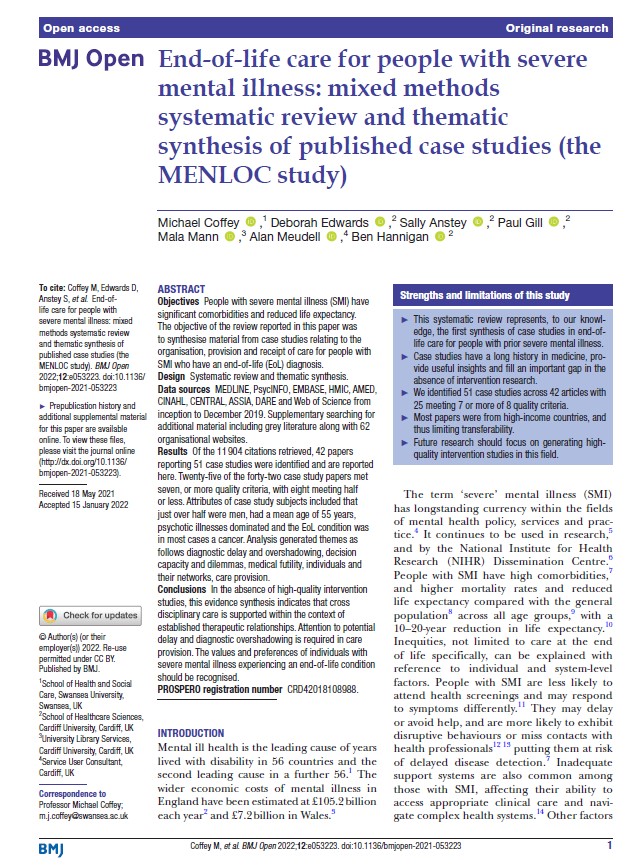
Here is our second published paper from the MENLOC project, which has synthesised what is known about end of life care for people with severe mental health problems. This article, led by Michael Coffey, reports on our theming of the evidence derived from previously-published case studies. The paper is in BMJ Open, is open access, and has this as its abstract:
Objectives: People with severe mental illness (SMI) have significant comorbidities and reduced life expectancy. The objective of the review reported in this paper was to synthesise material from case studies relating to the organisation, provision and receipt of care for people with SMI who have an end-of-life (EoL) diagnosis.
Design: Systematic review and thematic synthesis.
Data sources: MEDLINE, PsycINFO, EMBASE, HMIC, AMED, CINAHL, CENTRAL, ASSIA, DARE and Web of Science from inception to December 2019. Supplementary searching for additional material including grey literature along with 62 organisational websites.
Results: Of the 11 904 citations retrieved, 42 papers reporting 51 case studies were identified and are reported here. Twenty-five of the forty-two case study papers met seven, or more quality criteria, with eight meeting half or less. Attributes of case study subjects included that just over half were men, had a mean age of 55 years, psychotic illnesses dominated and the EoL condition was in most cases a cancer. Analysis generated themes as follows: diagnostic delay and overshadowing, decision capacity and dilemmas, medical futility, individuals and their networks, care provision.
Conclusions: In the absence of high-quality intervention studies, this evidence synthesis indicates that cross-disciplinary care is supported within the context of established therapeutic relationships. Attention to potential delay and diagnostic overshadowing is required in care provision. The values and preferences of individuals with severe mental illness experiencing an end-of-life condition should be recognised.

 This new paper has been a long time in the making. Work on it began with preparations for an address given at the
  In July 2020, with colleagues I received peer review feedback on our draft MENLOC study final report, about which
  In the case of MENLOC the journal in which our final report will be published is
  Back in summer 2019 (which seems, for pandemic-related reasons, to be much longer than a year ago) I wrote
  Meanwhile, one type of research relatively unaffected by the coronavirus outbreak is the evidence synthesis. In Cardiff we have the
  Here’s a belated catch-up post (the second of three), produced largely with the aim of revitalising this blogsite and summarising recent happenings. This one I’ve dated to March 2020, and the period in which UK was first locking down in response to the COVID-19 pandemic.
