Category: Services

Summer sun

Just as predicted by those nice people at the Met Office, South Wales is warming up. The sun is high, and I hear the voices of schoolchildren playing football. I’ve been stuck inside all day, which in the circumstances has been something of a drag, but in the last hour or so I’ve gravitated outside to soak up some of this long-awaited summer.

This has been a working week as varied as any. I had a couple of School committees to chair (research ethics, and scientific review), some teaching (MSc), and a meeting with colleagues to plan some pre-registration interprofessional education in the autumn. This is a continuing mental health nursing/occupational therapy initiative (which I’ve posted about before), and on this occasion we’re planning some technological innovation involving the use of video recording and playback. On the research front I’ve been working on RiSC and keeping in touch with COCAPP, and found myself contributing to a rapidly convened meet-up to talk through a brand new project idea. I received page proofs for our new Critical junctures paper, peer reviewed a manuscript submitted for publication, and received a citation alert from Scopus. This was particularly pleasing as it took my ‘h’ index to 15, for what that’s worth. I also completed preparations for a doctoral examination taking place next Tuesday, and managed to squeeze in a pleasant catch-up with an esteemed colleague working in NHS mental health services. Mostly we exchanged news of developments in practice, services and research locally.

And with that, I’m off. Beer in the back garden calls.

Increasing the visibility of research

Where publishers’ copyright rules permit, since last year I have been uploading green open access versions of peer reviewed research papers I have written or co-written to ORCA, Cardiff University’s digital repository. I have then been adding hyperlinks to these papers to research-related posts on this blog. To round this all off I’ve been using Twitter to draw attention to what I’ve been up to.

Having a WordPress blog means that I get to see which hyperlinks anonymous readers are following, and I know that some onward clicks are taking people to my open access articles. At the end of last week I asked colleagues managing ORCA if any tools existed to help me find out which of my papers have been downloaded, and when.

What I now have is access to an application allowing me to interrogate ORCA in all sorts of ways. So I know, for example, that full-text papers I have authored and saved to the repository have been downloaded 360 times between January 1st 2005 (the earliest date I can select) and today, July 3rd 2013. Two hundred and eighty eight of these downloads have taken place since November 24th 2012, this being the date I created this blog and first posted.

Here is a summary of my ORCA ‘eprints’ and the number of times each has been downloaded up to today:

Eprint Fulltext Downloads
Hannigan, Ben and Allen, Davina Ann 2013. Complex caring trajectories in community mental health: contingencies, divisions of labor and care coordination. Community Mental Health Journal 10.1007/s10597-011-9467-9
file
150
Hannigan, Ben and Coffey, Michael 2011. Where the wicked problems are: the case of mental health. Health Policy 101 (3) , pp. 220-227. 10.1016/j.healthpol.2010.11.002
file
70
Coffey, Michael and Hannigan, Ben 2013. New roles for nurses as approved mental health professionals in England and Wales: A discussion paper. International Journal of Nursing Studies 10.1016/j.ijnurstu.2013.02.014
file
65
Hannigan, Ben and Allen, Davina Ann 2011. Giving a fig about roles: Policy, context and work in community mental health care. Journal of Psychiatric and Mental Health Nursing 18 (1) , pp. 1-8. 10.1111/j.1365-2850.2010.01631.x
file
24
Hannigan, Ben 2013. Connections and consequences in complex systems: insights from a case study of the emergence and local impact of crisis resolution and home treatment services. Social Science & Medicine 10.1016/j.socscimed.2011.12.044
file
20
Hannigan, Ben and Allen, Davina Ann 2006. Complexity and Change in the United Kingdom’s System of Mental Health Care. Social Theory & Health 4 (3) , pp. 244-263. 10.1057/palgrave.sth.8700073
file
18
Hannigan, Ben and Allen, Davina Ann 2003. A tale of two studies: research governance issues arising from two ethnographic investigations into the organisation of health and social care. International Journal of Nursing Studies. 40 (7) , pp. 685-695. 10.1016/S0020-7489(02)00111-6
file
13

All are papers I have specifically blogged about, and have subsequently flagged up on my Enduring posts page. I am therefore going to tentatively conclude that the approach I have taken to increase the visibility of my research is having an effect.

What I do not know is who has been downloading (and hopefully reading!) these articles, and for what purposes. I would like to think it has been a mixture of researchers, practitioners, managers, policymakers and service users. I also hope they have found what they have read to have been both interesting and useful.

Jobs for new nurses

One of the things I’ve been doing recently is meeting up with final year students about to complete their degrees and register with the Nursing and Midwifery Council. These are hard-working, committed, people who have chosen to prepare for careers in mental health nursing. They’re now looking for jobs, and from what I’m hearing opportunities locally and nationally are few and far between.

Here, then, is the sharp end of NHS underfunding. There’s no question that new mental health nurses are required. In fact, we should expect demand to increase at a time of hardship. The problem is that vacancies are being frozen and services are generally retracting. As economic collapse fuels distress and increases need austerity bleeds public services of the capacity to respond.

So, good luck to everyone preparing to qualify. I hope you get the jobs you want and deserve, because you’re needed.

Welcome meeting for the RiSC project

Yesterday brought a there-and-back trip to Southampton, with esteemed colleagues Nicola Evans and Deborah Edwards, for an NIHR Health Services and Delivery Research Programme welcome meeting for our RiSC project. This was an opportunity to meet with other funded researchers (and very interesting they were, too) and to learn more about how the HS&DR Programme works with investigators over the lifetime of projects and beyond. We also had the chance to present our study, and to field questions from the floor.

On its website the HS&DR Programme says that it:

aims to produce rigorous and relevant evidence on the quality, access and organisation of health services, including costs and outcomes. The programme will enhance the strategic focus on research that matters to the NHS including research on implementation and a range of knowledge mobilisation initiatives. It will be keen to support ambitious evaluative research to improve health services.

And that it:

aims to support a range of types of research including evidence synthesis and primary research. This includes large scale studies of national importance. This means primary research projects which:

  • Address an issue of major strategic importance to the NHS, with the cost in line with the significance of the problem to be investigated
  • Are likely to lead to changes in practice that will have a significant impact on a large number of patients across the UK
  • Aim to fill a clear ‘evidence gap’, and are likely to generate new knowledge of direct relevance to the NHS
  • Have the potential for findings to be applied to other conditions or situations outside the immediate area of research
  • Bring together a team with strong expertise and track record across the full range of relevant disciplines
  • Will be carried out across more than one research site.

A search through the programme’s portfolio of projects turns up a raft of studies of national and international significance, including work (ongoing and completed) led by or involving nurses. Well worth a look, in my view…

Mental health nursing’s dirty work

Yesterday the national mental health charity Mind released information on the use of face-down restraint in mental health services. It says:

Mind is today calling for the government and NHS England to put an end to life-threatening face down restraint of people with mental health problems in healthcare settings. Data secured by Mind under the Freedom of Information Act reveals that at least 3,439 patients in England were restrained in a face down position in 2011-12, despite the increased risk of death from this kind of restraint.

Restraining people is part of mental health nursing’s ‘dirty work’. This is a phrase which originally comes from the American sociologist Everett Hughes. Robert Emerson and Melvin Pollner picked it up in a paper titled, Dirty work designations: their features and consequences in a psychiatric setting, and more recently Paul Godin wrote about A dirty business: caring for people who are a nuisance or a danger. There are plenty of other ‘dirty work’ articles out there, too, for those interested in finding them.

‘Dirty work’ involves doings things which are in some way tainted or shameful, but which might still have to be done. A professional group’s dirty work is not the first thing its members typically like to talk about when asked to describe what they do. When mental health nurses present themselves to others it is the helping relationships they build, the listening they do and the recovery they promote that are more likely to feature. My guess is that experiences of holding, secluding and forcibly medicating people are not things that nurses immediately volunteer.

Because dirty work can sometimes feel degrading and morally suspect it can feel easier not to talk about it at all. The good news in mental health nursing is that there are plenty of people interested in describing, researching and questioning the more coercive and controlling aspects of what we collectively do. Len Bowers and Joy Duxbury are examples. In addition to calling for a ban on face-down restraint, in its news release yesterday Mind pressed for the implementation of national standards and accredited training in this area. Nurses have a big part to play in the debates which are to follow and in developing new practices, and I’ll be watching with interest.

First reflections on two days away

A series of train journeys home gives me space to mull over two days spent in London. Yesterday opened with a meeting of the COCAPP Lived Experience Advisory Group (LEAG), expertly chaired by the wonderful Alison Faulkner. Significantly, key parts of COCAPP are changing in response to LEAG recommendations. Our semi-structured interview schedules, for example, directly reflect the LEAG’s input. This is all good, and I am personally learning huge amounts from the opportunity to be involved.

Yesterday evening saw Alan Simpson give his Skellern Lecture followed by Malcolm Rae receiving his Journal of Psychiatric and Mental Health Nursing Lifetime Achievement Award.

As entirely anticipated Alan gave an informed, engaging and challenging talk, which took in his personal journey into mental health nursing and conveyed key messages from his research. Alan gave us plenty to think about. Might peer support workers be attractive to managers with squeezed budgets? Might they begin to replace members of more established groups, nurses included? Or, as Alan hoped, can peer support workers, nurses and others work side-by-side in harmonious fashion for the benefit of people using services?

Malcolm Rea I do not personally know, though based on the talk on leadership in mental health nursing he gave yesterday this has been my loss. I shall remember his contrasting of ‘drains’ and ‘radiators’ (and try personally to be more of the latter than the former).

Yesterday ended with a convivial social in a London pub, and today was more COCAPP: this time a team meeting followed by a Project Advisory Group (PAG) skillfully chaired by John Larsen from Rethink. Some of our discussion centred on the finer aspects of COCAPP’s design and methods, and for that the study will benefit.

So there we are then: only the shortest summary of some pretty involved discussions, but it will do for now. Home calls.

Nursing beleaguered?

Catching my eye earlier this week was an interview in The Guardian with Jane Cummings, Chief Nursing Officer (CNO) with a place on NHS England‘s National Commissioning Board. Under the header, ‘Nobody can say care is brilliant all the time’ the article opened with this understated quote:

‘It was very clear that nursing was getting a bit of a bad name and it felt like the profession was being quite beleaguered and criticised.’

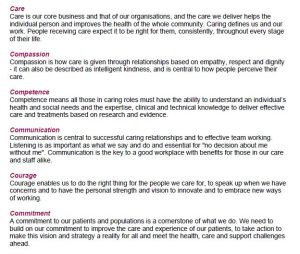
Nursing certainly has been under siege. Responses to descriptions of poor care have included the three year Compassion in Practice strategy introduced by the CNO and her Director of Nursing counterpart at the Department of Health, Viv Bennett. It is in this document that the 6Cs are described:
It is also in this general context, but specifically following the publication of the Francis Report into Mid Staffordshire NHS Foundation Trust, that the proposal was made that student nurses should spend a year doing health care assistant (HCA) work before beginning their training. This government plan has proven mightily controversial, and when announced provoked immediate broadsides from (amongst others) June Girvin (a nurse, and Pro Vice Chancellor at Oxford Brookes University) and Jackie Kirkham (a health visitor and researcher at Edinburgh University). Now it has drawn a closely referenced rebuttal from the Council of Deans of Health. Here is what the Council says in its conclusion:

The proposals for HCA experience prior to joining a pre-registration nursing programme are underpinned by a set of assumptions about nursing education and selection of prospective students that is deeply flawed. It paints a picture of students who have never had experience of caring and little interest in patient care, picked out for their grades by a group of academics in total isolation from staff working in clinical services. The message from current practices and the NMC Standards that govern them is that this mental picture needs to change. In particular, the assumption that students are not recruited for their values and that students do not have prior care experience are incorrect.

What about the nub of the proposal: that exposure to the clinical frontline as a HCA will create better nurses? The evidence here is equivocal at best. What care experience does seem to do is give prospective students exposure to the reality of working in healthcare and so it may reduce attrition from programmes. But there is also evidence that working as a HCA can socialise prospective students into poor practice and inhibit their development as nurses. Unless the evidence is looked at carefully, these proposals could therefore embed rather than challenge poor patient care. As the pilots of the proposals are developed, care must be taken both to recognise existing practice and carefully test assumptions against the evidence.

So, nursing practice and nursing education are in the spotlight, and the profession has responded. Senior members have asserted a set of fundamental values (the 6Cs), and in resisting the year-as-an-HCA idea have reminded people of the differences between what nurses and other health care workers do.

Nurses discomforted by this heightened scrutiny might consider their position alongside that of other public services workers. Social workers draw attention to the problem they face of being ‘damned if they do and damned if they don’t’. Then there are teachers, who fear the erosion of their professional standing as former servicemen and women prepare to enter the classroom without having to study for degrees. Back in the health service, some doctors (psychiatrists, in this instance) express concern over threats to their role and identity, whilst the profession as a whole is accused of greed.

We are therefore in good company. Other workers know what it is like to be told they have collectively fallen short, and understand how it feels to have their status undermined. Status-knocking sometimes happens because professional groups engage in ongoing division of labour skirmishes, as I have drawn attention to on this site before. But nursing’s current predicament, in which we are charged with having a ‘compassion deficit’ and sacrificing a commitment to care in the pursuit of academic credentials, is different.

Perhaps nurses have finally lost enough of the untouchable, ‘angel’, image (no bad thing, in my view) to now be viewed as ‘just’ another professional group in whom trust is conditional. We control entry to our profession, expect degrees from new entrants, have university departments and lead interprofessional teams and whole services within the NHS. In turn, we must expect to face questions when things go wrong, and to justify why we do practice and education in the ways that we do. For the record, I strongly favour system explanations for what happens in the health service (including its failures), see no evidence that student nurses no longer care and much prefer practitioners to be educated than not. But I also think we must expect, and should prepare for, more ‘bashing’ in the future.

What future the NHS (2)?

Further to my last post referring to Raymond Tallis’ staunch defence of the NHS, a second excellent health service-related talk at Hay was Andrew Edgar’s. Andrew is a philosopher at Cardiff University, and on Tuesday he gave a customarily considered account of (amongst other things) the principles underpinning the NHS and how these contrast with those associated with health care systems elsewhere in the world. I particularly appreciated Andrew’s view of the NHS as being more than a way of simply (simply?) funding and delivering health care. It is a unifying force, embodying the majority view that some things are best paid for and organised collectively. Insurance based systems, as Andrew observed, are abhorrent to many in the UK because they treat health care as a commodity and pay insufficient regard to need.

Beyond the principles, as Andrew also pointed out, lie some difficult day-to-day health service realities. These include the existence of rationing (which clearly exists, but is rarely talked about in an open way), and the fact that the system retains a capacity to grind down, and sometimes even brutalise, those who work within it. But opening the service up to market forces, along the lines happening in England with the passing of the Health and Social Care Act 2012, is no remedy. Note my reference to ‘England’ here. Quite correctly, in my view, Andrew was careful to talk of not one but four ‘NHSs’ reflecting the divergence in systems across the different countries.

What future the NHS?

Yesterday at the Hay Festival I heard Raymond Tallis deliver a strong attack on the coalition government’s ‘redisorganisation’ of the NHS in England. The Health and Social Care Act 2012 has opened the NHS to the market in unprecedented fashion. Tallis talked of the dominance of private providers on clinical commissioning groups, and gave examples of patients being cherrypicked by organisations more concerned with profit than with meeting need. He also contrasted the upheaval with pre-2010 general election promises by both the Conservatives and the LibDems not to unleash major top-down change on the health service.

Tallis was critical of his own profession (medicine) for having failed to coordinate opposition to the legislation as it worked its way through parliament. He did, though, pick out and praise Clare Gerada of the RCGP for leading the resistance. I’m aware that the RCN was against the proposed Act, but I’m not sure that nurses as a group were particularly visible during the debates.

The first question from the audience asked what needs to be done to prevent the Act infecting Wales. The balance of politics here is different than in England, but it was a good question nonetheless.

COCAPP: involving service users

Time this morning for a brief post drawing attention to two excellent opportunities for people with personal experience of using mental health services to contribute to COCAPP.

I’ve written about COCAPP on this site before, and we’re now looking for people to work with us in the recruitment of participants and with the generation of data.

Information about the positions can be found by clicking this link, then following the link onwards to ‘Managerial, Administration and Support’. The opportunities are listed as vacancy number 1007BR, ‘Service User Project Assistants’.