Category: Research

#NPNR2016 review 

I’m back from my annual trip to the International Network for Psychiatric Nursing Research conference, held this year in Nottingham and once again presented as a collaboration between MHNAUK and the RCN

This, the 22nd NPNR gathering, is the second for which I have served as a member of the conference organising and scientific committee. Our theme – trailed well in advance via our dedicated conference twitter account – was mental health across the lifecourse. We had some super keynote speakers: Elaine Hanzak, who spoke with openness about her recovery from postnatal mental illness; Luciana Berger MP, former Shadow Minister for Mental Health and President of the Labour Campaign for Mental Health, who demonstrated knowledge of, and commitment to, the field; John Keady, who spoke with passion about creative, biographical, approaches to researching the needs and experiences of people with dementia, including in his ongoing Neighbourhoods and Dementia programme; Steven Pryjmachuk, who made the case for nursing leadership in children and young people’s mental health research, and along the way gave a mention to the RiSC study; and Bryn Lloyd-Evans, who summarised the state of play in crisis resolution research, drawing (amongst other things) on the CORE programme. Our plenary sessions were expertly chaired by Wendy Cross and Geoff Dickens, and – as a first – this year’s event also included a partnership with André Tomlin from the Mental Elf Service and Mark Brown and Vanessa Garrity from the WeMHNurses community. This meant we had lots of social media and online discussion throughout the conference, recording of plenary sessions and a live-streamed pre-event round table evening discussion chaired by Alan Simpson. Here is a link to the recording, for those who missed it as it happened:

Once I have a link to the recordings of #NPNR2016’s keynote talks I’ll update this post with these, too. 

A note, too, on the conference’s workshops and concurrent sessions. I enjoyed participating in André Tomlin’s critical appraisal workshop, and with Elaine Hanzak writing a contribution during this to the blog post published on The Mental Elf website here. I also enjoyed our follow-up discussion on using social media, convened by André and Vanessa Garrity. I heard Nicky Lambert give two presentations (no less), and listened to talks from Karen Wright, Paula Libberton, Andrew Grundy and Ashlee Charles. There’s some great work going on out there, let it be said. That includes in COCAPP-A, Plan4Recovery and RiSC, all of which were presented in Nottingham.

As soon as we’re able, the conference organising committee will announce details of both dates and venue for #NPNR2017. Watch this space for an update. 

Recovery Colleges

Last month I had the opportunity to visit Gellinudd, the soon-to-be-opened recovery centre in Pontardawe run by the Welsh mental health charity Hafal. I was there with my Cardiff colleague Aled Jones, but also with Shu-Jen Chen (a former PhD student of mine: as an aside, follow this link for a copy of her thesis, which is on self awareness and the therapeutic use of self in Taiwanese community mental health nurses), four of her students from the College of Nursing at the Central Taiwan University of Science and Technology and one of our Cardiff mental health nursing students, Alys Jones.

Following this link takes you to the report of our visit published on the Hafal website, complete with photos. The Gellinudd Recovery Centre is opening at the beginning of 2017, and will be Wales’ first recovery college. Recovery colleges are a relatively new arrival within the mental health system; a useful introduction to them is this Centre for Mental Health briefing. The Gellinudd Recovery Centre buildings used to be an NHS hospital, and the whole is located in very pleasant woodland. Right now, Hafal is recruiting for registered nurses (and others) to work there.

Recovery, it has to be said, can mean different things to different people. This is one of the things we found in COCAPP, as we reported in our main findings paper. No shared understanding was revealed amongst people taking part in our interviews. Hafal write about what they believe ‘recovery’ means in their booklet, Recovery: the way ahead for people with severe mental illness. This is referenced in the job descriptions currently on the Hafal website as part of their current Gellinudd recruitment campaign. They place particular emphasis on empowerment, a whole person approach and progress. The term which will be used in the recovery centre to refer to people in residence is ‘guests’, and plans are in place to make the most of the centre’s green environment.

Elsewhere, #NPNR2016 is now only a few weeks away. We meet in Nottingham, and the conference promises to be an excellent one. I’ll aim to post some more about this at a later point.

Mental health and Europe

I am all for interdependence and collaboration, and take no pleasure in the prospect of the UK casting itself adrift from the European Union. With MSc students I have sometimes discussed global mental health, and policy in this area. This has included talking about work led by the EU. Derived from my teaching, here for information are some of the initiatives member states have taken together.

First is 2005’s Green Paper, Improving the mental health of the population: towards a strategy on mental health for the European Union. Green Papers stimulate discussion, and this one made its case for action with reference to the extent of mental health need across Europe, the cost to economies and the problem of social exclusion.

Next up is the European pact for mental health and wellbeing, which in 2008 presented five priorities against a background of rising rates of mental illness:

  • Prevention of depression and suicide
  • Mental health in youth and education
  • Mental health in workplace settings
  • Mental health of older people
  • Combating stigma and social exclusion

The Joint action mental health and wellbeing from 2013 uses its funds to address these five areas:

  • Depression, suicide and e-health
  • Community-based approaches
  • Mental health at workplaces
  • Mental health and schools
  • Mental health in all policies [which recognises how policy in non-health areas can have an effect on mental health]

The European Union also supports mental health research. Take, for example, the work of the ROAMER consortium which has agreed a series of research priorities. Here they are:

  • Preventing mental disorders, promoting mental health and focusing on young people
  • Focusing on causal mechanisms of mental disorders
  • Setting up international collaborations and networks for mental health research
  • Developing and implementing new and better interventions for mental health and well-being
  • Reducing stigma and empowering service users and carer
  • Research into health and social systems

For a comprehensive list of Horizon 2020 and FP7 projects in the field of mental health, try following this link.

Leaving the EU will greatly diminish opportunities for people in the UK to cooperate with people in Europe to tackle our shared problems, of which mental ill-health and its associated stigma is most definitely one. On the research front, post-EU referendum some in UK universities are already reporting that their collaborations with academics in other EU member states are under threat. Suffice to say I wish the vote on June 23rd had gone the other way.

Ordinary risks and accepted fictions

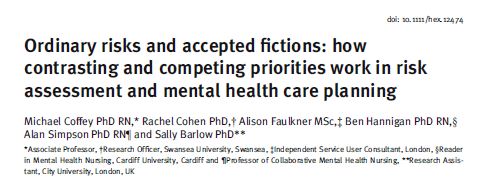
Ordinary risksThis new paper you need to read. You also can, because it is published in gold open access form and is therefore free to download to anyone with an internet connection. Lead authored by Michael Coffey, and arising from the larger COCAPP study (see also here, here and here), it draws on qualitative data to examine in detail what staff, service users and carers say about risk assessment and management. Here’s the abstract:

Background

Communication and information sharing are considered crucial to recovery-focused mental health services. Effective mental health care planning and coordination includes assessment and management of risk and safety.

Objective

Using data from our cross-national mixed-method study of care planning and coordination, we examined what patients, family members and workers say about risk assessment and management and explored the contents of care plans.

Design

Thematic analysis of qualitative research interviews (n = 117) with patients, family members and workers, across four English and two Welsh National Health Service sites. Care plans were reviewed (n = 33) using a structured template.

Findings

Participants have contrasting priorities in relation to risk. Patients see benefit in discussions about risk, but cast the process as a worker priority that may lead to loss of liberty. Relationships with workers are key to family members and patients; however, worker claims of involving people in the care planning process do not extend to risk assessment and management procedures for fear of causing upset. Workers locate risk as coming from the person rather than social or environmental factors, are risk averse and appear to prioritize the procedural aspects of assessment.

Conclusions

Despite limitations, risk assessment is treated as legitimate work by professionals. Risk assessment practice operates as a type of fiction in which poor predictive ability and fear of consequences are accepted in the interests of normative certainty by all parties. As a consequence, risk adverse options are encouraged by workers and patients steered away from opportunities for ordinary risks thereby hindering the mobilization of their strengths and abilities.

Reported here is one of the most important sets of findings arising from the COCAPP study. Diana Rose has written a post on the article, which is scheduled to appear on the inestimable Mental Elf site next week. I’m very much looking forward to reading that.

Resilience of community mental health nurses in Palestine

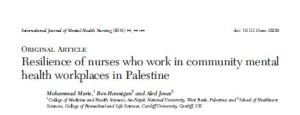
Earlier this week a new article lead authored by Mohammad Marie, and co-authored by Aled Jones and me, was published in the International Journal of Mental Health Nursing. The title of the article is Resilience of nurses who work in community mental
health workplaces in Palestine
, and is the second paper arising from Mohammad’s completed PhD. As the article appears in gold open access form copies can be directly downloaded from the journal’s website for free: or indeed, by clicking either the hyperlinked title or image above.

The larger part of Mohammad’s qualitative dataset is interviews conducted with CMHNs working in the West Bank. Fifteen practitioners took part, from a total population of 17. For the record, that’s 17 community mental health nurses for a population of some three million people. That’s an astonishingly low number by UK standards; for more on mental health needs and services in Palestine, the place to go is Mohammad’s first paper (Mental health needs and services in the West Bank, Palestine) about which I previously blogged here.

Here is the abstract from this latest paper:

People in Palestine live and work in a significantly challenging environment. As a result of these challenges they have developed resilient responses which are embedded in their cultural context. ‘Sumud’, in particular, is a socio-political concept which refers to ways of surviving in the context of occupation, chronic adversity, lack of resources and limited infrastructure. Nurses’ work in Palestine is an under-researched subject and very little is known about how nurses adjust to such challenging environments. To address this gap in the literature this study aimed to explore the resilience of community mental health nurses (CMHNs) who work in Palestine. An interpretive qualitative design was chosen. Fifteen face-to-face interviews were completed with participants. Thirty-two hours of observations of the day-to-day working environment and workplace routines were conducted in two communities’ mental health centres. Written documents relating to practical job-related policies were also collected from various workplaces. Thematic analysis was used across all data sources resulting in four main themes, which describe the sources of resilience among CMHNs. These sources are ‘Sumud and Islamic cultures’, ‘Supportive relationships’, ‘Making use of the available resources’, and ‘Personal capacity’. The study concludes with a better understanding of resilience in nursing, which draws on wider cultural contexts and social ecological responses. The outcomes from this study will be used to develop the resilience of CMHNs in Palestine.

The idea of ‘Samud’ which is referred to above is an important one in Mohammad’s work, and (as I have learned) for Palestinian people. Drawing on the work of Toine Van Teeffelen, here is what Mohammad says about it in his thesis:

[Samud] is the art of living to survive and thrive on their homeland in spite of hardship and under occupation practices. These skills of how to live are used in different aspects of life such as economic, political and social. They can also be used at many levels: individual, family and within the Palestinian community. Moreover, Sumud has been divided into two types: tangible resources such as the infrastructure supporting basic needs (for example, schools and hospitals) which enable the existence of the Palestinians on their land and help them to be more resilient. In addition intangible sources of Sumud also exist, which include: belief systems, religion and social and family support which help the Palestinians to cope with their chronic daily collective suffering.

For Mohammad, Samud is closely related to the more familiar (to me, at any rate) idea of resilience. Or, more properly put, Samud connects to social ecological variants of resilience which place as much emphasis on the social and cultural as they do on the individual.

I’ll stop here and leave people to download and read this new paper for themselves. For those interested, Mohammad, Aled and I are working on further publications from this doctorate: so more will follow in due course.

Understanding mental health systems and services — Mental Health / Iechyd Meddwl

Here’s a link to my first post for a new Cardiff University Mental Health Blog. The content will be broadly familar to people who have dipped into my personal blog in the past, insofar as I have chosen to say something general about doing mental health services research.

Working in collaboration with colleagues across the UK, including with people who have directly used services, researchers in the School of Healthcare Sciences at Cardiff University study mental health systems.

via Understanding mental health systems and services — Mental Health / Iechyd Meddwl

Clicking the hyperlink above, which appears beneath the brief snippet of text, will take you to the full piece. There are already some interesting other posts on the site, too, including a piece by Mike Owen written as an opener.

COCAPP main findings

In a post last week I drew attention to a recent run of publications, promising to write a single post for each as it appears. Yesterday saw the appearance of Recovery-focused care planning and coordination in England and Wales: a cross-national mixed methods comparative case study. This is the main findings paper from COCAPP, published in BMC Psychiatry. Here’s the abstract, for readers wanting a taster:

Background: In the UK, concerns about safety and fragmented community mental health care led to the development of the care programme approach in England and care and treatment planning in Wales. These systems require service users to have a care coordinator, written care plan and regular reviews of their care. Processes are required to be collaborative, recovery-focused and personalised but have rarely been researched. We aimed to obtain the views and experiences of stakeholders involved in community mental health care and identify factors that facilitate or act as barriers to personalised, collaborative, recovery-focused care.

Methods: We conducted a cross-national comparative study employing a concurrent transformative mixed-methods approach with embedded case studies across six service provider sites in England and Wales. The study included a survey of views on recovery, empowerment and therapeutic relationships in service users (n = 448) and recovery in care coordinators (n = 201); embedded case studies involving interviews with service providers, service users and carers (n = 117) and a review of care plans (n = 33). Quantitative and qualitative data were analysed within and across sites using inferential statistics, correlations and framework method.

Results: Significant differences were found across sites for scores on therapeutic relationships. Variation within sites and participant groups was reported in experiences of care planning and understandings of recovery and personalisation. Care plans were described as administratively burdensome and were rarely consulted. Carers reported varying levels of involvement. Risk assessments were central to clinical concerns but were rarely discussed with service users. Service users valued therapeutic relationships with care coordinators and others, and saw these as central to recovery.

Conclusions: Administrative elements of care coordination reduce opportunities for recovery-focused and personalised work. There were few common understandings of recovery which may limit shared goals. Conversations on risk appeared to be neglected and assessments kept from service users. A reluctance to engage in dialogue about risk management may work against opportunities for positive risk-taking as part of recovery-focused work. Research to investigate innovative approaches to maximise staff contact time with service users and carers, shared decision-making in risk assessments, and training designed to enable personalised, recovery focused care coordination is indicated.

People may be interested to learn that COCAPP will also be the subject of a Mental Elf blog and podcast in a week or so’s time:

And, for those wanting the fine-grained detail, there is always our main report to the National Institute for Health Research (NIHR) Health Services and Delivery Research (HS&DR) Programme.


Bus blogging

Time, just about, to use a bus journey across Cardiff en route to the University Hospital of Wales site (for the purposes of teaching) to post an update on recent activities.

There’s lots to say. Projects I’ve blogged about on this site (COCAPP, COCAPP-A, Plan4Recovery) are now being written up. Our main findings paper from COCAPP appears imminently in BMC Psychiatry. Alan Simpson, as lead author, completed checking the proofs of this in the last few days so we know it’s on its way. Michael Coffey has lead authored a COCAPP paper addressing risk; earlier this week this was accepted for publication in Health Expectations. Further papers will follow, as they will in the future from COCAPP-A. I’ll make a point of posting about each as they appear. Plan4Recovery has been about shared decision-making and social approaches to care, and here, too, work on a first publication is well underway. 

Meanwhile, Therapeutic skills for mental health nurses edited by Nicola Evans and me has just been published by Open University Press. This is a fine text indeed (though I say so myself), which we hope proves particular useful to students.

A big highlight of the last few weeks has been the award of a doctorate to my colleague and (now former) student Pauline Tang. Pauline used qualitative methods to investigate the use of electronic patient records in a medical assessment unit, and you can read her thesis here. And talking of doctorates: Mohammad Marie, writing with Aled Jones and me, has a second paper from his study of resilience in Palestinian community mental health nurses about to appear: this one in the International Journal of Mental Health Nursing

Right! I’m off the bus and walking to a classroom. Time to fly, and to remind myself that it is perhaps better to post more frequently than to cram so much into a single, short, piece like this. 

Studying young people’s experiences of cancer

Jane's PhD

Clicking the image of the front page of Jane Davies‘ PhD in this post will download the complete text of this newly completed doctorate. Danny Kelly and I were Jane’s supervisors, and for a flavour of her study and its findings here is its abstract:

This thesis is the result of an in-depth study, which explored the experience of choice and control in decision making when five young people developed and were subsequently treated for cancer. The study was underpinned by the sociological theories of agency and structure against the backdrop of the developmental nature of adolescence and emerging adulthood. The experience of the disease was situated at a time when these young people were in the process of developing their early adult life plans and were at a fundamental crossroad in the life cycle. The diagnosis and subsequent treatment for cancer at this juncture impacted significantly on the lives of these five young people and those close to them.

Exploratory case studies were utilised in an attempt to examine more specifically each young person’s choice, intentionality, control and freedom in deciding all aspects of decision making, beginning with the onset of symptoms followed by diagnosis and treatment. Interviews, observations and documentary analysis were instigated to generate data. Multiple sources were selected to generate further insights and these included family, partners, friends and health care professionals who were close to the young people during their experience.

Three overarching themes were identified during analysis of the data: ‘life then’, ‘life interrupted’ and ‘life reclaimed’. Key elements of these themes included a number of complex and interrelating factors which were interwoven within the everyday lives of the young people. In the ‘life then’ phase, ‘holding on’ to agency prior to diagnosis and the importance of close and intimate relationships was illuminated. In ‘life interrupted’, agentic power during treatment, in terms of the range of decision making and the complexity of the parental role, were prominent. In ‘life reclaimed’ the ‘different but determined’ nature of young people’s behaviour and re-aligned agency was transparent as they made their way towards the end of treatment.

The findings culminated in the illumination of individual trajectories relating to the fluctuating nature of agency during the cancer experience. These incorporated the three overarching themes as three sequential phases. Commonalities in this regard were also identified across the five cases. Several discussions with practice colleagues resulted in the formulation of potential ways in which ultimately these trajectories might be applied to practice in the future.

For those who may need additional persuading: further to my post last week on qualitative research, Jane’s thesis is another example of why this type of study needs to be done. This is an excellent doctorate. The data therein were carefully and sensitively generated, analysed and written up. Jane has already lead authored this paper, which appeared in the Journal of Advanced Nursing last year. Expect more to follow.

Sticking up for qualitative research

Technological failure meant I was unable to participate in this week’s Mental Elf campfire discussion, What has qualitative research ever done for us? The context for the event was the recent decision by the BMJ to reject a paper submitted for publication by members of the McGill Qualitative Research Group on the grounds that qualitative research reports are of low priority. This, the BMJ editors added, is because they are downloaded and cited less often than are reports of quantitative research. The BMJ communication conveying this news to the McGill team was posted on social media, triggering significant protest and then a letter to the BMJ making the case for qualitative methods and urging an editorial rethink.

These kinds of debates over the relative value of different research approaches flare up from time-to-time. Sixteen years ago Philip Burnard and I wrote a paper on the emergence of two camps within mental health nursing. We characterised these with reference to a quantitative/qualitative divide, and made a case for rapprochement and synthesis.

In the event, this week’s campfire which I missed was a sensible and informed one, with excellent speakers. The recording can be viewed here:

For the record, the exemplar piece of qualitative mental health research which I had prepared to talk about is Strauss and colleagues’ Psychiatric ideologies and institutions. I wrote a short piece about this book in 2014, on the occasion of its fiftieth birthday. My view remains that many of the observations made within it are as relevant now as they were in 1964. Ideas and practices, for example, remain contested.

Suffice to say that there has been no shortage of very high-quality qualitative mental health research produced in the years since, including by nurses. Check out these papers by two other invited campfire participants: Alan Simpson on the squeezing of community mental health nurses’ time, and Michael Coffey on the use of time in the accounts of conditionally discharged patients living in the community. Both show how the considered analysis of detailed qualitative data can reveal vital new knowledge of mental health systems, and of the views and experiences of people working within, or using, them. For readers wanting more, over on the Mental Elf website there are currently more than 200 blog posts on recent qualitative research: a rich repository indeed.

This week’s Mental Elf campfire discussion also included some commentary on the use of mixed methods. COCAPP and COCAPP-A demonstrate the value of combining quantitative and qualitative approaches, and reveal how data from surveys, interviews, observations and documentary review can be fruitfully brought together. This type of study is becoming increasingly popular, informed by the idea that different research questions (of a type which might be brought together in a single project) simply require different methods to answer them. This is a position I remain comfortable with.

And so we press on. I’ve been involved in lots of writing lately, as projects yield papers. As per my usual practice, as these appear in journals I’ll aim to write posts on this blog about them and include links to open access versions as I am able. Thanks for reading, and feel free to comment.