Category: Research

Abstract top tips

img_6122As I mentioned in this earlier post, last month I made the trip to the RCN’s headquarters in London for a first planning meeting for this coming September’s 23rd International Mental Health Nursing Research Conference. Handily for me, we’re meeting in Cardiff: and the call for abstracts will be published soon (very soon). This will include information on the themes for #MHNR2017, and guidance on the preparation and submission of abstracts. Further down the line, sometime in May, the scientific committee will convene to deliberate over which abstracts to accept.

Here, then, are some top tips for people sharpening their pencils in anticipation of the call appearing. When the conference scientific committee meets to pool our individual abstract assessments and to make decisions we’ll be looking, generally put, for well-presented submissions which follow our published guidelines. This may sound obvious, but experience suggests that not everyone submitting abstracts pays close attention to the information provided. We’ll be looking for evidence of relevance to mental health nursing, and commitments to rigour. We will also pay considerable attention to the categorisation of abstracts. Workshops need to involve work; proposals for these should therefore promise interaction and participant activity. Suggestions for symposia should offer to bring a number of people together to present papers on a shared theme, and be presented as a package. Proposals for concurrent sessions should present work completed or well underway; offers to present findings from studies in which data have yet to be generated are unlikely to be accepted. In these cases, submitting poster abstracts might be a better option. And, whilst our conference themes are important, they are not intended to serve as straightjackets: so abstracts relevant to the field but which do not fit perfectly are still worth submitting.

I’ll post more on the conference and its call for papers as things unfold. In the meantime, dig that keyboard out and prepare to get writing.

Out with the old

Happy new year. In one of my earliest posts on this blog I wrote of coming across a fallen tree. Over the months and years following this became something of a local landmark for those of us fond of making the trip over Craig yr Allt by foot. The tree was removed sometime last autumn, with tyre tracks telling a tale. I’ll add its disappearance to the long list of last year’s losses, included on which are Carrie Fisher, George Michael and the security of Britain remaining in the EU.

2016-10-28-08-40-23

If 2016 had more than its fair share of trampling, and like the track up Craig yr Allt bowed out with its topsoil removed, perhaps this year will be different. Or maybe not. Anyway…

As 2017 gets underway I’ve opened my term of office as Vice Chair of Mental Health Nurse Academics UK with a fruitful conversation with Steven Pryjmachuk, the group’s Chair for this year and next. Ideas for refreshing the MHNAUK website, and our March meeting at the University of Hertfordshire, were amongst things on the agenda. We’ll have lots to talk about; as I observed in my last post, a number of important things are afoot with likely changes to the education of nurses and the beginnings of plans being laid for the next research excellence framework.

Elsewhere, the forthcoming care planning and care coordination themed issue of the Journal of Psychiatric and Mental Health Nursing which Michael Coffey, Alan Simpson and I are guest editing is taking shape nicely. We have some super articles lined up, and will be writing editorials in the near future.

Later in the year, in September, the newly renamed International Mental Health Nursing Research Conference (the NPNR, as was) meets in Cardiff. I’ll be off to a conference planning meeting in London in a week’s time where we’ll be talking about a theme for #MHNR2017 and possible keynote speakers. I’ll perhaps blog something about that when we’re done.

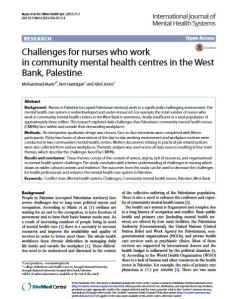
marie-et-al-2017On the publications front, Mohammad Marie has lead authored (with Aled Jones and me in support) this latest paper. It’s all about the challenges faced by Palestinian community mental health nurses, and represents the fourth article emerging from Mohammad’s PhD thesis in something like 18 months. That’s good going indeed. Here’s the abstract:

Background:
Nurses in Palestine (occupied Palestinian territory) work in a significantly challenging environment. The mental health care system is underdeveloped and under-resourced. For example, the total number of nurses who work in community mental health centres in the West Bank is seventeen, clearly insufficient in a total population of approximately three million. This research explored daily challenges that Palestinian community mental health nurses (CMHNs) face within and outside their demanding workplaces.
Methods:
An interpretive qualitative design was chosen. Face-to-face interviews were completed with fifteen participants. Thirty-two hours of observations of the day-to-day working environment and workplace routines were conducted in two communities’ mental health centres. Written documents relating to practical job-related policies were also collected from various workplaces. Thematic analysis was used across all data sources resulting in four main themes, which describe the challenges faced by CMHNs.
Results and conclusion:
These themes consist of the context of unrest, stigma, lack of resources, and organisational or mental health system challenges. The study concludes with a better understanding of challenges in nursing which draws on wider cultural contexts and resilience. The outcomes from this study can be used to decrease the challenges for health professionals and enhance the mental health care system in Palestine.


In with the new

Following a discussion involving the event’s steering committee and Mental Health Nurse Academics UK (MHNAUK), what was the International Network for Psychiatric Nursing Research Conference has now become the International Mental Health Nursing Research Conference. Next year we meet in Cardiff on September 14th and 15th, and early information can be found here. This site will be updated as further plans are made, so it’s worth checking in from time to time. We’ve also updated our conference twitter feed; clicking takes you there. Our hashtag, which is already in use, is #MHNR2017.

For a taster of the conference, here are links to four of last year’s keynote presentations: Steven Pryjmachuk, Elaine Hanzak, Luciana Berger MP and Bryn Lloyd-Evans:

Meanwhile, I’m pleased to have been elected as Vice Chair of MHNAUK. I’ll be working with the Chair, Steven Pryjmachuk, throughout 2017 and 2018 before becoming Chair at the start of 2019 for a further two years. I’m grateful for the opportunity colleagues have given me, and will do my best to lead and represent the group and the wider field. I anticipate having plenty to do, noting changes ahead in the education of nurses, the funding of students and the run-in to the next research excellence framework. More on all these to follow, I’m sure: with time today to draw attention to the decision by the Welsh Government to continue bursary payments in 2017-18 for eligible students of nursing, midwifery and the allied health professionals. As the press release announcing this makes clear, individuals taking this offer up will need to commit ‘in advance to taking up the opportunity to work in Wales, post qualification, for a period of two years’. Entirely unclear are funding arrangements for the period from 2018-19 onwards.

Reflections on #AfterWhitchurch

Further to my last post looking ahead to #AfterWhitchurch, here now are my reflections on the event as it happened as also recorded on the Cardiff University mental health blog. I’ve selected some photos, too.

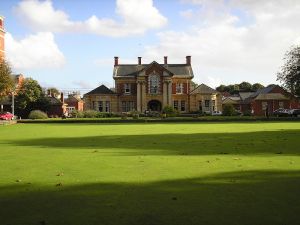
The closure of Whitchurch Hospital to inpatients in spring 2016 provided the backdrop for #AfterWhitchurch, a collaborative Economic and Social Research Council (ESRC)/Cardiff University Festival of Social Science event focusing on the changing system of mental health care hosted at Cardiff’s Chapter Arts on November 10th 2016.

2016-11-10-17-42-30

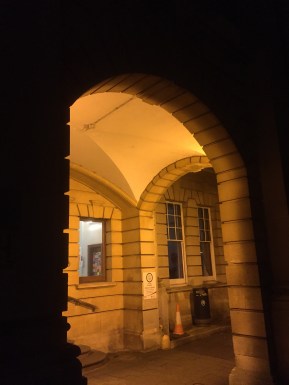
Whitchurch Hospital opened as the Cardiff City Mental Hospital in 1908, the image below being the first entry on the first page of the hospital’s visitors book.

2016-11-10-21-40-00

Members of the hospital’s Historical Society were on hand with objects, documents and photographs from their archive. Artist and director Elaine Paton presented and talked about her work with Moment(o)s of Leaving, a multimedia performance produced to mark the occasion of the hospital’s closure. Audiorecorded interviews, created for Momento(s) of Leaving by artist/curator and researcher Julia Thomas, recounted staff members’ reflections on leaving Whitchurch and their thoughts for the future.

Chaired by Norman Young from Cardiff and Vale University Health Board, School of Healthcare Sciences and service user researchers discussed how mental health care has shifted from hospital to the community, and shared reflections from research into the organisation of services, the work and experiences of service users and staff and the provision and evaluation of novel psychological interventions.

2016-11-10-21-47-35

Ben Hannigan talked about using in-depth case methods to understand mental health services at different levels of organisation, and Nicola Evans discussed her research into the mental health of children and young people. Dean Whybrow drew on 18 years of experience in the Royal Navy to describe how mental health support and interventions is provided in the military. Alan Meudell shared his reflections on being a service user researcher, and Bethan Edwards spoke of her dual identity as an occupational therapy researcher investigating care for older people with dementia and as a service user researcher. Stimulating and informed questions from the floor challenged the panel to think about stigma, the impact of research on changing practice and services offering respite and asylum.

Programme for #AfterWhitchurch

Tomorrow evening at Chapter Arts I’ll be joining friends for #AfterWhitchurch, an Economic and Social Research Council/Cardiff University Festival of Social Science event on the changing system of mental health care. Here is our programme, for those interested:

And here is a link to Elaine Paton’s Moment(o)s of Leaving video, which Elaine herself will be introducing:

As I type this post we have a handful of (free) tickets which have just become available, returned by people no longer able to be there. Follow this link to book in: and look forward to seeing people there.

COCAPP Knowledge Transfer

Last week I joined the rest of the COCAPP team at an all-day event at City University London, designed to help NHS staff, service users and carers make use of what we found. I was pleased to meet Donna Kemp, who has since written about her experiences of the day. I thought it would be a nice idea to reblog this.

donnakemp's avatardonnajkemp

Last week I was fortunate enough to be invited to the COCAPP Knowledge Transfer event held at City University London on 21st July 2016. You can read more about this here.

It was great to meet people face to face, beyond Twitter – particularly Alan Simpson (PI) Ben Hannigan, and Michael Coffey who are leading this important NIHR funded research, #COCAPPimpact.

Whats really good about this piece of research is that it is within my area of interest and that the method used aimed to address care planning on 3 levels – macro (national), meso (organisation) and micro (care delivery, face to face). To achieve this they used a mixed methods approach . The fabulousness of this is that it answered the research question on the 3 levels, perhaps anticipating that tackling one level in isolation would give rise to questions in the other levels. Adding to the credibility is…

View original post 359 more words

Mental health across the life course

NPNR twitter logoThe theme for this year’s Network for Psychiatric Nursing Research conference is Mental health across the life course. We’re convening in Nottingham on September 15th and 16th, and I’m very much looking forward. With help from André Tomlin (of the Mental Elf Service) we’re aiming to organise some pre-conference social media events: watch out for more on this, including via the new @npnrconf Twitter account. We’re also hoping to add some social media to the conference itself, including streaming. Very exciting.

Best of all, of course, is to come along to the conference as a delegate. This is an event which prides itself on its friendliness. Here are the keynote speakers:

  • Luciana Berger MP – Former Shadow Minister (Mental Health)
  • Elaine Hanzak, Inspirational speaker and author on perinatal mental health
  • Professor John Keady – Professor of Older People’s Mental Health Nursing, University of Manchester
  • Professor Steven Pryjmachuk – Professor of Mental Health Nursing Education, University of Manchester
  • Dr Bryn Lloyd-Evans – Lecturer in Mental Health and Social Care/ CORE Programme Manager, University College London


Research impact

Yesterday’s Health and Care Research Wales conference, held at the SWALEC stadium in Cardiff (more about that later), was all about closing the gaps between research, policy and practice.

There were some excellent keynote speakers. Jenny Kitzinger spoke of her research involving families of people who are minimally conscious, sharing her experiences of working with policymakers to influence at a national level. Jenny argued that impact is helped when research (1) has strong foundations, (2) is collaborative, and (3) is communicated through diverse outputs. ‘Diverse outputs’ means doing a whole lot more than simply writing journal articles (particularly those which end up behind publisher paywalls). For a direct example of how Jenny’s work influences, follow this link for a Parliamentary Office of Science and Technology POSTnote which cites a number of her and her collaborators’ publications.

André Tomlin, aka The Mental Elf, drew on his work with the National Elf Service to make the case for getting evidence into practice. This means communicating research findings in ways which are both understandable and accessible to practitioners. This, of course, is exactly what the Mental Elf Service does, using blog posts and other social media to share key research messages.

Steve Jones is a biologist known to many for his efforts to improve the public understanding of science. In his afternoon address he gave a fascinating account of working with government and the BBC. I liked his upbeat take on the past and present strength of UK science, but also noted his examples of scientific advice being flatly ignored or misused.

The day’s final keynote speaker was Malcolm Mason, whose talk emphasised the time it can take to generate research findings which have the potential to change care and treatment. Malcolm is an oncologist, specialising in prostate cancer, and his message for researchers wanting to make a difference is that they must ask questions which are important and not only interesting.

Worth mentioning, too, are yesterday’s workshops. Three were on offer, from which delegates had the chance to participate in two. As I have some experience in public involvement in research I elected to join the ‘impact on practice’ and ‘impact on policy’ options.

I enjoyed the day, and along the way also appreciated the chance to catch up with colleagues. Overwhelmingly, though, I am left thinking that the work of getting research into policy, services and everyday practice is something which needs to be planned for, and resourced. I also think most researchers (myself included) have some learning to do on this front, and perhaps need to develop some new skills and to make some new friends. In the past I’ve come across the Economic and Social Research Council’s impact toolkit, and yesterday was alerted to the existence of a study titled, A systematic review of barriers to, and facilitators of, the use of evidence by policymakers. Worth a read, perhaps.

Anyway…

I’ve now been to the SWALEC stadium five or six times for meetings, conferences and the like. I’ve never been there, though, to watch sport: the stadium being the home of Glamorgan Cricket. Perhaps I should rectify this at some point, as the idea of watching a match which might last days, involve beer (for spectators, if not players) and then end in a draw rather appeals.



#AfterWhitchurch

On the evening of Thursday November 10th at Chapter in Cardiff, as part of Cardiff University‘s contribution to this year’s ESRC Festival of Social Science, I’ll be joining friends from the School of Healthcare Sciences, the Whitchurch Hospital Historical Society, the service user community, the National Centre for Mental Health and the world of community arts for an evening reflecting on the changing mental health system. The event is free to members of the public, and further details (and a link for ordering tickets) can be found on our #AfterWhitchurch page.

For a snippet, here’s what we’re planning:

Whitchurch Hospital opened as the Cardiff City Mental Hospital in 1908. The transfer of its last inpatients to new purpose-built facilities in April 2016 provides a backdrop for an event reflecting on the changing shape of mental health care. In conjunction with the Whitchurch Hospital Historical Society and the National Centre for Mental Health, we will invite our public audience to review care as it used to be and care as it is now. We will draw on current Cardiff University mental health services research and use a range of historical and artistic media to maximise participation and provide variety.

Spread the word!