Follow @benhanniganHappy April. Here’s a new venture for me: blogging for the Mental Elf, part of the National Elf Service. This is a fine site indeed, which André Tomlin set up in 2011 with the aim of helping people find ‘just what you need to keep up-to-date with all of the important and reliable mental health research and guidance’.
Here’s a summary of my first post, which can be read in full by following the link at the bottom.
Ben Hannigan writes his debut blog on the CADET cluster RCT, which investigates the clinical effectiveness and cost-effectiveness of collaborative care for depression in UK primary care.
Category: Research
Mental health needs and services in Palestine
 Mohammad Marie, Aled Jones and I have co-authored a paper arising from Mohammad’s PhD. This appears in the gold open access International Journal of Mental Health Systems, and a copy can be downloaded by following this link.
The article is titled Mental health needs and services in the West Bank, Palestine and has this for an abstract:
Background: Palestine is a low income country with scarce resources, which is seeking independence. This paper discusses the high levels of mental health need found amongst Palestinian people, and examines services, education and research in this area with particular attention paid to the West Bank.
Methods: CINAHL, PubMed, and Science Direct were used to search for materials.
Results and conclusion: Evidence from this review is that there is a necessity to increase the availability and quality of mental health care. Mental health policy and services in Palestine need development in order to better meet the needs of service users and professionals. It is essential to raise awareness of mental health and increase the integration of mental health services with other areas of health care. Civilians need their basic human needs met, including having freedom of movement and seeing an end to the occupation. There is a need to enhance the resilience and
capacity of community mental health teams. There is a need to increase resources and offer more support, up-to-date training and supervision to mental health teams.
Further papers from Mohammad’s study will follow, and I’ll aim to post updates as work progresses.
Follow @benhannigan#MHNAUK meets in Leeds, and talks work and roles

Mental Health Nurse Academics UK met yesterday in Leeds, hosted by John Baker and chaired by Joy Duxbury. Our discussions were wide-ranging: proposed changes to the composition of the English NHS workforce signalled by the introduction of associate nurses; the arrival, in England, of student fees for nursing degrees from 2017; safe staffing (see also this editorial in the Journal of Psychiatric and Mental Health Nursing); plans for #NPNR2016; arrangements for a second student mental health nursing conference; the Shape of Caring; England’s Five Year Forward View for Mental Health; guidance for adult field nurses caring for people with mental health problems; this year’s Skellern Lecture and JPMHN Lifetime Achievement Award; the current call for papers for a themed care planning and coordination issue of the Journal of Psychiatric and Mental Health Nursing (which Michael Coffey, Alan Simpson and I are co-editing); and the hot-off-the-press announcement of a Foundation of Nursing Studies-sponsored review into the role of mental health nurses.
In this post I’ll largely confine myself to some thoughts on the mental health workforce and on the place of nurses within this. Yesterday’s discussions in this area exercised MHNAUK members greatly. Proposed changes to the occupational mix to be found within mental health services, debates over nursing numbers and safe staffing, and new arrangments for the funding of education have the potential to trigger significant turbulence in an already-complex system of care. MHNAUK members rightly identified how the appearance of a new associate nurse role, sitting in between health care support workers and registered nurses, will trigger unrest. This is always the case when professional jurisdictions come under pressure (see here and here for papers I have co-written which expand on this point). In this current case, some registered nurses will see new associates as a threat to their hard-won jurisdiction. At a time when nurses are pressing for safe staffing, some are likely to argue that the introduction of associates will also open the door to role substitution and eventual reductions in numbers of registered nurses, thereby threatening both quality and safety.
Should associate nurses appear, we can be certain that plenty of inter-occupational jostling will take place as support workers, associates and registered nurses (amongst others) negotiate their relative positions and assert control over areas of work. In this regard, abstract descriptions of the tasks which new associates will (and will not) be permitted to carry out will provide only the most limited of guides. Differentiations between who does what will inevitably be hammered out in the workplace.
And what of the cross-UK implications for all of this, given that the Department of Health’s associate nurse announcement is for England only? To me it is unclear how new associates will be regulated, or how transferable their future qualifications might be should any wish to move to, say, Wales. Across the four countries of the UK important differences are appearing in the ways people are prepared for health care practice, and in the funding of this. Student nurses will pay fees in England from next year, but student nurses in Scotland will not and will continue to receive a bursary. Here in Wales (unless I’ve been asleep and have missed a piece of essential news), we will need to wait until after our forthcoming Assembly elections and the formation of a new Welsh Government for an announcement on future financial arrangments for nursing education. Perhaps we’ll hear more about the shape of the future Welsh NHS workforce then, too.
Follow @benhanniganCall for abstracts: #NPNR2016
 Over on the #NPNR2016 website the call for abstracts has now been published. The conference takes place on September 15th and 16th, at the Nottingham Conference Centre, and our theme for this year’s event is mental health across the life course. Here’s some more information:
Follow @benhanniganThe NPNR conference is the leading mental health nursing conference in the UK. This year our 22nd conference will explore the challenges faced by mental health nurses in delivering evidenced-based compassionate care across the life course. We will consider both the complexity of issues faced by individuals throughout the life course, and also how well services and nurses meet the mental health needs of the people they collaborate with .
Once again, our intention is to provide an event where you can engage and critically debate issues (from education, practice and research) of relevance to the way care is provided and received. The NPNR conference is the place for mental health nurses and those we work with to present and learn new knowledge, therefore we encourage you to submit your research and practice development initiatives.
The conference also provides a great opportunity to participate in discussion so that you leave the conference informed, enlightened and with new energy to engage with the challenges ahead. Alongside our expert speakers, great practice development and research papers the conference promotes a friendly and welcoming atmosphere that has been the hallmark of NPNR for over 20 years.
How to submit your abstract
• Step 1: Read and refer to the Themes and Guidance document
• Step 2: Refer to the Submission Criteria making sure you tick every requirement.
• Step 3: Fill out the Abstract Submission Form.Key Dates
• Abstract submission Deadline – Friday 29th April 2016 midnight.
• Abstract Review – May 2016
• Abstract Results – June 2016
• Deadline for discounted presenter fee – Friday 15th July 2016.Booking Information
Booking information coming soon.
Conference Fees (2 days)
Presenter Rate – £255 (upon acceptance to 29 July 2016)
Member/ International delegate – £300
Non-member – £440
RCN Student/Service user/Carer- £180
Event Contact:
Rebecca Hoole
Conference & Events Organiser
Royal College of Nursing
Email: npnr@rcn.org.uk
Linkedin: uk.linkedin.com/in/inpnr
COCAPP findings published
 This morning saw the publication of the full and final report from COCAPP. COCAPP has been led by Professor Alan Simpson from City University London, and (as readers of this blog will know) has been concerned with care planning and coordination in community mental health, and the relationships between these processes and recovery-oriented and personalised care.
Today’s report appears in a single issue of the NIHR’s Health Services and Delivery Research journal. Following the link above takes you to a page from which the complete, 218-page, document can be downloaded. For a shorter read, follow the links instead to either the scientific or the plain English summaries.
Over on the COCAPP blog site, meanwhile, Alan Simpson and Alison Faulkner have written this accessible summary:
Follow @benhanniganWho carried out the research?
The research was carried out by a team of researchers from three universities: City University London in England, and Cardiff and Swansea Universities in Wales. The team was led by Professor Alan Simpson at City University.
Service user and carer involvement:
Of the 13 researchers working directly on the study, six were involved in part time roles as service user researchers: one as co-applicant and the others to interview service users and carers. In addition, there was an advisory group of people with lived experience.
Who funded the research?
The National Institute for Health Research (NIHR) Health Services and Delivery Research Programme (HS&DR 11/2004/12). This is a Government research funding body.
Why did we do the research?
Although there are two different systems in England and Wales, both mean that people receiving mental health services should have a care coordinator, a written care plan and regular reviews of their care. With the introduction of the recovery approach and personalisation, it is now expected that care planning and coordination should be recovery-focused and that people will be taking more control over their own support and treatment.
What were the aims of the research?
We wanted to find out what helps and what hinders care planning for people with mental health problems to be collaborative, personalised and recovery-focused.
By collaborative we mean that care planning is completed in partnership with the service user: the care coordinator works with the service user to plan their care.
By personalised we mean that care is designed with the full involvement of the service user and designed to meet their individual needs.
By recovery, we mean ‘a personal journey … one that may involve developing hope, a secure base and supportive relationships, being more in control of your life and care, social inclusion, how you develop coping skills, and self-management … often despite still having symptoms of mental illness.’
Where was the research carried out?
The research was carried out in six NHS mental health service provider organisations: four in England and two in Wales. One of the reasons for carrying out the research in both England and Wales is that Wales has a legal framework in place called the Mental Health Measure, introduced in 2010. This is intended to ensure that where mental health services are delivered, they focus more appropriately on people’s individual needs. In England, care planning is informed by guidance and is not legally required.
What did we do?
The focus of our research was on community mental health care. We wanted to find out the views and experiences of all of the different people involved: care coordinators (in community mental health teams), managers, senior practitioners, service users and their carers.
- We carried out an extensive literature review.
- We sent out questionnaires to large numbers of people, and received replies from service users (449) and care coordinators (205); these included questions on recovery, therapeutic relationships, and empowerment.
- We interviewed senior managers (12) and senior practitioners (27), care coordinators (28), service users (33) and carers (17).
- We reviewed 33 care plans with the permission of the service users concerned.
What did we find?
Summary of the survey findings:
- There were no major differences between the six sites on the empowerment or recovery scores on the service user questionnaires;
- There were some significant differences between the sites on therapeutic relationships: where there was good collaboration and input from clinicians, relationships were rated as more therapeutic;
- We also found significant differences between sites on some recovery scores for the care coordinators: where they saw a greater range of treatment options, the service was rated as more recovery-focused;
- We found a strong positive correlation between scores on the recovery scale and the therapeutic relationship scale for service users; this suggests that organisations perceived to be more recovery-focused were also perceived as having more therapeutic relationships.
#NPNR2016 committee opportunity

Safe staffing
In a post on this site last year I drew attention to the (highly contested) decision by NICE to suspend its work on safe nurse staffing in inpatient mental health settings. Now, and with thanks to Shaun Lintern from the Health Service Journal (and to John Baker, who amongst mental health nurses has worked particularly hard to keep this issue alive), NICE’s evidence review in this area has just been published.
Here’s how the news was broken earlier this week:
Here’s a quick summary. Seven research questions were asked in the review, with searches made of fifteen databases for evidence published since 1998. To be included, studies had to report on at least one of:
- staffing in relation to outcomes;
-
staffing in relation to factors (such as service user factors, environmental factors);
-
staffing in relation to factors and outcomes.
Studies were eligible for inclusion if they reported findings from inpatient mental health areas serving people of any age. Outcomes of interest included serious incidents (e.g., self-harm, violence), delivery of nursing care (e.g., levels of contact) and other (e.g., nurse vacancy rates). Following a process of searching and sifting just 29 papers were finally included, and subject to quality appraisal. And the conclusions? Here they are, as extracted by John Baker with a call for action:
Follow @benhannigan
Cumulative insights
Not for the first time, I’ve attempted to produce some cumulative insights from the past and present mental health research studies I’ve had the opportunity to work on. These include my PhD investigation into work and roles in community mental health care, my post-doctoral study of crisis services, and more recent projects which Alan Simpson, Michael Coffey or I have led on.
The prompt, on this occasion, has been the chance to give a presentation at a School of Healthcare Sciences research seminar taking place this afternoon. For anyone interested, here is the PowerPoint I used. I opened with some general comments on the need for mental health research, and on the funding landscape. I then had some things to say about theory, design and methods. Many of the individual slides have hyperlinks to green open access publications:
Follow @benhanniganOut of the Asylum
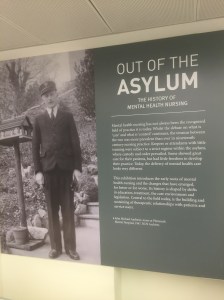 Belated happy new year. Visiting the Royal College of Nursing headquarters in London last Friday ahead of a meeting of the Network for Psychiatric Nursing Research (NPNR) conference committee (more on that below) gave me an opportunity to pop into the ‘Out of the Asylum’ exhibition. I’m glad I did. Texts, photographs and other artefacts illustrate the history of mental health nursing.
 Here are some of the pictures I took. These include a photo of the RCN’s copy of a sixth edition of the Red Handbook, displayed alongside nurses’ badges, a Bethlem Royal Hospital pamphlet, a syringe and other items of interest. For more on the Red Handbook see this earlier post, along with this post which includes material from my copy of a fourth edition of the same. Another picture relates a set of regulations for the bathing of patients.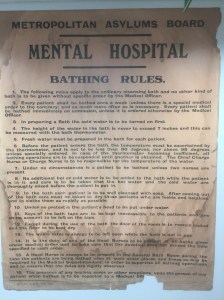
One of the display boards makes the observation that ‘few mental health nurses now wear uniforms’. As an unfortunate aside, this may need some future updating. From what I’m hearing, the historic trend towards mental health nurses wearing everyday clothes at work is reversing, with numbers of NHS trusts and health boards contemplating a return to uniforms. I regret that. But sticking with the exhibition…

…a final photograph I’m reproducing here is the front sheet of an early 1930s examination paper. Look hard and you’ll see questions on bones, asphyxia and antiseptics (amongst other things).
 The NPNR planning meeting, this being the purpose of my trip, was a productive one. This year’s event (the 22nd) will be taking place in Nottingham on September 15th and 16th. I’ll add more on this when I can, and include some regular updates on this site.
Fees, theses and project updates
Last week brought the news that, in England, people beginning nursing degrees from the 2017-18 academic year will need to take out student loans to cover the cost of their tuition fees. The cap on student numbers will also be removed. The Council of Deans of Health broadly supports this move, having previously argued for change. One of the things it points out is that current funding for students (via the agreement of the benchmark price) does not cover the real costs of educating new nurses. The Royal College of Nursing, on the other hand, is concerned that last week’s announcement prepares to break the connection between the NHS and financial support for student nurses, and simultaneously risks making nursing a less attractive career option. This concern particularly relates to mature students and those contemplating a second degree, for some of whom the prospect of additional debt may be exceptionally unappealing. As a nurse academic in Wales I wait with interest to see what policy on fees will emerge from the Welsh Government.
In other news, I find myself engaged in a prolonged period of doctoral student activity. I’ve examined a number of theses in and out of Cardiff in recent months, and have sat with students during their vivas as either supervisor or independent chair. This term has been particularly packed. Plenty of writing has also been taking place: papers and reports are being written from COCAPP, RiSC and Plan4Recovery, and from completed theses I have helped to supervise. Data generation in COCAPP-A has almost concluded, and new research ideas are taking shape. Exciting times, if a little frenetic.
Follow @benhannigan Ben Hannigan's blog