Category: Policy

Research in the School of Healthcare Sciences

In February 2015, in the School of Healthcare Sciences at Cardiff University we launched our new research strategy. The School’s main research webpage can be found here, and for the nuts-and-bolts of our four research themes the links to follow are these:

Meanwhile, in the very near future the School (including its researchers) will be occupying additional floors at our base in Eastgate House. This, for those who know Cardiff, is a building situated at the junction of Newport and City Roads. My office, I think, will move: giving me fine views over the city and beyond.

Here are some photos of the 12th floor, as previously shared via a Tweet:

It is very welcome that we will soon have these new facilities available to us, with the rooms in the photos being used mainly by PhD and Professional Doctorate students.

Which brings me neatly to…

Other interesting developments in the School on the postgraduate research student front are plans to recruit very pro-actively. Research theme members have been busy generating topics for doctoral study, which reflect existing areas of substantive and methodological expertise and where capacity to supervise is known to exist. We’ll be advertising these soon, and inviting potential students to tell us how their plans align. The aim, obviously, is that we grow research in programmatic style by building on established and emerging lines of enquiry. For anyone interested, I’m looking to supervise people who want to use in-depth qualitative methods to examine mental health systems (no surprises there, then!). Specifically, this means projects investigating aspects of: policy; service organisation and delivery; work, roles and values; and user and carer experiences.

Other postdoctoral news includes Mohammad Marie‘s (that’s Dr Mohammad Marie’s) successful defence of his thesis at viva last month. Well done! Mohammad has been supervised by Aled Jones and me, and the title of his thesis is Resilience of nurses who work in community mental health workplaces in West Bank, Palestine. Next up for him are papers for publication: and jolly interesting they’ll be, too.

The shape of nursing (reprise)

York, March 10th 2015
Yesterday I joined other members of Mental Health Nurse Academics UK at the University of York, for what turned out to be a particularly lively spring term meeting. 

We were treated to two high-quality local presentations in the morning: from Simon Gilbody on smoking cessation interventions for people using mental health services, and from Jerome Wright on developing community mental health in Malawi. 

In the early afternoon David Sallah from Health Education England (HEE) took the floor to talk about the Shape of Caring review, the final report from which is due to be published later this week. From David’s presentation it is evident that HEE will be making a case for a significant shake-up to the way nurses are prepared. 

MHNAUK members in York were concerned with what they heard. Uppermost for many was a concern that HEE’s wish for future student nurses to commence their courses with two years of Project 2000-style generalist preparation will erode the time available for mental health-specific learning. People were also struck by the apparent lack of a clear evidence base for change. It is, after all, only a handful of years since the Nursing and Midwifery Council introduced its current standards for education, and curricula up and down the country were rewritten in response. In the absence of robust evaluations of what we already have, are we really sure we know what needs fixing in nurse preparation? 

The Shape of Caring review is sponsored by a body with authority in England only, but I am under no illusions that any changes flowing from it will be felt equally here in Wales. David Sallah mentioned cross-UK talks as having already opened. As people observed yesterday, however, any changes to nursing education recommended at this point may be lost following a general election where greater priorities occupy the time of a newly formed government. 

Meanwhile, and with a firm eye on the forthcoming election, the Council of Deans of Health has been busy making a case for health higher education and research in its new publication Beyond Crisis. This has three main messages, addressing: workforce planning; building on the talents of the current workforce; and investing in research. Amongst other things the Council is asking for proper forward planning to avoid cycles of boom and bust, opening up opportunities for continuous professional development and protecting and advancing research. It is also suggesting that new ways of financially supporting health professional education should be looked at, including models where contributions are made by students and employers.

Taking Measure

Here in Wales we have the Mental Health Measure. This is a piece of legislation passed in 2010 and implemented in phases in 2012, and which is intended to improve the quality and timeliness of mental health services. Specifically, it provides for:

  • primary mental health care;
  • care and treatment planning and care coordination;
  • the right for an automatic reassessment of needs in secondary mental health services for people discharged within the previous three years;
  • advocacy in hospital.

This month the National Assembly for Wales Health and Social Care Committee has reported on its post-legislative scrutiny of the Measure. The Welsh Government has already committed to conduct a formal evaluation of the legislation through a duty to review, built in as the Measure passed into law. In pursuit of this an inception and an interim report have already appeared, with a final document due in 2016. With the Health and Social Care Committee’s report appearing this month it is clear that the Mental Health Measure is becoming seriously scrutinised.

When the Committee published its call for evidence last year the COCAPP research team submitted a response alerting Assembly Members to our ongoing study. It would have been ideal had we been able to report key findings, given that COCAPP is an examination of care planning and care coordination and is, therefore, of interest to anyone wanting to know how part 2 of the Measure (dealing with care and treatment planning) is being experienced. But the Health and Social Care Committee’s timescales and those of COCAPP were not aligned, meaning the best we could do was to draw attention to our project.

This month the Committee praises many aspects of the Measure but also makes ten recommendations. They address:

  1. meeting demands for primary mental health care, particularly in the case of children and young people;
  2. improving the collection of data to better support the evaluation of primary mental health services;
  3. taking action to improve the form, content and quality of care and treatment plans, with a view to increasing service user involvement and spreading best practice through training;
  4. making sure that rights to self-refer for reassessment are properly understood and communicated to all;
  5. improving staff awareness of service users’ eligibility for independent mental health advocacy in hospital;
  6. setting timescales for new task and finish groups reviewing the Measure, and setting out plans to respond to their recommendations;
  7. during evaluations of the legislation, consulting with as wide a range of people as possible using traditional and novel approaches;
  8. ensuring that information is available in a variety of formats, so that all groups of people are able to access this and to understand;
  9. following the publishing of new plans for the improvement of child and adolescent mental health services, making clear how these will be realised;
  10. carrying out a cost benefit analysis of the Measure.

Clearly, Assembly Members have detected evidence of an uneven pace in the development of primary mental health care across Wales, and are particularly concerned to make sure that the mental health needs of children and young people are properly identified and met in timely fashion. As a COCAPP-er, I am interested to read that the Committee thinks care and treatment planning for everyone can be improved, informed by examples of best practice and through investment in staff training. I also pick out the recommendations on improving service user collaboration, and estimating the costs and benefits of the Measure. These resonate, to me, with current concerns in Wales with prudent health care and co-production.

And as for COCAPP’s findings? Suffice to say our draft final report is now under review with the National Institute for Health Research (NIHR) Health Services and Delivery Research (HS&DR) Programme. More to follow in due course…

Critical junctures goes green

CJIn a series of earlier posts on this site (here and here), and in a piece for the LSE’s Impact Blog here, I wrote about Nicola Evans‘ and my article, ‘Critical junctures in health and social care: service user experiences, work and system connections’. This is published in the journal Social Theory & Health, and the behind-the-paywall link to the full text can be found here. Now that 18 months has passed since the article first appeared online, Palgrave’s copyright rules allow a post-peer-review, pre-copyedit, green open access version of the full text to be made publicly available. So, for a free copy of the paper downloadable from Cardiff University’s ORCA repository the link to follow is this:

Hannigan B. and Evans N. (2013) Critical junctures in health and social care: service user experiences, work and system connections. Social Theory & Health 11 (4) 428-444

The paper draws on data from Nicola’s PhD, ‘Exploring the contribution of safe uncertainty in facilitating change‘, and from my post-doctoral study of crisis resolution and home treatment services, ‘Mental health services in transition‘. For a reminder of what the paper is about, here’s the abstract in full:

This article makes an original contribution through the revitalisation, refinement and exemplification of the idea of the ‘critical juncture’. In the health and illness context, a critical juncture is a temporally bounded sequence of events and interactions which alters, significantly and in a lasting way, both the experience of the person most directly affected and the caring work which is done. It is a punctuating moment initiating or embedded within a longer trajectory and is characterised by uncertainty. As contingencies come to the fore, individual actions have a higher-than-usual chance of affecting future, enduring, arrangements. These ideas we illustrate with detailed qualitative data relating to one individual’s journey through an interconnected system of mental health care. We then draw on observations made in a second study, concerned with the improvement of mental health services, to show how micro-level critical junctures can be purposefully used to introduce instability at the meso-level in the pursuit of larger organisational change. In addition to demonstrating why scholars and practitioners should pay closer attention to understanding and responding to critical junctures we are, therefore, also able to demonstrate how their emergence and impact can be examined vertically, as well as horizontally.

The shape of nursing?

Congratulations to Steven Pryjmachuk on his pre-Christmas election as Vice Chair, and Chair-elect, for Mental Health Nurse Academics UK. Steven works with Joy Duxbury throughout 2015 and 2016, and becomes Chair for the two years following.

During the December 2014 MHNAUK election, for which I acted as returning officer, news seeped out that Health Education England’s Shape of Caring review (led by Lord Willis) was weighing up the future of UK nursing’s four fields (mental health, adult, child, learning disability). Michael Coffey, in his last month as MHNAUK Chair, led this response sent to the Health Service Journal:

Michael Coffey
Chair of MHNAUK

11th December 2014

Dear Sir

Shaun Lintern writes in the Health Service Journal (11th December 2015) that Lord Willis, chair of the Shape of Caring review envisages changes to nurse education that would see the loss of the current branches of nursing. One of those fields is mental health nursing. Those who practise in this area provide skilled compassionate care to some of the most marginalised and stigmatised people in society. We write on behalf of Mental Health Nurse Academics UK a group consisting of representatives of 65 Higher Education Institutions providing education and research in mental health nursing. As people long experienced in this field we are disappointed though not surprised to read your article presenting these views on the future of nurse education. We are disappointed because the evidence for the changes that Lord Willis claims are needed is largely non-existent. We are not surprised because we have been here before and can see that despite claims to the contrary, there is no evidence that this future for nurse education will deliver what it promises.

Nurses account for the highest number of professionals providing mental health care; the median average number of nurses per 100,000 of the population working in mental health is 5.8, more than all other professionals combined (WHO, 2011), making mental health nurses pivotal to the delivery of the WHO action plan. None of this is likely with a generic curriculum.

To be clear “the greater element of generalism” (which presumably means adult nursing) has been tried previously in the UK and found wanting. Internationally generalism has failed to deliver better care for people with mental health problems. The effect will be to dilute mental health nursing when there is increasing evidence that specialist knowledge, values and skills are required in the care of people with a range of long-term conditions and dementia. We remain unclear from your article what precisely is being proposed though our favoured suggestion would be for nurses to spend two years rigorously learning how to interact with people in compassionate ways that promote dignity and respect (core mental health nursing skills if you will) before launching themselves into the cold clinical world of high technology nursing.

The evidence from abroad and from evaluations here in the UK of the previous version of generalist frontloaded training (Project 2000; Robinson and Griffith 2007) show clearly that mental health nursing as a specialism suffered from a minimal focus on mental health in curricula and a depletion of mental health skills across the workforce. The strengthening of the mental health ‘field specific’ elements within the 2010 NMC standards reflected positive differences in areas such as language, the co–production of care and inter–professional practice. Any move to generic, or general (adult?) nurse ‘training’ as a start point for all will inevitably lead to a different set of values underpinning mental health nursing practice over time.

The expectation that the training of mental health nursing skills will be picked up and delivered in the workplace is without foundation despite the numerous examples to do this. The result will be that in an era of claims of parity of esteem people who use services will effectively be deprived of specialist trained nurses. Moreover, there is no evidence that current models of training are not fit for purpose or that a focus on generalist nursing skills will adequately address the needs of people with complex and enduring mental health difficulties.

The longer term effect of this approach is clear to see from countries who have moved down this road ahead of us, depleted services provided by unskilled workers, extra costs for employers in re-training and educating a workforce not fit for practice, difficulty in securing sufficient qualified staff to provide evidence based mental health care and longer term the stripping away of a set of skills in higher education that are unlikely to be replaced.

We don’t know what advice Lord Willis has taken to come to his view. Our worry though is that already the language being used here is designed to undermine professional skills that have been long in the making. For example, the unhelpful rhetoric embodied in the use of the term “silo” downplays specialist skills for the purposes of promoting something far less specific like “flexibility”. It is a largely hollow rhetoric and is never heard in relation to cardiologists, neurosurgeons or diabetes nurses. It seems that the pressure for change then is not one premised on the needs of people using healthcare services nor one based on the evidence of what works but driven by other factors that choose to position specialist nursing skills (and by corollary those who need these skills) as having little value.

We also note that any modification to the NMC’s standards for pre-registration nursing education and to the four fields driven by the Shape of Caring review will be felt across all parts of the UK. As an HEE-sponsored Review we are concerned that voices from parts of the UK other than England will not have opportunities to be heard.

We readily acknowledge that the full report is not yet due but wish to advance the notion of such a review democratically reflecting the voices of nurses and the people who use their services. In this regard we have been disappointed at the absence of any real attempt by the review to engage with our group specifically and have questions about the level of engagement with mental health service users more generally.

Yours Sincerely

Dr Michael Coffey
Chair of Mental Health Nurse Academics UK
Swansea University

Professor Joy Duxbury
Chair-elect of Mental Health Nurse Academics UK
University of Central Lancashire

Professor Len Bowers
Institute of Psychiatry
Kings College London

Professor Patrick Callaghan
Nottingham University

Professor Alan Simpson
City University London

Professor John Playle
University of Huddersfield

Professor Steven Pryjmachuk
University of Manchester

Professor Hugh McKenna
University of Ulster

Professor Doug Macinnes
University of Canterbury

Professor Karina Lovell
University of Manchester

Professor Geoff Dickens
Abertay University

Dr Ben Hannigan
Cardiff University

Dr Liz Hughes
University of York

Dr John Baker
University of Manchester

Dr Mick McKeown and Dr Karen Wright
University of Central Lancashire

Dr Robin Ion and Emma Lamont
Abertay University

Dr Sue McAndrew
University of Salford

Dr Andy Mercer
Bournemouth University

Dr Naomi Sharples
University of Chester

Dr Majorie Lloyd
Bangor University

Around this time there was some debate, via email, amongst MHNAUK members centring on the kind of nurses people felt were needed for the future and how they might best be prepared for practice. Important differences in view were freely expressed. Not all who are associated with MNHAUK are in favour of the retention of mental health nursing as a pre-registration field, for example, though my reading of the flow of pre-Christmas exchanges is that most are. Joy Duxbury and Steven Pryjmachuk, I suspect, will be returning to some of this debate during their tenures.

REF results out, COCAPP in

The publication of results from the Research Excellence Framework 2014 (#REF2014) has made this a big week for universities. REF is important for lots of reasons. First, it is assumed that recurring, quality-related (QR), research funding from the UK’s four higher education funding councils will be weighted to the REF results (I say ‘assumed’ here in the light of reports, today, on possible changes to the dual support system: see below for more). Second, universities and the departments within them are ranked based on REF outcomes, making the exercise a crucial one for relative reputations. Third, for governments the REF (like the various research assessment exercises (RAEs) before it) is a way of showcasing the value of research investment and the wider benefits this brings.

Universities will have followed different strategies in managing their REF submissions. In Cardiff a selective return produced a result comfortably better than had been aimed for with the University now ranked in the top five based on research quality. Check out this short video for an overview:

As I hinted above there are, already, questions being asked of how the REF results will (or will not?) be converted into future funding. A report in today’s Observer suggests that changes may be afoot to the dual support (QR and programme/project-related) system. Here’s an early morning tweet from Phil Baty at the Times Higher Education:

So that’s an evolving story which deserves to be closely watched.

Meanwhile…

…moving from research in the round to research projects specifically, this has also been the week that our draft final report from COCAPP has been submitted for peer review to the NIHR Health Services and Delivery Research Programme:

COCAPP has been an investigation into care planning and care coordination in mental health services, and has already been partnered by COCAPP-A. This related study is asking questions in the hospital setting similar to those asked by COCAPP in the community. The coming year sees COCAPP-A getting into full swing, with qualitative and quantitative data being generated across multiple NHS sites in England and Wales.

December catch-up

Competing priorities have kept me away from this site in recent weeks. There’s been work to do on COCAPP, which is close to the finish line, and doctoral students’ drafts to read and comment on (before imminent thesis submission, in one case). I’ve also been reading a thesis ahead of a PhD examination I’m involved in at the end of the coming week. So if this catch-up post feels a little bitty, then that’s because it is: there’s been lots happening that I want to comment on.

First up is the RiSC study, which I’ve mentioned here plenty of times before. In the last ten or so days the NIHR has published a first look summary of our aims, methods and findings. This is a precursor to the publication of our whole report, which is now post-peer review. Sometime in the new year we’ll be reconvening as a research team to plan our next project.

In October I made the short trip to the University of South Wales to hear Professor Linda Aiken from the University of Pennsylvania deliver this year’s RCN Winifred Raphael Lecture. Professor Aiken spoke on Quality nursing care: what makes a difference?, drawing on findings from the RN4Cast study and more. As promised, the RCN Research Society has now uploaded its video of the event for the world to see. It’s well worth watching.

News on the Mental Health Nurse Academics UK front includes an election, which we are now midway through, for the group’s next Vice Chair and Chair Elect. I’m overseeing this process (as I’ve done twice before), and will be in a position to announce the successful nominee on December 15th. One of the things that MHNAUK does is to work with the RCN to run the annual NPNR conference, and I’m very pleased to have had the chance to join the NPNR scientific and organising committee for a three year stint. More to follow on that front in the future, including details of next year’s event as they emerge.

Elsewhere I read that the Shape of Caring review, chaired by Lord Willis, is looking at the UK practice of preparing new nurses, at the point of registration, for work in one of four fields (mental health, adult, child and learning disability). This is something to keep a close eye on, with reports from last month’s Chief Nursing Officer Summit in England suggesting that the fields may be on their way out. For a useful, balanced, review in this area I refer the reader to the 2008 King’s College London Policy+ paper Educating students for mental health nursing practice: has the UK got it right? and, for a longer read, to Approaches to specialist training at pre-registration level: an international comparison.

Turning back the clock?

Here’s a post to draw attention to the RCN‘s newly published Report on Mental Health Services in the UK. This looks to be the latest document from Frontline First, a campaign revealing the effects of funding cuts on NHS care and nursing.
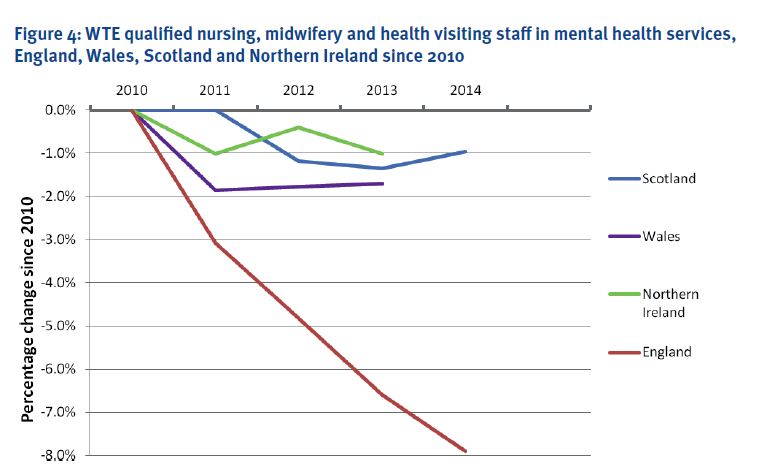
Working with the charity Rethink Mental Illness, and drawing on publicly available data, the RCN shows how (since 2010) the number of staffed mental health hospital beds across all four countries of the UK has reduced. The number of nurses working in NHS mental health services has also fallen, those remaining being revealed as an ageing group. Year on year, an increasing proportion is shown to be over the age of 50.

Here’s a chart showing reductions in the mental health nursing workforce, which I’ve extracted from page 16 of the report:

And, right at the front of the document, I see a clear case for investment contained in these recommendations which I reproduce word-for-word:

1) Governments must ensure there is equal
access to mental health services and that
the right treatment is available for people
when they need it.

2) Governments and NHS providers must
ensure that the commitment to parity of
esteem is directly reflected in the funding,
commissioning of services, workforce
planning, and patient outcomes.

3) Local commissioners and health boards
must make available enough local beds
to meet demand.

4) The principle of least restriction must
be embedded across all mental health
services. Detention under mental health
legislation should always be based on
clinical opinion and never be a result
of local failures to provide appropriate
care. Due to the significant increase in
detentions under the Mental Health Act
there should be a national objective set
to reduce detention rates in England.

5) There must be a consistent shift across
the UK from inpatient acute care to
community-based services which
recognises that prevention and early
intervention results in better outcomes,
reduces the pressure on acute services,
and reduces the overall cost to the NHS
in the long term.

6) Urgent action must be taken to address
the workforce shortages. Resources must
be committed to training and recruiting
enough mental health nurses who are able
to deliver specialist care in the changing
health and social care landscape.

7) NHS providers must invest in the current
mental health nursing workforce.
Band 6, 7 and 8 mental health nurses
should be developed to become advance
practitioners to deliver effective
recovery-led care in mental health
services.

8) There must be a sustainable and
long-term workforce planning strategy
which acknowledges the current
challenges facing the mental health
nursing workforce.

Horatio Festival of Psychiatric Nursing

Horatio is the European Association for Psychiatric Nurses. On the group’s website it says:

The aims of the Association are twofold: to advocate for the interest of the members by providing input into the decision-making processes on issues relevant to psychiatric and mental health nursing in Europe and to promote the development of psychiatric and mental health nursing practice, education, management and research.

I’m just back from Horatio’s latest gathering: the Third European Festival of Psychiatric Nursing, with its theme of ‘Creativity in Care’. This took place between November 6th-9th in Malta, which (unfortunately for those of us aiming to sightsee on our single free afternoon) happened to be experiencing some unseasonably miserable weather.

As an event, this was a large and properly international one. Whilst there I delivered two presentations: one from the RiSC study, and one a knitting-together of ideas, methods and findings from a series of interconnected and now-completed studies into changing mental health systems and nursing work. My themes in this second presentation will be familiar to readers of this blog, but if it’s worth saying once it’s worth saying again. Here are my slides, for anyone interested:


Voting for mental health

In this post I underestimated the number of charities which specifically fund mental health research. Last week Hugh McKenna sent a message to members of Mental Health Nurse Academics UK alerting us to the Alliance of Mental Health Research Funders, and particularly to this group’s Prioritising Mental Health Research manifesto produced ahead of next year’s general election.

I count 13 members of the Alliance, and read this from the about section of the organisation’s website:

We are a group of charities and foundations that support mental health research. We meet regularly to share progress and generate new ideas for improving mental health research in the UK. We believe that more and better research is urgently needed to find ways of promoting good mental health, treating mental health problems, and supporting the wellbeing of individuals, families and communities. Research can help people with mental health problems, and those around them such as family members or friends, practitioners and leaders of organisations, to find solutions so individuals can enjoy better health and longer, more fulfilling lives.

In its 2015 manifesto the AMHRF says:

We all know someone with a mental health problem and can see how lives would be improved with better treatments and support and less stigma. Mental health research saves lives, relieves significant distress
and improves quality of life. It also benefits the whole of our society by generating social and economic benefits that contribute to thriving communities built upon resilience, reduced levels of mental ill-health and less stigma and discrimination.

Yet mental health research is underfunded and under-prioritised by government. We are missing opportunities to achieve breakthroughs seen in other areas of healthcare that could transform people’s lives and enhance wellbeing.

The 2015 General Election is a landmark opportunity for political parties to build on growing public awareness of mental health and the value of all health and social care research.

The Alliance is right about a growing public awareness of mental health issues, and its message on underfunding is an important one which deserves to be heeded. The LibDems have promised to include a commitment to increasing mental health research in their 2015 manifesto, and other parties (including those with a chance of forming a government) might consider following suit. Personally I would like to see this wrapped up in a more overarching promise to invest properly in mental health across the board, including in services. Elsewhere this week announcements have been made of extra funds to reduce waiting times for mental health care in England. This is a good thing, but needs to be seen in the context of persistent cuts to the mental health system over the lifetime of this government which have  had serious implications for people left in need.