Category: People

NPNR 2015 review

About to commence: #NPNR2015

The 21st Network for Psychiatric Nursing Research (NPNR) conference took place on Thursday and Friday, September 17th and 18th 2015, with the theme of ‘Building new relationships in mental health nursing: opportunities and challenges’. The occasion was a fine one, with just short of 200 people in attendance. For those not able to make it but wanting to know more, the programme can still be found here and the book of abstracts here.

I’ve been on the NPNR scientific and organising committee this year, courtesy of my membership of Mental Health Nurse Academics UK. This afforded me the chance to welcome delegates at the conference opening, and to draw attention to the just-breaking news of Professor Len Bowers’ planned retirement at the start of 2016. Len has been an inspirational mental health nurse researcher: more on this later.

2015-09-17 15.58.04
#NPNRselfie with Karina Lovell

Introduced by Professor Liz Hughes as day one conference chair, this year’s keynotes commenced with Professor Karina Lovell giving an overview of the current state of knowledge in remote psychological therapies. Karina is a world leader in research into interventions for people with commoner mental health problems such as depression and anxiety, as well as being actively involved in services and practice through her work with organisations like Anxiety UK and others. For an example of important new research in this area check out the REEACT trial into computerised CBT for people with depression. This is an important study which Karina both referenced in her talk, and is actively involved in.

Dr Geraldine Strathdee, NHS England’s National Clinical Director for Mental Health, delivered a second keynote on using mental health intelligence. She praised the work of nurses, and made a strong case for mental illness prevention. Geraldine also reminded delegates of the high rates of premature mortality of people living with mental health difficulties, and the continued exclusion of many from employment. As routes to improvement she pointed to leadership, and the value of data to benchmark and drive up standards.
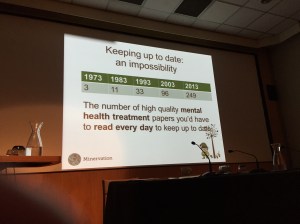
Keeping up with the evidence: an impossibility?

Day one’s final keynote presentation was delivered by André Tomlin, founder of the Mental Elf website and author of this pre-conference blogpost. André is an information scientist, who illustrated the challenge of keeping up-to-date with the evidence using this slide. Podcasts, social media, tweetchats and other new technologies are all part of André’s solution to the challenge of information overload, and as strategies to help plug the leaky evidence pipeline. The National Elf Service, of which the Mental Elf is a part, plays a big part in this area; for an overview of what’s on offer, here’s one of André’s videos:

Therapeutic approach, or therapeutic alliance?

Chair for day two was Professor Doug MacInnes, one of whose duties was to introduce Professor Shôn Lewis from the Institute of Brain, Behaviour and Mental Health at the University of Manchester as the deliverer of the conference’s fourth keynote lecture. Shôn spoke about current approaches to the care and treatment of people with psychosis and schizophrenia, using findings from the non-commercial CATIE and CUtLASS trials to suggest that newer antipsychotics are generally no better than first generation antipsychotics. Shôn also referenced the SoCRATES trial to evidence the idea that outcomes are associated with the quality of the therapeutic alliance, rather than with the specific therapeutic approach used. SoCRATES, I have now discovered, compared the effectiveness of (1) CBT plus routine care, (2) supportive counselling plus routine care and (3) routine care alone for people with schizophrenia. Shôn devoted the last part of his presentation to ClinTouch (a mobile phone app to record and upload symptoms) and CareLoop (which is testing if ClinTouch can be connecteded to NHS IT systems and to everyday practice).

Mark Brown about to begin his talk

#NPNR2015’s final keynote was delivered by Mark Brown, and the full text of his talk can be read here. Mark edited One in Four magazine, and is now development director of Social Spider, runs the Day in the Life project and is part of the team behind the WeMHNurses Twitter meeting place. Drawing on personal experience of its usefulness he described digital technology as less of a possible future than an unfolding present. One example of tech in action, which Mark referred to in his talk, is his own Doc Ready website. This was designed to help people prepare for discussions with doctors about their mental health difficulties.
SUGAR does Dragons' Den
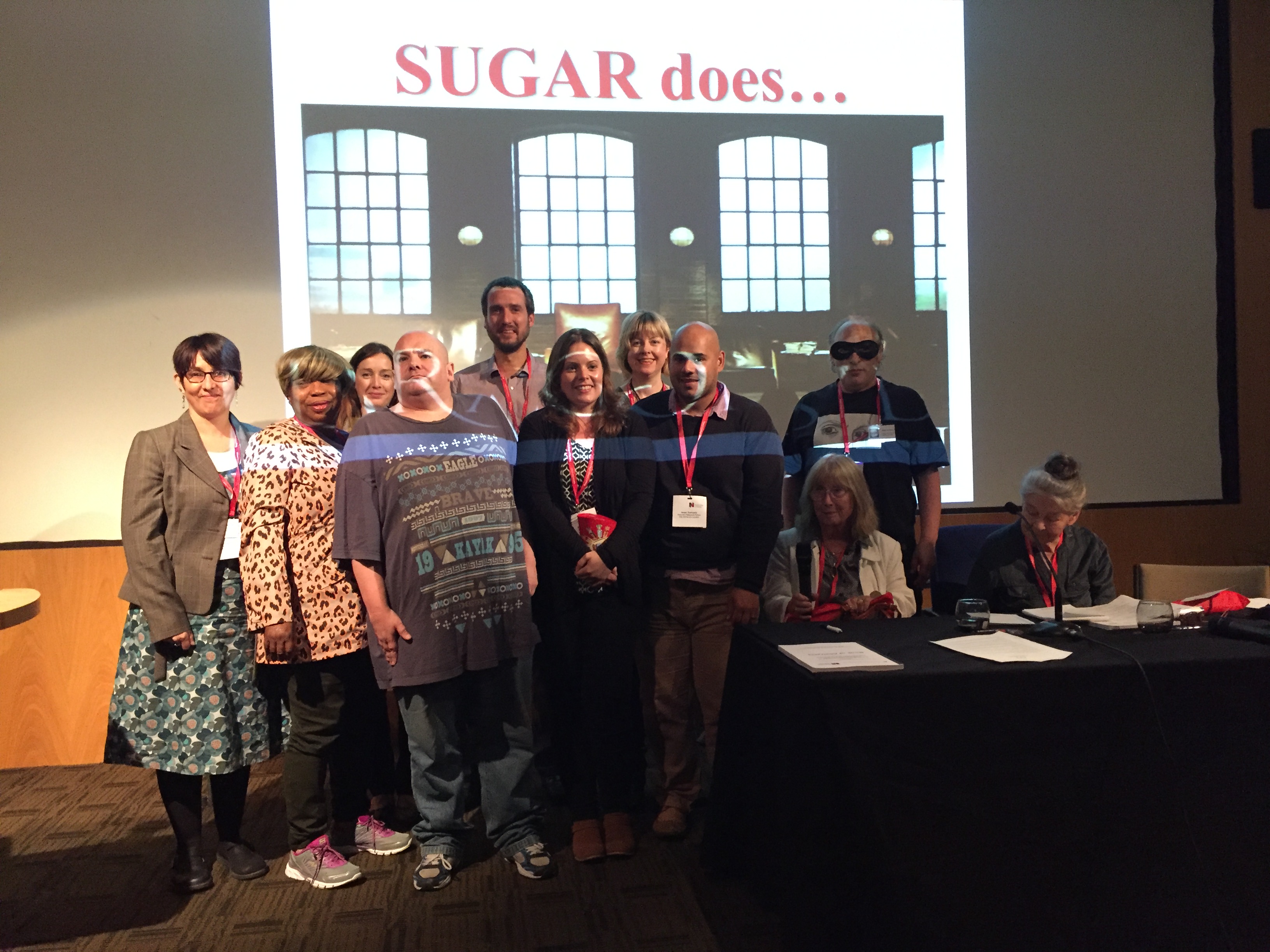
SUGAR does Dragons’ Den

That’s summary enough of the keynotes. From the concurrent sessions I participated in, chaired or observed I’ll first start with the SUGAR meets Dragons’ Den workshop. Three volunteers – Jason Hickey, Laoise Renwick and Cher Hallett – pitched their research ideas to SUGAR members. In the event, SUGAR offered their time and support to all three, but also voted Cher’s plans (on intramuscular injections) as the best of the batch. In the second concurrent I’m picking out, Julian Hunt, Alan Meudell and Michael Coffey presented reflections from Plan4Recovery. This project, which I’m also part of, is examining shared decision-making and social networks for people using secondary mental health services. And, finally, a word about our COCAPP symposium. This started with an overview paper from Alan Simpson, was followed by a presentation from Michael Coffey titled, ‘Ordinary risks and accepted fictions: how contrasting and competing priorities work in risk assessment care planning’ and concluded with a paper from Sally Barlow and me on participants’ views and experiences of recovery and personalisation.

The RCN's history of mental health nursing exhibition
The RCN’s history of mental health nursing exhibition

Organised by Laoise Renwick, this year for the first time the NPNR conference featured a poster trail. This worked well. Displayed posters were themed, and during lunchtime on day two guided delegates took opportunities to speak with those associated with them. Along the way I spotted some interesting posters from the RCN, drawing attention to an upcoming history of mental health nursing exhibition (organised with lots of help from Ian Hulatt) about to launch in London.

Elsewhere, the NPNR conference has become the place where the names of the following year’s Eileen Skellern Lecturer and the winner of the Journal of Psychiatric and Mental Health Nursing Lifetime Achievement Award are announced. Check out my tweet below for news for 2016. Many congratulations indeed to both Cheryl and Tony:

Len Bowers at #NPNR2015

Finally, a word on Len Bowers. At Doug MacInnes’ invitation, Len took to the lectern during the afternoon of day two to confirm his upcoming retirement and his plans for the future. These include (we learned) playing the flute, travel, photography and electronic music-making. Very nice. Len is a generous, principled and humble man whose contribution to creating new knowledge for mental health nursing has been immense. Take Safewards as an example. This is Len’s NIHR-funded programme grant, findings from which are changing practice in the UK and around the world. That’s some achievement, in my book. We wish him well.

Labour on mental health

Politics in the UK has just become a whole lot more interesting with the election of Jeremy Corbyn as leader of the Labour Party. During the leadership campaign differences between the candidates on health care did not feature as strongly as they might. Perhaps this is because more obvious variances existed in other areas, such as in economic, foreign and defence policies.

Following this link takes you to the new Labour leader’s proposed policies for mental health. These are clearly displayed on his campaign website; further evidence, perhaps, of the way mental health issues have become prominent in politics in recent years. To summarise, Corbyn’s plans include campaigning to reverse cuts to services, increase the numbers of professionals and improve services for young people. They also include introducing mental health education into the school curriculum, tackling stigma and loneliness and challenging the social causes of mental ill-health for women as well as investing in services. Corbyn also talks of addressing the over-representation of members of black and minority ethnic communities in mental health services, along with tackling homelessness, the mental health crisis in prisons, poverty, and failures in the welfare system and the workplace. He closes with this:

I am committed to a holistic approach that sees emotional well being as fundamentally connected with a society less atomised and individualistic, more socially connected, more caring, more inclusive and more equal.

A search through the new Labour leader’s website also turns up speeches he has given on mental health topics, the contents of which very much reflect the emphasis in his policy statement referenced above. An example can be read here. In the face of so many competing priorities, it will be interesting in the coming months to see how far mental health remains towards the top of the Leader of the Opposition’s agenda. 

Studying for a PhD in the School of Healthcare Sciences

PhD2Here in the School of Healthcare Sciences at Cardiff University we’ve continued to think about how best to appeal to potential PhD students, and to simultaneously develop research capacity across nursing, midwifery and the allied health professions. A change which we’ve recently made is to invite applicants for postgraduate research study to make clear how their developing plans fit with the research already going on in at least one of the School’s research themes. To help in this process we’re now advertising areas for future PhD study, closely aligned to the substantive and methodological expertise already found in the School. This makes lots of sense, and will help us to grow research in programmatic fashion and ensure students are appropriately supervised.

The place to go for the current list of topics/areas is here, where under the Workforce, Innovation and Improvement theme you’ll find this:

The use of in-depth qualitative methods to examine mental health systems. Specifically, projects investigating aspects of policy; service organisation and delivery; work, roles and values and user and carer experiences.

That’s the kind of PhD I’m primarily interested in supervising. For an example of what a completed one looks like, then follow this link to the full text of Dr Mohammad Marie’s freshly minted thesis titled, Resilience of Nurses who work in Community Mental Health Workplaces in West Bank-Palestine.

Mental Health Nurse Academics UK meets in Nottingham

I was unable to make Thursday evening’s Skellern Lecture and Journal of Psychiatric and Mental Health Nursing Lifetime Achievement event hosted by Patrick Callaghan at Nottingham University. My congratulations to Ian Norman and to Marion Janner, this year’s very worthy award winners. As it happens, Ian was one of my PhD examiners. My following of Thursday’s proceedings from afar, via Twitter, tells me I missed a treat.

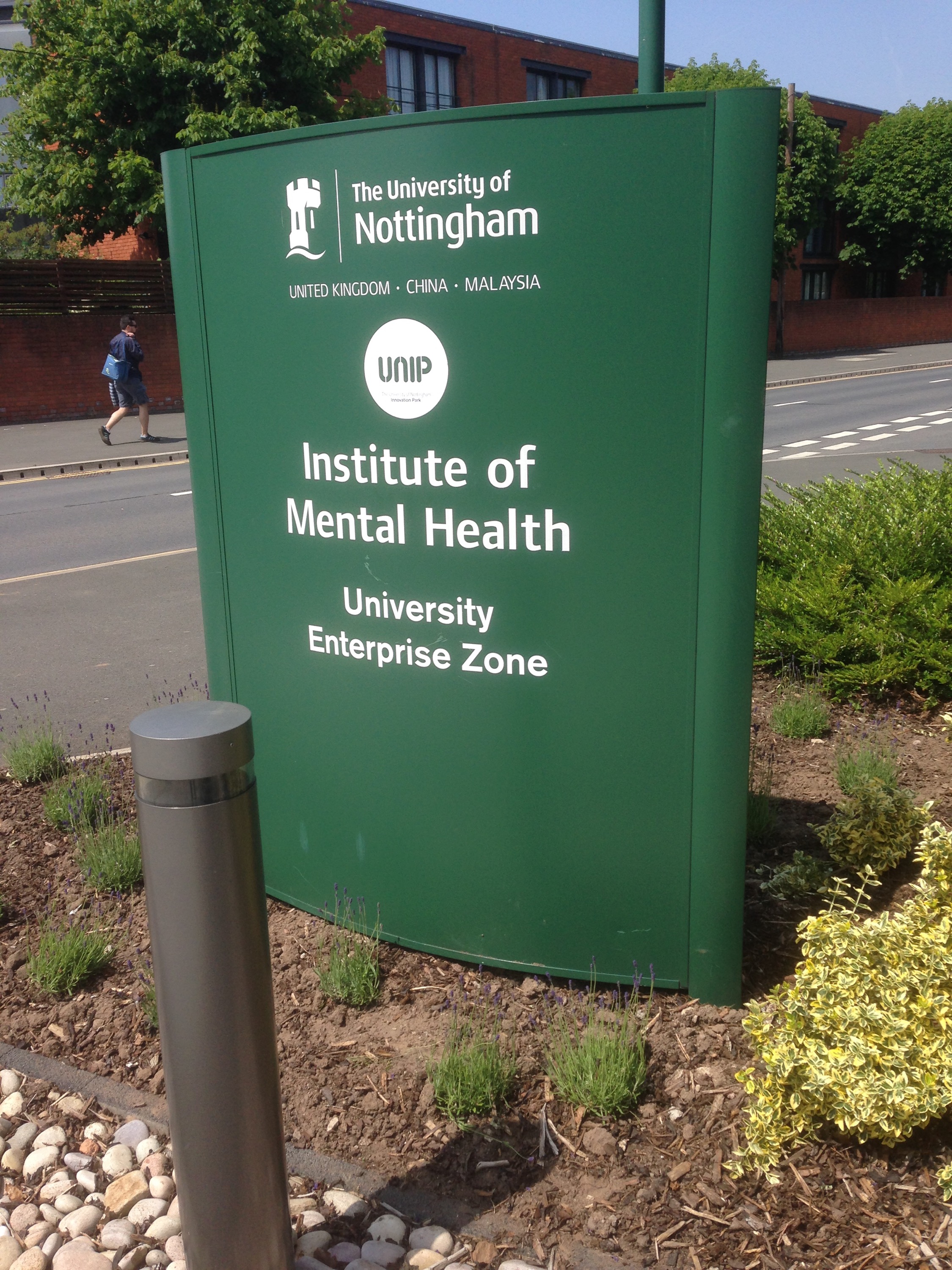
I was, however, able to make the trip to Nottingham for Friday’s summer term meeting of Mental Health Nurse Academics UK (MHNAUK). This was held in the new, and rather impressive, Institute of Mental Health building:

Here’s a picture I took of the sculpture, titled House for a Gordian Knot, displayed at the entrance to the Institute’s main building:

We had three local presentations. First up was  Paul Crawford, who gave a broad overview of the Creative Practice as Mutual Recovery research programme which he leads, followed by Andrew Grundy giving an account of qualitative findings from the Enhancing the Quality of User Involved Care Planning in Mental Health Services (EQUIP) study. EQUIP is an important, NIHR-funded, programme of work which (along with COCAPP and COCAPP-A) is producing evidence of how care planning is being done and how it might be improved. Here’s a photo, taken and shared by Karen Wright, of one of Andrew’s final slides outlining steps to successful user involvement in this process:

Tim Carter talked us through his freshly-minted mixed methods PhD, in which he investigated the use of a preferred-intensity exercise programme for young people with depression. I thought this to be a very well-designed study, which generated considerable discussion around the active ingredients of the intervention and plans for a future follow-up.

Elsewhere Lawrie Elliott, editor of the Journal of Psychiatric and Mental Health Nursing, was welcomed by the group to give an update on developments at the journal in his first year at the helm. I really liked what I heard, and said as much in our discussion. Quality of papers, and relevance to mental health nursing, are being prioritised. Word limits have been increased to allow for more in-depth analysis in accepted articles. To extend its reach the journal now has a Twitter account, which can be followed by clicking the following link:

Ben Thomas from the Department of Health opened a discussion on the future of the Student Mental Health Nursing Conference, the inaugural event having taken place at the O2 Arena in London in February this year. As I understand it, much of the organising was done by staff and students at Greenwich University: well done, them. A group of MHNAUK members representing different universities has agreed to collaborate to keep this initiative going, and with a view to turning it into a cross-UK, rather than an England-only, opportunity.

Following David Sallah’s meeting with MHNAUK in York in March 2015, Joy Duxbury and Steven Pryjmachuk chaired a discussion on the current status of the Shape of Caring review. Since returning from Nottingham I have found that Health Education England is planning to sound out opinion through a series of events running into the autumn. Details are to follow.

Thanks particularly to John Baker, in the weeks leading up to this latest meeting MHNAUK published a response strongly criticising the announcement that the National Institute for Health and Care Excellence (NICE) was ending its work in the area of safe staffing. This decision, defended two days ago by Jane Cummings (Chief Nursing Officer at NHS England), has also been challenged by others including Sir Robert Francis and now the Council of Deans of Health. The Safe Staffing Alliance campaigns in this area, and MHNAUK will continue to make a contribution via a further response the outline of which was agreed in Nottingham. As a reminder of some of the key evidence supporting the importance of registered, graduate, nurses for quality and safety follow this link to an earlier post on this site and this link to a recording of Linda Aiken delivering the Winifred Raphael Memorial Lecture at the University of South Wales on October 1st 2014. And, for those interested in how #safestaffing is shaping up differently across the countries of the UK, follow this link for a record of the progress of the Safe Nurse Staffing Levels (Wales) Bill through the National Assembly for Wales. Following this link brings you to a report reviewing the evidence, commissioned by the Welsh Government and produced by a team led by Aled Jones in the Cardiff School of Healthcare Sciences.

Fiona Nolan shared progress on her survey of mental health nursing research interests and expertise in UK higher education institutions. And, finally, on behalf of the organising and scientific committee Russell Ashmore, Laoise Renwick and I took the chance to update MHNAUK members on progress for the 21st International Network for Psychiatric Nursing Research conference.

#NPNR2015 takes place at the Manchester Conference Centre on Thursday 17th and Friday 18th September 2015. We think the programme is shaping up perfectly, with keynote speakers including England’s National Clinical Director for Mental Health Dr Geraldine Strathdee, Prof Shôn Lewis from the University of Manchester, Mark Brown who ran One in Four magazine and is now involved with The New Mental Health, and André Tomlin who runs The Mental Elf service. We have symposia, workshops and concurrent sessions with papers accepted from presenters around the world, a walking poster tour and the opportunity for fringe events. Make your booking now!

Making Hay

Hay Festival 2015

I’m back from the annual week-long trip to the Welsh Marches, taking in an eclectic mix of speakers at both the Hay and the newer How the Light Gets In festivals. The first of these has grown in size to the extent that, for some years, it has been located out-of-town in a field of marquees. I remember visiting when events took place in the local primary school. The second, much smaller, festival makes use of the Globe building supplemented with tents across two sites.

There was plenty on offer related to the field of mental health. Andrew Scull used images to support a tour through mental health services across time, and Mark Salter gave a lively account of the limits of biology. Richard Bentall, Dinesh Bhugra and Simon Baron-Cohen debated categorisation and diagnosis, concluding (in largely consensual style) that what we need is more public mental health, peer support and respect. David Healy continued his critique of the pharma industry.

This year the weather was kind, which always makes a difference. Travelling further north for a day, deep into Powys, took us to the Elan Valley and a fine walk in the hills.

Caban Coch dam
Carn Gafallt

Back at the festivals, I’m always impressed when natural scientists are able to convey difficult concepts in ways which are understandable to lay audiences. This is not easy, I would have thought, when the working language is that of mathematics. On this occasion I took the time to listen to a discussion on the physics of black holes, and was glad that I did.

Next week sees me back at work, with a new office giving views over Cardiff towards the Bristol Channel. Here’s a photo taken just before I headed off for my week away. Look hard enough and you can, just about, make out the sea.

Office view: Cardiff, then the Bristol Channel, and Somerset in the far distance

Research capacity building in Wales

The Nursing and Midwifery Council (NMC) here in the UK tells us that, at the end of March 2014, there were 680,858 nurses and midwives on the register. The Health and Care Professions Council (HCPC), which regulates 16 different professions, tells us that on the same date approximately 322,000 individuals were registered. Adding these numbers together gives a total in excess of one million. That’s an awful lot of registrants. Only a small number of these, however, are directly engaged in research to inform current and future practice and fewer still have had opportunities to become fully independent investigators. As the Shape of Caring review puts it with regard to nursing:

It is currently estimated that 0.1 per cent of the nursing workforce in England are professors of nursing: an indication that there are simply inadequate numbers for the task of leading research and evidence-based practice. Many of these academics will retire in the next 10 to 15 years.

Given this mismatch, efforts to grow research are immensely important. Leading the way in this part of the UK is the RCBC Wales scheme, which:

[…] was established in order to increase the research capacity of nursing, midwifery and allied health professions in Wales and to contribute toward the development of clinical academic roles.

I was fortunate enough to be awarded an RCBC Wales post-doctoral research fellowship in 2006. In the last few weeks three Cardiff-based colleagues have been successful in securing the same in the most recent round of applications: Dr Jessica Baillie, Dr Lucie Warren and Dr Liba Sheeran. Jess is a nurse who will be researching the experiences of people who develop peritonitis as a result of peritoneal dialysis, Lucie is a midwife who will be investigating an intervention to improve the diet and physical activity of pregnant women, and Liba is a physiotherapist who is exploring how smartphone technology can help people recovering from back pain. Congratulations to all three.

Spring election, and the politics of mental health

It hasn’t always been like this, but mental health is something which politicians now talk about. In the run-up to next week’s general election mental health has even featured in public appeals to voters. The Liberal Democrats have particularly campaigned in this area, and in their manifesto promise £500 million per year for better mental health, and specifically make a case for investing in research. Labour talk about giving mental health the same priority as physical health, and the Conservatives say pretty much the same. Reviewing all the main parties’ manifesto promises for evidence of concrete plans for post-election improvements to mental health care, over on his blogsite the Psychodiagnosticator observes ‘that many of them were so vague as to amount to no promise at all‘. I think he has a point.

Possibly the broad manifestos produced in the run-up to a general election are not the places to look for fully worked-up blueprints of what future mental health policy across the UK might look like. Perhaps, more accurately, we should not think about ‘UK policy’ in this context at all. Members of Parliament elected to Westminster next week, from amongst whom a new government will be formed, will have authority to directly shape services in England only. Health and social care remain areas over which devolved authorities have jurisdiction, and for a ballot delivering a government with the power to pronounce on mental health care here in Wales we must look to the National Assembly elections to be held in 2016. I’ve indicated before that mental health policy here is different from that in England, and indeed from other countries in the UK. Consider again the case of the Mental Health (Wales) Measure. This is a piece of legislation for Wales alone, mandating for care and treatment plans, care coordinators, access to advocates in hospital and the right of reassessment within secondary mental health services following discharge. It was introduced in the face of some strong, pre-legislative, criticism from at least one senior law academic (Phil Fennell) who in 2010 began his submission to the National Assembly by saying,

The gist of my submission to the Committee is that this measure, although well-intentioned, is cumbersome, unduly complex, and will lead to a delay in providing services which ought to have been available already to service users and their families in Wales under the National Service Framework for Adult Mental Health and the Care Programme Approach.

Five years on the Measure has not only passed into law, but been subjected to a round of post-legislative scrutiny by the National Assembly’s Health and Social Care Committee (see my post here), to which the Welsh Government has now responded. With data from across both England and Wales, COCAPP (and in the future, COCAPP-A) will have something to say about how care planning and care coordination are actually being done, and readers will be able to draw their own conclusions on the extent to which changes in the law trigger changes to everyday practice. And, whilst we’re in policy comparison mode, for a view from Scotland try Paul Cairney. He argues that divergence in mental health policy across the UK, exemplified by contrasting English and Scottish experiences of reforming the law, reflect differences in both the substance of policy and in policymaking style.

In all of this I am, again, reminded of the wicked problems facing all policymakers who seek to intervene in the mental health field. Whatever direction it takes, future policy will be open to contest and will surely trigger waves of consequences.

Research in the School of Healthcare Sciences

In February 2015, in the School of Healthcare Sciences at Cardiff University we launched our new research strategy. The School’s main research webpage can be found here, and for the nuts-and-bolts of our four research themes the links to follow are these:

Meanwhile, in the very near future the School (including its researchers) will be occupying additional floors at our base in Eastgate House. This, for those who know Cardiff, is a building situated at the junction of Newport and City Roads. My office, I think, will move: giving me fine views over the city and beyond.

Here are some photos of the 12th floor, as previously shared via a Tweet:

It is very welcome that we will soon have these new facilities available to us, with the rooms in the photos being used mainly by PhD and Professional Doctorate students.

Which brings me neatly to…

Other interesting developments in the School on the postgraduate research student front are plans to recruit very pro-actively. Research theme members have been busy generating topics for doctoral study, which reflect existing areas of substantive and methodological expertise and where capacity to supervise is known to exist. We’ll be advertising these soon, and inviting potential students to tell us how their plans align. The aim, obviously, is that we grow research in programmatic style by building on established and emerging lines of enquiry. For anyone interested, I’m looking to supervise people who want to use in-depth qualitative methods to examine mental health systems (no surprises there, then!). Specifically, this means projects investigating aspects of: policy; service organisation and delivery; work, roles and values; and user and carer experiences.

Other postdoctoral news includes Mohammad Marie‘s (that’s Dr Mohammad Marie’s) successful defence of his thesis at viva last month. Well done! Mohammad has been supervised by Aled Jones and me, and the title of his thesis is Resilience of nurses who work in community mental health workplaces in West Bank, Palestine. Next up for him are papers for publication: and jolly interesting they’ll be, too.

The shape of nursing (reprise)

York, March 10th 2015
Yesterday I joined other members of Mental Health Nurse Academics UK at the University of York, for what turned out to be a particularly lively spring term meeting. 

We were treated to two high-quality local presentations in the morning: from Simon Gilbody on smoking cessation interventions for people using mental health services, and from Jerome Wright on developing community mental health in Malawi. 

In the early afternoon David Sallah from Health Education England (HEE) took the floor to talk about the Shape of Caring review, the final report from which is due to be published later this week. From David’s presentation it is evident that HEE will be making a case for a significant shake-up to the way nurses are prepared. 

MHNAUK members in York were concerned with what they heard. Uppermost for many was a concern that HEE’s wish for future student nurses to commence their courses with two years of Project 2000-style generalist preparation will erode the time available for mental health-specific learning. People were also struck by the apparent lack of a clear evidence base for change. It is, after all, only a handful of years since the Nursing and Midwifery Council introduced its current standards for education, and curricula up and down the country were rewritten in response. In the absence of robust evaluations of what we already have, are we really sure we know what needs fixing in nurse preparation? 

The Shape of Caring review is sponsored by a body with authority in England only, but I am under no illusions that any changes flowing from it will be felt equally here in Wales. David Sallah mentioned cross-UK talks as having already opened. As people observed yesterday, however, any changes to nursing education recommended at this point may be lost following a general election where greater priorities occupy the time of a newly formed government. 

Meanwhile, and with a firm eye on the forthcoming election, the Council of Deans of Health has been busy making a case for health higher education and research in its new publication Beyond Crisis. This has three main messages, addressing: workforce planning; building on the talents of the current workforce; and investing in research. Amongst other things the Council is asking for proper forward planning to avoid cycles of boom and bust, opening up opportunities for continuous professional development and protecting and advancing research. It is also suggesting that new ways of financially supporting health professional education should be looked at, including models where contributions are made by students and employers.

Fieldwork

FieldworkToday brought some interesting discussions on qualitative fieldwork, including on researcher roles and relations during data generation. First up was a COCAPP-A project meeting which included a conversation about observational methods in inpatient mental health settings. Second was a seminar led by Michael Coffey‘s PhD student Brian Mfula, drawing on his ongoing PhD experiences of ethnographic fieldwork centring on care planning and care coordination in forensic mental health care.

Brian shared his experiences of negotiating access, and of his reading and thinking about insider and outsider roles. This led to a wide-ranging talk amongst those present on fieldnotes and approaches to qualitative research (Grounded theory, anyone? Phenomenology? Or perhaps thematic analysis is more your thing?). We talked, too, about reflexivity, and knowing when (and how) to leave the field. Along the way this took us to the National Centre for Research Methods’ excellent Review Paper, How many qualitative interviews is enough?

Around ten years ago I contributed a chapter covering some of this territory to Davina Allen and Patricia Lyne’s edited book, The Reality of Nursing Research: Politics, Practices and Processes. Titled Data generation, this contrasted survey principles and practices in The All Wales Community Mental Health Nursing Stress Study with the ideas and methods in my (then-ongoing) ethnographic PhD, Health and Social Care for People with Severe Mental Health Problems. I wrote about decision-making, and the extent to which data are interactionally produced by researchers and participants together:

Whilst different strategies place different expectations and demands on nurse researchers, this chapter has also shown that – whatever approach is followed – data generation is always a purposeful activity demanding a reflexive stance. The principle of reflexivity underpins the idea that research always takes place in contexts, shaped to significant degree through an interaction between researcher and researched. The character of data produced in a study is moderated by aspects of the researcher’s personal biography and their interaction with research participants. This is a well-established principle in the social sciences. In nursing research, however, reflexive investigators have to give consideration not only to general biographical aspects such as age and gender, but also to their specific occupational backgrounds and practitioner experiences. A self-conscious, reflexive approach includes acknowledgement of the utility and the limitations of practitioner knowledge, and the implications of this for data production.

I’m now thinking that today’s seminar and discussions show how live these issues remain, and will ever remain so.