Category: People

Mental health awareness week

Mental Health Awareness Week 2017 has the theme of ‘surviving or thriving’, this also being the title of a new report from the Mental Health Foundation. Included in this document is a summary of research completed by NatCen, on behalf of the Mental Health Foundation, into the prevalence of mental health problems across the population and into the activities that people do to manage these.

Here’s a snip from the report, summarising the self-reported difficulties experienced by the 2,290 people who took part:

MHF thriving
Extracted from Surviving or thriving

Using their NatCen data the Mental Health Foundation goes on to highlight major health inequalities. Almost three quarters of those on the lowest household income report experience of mental health difficulties, compared to six in ten of the wealthiest. A large majority of unemployed people responding reported experience of mental health problems, with women and younger people also particularly affected.

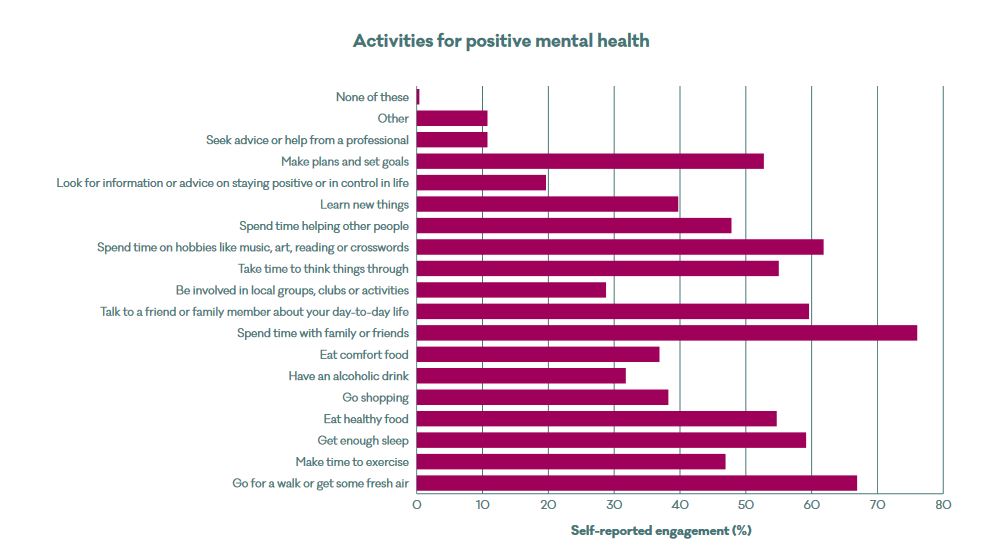
These findings are broadly in line with those reported in the most recent Mental Health and Wellbeing in England Adult Psychiatric Morbidity Survey, the data for which was collected in 2014. This is the latest in a series of studies dating back to 1993, involving (in the 2014 iteration) a sample of some 7,500 people. In the case of Surviving or thriving, the new (to me, at any rate) detail is the reporting of what actions people take to help themselves with their difficulties. Here’s another snip:
Surviving 2
Extracted from Surviving or thriving

Family and friends, outdoor physical activity and hobbies look to be the three most-used strategies. I can’t say I’m surprised by this, and am reminded of the value placed in relationships with others by people taking part in COCAPP.

Elsewhere during Mental Health Awareness Week, The Guardian has published a number of pieces including this one on the shortage of mental health nurses and this one on Hafal‘s Gellinudd Recovery Centre (about which I previously blogged here). Coincidentally, this is also the month that the full and final report from COCAPP-A has been accepted for publication: well done Alan Simpson for leading this work. This mighty tome, reporting from our cross-national study into care planning and coordination in acute mental health inpatient settings, has now proceeded to the production arm of the NIHR and is scheduled to appear in gold open access form towards the end of the year. In the meantime, work is progressing to produce papers for journals. More on these to follow in due course.

PhD opportunity

KESS2With Nicola Evans and Rebecca Playle I’m on the look-out for someone to begin a full-time PhD in the autumn, investigating the interventions and processes that promote young people’s connection to their education, friends and families during inpatient mental health care. This is a Knowledge Economy Skills Scholarship (KESS2), which is part funded by the Welsh Government’s European Social Fund (ESF) West Wales and the Valleys programme. It has also been developed in collaboration with Cwm Taf University Health Board which is making a contribution to the award.

For those interested, the studentship has been explicitly designed to build on our RiSC evidence synthesis, about which I have previously written here, here and here. We found significant knowledge gaps in this previous project, which we’re now anticipating this PhD will begin to fill.

#MHNAUK meets at the University of Hertfordshire

MHNAUK met on March 31st at the University of Hertfordshire, hosted by Greg Rooney and chaired by Steven Pryjmachuk. Anne Trotter from the NMC was welcomed for a detailed discussion on the development of new standards for pre-registration nursing, and on the NMC’s wider work to create a framework for education of which this is […]

via #MHNAUK meets at the University of Hertfordshire  — MHNAUK

Safe staffing (again)

safe staffingJust over a year ago I posted a short piece on this site on safe staffing, particularly noting the work of Shaun Lintern and John Baker in alerting people to the importance of this in the mental health nursing context. Since then, the Nurse Staffing Levels (Wales) Act 2016 has passed into law, and the Welsh Government has opened this consultation on its draft statutory guidance for Local Health Boards and NHS Trusts. My colleague Aled Jones is coordinating a School of Healthcare Sciences response.

Here in Wales, the duty to calculate nurse staffing levels is currently limited to adult acute medical and surgical inpatient wards. In each NHS organisation with responsibilities in these fields, the Government’s draft document refers to the appointment of a ‘designated person’ with the job of calculating nurse staffing levels using three elements:

  • professional judgement;
  • use of an evidence-based workforce planning tool; and
  • a consideration of the extent to which patients’ wellbeing is sensitive to nursing care.

Making these calculations, I can only imagine, will be a mighty challenging task requiring in-depth understanding of individual wards, the characteristics of patients admitted, and use of a tool which has (so far as I understand it) yet to be finalised.

Meanwhile, via John Baker I learn today of this new publication by NHS Improvement on safe, sustainable and productive staffing in mental health services. This is not about safe nursing staffing, but is about interprofessional staffing in specialist mental health services. Here I read of expectations around right staff, right skills and right place, right time and also spot a rapid review of the relevant literature. This begins with the understated observation that, ‘the issue of safe and sustainable staffing in mental health is complex and research is lacking’. I should say so. The time is ripe, I think, for some serious independent studies in this area.


Out with the old

Happy new year. In one of my earliest posts on this blog I wrote of coming across a fallen tree. Over the months and years following this became something of a local landmark for those of us fond of making the trip over Craig yr Allt by foot. The tree was removed sometime last autumn, with tyre tracks telling a tale. I’ll add its disappearance to the long list of last year’s losses, included on which are Carrie Fisher, George Michael and the security of Britain remaining in the EU.

2016-10-28-08-40-23

If 2016 had more than its fair share of trampling, and like the track up Craig yr Allt bowed out with its topsoil removed, perhaps this year will be different. Or maybe not. Anyway…

As 2017 gets underway I’ve opened my term of office as Vice Chair of Mental Health Nurse Academics UK with a fruitful conversation with Steven Pryjmachuk, the group’s Chair for this year and next. Ideas for refreshing the MHNAUK website, and our March meeting at the University of Hertfordshire, were amongst things on the agenda. We’ll have lots to talk about; as I observed in my last post, a number of important things are afoot with likely changes to the education of nurses and the beginnings of plans being laid for the next research excellence framework.

Elsewhere, the forthcoming care planning and care coordination themed issue of the Journal of Psychiatric and Mental Health Nursing which Michael Coffey, Alan Simpson and I are guest editing is taking shape nicely. We have some super articles lined up, and will be writing editorials in the near future.

Later in the year, in September, the newly renamed International Mental Health Nursing Research Conference (the NPNR, as was) meets in Cardiff. I’ll be off to a conference planning meeting in London in a week’s time where we’ll be talking about a theme for #MHNR2017 and possible keynote speakers. I’ll perhaps blog something about that when we’re done.

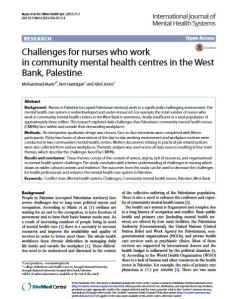
marie-et-al-2017On the publications front, Mohammad Marie has lead authored (with Aled Jones and me in support) this latest paper. It’s all about the challenges faced by Palestinian community mental health nurses, and represents the fourth article emerging from Mohammad’s PhD thesis in something like 18 months. That’s good going indeed. Here’s the abstract:

Background:
Nurses in Palestine (occupied Palestinian territory) work in a significantly challenging environment. The mental health care system is underdeveloped and under-resourced. For example, the total number of nurses who work in community mental health centres in the West Bank is seventeen, clearly insufficient in a total population of approximately three million. This research explored daily challenges that Palestinian community mental health nurses (CMHNs) face within and outside their demanding workplaces.
Methods:
An interpretive qualitative design was chosen. Face-to-face interviews were completed with fifteen participants. Thirty-two hours of observations of the day-to-day working environment and workplace routines were conducted in two communities’ mental health centres. Written documents relating to practical job-related policies were also collected from various workplaces. Thematic analysis was used across all data sources resulting in four main themes, which describe the challenges faced by CMHNs.
Results and conclusion:
These themes consist of the context of unrest, stigma, lack of resources, and organisational or mental health system challenges. The study concludes with a better understanding of challenges in nursing which draws on wider cultural contexts and resilience. The outcomes from this study can be used to decrease the challenges for health professionals and enhance the mental health care system in Palestine.


In with the new

Following a discussion involving the event’s steering committee and Mental Health Nurse Academics UK (MHNAUK), what was the International Network for Psychiatric Nursing Research Conference has now become the International Mental Health Nursing Research Conference. Next year we meet in Cardiff on September 14th and 15th, and early information can be found here. This site will be updated as further plans are made, so it’s worth checking in from time to time. We’ve also updated our conference twitter feed; clicking takes you there. Our hashtag, which is already in use, is #MHNR2017.

For a taster of the conference, here are links to four of last year’s keynote presentations: Steven Pryjmachuk, Elaine Hanzak, Luciana Berger MP and Bryn Lloyd-Evans:

Meanwhile, I’m pleased to have been elected as Vice Chair of MHNAUK. I’ll be working with the Chair, Steven Pryjmachuk, throughout 2017 and 2018 before becoming Chair at the start of 2019 for a further two years. I’m grateful for the opportunity colleagues have given me, and will do my best to lead and represent the group and the wider field. I anticipate having plenty to do, noting changes ahead in the education of nurses, the funding of students and the run-in to the next research excellence framework. More on all these to follow, I’m sure: with time today to draw attention to the decision by the Welsh Government to continue bursary payments in 2017-18 for eligible students of nursing, midwifery and the allied health professionals. As the press release announcing this makes clear, individuals taking this offer up will need to commit ‘in advance to taking up the opportunity to work in Wales, post qualification, for a period of two years’. Entirely unclear are funding arrangements for the period from 2018-19 onwards.

Reflections on #AfterWhitchurch

Further to my last post looking ahead to #AfterWhitchurch, here now are my reflections on the event as it happened as also recorded on the Cardiff University mental health blog. I’ve selected some photos, too.

The closure of Whitchurch Hospital to inpatients in spring 2016 provided the backdrop for #AfterWhitchurch, a collaborative Economic and Social Research Council (ESRC)/Cardiff University Festival of Social Science event focusing on the changing system of mental health care hosted at Cardiff’s Chapter Arts on November 10th 2016.

2016-11-10-17-42-30

Whitchurch Hospital opened as the Cardiff City Mental Hospital in 1908, the image below being the first entry on the first page of the hospital’s visitors book.

2016-11-10-21-40-00

Members of the hospital’s Historical Society were on hand with objects, documents and photographs from their archive. Artist and director Elaine Paton presented and talked about her work with Moment(o)s of Leaving, a multimedia performance produced to mark the occasion of the hospital’s closure. Audiorecorded interviews, created for Momento(s) of Leaving by artist/curator and researcher Julia Thomas, recounted staff members’ reflections on leaving Whitchurch and their thoughts for the future.

Chaired by Norman Young from Cardiff and Vale University Health Board, School of Healthcare Sciences and service user researchers discussed how mental health care has shifted from hospital to the community, and shared reflections from research into the organisation of services, the work and experiences of service users and staff and the provision and evaluation of novel psychological interventions.

2016-11-10-21-47-35

Ben Hannigan talked about using in-depth case methods to understand mental health services at different levels of organisation, and Nicola Evans discussed her research into the mental health of children and young people. Dean Whybrow drew on 18 years of experience in the Royal Navy to describe how mental health support and interventions is provided in the military. Alan Meudell shared his reflections on being a service user researcher, and Bethan Edwards spoke of her dual identity as an occupational therapy researcher investigating care for older people with dementia and as a service user researcher. Stimulating and informed questions from the floor challenged the panel to think about stigma, the impact of research on changing practice and services offering respite and asylum.

Playing our Part

A short post this morning to draw attention to Professor Tony Butterworth’s Playing our Part review, this being something which occupied me towards the start of last week. With the support of the Foundation of Nursing Studies Tony is conducting a review of mental health nursing, by mental health nurses. I made the trip to the (very plush) King’s Fund headquarters in London’s Cavendish Square on Monday, where FoNs is currently in residence, to join an educators’ group discussing responses to a series of questions Tony had set for us in advance. The questions were of a type always easier to ask than to answer (‘how do you prepare students to uniquely become mental health nurses?’, and ‘do you think that students should be exposed to some form of basic psychosocial education skills at undergraduate level?’ being two examples). We talked lots about the interpersonal aspects of nursing, and the enduring importance of relational work, but also about the roles that mental health nurses fulfil in managing the system and coordinating care. I’ll be keeping an eye on the Playing our Part blog over the coming weeks as Tony continues his tour through the UK, meeting groups of nurses to draw out their views and experiences. The final report, as I understand it, is due to appear towards the end of the year. 

Elsewhere I’ve been working with co-conspirators to fine-tune next week’s #AfterWhitchurch ESRC Festival of Social Science event at Chapter in Cardiff. I’ll have to post something uniquely about that once we’re done. 

COCAPP Knowledge Transfer

Last week I joined the rest of the COCAPP team at an all-day event at City University London, designed to help NHS staff, service users and carers make use of what we found. I was pleased to meet Donna Kemp, who has since written about her experiences of the day. I thought it would be a nice idea to reblog this.

donnakemp's avatardonnajkemp

Last week I was fortunate enough to be invited to the COCAPP Knowledge Transfer event held at City University London on 21st July 2016. You can read more about this here.

It was great to meet people face to face, beyond Twitter – particularly Alan Simpson (PI) Ben Hannigan, and Michael Coffey who are leading this important NIHR funded research, #COCAPPimpact.

Whats really good about this piece of research is that it is within my area of interest and that the method used aimed to address care planning on 3 levels – macro (national), meso (organisation) and micro (care delivery, face to face). To achieve this they used a mixed methods approach . The fabulousness of this is that it answered the research question on the 3 levels, perhaps anticipating that tackling one level in isolation would give rise to questions in the other levels. Adding to the credibility is…

View original post 359 more words