Category: Nursing

First COCAPP publication

COCAPP BMC protocol

Here’s a brief post to flag this week’s appearance of a first published paper from COCAPP. This is the study protocol, and can be found in BMC Psychiatry. Clicking the image above will take you directly to the gold open access PDF of the article.

Protocol publishing is a fairly new phenomenon. It encourages transparency, and in the case of health intervention studies is a way of meeting the registration and reporting standards which organisations like AllTrials are campaigning for. COCAPP has not been an intervention study, but publishing the protocol is still valuable for the purposes of openness. When findings are published at a later point, readers can also be given the briefest of summaries of the methods used coupled with a reference to the protocol paper for the full detail.

Mental Health Nurse Academics UK meets in Nottingham

I was unable to make Thursday evening’s Skellern Lecture and Journal of Psychiatric and Mental Health Nursing Lifetime Achievement event hosted by Patrick Callaghan at Nottingham University. My congratulations to Ian Norman and to Marion Janner, this year’s very worthy award winners. As it happens, Ian was one of my PhD examiners. My following of Thursday’s proceedings from afar, via Twitter, tells me I missed a treat.

I was, however, able to make the trip to Nottingham for Friday’s summer term meeting of Mental Health Nurse Academics UK (MHNAUK). This was held in the new, and rather impressive, Institute of Mental Health building:

Here’s a picture I took of the sculpture, titled House for a Gordian Knot, displayed at the entrance to the Institute’s main building:

We had three local presentations. First up was  Paul Crawford, who gave a broad overview of the Creative Practice as Mutual Recovery research programme which he leads, followed by Andrew Grundy giving an account of qualitative findings from the Enhancing the Quality of User Involved Care Planning in Mental Health Services (EQUIP) study. EQUIP is an important, NIHR-funded, programme of work which (along with COCAPP and COCAPP-A) is producing evidence of how care planning is being done and how it might be improved. Here’s a photo, taken and shared by Karen Wright, of one of Andrew’s final slides outlining steps to successful user involvement in this process:

Tim Carter talked us through his freshly-minted mixed methods PhD, in which he investigated the use of a preferred-intensity exercise programme for young people with depression. I thought this to be a very well-designed study, which generated considerable discussion around the active ingredients of the intervention and plans for a future follow-up.

Elsewhere Lawrie Elliott, editor of the Journal of Psychiatric and Mental Health Nursing, was welcomed by the group to give an update on developments at the journal in his first year at the helm. I really liked what I heard, and said as much in our discussion. Quality of papers, and relevance to mental health nursing, are being prioritised. Word limits have been increased to allow for more in-depth analysis in accepted articles. To extend its reach the journal now has a Twitter account, which can be followed by clicking the following link:

Ben Thomas from the Department of Health opened a discussion on the future of the Student Mental Health Nursing Conference, the inaugural event having taken place at the O2 Arena in London in February this year. As I understand it, much of the organising was done by staff and students at Greenwich University: well done, them. A group of MHNAUK members representing different universities has agreed to collaborate to keep this initiative going, and with a view to turning it into a cross-UK, rather than an England-only, opportunity.

Following David Sallah’s meeting with MHNAUK in York in March 2015, Joy Duxbury and Steven Pryjmachuk chaired a discussion on the current status of the Shape of Caring review. Since returning from Nottingham I have found that Health Education England is planning to sound out opinion through a series of events running into the autumn. Details are to follow.

Thanks particularly to John Baker, in the weeks leading up to this latest meeting MHNAUK published a response strongly criticising the announcement that the National Institute for Health and Care Excellence (NICE) was ending its work in the area of safe staffing. This decision, defended two days ago by Jane Cummings (Chief Nursing Officer at NHS England), has also been challenged by others including Sir Robert Francis and now the Council of Deans of Health. The Safe Staffing Alliance campaigns in this area, and MHNAUK will continue to make a contribution via a further response the outline of which was agreed in Nottingham. As a reminder of some of the key evidence supporting the importance of registered, graduate, nurses for quality and safety follow this link to an earlier post on this site and this link to a recording of Linda Aiken delivering the Winifred Raphael Memorial Lecture at the University of South Wales on October 1st 2014. And, for those interested in how #safestaffing is shaping up differently across the countries of the UK, follow this link for a record of the progress of the Safe Nurse Staffing Levels (Wales) Bill through the National Assembly for Wales. Following this link brings you to a report reviewing the evidence, commissioned by the Welsh Government and produced by a team led by Aled Jones in the Cardiff School of Healthcare Sciences.

Fiona Nolan shared progress on her survey of mental health nursing research interests and expertise in UK higher education institutions. And, finally, on behalf of the organising and scientific committee Russell Ashmore, Laoise Renwick and I took the chance to update MHNAUK members on progress for the 21st International Network for Psychiatric Nursing Research conference.

#NPNR2015 takes place at the Manchester Conference Centre on Thursday 17th and Friday 18th September 2015. We think the programme is shaping up perfectly, with keynote speakers including England’s National Clinical Director for Mental Health Dr Geraldine Strathdee, Prof Shôn Lewis from the University of Manchester, Mark Brown who ran One in Four magazine and is now involved with The New Mental Health, and André Tomlin who runs The Mental Elf service. We have symposia, workshops and concurrent sessions with papers accepted from presenters around the world, a walking poster tour and the opportunity for fringe events. Make your booking now!

Research capacity building in Wales

The Nursing and Midwifery Council (NMC) here in the UK tells us that, at the end of March 2014, there were 680,858 nurses and midwives on the register. The Health and Care Professions Council (HCPC), which regulates 16 different professions, tells us that on the same date approximately 322,000 individuals were registered. Adding these numbers together gives a total in excess of one million. That’s an awful lot of registrants. Only a small number of these, however, are directly engaged in research to inform current and future practice and fewer still have had opportunities to become fully independent investigators. As the Shape of Caring review puts it with regard to nursing:

It is currently estimated that 0.1 per cent of the nursing workforce in England are professors of nursing: an indication that there are simply inadequate numbers for the task of leading research and evidence-based practice. Many of these academics will retire in the next 10 to 15 years.

Given this mismatch, efforts to grow research are immensely important. Leading the way in this part of the UK is the RCBC Wales scheme, which:

[…] was established in order to increase the research capacity of nursing, midwifery and allied health professions in Wales and to contribute toward the development of clinical academic roles.

I was fortunate enough to be awarded an RCBC Wales post-doctoral research fellowship in 2006. In the last few weeks three Cardiff-based colleagues have been successful in securing the same in the most recent round of applications: Dr Jessica Baillie, Dr Lucie Warren and Dr Liba Sheeran. Jess is a nurse who will be researching the experiences of people who develop peritonitis as a result of peritoneal dialysis, Lucie is a midwife who will be investigating an intervention to improve the diet and physical activity of pregnant women, and Liba is a physiotherapist who is exploring how smartphone technology can help people recovering from back pain. Congratulations to all three.

The shape of nursing (reprise)

York, March 10th 2015
Yesterday I joined other members of Mental Health Nurse Academics UK at the University of York, for what turned out to be a particularly lively spring term meeting. 

We were treated to two high-quality local presentations in the morning: from Simon Gilbody on smoking cessation interventions for people using mental health services, and from Jerome Wright on developing community mental health in Malawi. 

In the early afternoon David Sallah from Health Education England (HEE) took the floor to talk about the Shape of Caring review, the final report from which is due to be published later this week. From David’s presentation it is evident that HEE will be making a case for a significant shake-up to the way nurses are prepared. 

MHNAUK members in York were concerned with what they heard. Uppermost for many was a concern that HEE’s wish for future student nurses to commence their courses with two years of Project 2000-style generalist preparation will erode the time available for mental health-specific learning. People were also struck by the apparent lack of a clear evidence base for change. It is, after all, only a handful of years since the Nursing and Midwifery Council introduced its current standards for education, and curricula up and down the country were rewritten in response. In the absence of robust evaluations of what we already have, are we really sure we know what needs fixing in nurse preparation? 

The Shape of Caring review is sponsored by a body with authority in England only, but I am under no illusions that any changes flowing from it will be felt equally here in Wales. David Sallah mentioned cross-UK talks as having already opened. As people observed yesterday, however, any changes to nursing education recommended at this point may be lost following a general election where greater priorities occupy the time of a newly formed government. 

Meanwhile, and with a firm eye on the forthcoming election, the Council of Deans of Health has been busy making a case for health higher education and research in its new publication Beyond Crisis. This has three main messages, addressing: workforce planning; building on the talents of the current workforce; and investing in research. Amongst other things the Council is asking for proper forward planning to avoid cycles of boom and bust, opening up opportunities for continuous professional development and protecting and advancing research. It is also suggesting that new ways of financially supporting health professional education should be looked at, including models where contributions are made by students and employers.

Fieldwork

FieldworkToday brought some interesting discussions on qualitative fieldwork, including on researcher roles and relations during data generation. First up was a COCAPP-A project meeting which included a conversation about observational methods in inpatient mental health settings. Second was a seminar led by Michael Coffey‘s PhD student Brian Mfula, drawing on his ongoing PhD experiences of ethnographic fieldwork centring on care planning and care coordination in forensic mental health care.

Brian shared his experiences of negotiating access, and of his reading and thinking about insider and outsider roles. This led to a wide-ranging talk amongst those present on fieldnotes and approaches to qualitative research (Grounded theory, anyone? Phenomenology? Or perhaps thematic analysis is more your thing?). We talked, too, about reflexivity, and knowing when (and how) to leave the field. Along the way this took us to the National Centre for Research Methods’ excellent Review Paper, How many qualitative interviews is enough?

Around ten years ago I contributed a chapter covering some of this territory to Davina Allen and Patricia Lyne’s edited book, The Reality of Nursing Research: Politics, Practices and Processes. Titled Data generation, this contrasted survey principles and practices in The All Wales Community Mental Health Nursing Stress Study with the ideas and methods in my (then-ongoing) ethnographic PhD, Health and Social Care for People with Severe Mental Health Problems. I wrote about decision-making, and the extent to which data are interactionally produced by researchers and participants together:

Whilst different strategies place different expectations and demands on nurse researchers, this chapter has also shown that – whatever approach is followed – data generation is always a purposeful activity demanding a reflexive stance. The principle of reflexivity underpins the idea that research always takes place in contexts, shaped to significant degree through an interaction between researcher and researched. The character of data produced in a study is moderated by aspects of the researcher’s personal biography and their interaction with research participants. This is a well-established principle in the social sciences. In nursing research, however, reflexive investigators have to give consideration not only to general biographical aspects such as age and gender, but also to their specific occupational backgrounds and practitioner experiences. A self-conscious, reflexive approach includes acknowledgement of the utility and the limitations of practitioner knowledge, and the implications of this for data production.

I’m now thinking that today’s seminar and discussions show how live these issues remain, and will ever remain so.

#NPNR2015 news

I’m pleased to have had the chance to join the scientific and organising committee for the NPNR Conference, and to have taken part in a series of face-to-face and electronic discussions to plan this autumn’s event.

Nowadays the NPNR Conference is a collaboration between Mental Health Nurse Academics UK and the RCN. Early information about the 21st running of the event can be found here. For ease, here is an extract with an outline of this year’s themes and more:

21st International Network for Psychiatric Nursing Research conference
“Building new relationships in mental health nursing: opportunities and challenges”

17 September 2015 – 18 September 2015 – Manchester Conference Centre, Sackville Street, Manchester M1 3BB

As the NPNR conference convenes for the 21st time developments in research, education and delivery of mental health nursing care continue apace. New knowledge opens the way for new forms of relationships with people who use services, their families and with colleagues within and outside our discipline. The way mental health nurses are educated and how they develop and research their practice is also changing, bringing with it new opportunities and many challenges.

This year’s conference will engage with the emerging evidence and changes in the landscape of care as we seek to craft new understandings of what it means to be a mental health nurse. As we become attuned to the vagaries of policy and the volume of new knowledge for our profession we must also rise to the challenge of ‘seeing’ in new ways. Our intention is to provide a space where colleagues can debate and critically engage with flux in the profession.

The NPNR is the place for mental health nurses and those we work with to present and learn new knowledge. We encourage you to submit your research and practice development initiatives and participate in discussion so that you leave the conference informed, enlightened and with new energy to engage with the challenges ahead. Alongside our expert speakers, great practice development and research papers the conference promotes a friendly and welcoming atmosphere that has been the hallmark of NPNR for 20 years. This year in addition to our exciting themes we include new developments for 2015.

Conference Highlights for 2015

• Two day conference for academics and practitioners working across mental health nursing
• Renowned keynote speakers
• Call for abstracts including options to present posters, concurrent, symposia and workshops
• Networking, collaborating and discussing the latest in mental health nursing research
• Conference reception and networking dinner
• Announcing the recipients of both the Eileen Skellern Lecture and the Journal of Psychiatric and Mental Health Nursing Lifetime Achievement Award 2016
• Special discounts for conference presenters; RCN members; students; carers and service users
• Enhance your continuing professional development
• Poster Trail
• Fringe events
• RCN exhibition

Call for Papers will be open from the beginning of March 2015

Concurrent themes:

• New Conversations, New Platforms, New Evidence
• Collaborations and Partnership in Research
• New Voices, New Researchers
• Innovation and Development in Practice and Education
• Changing Systems, Changing Relationships

Abstracts addressing the conference themes are invited for the following types of presentations:

1. concurrent sessions
2. poster presentations
3. symposia
4. workshops
5. fringe events

Key timings:

Thursday 17 September 2015
8.30am – 10am: Registration and Fringe Events
10.00am – 6pm: Conference

Friday 18 September 2015
9.00am – 9.45am: Registration
9.45am – 4.15pm: Conference

The hashtag for the conference will be #NPNR2015:

And, for those who also use LinkedIn, there is this group.

I’ll aim to post further updates on all this over the coming weeks and months.

The shape of nursing?

Congratulations to Steven Pryjmachuk on his pre-Christmas election as Vice Chair, and Chair-elect, for Mental Health Nurse Academics UK. Steven works with Joy Duxbury throughout 2015 and 2016, and becomes Chair for the two years following.

During the December 2014 MHNAUK election, for which I acted as returning officer, news seeped out that Health Education England’s Shape of Caring review (led by Lord Willis) was weighing up the future of UK nursing’s four fields (mental health, adult, child, learning disability). Michael Coffey, in his last month as MHNAUK Chair, led this response sent to the Health Service Journal:

Michael Coffey
Chair of MHNAUK

11th December 2014

Dear Sir

Shaun Lintern writes in the Health Service Journal (11th December 2015) that Lord Willis, chair of the Shape of Caring review envisages changes to nurse education that would see the loss of the current branches of nursing. One of those fields is mental health nursing. Those who practise in this area provide skilled compassionate care to some of the most marginalised and stigmatised people in society. We write on behalf of Mental Health Nurse Academics UK a group consisting of representatives of 65 Higher Education Institutions providing education and research in mental health nursing. As people long experienced in this field we are disappointed though not surprised to read your article presenting these views on the future of nurse education. We are disappointed because the evidence for the changes that Lord Willis claims are needed is largely non-existent. We are not surprised because we have been here before and can see that despite claims to the contrary, there is no evidence that this future for nurse education will deliver what it promises.

Nurses account for the highest number of professionals providing mental health care; the median average number of nurses per 100,000 of the population working in mental health is 5.8, more than all other professionals combined (WHO, 2011), making mental health nurses pivotal to the delivery of the WHO action plan. None of this is likely with a generic curriculum.

To be clear “the greater element of generalism” (which presumably means adult nursing) has been tried previously in the UK and found wanting. Internationally generalism has failed to deliver better care for people with mental health problems. The effect will be to dilute mental health nursing when there is increasing evidence that specialist knowledge, values and skills are required in the care of people with a range of long-term conditions and dementia. We remain unclear from your article what precisely is being proposed though our favoured suggestion would be for nurses to spend two years rigorously learning how to interact with people in compassionate ways that promote dignity and respect (core mental health nursing skills if you will) before launching themselves into the cold clinical world of high technology nursing.

The evidence from abroad and from evaluations here in the UK of the previous version of generalist frontloaded training (Project 2000; Robinson and Griffith 2007) show clearly that mental health nursing as a specialism suffered from a minimal focus on mental health in curricula and a depletion of mental health skills across the workforce. The strengthening of the mental health ‘field specific’ elements within the 2010 NMC standards reflected positive differences in areas such as language, the co–production of care and inter–professional practice. Any move to generic, or general (adult?) nurse ‘training’ as a start point for all will inevitably lead to a different set of values underpinning mental health nursing practice over time.

The expectation that the training of mental health nursing skills will be picked up and delivered in the workplace is without foundation despite the numerous examples to do this. The result will be that in an era of claims of parity of esteem people who use services will effectively be deprived of specialist trained nurses. Moreover, there is no evidence that current models of training are not fit for purpose or that a focus on generalist nursing skills will adequately address the needs of people with complex and enduring mental health difficulties.

The longer term effect of this approach is clear to see from countries who have moved down this road ahead of us, depleted services provided by unskilled workers, extra costs for employers in re-training and educating a workforce not fit for practice, difficulty in securing sufficient qualified staff to provide evidence based mental health care and longer term the stripping away of a set of skills in higher education that are unlikely to be replaced.

We don’t know what advice Lord Willis has taken to come to his view. Our worry though is that already the language being used here is designed to undermine professional skills that have been long in the making. For example, the unhelpful rhetoric embodied in the use of the term “silo” downplays specialist skills for the purposes of promoting something far less specific like “flexibility”. It is a largely hollow rhetoric and is never heard in relation to cardiologists, neurosurgeons or diabetes nurses. It seems that the pressure for change then is not one premised on the needs of people using healthcare services nor one based on the evidence of what works but driven by other factors that choose to position specialist nursing skills (and by corollary those who need these skills) as having little value.

We also note that any modification to the NMC’s standards for pre-registration nursing education and to the four fields driven by the Shape of Caring review will be felt across all parts of the UK. As an HEE-sponsored Review we are concerned that voices from parts of the UK other than England will not have opportunities to be heard.

We readily acknowledge that the full report is not yet due but wish to advance the notion of such a review democratically reflecting the voices of nurses and the people who use their services. In this regard we have been disappointed at the absence of any real attempt by the review to engage with our group specifically and have questions about the level of engagement with mental health service users more generally.

Yours Sincerely

Dr Michael Coffey
Chair of Mental Health Nurse Academics UK
Swansea University

Professor Joy Duxbury
Chair-elect of Mental Health Nurse Academics UK
University of Central Lancashire

Professor Len Bowers
Institute of Psychiatry
Kings College London

Professor Patrick Callaghan
Nottingham University

Professor Alan Simpson
City University London

Professor John Playle
University of Huddersfield

Professor Steven Pryjmachuk
University of Manchester

Professor Hugh McKenna
University of Ulster

Professor Doug Macinnes
University of Canterbury

Professor Karina Lovell
University of Manchester

Professor Geoff Dickens
Abertay University

Dr Ben Hannigan
Cardiff University

Dr Liz Hughes
University of York

Dr John Baker
University of Manchester

Dr Mick McKeown and Dr Karen Wright
University of Central Lancashire

Dr Robin Ion and Emma Lamont
Abertay University

Dr Sue McAndrew
University of Salford

Dr Andy Mercer
Bournemouth University

Dr Naomi Sharples
University of Chester

Dr Majorie Lloyd
Bangor University

Around this time there was some debate, via email, amongst MHNAUK members centring on the kind of nurses people felt were needed for the future and how they might best be prepared for practice. Important differences in view were freely expressed. Not all who are associated with MNHAUK are in favour of the retention of mental health nursing as a pre-registration field, for example, though my reading of the flow of pre-Christmas exchanges is that most are. Joy Duxbury and Steven Pryjmachuk, I suspect, will be returning to some of this debate during their tenures.


December catch-up

Competing priorities have kept me away from this site in recent weeks. There’s been work to do on COCAPP, which is close to the finish line, and doctoral students’ drafts to read and comment on (before imminent thesis submission, in one case). I’ve also been reading a thesis ahead of a PhD examination I’m involved in at the end of the coming week. So if this catch-up post feels a little bitty, then that’s because it is: there’s been lots happening that I want to comment on.

First up is the RiSC study, which I’ve mentioned here plenty of times before. In the last ten or so days the NIHR has published a first look summary of our aims, methods and findings. This is a precursor to the publication of our whole report, which is now post-peer review. Sometime in the new year we’ll be reconvening as a research team to plan our next project.

In October I made the short trip to the University of South Wales to hear Professor Linda Aiken from the University of Pennsylvania deliver this year’s RCN Winifred Raphael Lecture. Professor Aiken spoke on Quality nursing care: what makes a difference?, drawing on findings from the RN4Cast study and more. As promised, the RCN Research Society has now uploaded its video of the event for the world to see. It’s well worth watching.

News on the Mental Health Nurse Academics UK front includes an election, which we are now midway through, for the group’s next Vice Chair and Chair Elect. I’m overseeing this process (as I’ve done twice before), and will be in a position to announce the successful nominee on December 15th. One of the things that MHNAUK does is to work with the RCN to run the annual NPNR conference, and I’m very pleased to have had the chance to join the NPNR scientific and organising committee for a three year stint. More to follow on that front in the future, including details of next year’s event as they emerge.

Elsewhere I read that the Shape of Caring review, chaired by Lord Willis, is looking at the UK practice of preparing new nurses, at the point of registration, for work in one of four fields (mental health, adult, child and learning disability). This is something to keep a close eye on, with reports from last month’s Chief Nursing Officer Summit in England suggesting that the fields may be on their way out. For a useful, balanced, review in this area I refer the reader to the 2008 King’s College London Policy+ paper Educating students for mental health nursing practice: has the UK got it right? and, for a longer read, to Approaches to specialist training at pre-registration level: an international comparison.

Turning back the clock?

Here’s a post to draw attention to the RCN‘s newly published Report on Mental Health Services in the UK. This looks to be the latest document from Frontline First, a campaign revealing the effects of funding cuts on NHS care and nursing.
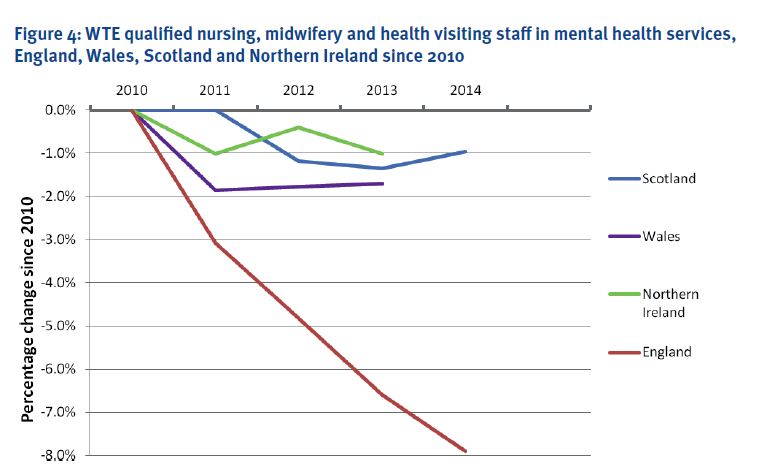
Working with the charity Rethink Mental Illness, and drawing on publicly available data, the RCN shows how (since 2010) the number of staffed mental health hospital beds across all four countries of the UK has reduced. The number of nurses working in NHS mental health services has also fallen, those remaining being revealed as an ageing group. Year on year, an increasing proportion is shown to be over the age of 50.

Here’s a chart showing reductions in the mental health nursing workforce, which I’ve extracted from page 16 of the report:

And, right at the front of the document, I see a clear case for investment contained in these recommendations which I reproduce word-for-word:

1) Governments must ensure there is equal
access to mental health services and that
the right treatment is available for people
when they need it.

2) Governments and NHS providers must
ensure that the commitment to parity of
esteem is directly reflected in the funding,
commissioning of services, workforce
planning, and patient outcomes.

3) Local commissioners and health boards
must make available enough local beds
to meet demand.

4) The principle of least restriction must
be embedded across all mental health
services. Detention under mental health
legislation should always be based on
clinical opinion and never be a result
of local failures to provide appropriate
care. Due to the significant increase in
detentions under the Mental Health Act
there should be a national objective set
to reduce detention rates in England.

5) There must be a consistent shift across
the UK from inpatient acute care to
community-based services which
recognises that prevention and early
intervention results in better outcomes,
reduces the pressure on acute services,
and reduces the overall cost to the NHS
in the long term.

6) Urgent action must be taken to address
the workforce shortages. Resources must
be committed to training and recruiting
enough mental health nurses who are able
to deliver specialist care in the changing
health and social care landscape.

7) NHS providers must invest in the current
mental health nursing workforce.
Band 6, 7 and 8 mental health nurses
should be developed to become advance
practitioners to deliver effective
recovery-led care in mental health
services.

8) There must be a sustainable and
long-term workforce planning strategy
which acknowledges the current
challenges facing the mental health
nursing workforce.

Horatio Festival of Psychiatric Nursing

Horatio is the European Association for Psychiatric Nurses. On the group’s website it says:

The aims of the Association are twofold: to advocate for the interest of the members by providing input into the decision-making processes on issues relevant to psychiatric and mental health nursing in Europe and to promote the development of psychiatric and mental health nursing practice, education, management and research.

I’m just back from Horatio’s latest gathering: the Third European Festival of Psychiatric Nursing, with its theme of ‘Creativity in Care’. This took place between November 6th-9th in Malta, which (unfortunately for those of us aiming to sightsee on our single free afternoon) happened to be experiencing some unseasonably miserable weather.

As an event, this was a large and properly international one. Whilst there I delivered two presentations: one from the RiSC study, and one a knitting-together of ideas, methods and findings from a series of interconnected and now-completed studies into changing mental health systems and nursing work. My themes in this second presentation will be familiar to readers of this blog, but if it’s worth saying once it’s worth saying again. Here are my slides, for anyone interested: