Category: Mental health

Cardiff Nursing

Undergraduate and postgraduate nursing education in Cardiff commenced in 1972, located within what was then the Welsh National School of Medicine. More than half a century later, the ambition which drove the creation of a four-year Bachelor of Nursing degree and the founding of a School of Nursing Studies continues in the successor School of Healthcare Sciences in Cardiff University. In this School, in which I have worked for over 27 years, nursing academics and students continue an unbroken tradition of education and research, underpinned by shared commitments to excellence in nursing practice and health care services. In this endeavour the School’s mental health, adult and child health nurses work side-by-side with colleagues and students many of whom are members of other health professions: midwifery; physiotherapy; occupational therapy; radiotherapy and oncology; and diagnostic radiotherapy. These networks extend outwards, to encompass collaborations at College and whole-University level. Courses are provided at undergraduate, taught postgraduate and postgraduate research levels and our students arrive from Wales, the rest of the UK and all around the world. The School’s programmes of study bring important opportunities for interprofessional learning, and over the years graduates (of whom there are now many thousands) have gone on to make a real difference and to occupy positions of influence. External reviews of the quality of the research which is undertaken in the School confirm this to be of the highest quality, relevant and applied. In short, we’re very good at what we do, and are recognised for this around the world.

In an editorial for the Journal of Advanced Nursing written shortly after the 40th anniversary of the appearance of graduate education for nurses in Cardiff, Daniel Kelly (now Emeritus RCN Professor of Nursing Research in Cardiff) and Kate Gerrish (a Cardiff nursing graduate who went on to become Professor of Nursing Research in Sheffield) celebrated the School’s successes but, presciently, also observed how ‘nursing’s place may now seem secure in the academy, but it remains a somewhat precarious relationship’. In what has rapidly become a widely publicised and fiercely contested announcement, on January 28th 2025 Cardiff University published a set of ‘Academic Futures’ proposals which include the intention to ‘discontinue activity for all three branches of nursing’. The Royal College of Nursing in Wales has issued a robust response protesting this plan, though the Welsh Government stands accused of a dereliction of duty in standing back whilst the crisis unfolds. To be clear, nursing in Cardiff is not the only discipline earmarked for possible removal or reduction: plans have been put forward to also close programmes in ancient history, modern languages, music, religion and theology, and to merge Schools and reduce staff numbers across the University’s three Colleges.

How have we arrived at this place? It has taken some time to register with the public, and even with policymakers, but the troubles facing the UK’s universities have now become widely known. University life is becoming harder, as the historian Glen O’Hara observes, and in ever-growing numbers of institutions staff numbers are reducing and courses being withdrawn. A combination of large-scale and local factors is driving this process: cost increases; a decline in (particularly international) student numbers; a fees structure which is working for neither home students nor universities; and investments in university estates designed to attract students in a marketised system, but which have become more difficult to sustain in a post-pandemic world in which work and study happen in hybrid ways and where the flow of new students is falling away. Gradually at first and, now, in accelerating fashion, the UK’s universities are in retreat.

Back in Cardiff, generalised concerns for the state of the university sector and for the challenges of providing health care education and doing research have given way to the altogether more terrifying prospect of losing our jobs. This is the reality for nursing and (some) related academics in Healthcare Sciences, for whom messages arrived last week telling us that we are now ‘in scope’ for possible redundancy. The University is being asked by our local branch of the University and College Union to make clear the full extent of its reserves, and to make use of these to protect jobs and courses. People, including staff and students in the School in which I work, are mobilising to protest against the proposals and to marshal counter-arguments. As the Royal College of Nursing has shown, Wales needs nurses in order that population needs are met and, indeed, to help promote the kind of good health which enables people to enjoy music, history and all those other disciplines which are also under threat in Cardiff.

Alongside the harm done to individuals whose jobs are under threat, the potential loss of nursing in Cardiff University also risks destabilising a complex system of commissioning and provision. This is creating uncertainty for existing students, and is likely to disincentivise large numbers of potential applicants. Because we no longer know exactly how, where and by whom the preparation of nurses in South Wales and the generation of new knowledge will take place in the future, staff will begin looking elsewhere for employment. In the School and University, the collaborative and intertwined work that nursing academics do will leave holes everywhere when they depart. In sum, health care education, research capacity and clinical academia are in jeopardy.

@benhannigan.bsky.social

Early intervention for people living with dementia

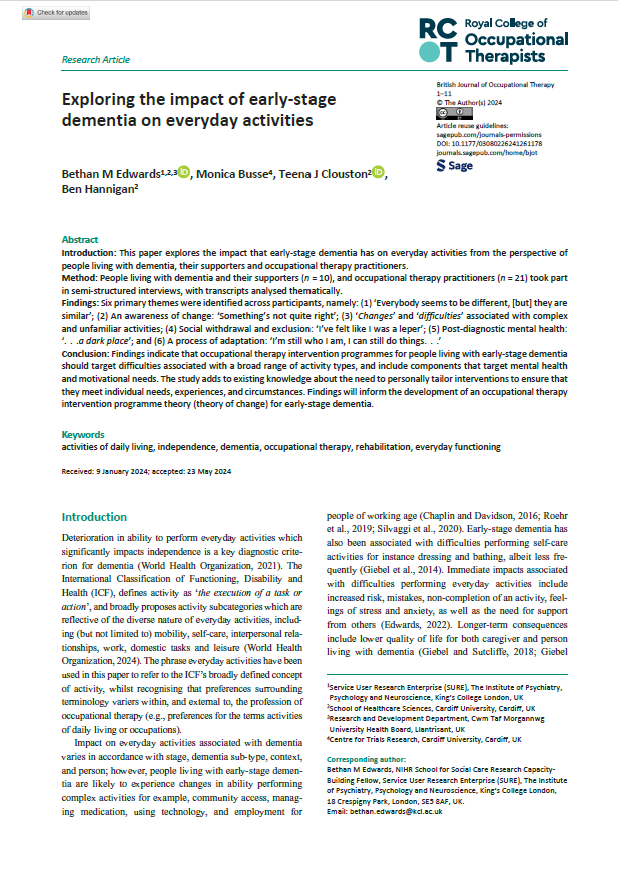
Here are links to two new papers led by Bethan Edwards, arising from her PhD which she completed in the School of Healthcare Sciences in Cardiff in 2022. Bethan is now working as a Capacity-Building Fellow at King’s College London, and her doctorate focused on the creation of an occupational therapy intervention for people living with early-stage dementia.

The first of these publications, which appears in the British Journal of Occupational Therapy, reports on interviews with people living with dementia, people supporting them and practitioners and has the aim of examining the impact that early dementia has on everyday activities. Here’s the abstract in full:

Introduction: This paper explores the impact that early-stage dementia has on everyday activities from the perspective of people living with dementia, their supporters and occupational therapy practitioners.

Method: People living with dementia and their supporters (n = 10), and occupational therapy practitioners (n = 21) took part in semi-structured interviews, with transcripts analysed thematically.

Findings: Six primary themes were identified across participants, namely: (1) ‘Everybody seems to be different, [but] they are similar’; (2) An awareness of change: ‘Something’s not quite right’; (3) ‘Changes’ and ‘difficulties’ associated with complex and unfamiliar activities; (4) Social withdrawal and exclusion: ‘I’ve felt like I was a leper’; (5) Post-diagnostic mental health: ‘. . .a dark place’; and (6) A process of adaptation: ‘I’m still who I am, I can still do things. . .’

Conclusion: Findings indicate that occupational therapy intervention programmes for people living with early-stage dementia should target difficulties associated with a broad range of activity types, and include components that target mental health and motivational needs. The study adds to existing knowledge about the need to personally tailor interventions to ensure that they meet individual needs, experiences, and circumstances. Findings will inform the development of an occupational therapy intervention programme theory (theory of change) for early-stage dementia.

The second of Bethan’s two papers has just appeared in Dementia, and draws on interview data to examine real-world community occupational therapy interventions for people with early-stage dementia. Here is this article’s abstract:

Aim: There is an absence of evidence generated in a UK context to support interventions based on occupational therapists’ core skills for people living with early-stage dementia. To inform the development of a programme theory and a future evaluation, this paper aimed to describe real-world (routine) community-based occupational therapy interventions for this population and contextual barriers.

Method: Occupational therapy practitioners (n = 21) from five Health Boards in Wales, UK participated in semi-structured interviews (n = 17) which were audio recorded, transcribed, and analysed thematically.

Findings: The availability of, and access to, real-world community-based interventions was variable, and associated with multilevel contextual barriers (resources, understanding of dementia specialist occupational therapy, professional influence, and evidence base). Where available and accessible, contents comprised a pre-intervention component (relational work, assessment, and goal setting) and intervention component (personalised problem-solving and coping strategies, emotional support, and advice and signposting), to meet needs associated with everyday activities and poor wellbeing. Variation in mode, duration, contents, and who received interventions, was associated with contextual barriers.

Conclusion: Findings indicate that the development of an intervention programme theory and future evaluation design, will need to account for the impact context may have on the variability of real-world intervention characteristics, and how this in turn may influence outcomes.

Bethan’s doctorate was an excellent one, and has laid the foundations for a programme of intervention research. Elsewhere in her thesis is a detailed two-stage evidence synthesis, and this, too, is well worth a read by anyone interested in this important field.

@benhannigan.bsky.social

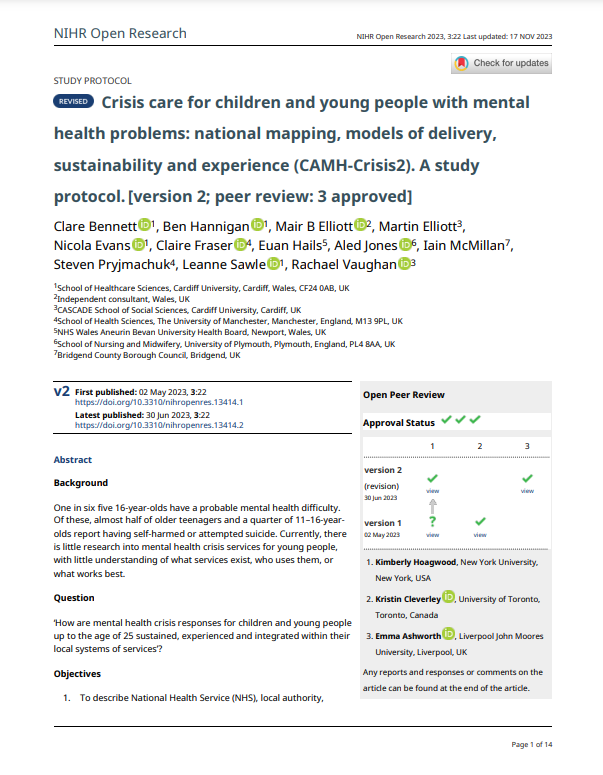
CAMH-Crisis2 protocol and progress

Here is something of a project update, following another hiatus in blogging.

Working alongside a fine set of colleagues, much of my research work both last year and this has focused on the CAMH-Crisis2 project funded by the National Institute for Health and Care Research. This has been examining how mental health crisis services for children and young people in England and Wales are organised, implemented and experienced.

In June 2023 a final, approved, version of our protocol appeared in the new(ish) NIHR Open Research journal. The paper is free to download and to read, via the link above.

As an aside, this was my (and I think the whole team’s) first experience of jointly producing an article using a post-publication open peer review process. This involves article revisions in the light of reviews received following initial publication, and in our case led to version 2 of our manuscript becoming the definitive version.

Since publishing this protocol paper, lots (and lots!) has happened with this study. We’ve completed the data generation phase for our first work package (a survey of services), and are close to completing our analysis. We’re deep into data generation in our second work package, which is largely involving interviews with commissioners, managers, practitioners, young people and family members in each of eight case study sites across Wales and England. By design our cases are remarkably diverse: more to follow once we have findings to share.

Meanwhile, here’s a link to my just-opened Bluesky account, which I’m planning to start using in preference to Twitter:

@benhannigan.bsky.social

People, interventions and context: a case study in theory-building

Commencing a series of long-overdue posts, here is a link to a final paper from the 3MDR project which I’ve blogged about in the past (see here, and here). This article, which draws on an unusually diverse range of data (researcher-assessed and self-report clinical measures; semi-structured interviews; physiological recordings; words used during therapy sessions; and subjective unit of distress scores), sets out to explore the complex relationships between people, interventions and context and how these interact in particular outcome typologies.

The paper was a long time in the making. Using a mixed methods approach, the various types of data brought together were initially analysed independently, before being subjected to an interpretation of how far these converged and diverged within a series of three therapy outcome typologies. Although the data relate to a relatively small number of therapy participants, the article makes its contribution by microscopically focusing on how different factors in different domains are patterned within different types of response.

Crisis responses paper

In February 2023, this new paper titled Review: Crisis responses for children and young people: a systematic review of effectiveness, experiences and service organisation (CAMH-Crisis) appeared in Child and Adolescent Mental Health journal. This reports on methods and findings from this study, which my colleague Dr Nicola Evans has led.

The journal asks for key practitioner messages, and these I’ve reproduced here:

  • Due to rising demand and increasing healthcare waiting times, more CYP present at mental health services at crisis point. To improve care, it is important to understand the types of mental health crisis services and how CYP and their families experience support at these facilities.
  • Findings from this systematic review indicate that CYP and their families are often unaware of available mental health services and how to access them. Children and young people should be involved in the development of public information about mental health services.
  • Mental health support needs to be provided through different mechanisms such as face-to-face appointments, text, email, or telephone via a direct line with round-the-clock availability.
  • Emergency departments (EDs) are often accessed at crisis point. EDs work well where care is provided in a calm and private environment by trained staff with experience in children’s and young people’s mental health.
  • Improving accessible community based early interventions with clear pathways to designated clinical services might prevent CYP reaching mental health crises.

Skellern Lecture and Lifetime Achievement Award 2023

The School of Healthcare Sciences in Cardiff University is hosting the 2023 Skellern Lecture and Lifetime Achievement Award evening, which takes place in the Glamorgan Building on June 15th. An Eventbrite link to book tickets to be there, in person, can be found here. Here, too, is the evening’s order of events:

A packed evening, for sure, with an invitation now to secure a place and to spread the word!

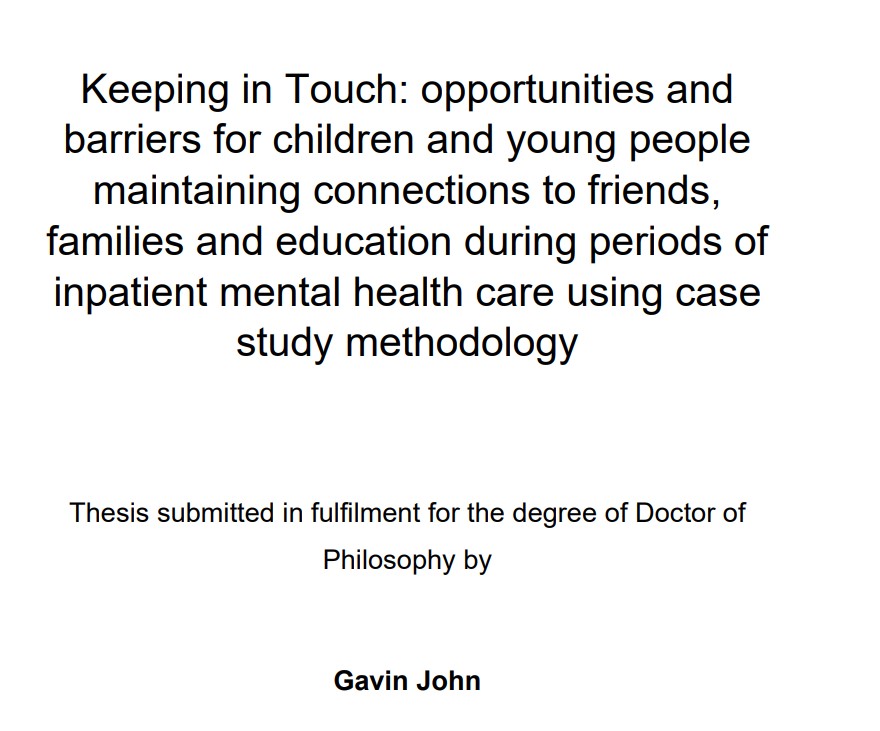
Keeping in Touch

Over a period of years, with Dr Nicola Evans and Dr Becky Playle I’ve been supervising Gavin John, whose doctoral studies have focused on (as Gavin himself puts it in his thesis), the ‘interventions and processes that promote or hinder children and young
people’s connections to their education, friends and families during periods of admission to
hospital for mental health care’.

Gavin’s research has built directly on the RiSC study (see here for an accessible summary). Following a viva at the end of 2022, in February 2023 Gavin officially because ‘Dr’: very many congratulations to him! For a direct link to Gavin’s thesis, the place to go is here. And, for flavour of what Gavin did in his research and what he found, here is his summary:

Background: Existing research has identified risks to children and young people’s (CYP)
connections to their friends, family and education during periods of inpatient mental health
care. However, to date there is a dearth of research on what interventions and processes
support CYP to maintain these connections.

Aim: To explore the interventions and processes that promote or hinder children and young
people’s connections to their education, friends and families during periods of admission to
hospital for mental health care.

Method: Case study methodology was used involving the generation of qualitative and
quantitative data in a single CAMHS inpatient unit. Three outcome measures relating to
mental health, friends, family and education were completed by adolescents admitted to
hospital for care and treatment of their mental ill-health (n=26). A subset of children and
young people (n=9), their caregivers (n=6) and health, social and education practitioners
(n=11) were interviewed, multidisciplinary team (MDT) meetings were observed, and policy
and procedure documents were examined.

Results: Demographic data were collected and results from three questionnaires indicate
participants were in the abnormal banding for the total difficulties score on the Strengths and
Difficulties Questionnaire (SDQ). Participants scored highest on the global scale and trust
and communication subscales in relation to mothers in the Inventory of Parent and Peer
Attachment-Revised (IPPA-R). Highest scores were recorded on the behavioural and
emotional engagement subscales of parts A and B of the Student School Engagement
Survey (SSES). Thematic analysis of interviews (n=26), observations and documentary
analysis of policy and procedure documents identified five themes: ‘Remote connections to
friends and family’, ‘Physical connections to friends and family’, ‘Peers in hospital’, ‘Impact
on families’ and ‘Connections to education’.

Conclusion: The study highlights significant barriers to children and young people
maintaining connections to their friends, family and education during periods of inpatient
mental health care. It identifies candidate interventions to help children and young people
maintain these connections.

CAMH-Crisis2

Crisis care for children and young people with mental health problems: national mapping, models of delivery, sustainability and experience is a new project funded by the National Institute for Health and Care Research (NIHR) Health and Social Care Delivery Research (HSDR) Programme, which my colleague Clare Bennett and I are jointly leading. The wider team includes Martin Elliott, Leanne Sawle, Aled Jones, Steven Pryjmachuk, Claire Fraser, Euan Hails, Iain McMillan, Nicola Evans, Mair Elliott, Rachael Vaughan and Aneta Taylor.

Our study builds on the now-completed Crisis responses for children and young people: an evidence synthesis of service organisation, effectiveness and experiences, led by Nicola Evans, about which I most recently wrote a post here. It also has a clear connection to the Developing a model for high quality service design for children and young people with common mental health problems project led by Steven Pryjmachuk, with which it shares aspects of study design.

Our new CAMH-Crisis2 study began in November 2022, and a summary of what we’re doing is here:

There has been a sharp and worrying increase in mental health problems experienced by children and young people. Prior to the pandemic, one in eight 5-19 year olds in England had a probable mental disorder. In 2020, amongst 5-16 year olds this figure had risen to one in six. Amongst those with a mental health difficulty, almost half of older teenagers and a quarter of 11-16 year olds report having self-harmed or attempted suicide. Extreme psychosocial distress, with or without self-harm, is often referred to as a ‘crisis’. Services for young people in crisis are a UK priority, and provision is expanding in the NHS, social care and educational settings. However, despite this and the appearance of national standards very little research into crisis services for young people has been undertaken. We therefore do not know what crisis responses currently exist, who uses services, or what works best for children and young people and their families.

Against this background this project will answer the question, ‘How are mental health crisis responses for children and young people up to the age of 25 sustained, experienced and integrated within their local systems of services’? We will work with a group of young people who advise on research, some of whom have used crisis services, to address the following three objectives:

  1. To describe and map NHS, local authority, education and third sector approaches to the implementation and organisation of crisis care for children and young people across England and Wales.
  2. To identify eight contrasting case studies in which to evaluate how crisis services have developed and are currently organised, sustained, experienced and integrated within the context of their local systems of services.
  3. To compare and contrast these services in the context of the available international evidence, drawing out and disseminating clear implications for the design and delivery of future crisis responses for children and young people and their families.

To help us answer our research question and to meet our objectives we will make use of normalisation process theory. This supports studies into what helps, and what hinders, the implementation and sustainability of new approaches to care.

We will meet our first objective using a survey, creating a detailed record of crisis responses across England and Wales and how they are organised, implemented and used. To meet our second objective, from this detailed record we will identify eight contrasting services selected for variety in terms of: geographic and socioeconomic setting (England/Wales, urban/rural, and relative affluence/poverty); populations served (including ethnic diversity); and service configuration (including third sector and/or social care involvement). Treating each as a case study, we will conduct interviews with children and young people and family members who have used the service. We will also interview commissioners, managers and practitioners, including those providing a crisis response and those working in other parts of the local system. We will gather operational policies and related documents, and data on how each service is used and by whom. In our analysis we will focus on understanding how each crisis service is provided, experienced, implemented and sustained. To meet our final objective we will compare and contrast each case study, and use our synthesised findings to advance the available international evidence for best practice in service provision. We will close by drawing clear, actionable, lessons for the future commissioning and provision of high-quality crisis responses which are sensitive to the support and access needs of a diverse range of children and young people receiving care from a range of services.

CAMH crisis animations

Over the last few years I’ve been a part of a team led by my Cardiff colleague, Dr Nicola Evans, synthesising the evidence in the area of mental health crisis responses for children and young people. Here is a link to the project, which has been funded by the National Institute for Health and Care Research (NIHR) Health and Social Care Delivery (HSDR) Research Programme.

Now, with the project having concluded, an animation with English and Welsh language versions has been produced. Here they are:

Conferences

This month brought, for me, the welcome return of face-to-face conferences. First, I was pleased to have received an invitation earlier in the year to deliver a keynote lecture at the RCN International Nursing Research Conference 2022, which took place at the Royal Welsh College of Music and Drama on September 5th and 6th. Rather than speak about any one, particular, study I used this as an opportunity to travel over a larger programme of research in the mental health field, pulling out underpinning ideas and key messages along the way.

Boiled down, my talk revolved around four ideas: health care can be thought of as a complex system; complex health systems can be understood through the study of cases, existing at different ‘levels’ of organisation (macro, meso and micro); to appreciate cases of health care system complexity it makes sense to use a plurality of analytic and methodological approaches; and research of this type demands a collaborative, stakeholder-informed, approach. These will be familiar themes to readers of this blog site. My talk at the RCN event, however, represented the most sustained effort I’ve made to date to articulate the principles and practices underpinning the research programme I have been involved in, to synthesise the main lessons learned, and to pull out some overarching observations. At some point it would make sense to write all of this up in an article.

Hot on the heels of the RCN International Nursing Research Conference came the 28th International Mental Health Nursing Research Conference, which took place at St Catherine’s College, Oxford, on September 8th and 9th. St Catherine’s was the home for the Network for Psychiatric Nursing Research Conference, as this event was originally known, for many years: returning there earlier this month seemed fitting after the two online editions of the event which happened in 2020 and 2021. I was pleased to be part of a symposium presenting findings from three NIHR-funded studies into mental health crisis services. Led By Dr Nichola Clibbens, this included a talk by Nicola and Michael Ashman drawing from their (and their colleagues’) realist synthesis of how, for whom and in what circumstances different community mental health crisis services work. Also featuring was a presentation from Professor Steve Gillard and Dr Katie Anderson on mental health decision units in acute care pathways. Third in the linked series of presentations was my talk summarising findings from an evidence synthesis, led by Dr Nicola Evans, into crisis responses for children and young people aged 5 to 25.

More generally, I very much appreciated the opportunity at both these events to renew my connections with friends and colleagues, and to meet and hear new people with interesting things to say. In the case of MHNR2022, particular thanks are due to the organising committee, which brought this conference together under the umbrella of Mental Health Nurse Academics UK without a dedicated events team in support.