Category: Education

Teaching preparation and bursaries

The formal academic year for students of the health professions (and therefore for their teachers, too) tends to be on the long side. Whilst many UK university students will have ended their studies until the autumn there are plenty of nurses, midwives and others with work to do before they can knock off for the summer. In September I’ll be working with pre-registration, second year, students of mental health nursing in a module assessed through the critiquing of published research. Before then I have a short, intensive, module to lead which is part of the taught component within the School’s professional doctorate.

This doctoral level module is all about ‘complexity’ and ‘systems’ and starts next month, and today I’ve been putting the finishing touches to some of the materials I’ll be using. As befits the student group and their thesis-producing aspirations I have opted to draw heavily on colleagues’ and my research experiences as far as is possible. I’m also hoping to foster a spirit of studying and learning together, and want to avoid being didactic.

Elsewhere today, in addition to research project-related work, I have had the opportunity to be part of a panel considering applications for RCN Foundation bursaries. There were some strong candidates, and well done to all who are about to get letters confirming their success. Others will be invited to interview (which I personally am unable to take part in). My commiserations, too, to those dropping out at this stage. I know how it feels to apply for support and not to get it, but there are always other opportunities. As I once heard someone, somewhere, say: if you’re not getting funding bids rejected you’re not applying enough!

Theses, vivas and research students

I’ll be examining another doctoral thesis soon, which today I’ve started reading. I won’t say anything about it specifically, but the occasion does give me a starting point for this post.

My own PhD thesis ran to about 450 pages, references and appendices included. It was years in the making, not least as I was a part-time student with plenty of other things to keep me busy. My supervisors, who I’ve mentioned on this blog before, were Davina Allen and Philip Burnard. As an internal candidate it was necessary for me to have two external examiners, and these were Ian Norman from King’s College London and Lesley Griffiths from Swansea University. Here’s the summary from my study:

My viva went well, proceeding in a spirit of collegial inquiry. This is how it ideally should be, and even where a thesis is judged to have major weaknesses I firmly believe that the examination should be conducted fairly and with courtesy. Cardiff University vivas are independently chaired, which I think helps the process, though I know this is not standard practice everywhere.

As it happens the Cardiff School of Nursing and Midwifery Studies has significantly grown its postgraduate research in recent years, and we now have a healthy number of UK and international PhD and Professional Doctorate students. Together they run a lively multi-author blog under the title PhDays. Check it out.

Skellern lecture, JPMHN lifetime achievement award and MHNAUK

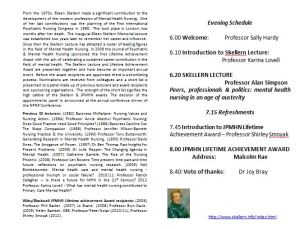
Just enough time for me to draw attention to some important happenings about to take place in the world of mental health nursing. Tomorrow evening (June 12th) Alan Simpson delivers this year’s Skellern Lecture and Malcolm Rae receives his Journal of Psychiatric and Mental Health Nursing Lifetime Achievement Award. Here are the flyers for these linked events, both taking place at City University London:

Next week brings this term’s meeting of Mental Health Nurse Academics UK, taking place at Liverpool John Moores University. Hosts are Lisa Woods and Grahame Smith, and the agenda is looking interesting.

Nursing beleaguered?

Catching my eye earlier this week was an interview in The Guardian with Jane Cummings, Chief Nursing Officer (CNO) with a place on NHS England‘s National Commissioning Board. Under the header, ‘Nobody can say care is brilliant all the time’ the article opened with this understated quote:

‘It was very clear that nursing was getting a bit of a bad name and it felt like the profession was being quite beleaguered and criticised.’

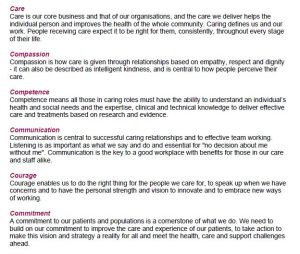
Nursing certainly has been under siege. Responses to descriptions of poor care have included the three year Compassion in Practice strategy introduced by the CNO and her Director of Nursing counterpart at the Department of Health, Viv Bennett. It is in this document that the 6Cs are described:

It is also in this general context, but specifically following the publication of the Francis Report into Mid Staffordshire NHS Foundation Trust, that the proposal was made that student nurses should spend a year doing health care assistant (HCA) work before beginning their training. This government plan has proven mightily controversial, and when announced provoked immediate broadsides from (amongst others) June Girvin (a nurse, and Pro Vice Chancellor at Oxford Brookes University) and Jackie Kirkham (a health visitor and researcher at Edinburgh University). Now it has drawn a closely referenced rebuttal from the Council of Deans of Health. Here is what the Council says in its conclusion:

The proposals for HCA experience prior to joining a pre-registration nursing programme are underpinned by a set of assumptions about nursing education and selection of prospective students that is deeply flawed. It paints a picture of students who have never had experience of caring and little interest in patient care, picked out for their grades by a group of academics in total isolation from staff working in clinical services. The message from current practices and the NMC Standards that govern them is that this mental picture needs to change. In particular, the assumption that students are not recruited for their values and that students do not have prior care experience are incorrect.

What about the nub of the proposal: that exposure to the clinical frontline as a HCA will create better nurses? The evidence here is equivocal at best. What care experience does seem to do is give prospective students exposure to the reality of working in healthcare and so it may reduce attrition from programmes. But there is also evidence that working as a HCA can socialise prospective students into poor practice and inhibit their development as nurses. Unless the evidence is looked at carefully, these proposals could therefore embed rather than challenge poor patient care. As the pilots of the proposals are developed, care must be taken both to recognise existing practice and carefully test assumptions against the evidence.

So, nursing practice and nursing education are in the spotlight, and the profession has responded. Senior members have asserted a set of fundamental values (the 6Cs), and in resisting the year-as-an-HCA idea have reminded people of the differences between what nurses and other health care workers do.

Nurses discomforted by this heightened scrutiny might consider their position alongside that of other public services workers. Social workers draw attention to the problem they face of being ‘damned if they do and damned if they don’t’. Then there are teachers, who fear the erosion of their professional standing as former servicemen and women prepare to enter the classroom without having to study for degrees. Back in the health service, some doctors (psychiatrists, in this instance) express concern over threats to their role and identity, whilst the profession as a whole is accused of greed.

We are therefore in good company. Other workers know what it is like to be told they have collectively fallen short, and understand how it feels to have their status undermined. Status-knocking sometimes happens because professional groups engage in ongoing division of labour skirmishes, as I have drawn attention to on this site before. But nursing’s current predicament, in which we are charged with having a ‘compassion deficit’ and sacrificing a commitment to care in the pursuit of academic credentials, is different.

Perhaps nurses have finally lost enough of the untouchable, ‘angel’, image (no bad thing, in my view) to now be viewed as ‘just’ another professional group in whom trust is conditional. We control entry to our profession, expect degrees from new entrants, have university departments and lead interprofessional teams and whole services within the NHS. In turn, we must expect to face questions when things go wrong, and to justify why we do practice and education in the ways that we do. For the record, I strongly favour system explanations for what happens in the health service (including its failures), see no evidence that student nurses no longer care and much prefer practitioners to be educated than not. But I also think we must expect, and should prepare for, more ‘bashing’ in the future.

Exam time

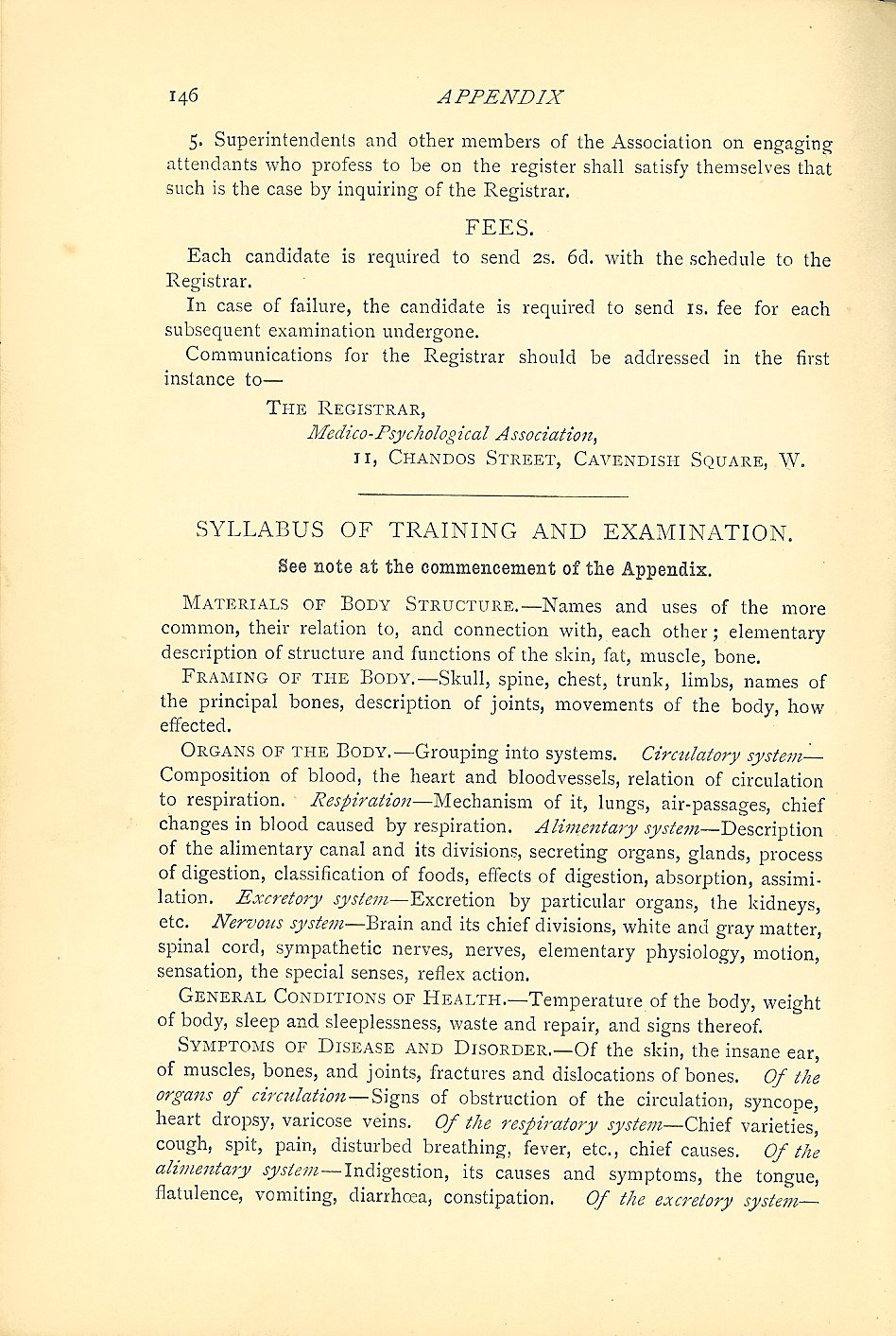
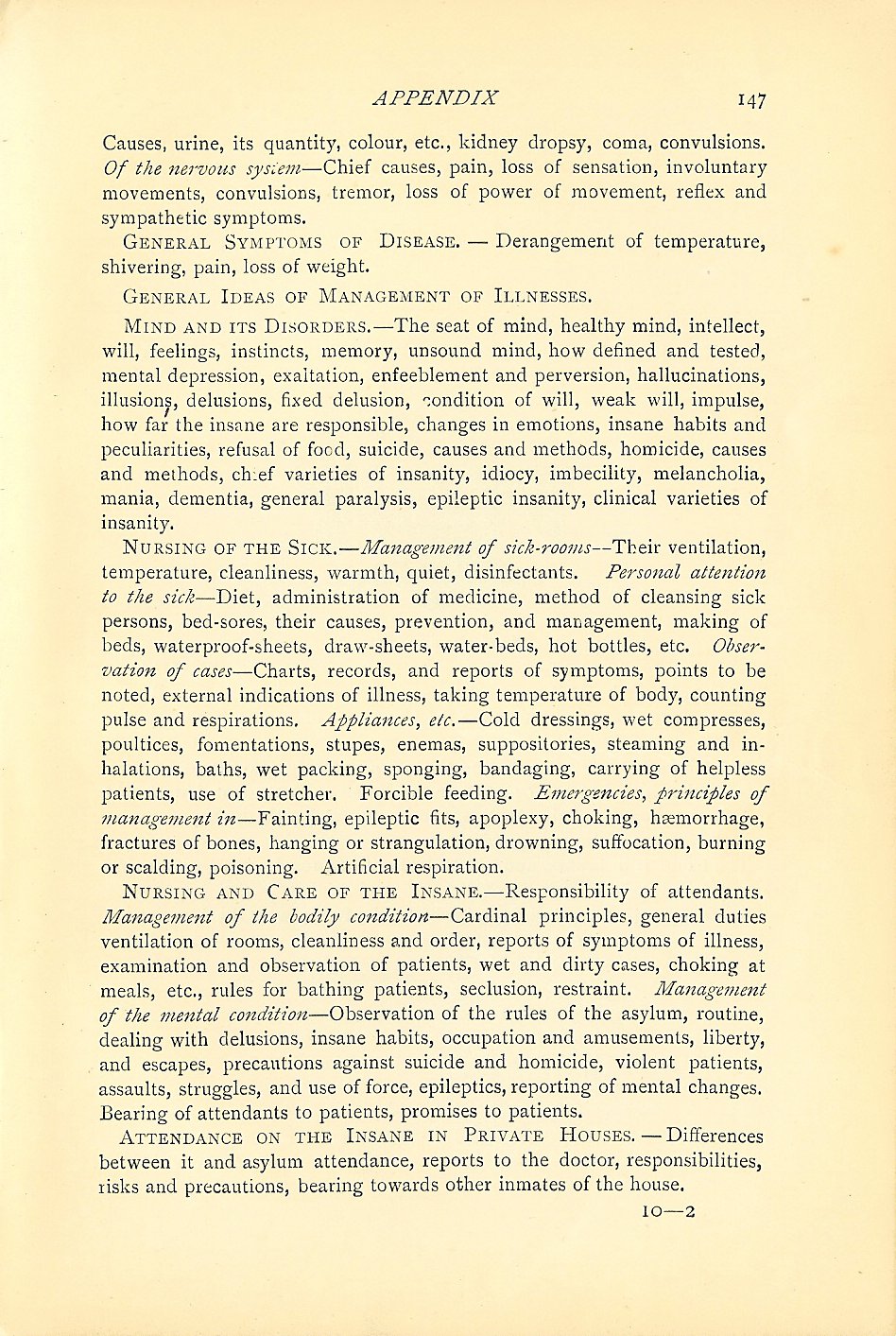
For students up and down the country it is examination season. Whilst students of mental health nursing are busy submitting their dissertations, writing up their reflective essays and achieving their practice-based ‘competencies’ I thought it might be interesting to share the ‘Regulations for the Training and Examination of Candidates for the Certificate of Proficiency in Nursing and Attending on the Insane’. I have scanned these from my copy of the Red Handbook:

In uploading these pages I have just noticed the mention (on page 147, the last-but-one reproduced above) of ‘Attendance of the insane in private houses’. Is it stretching things too far to suggest this as an early reference to community mental health nursing?

I also notice how much these regulations refer to the assessment and maintenance of bodily health (although I have no idea whatsoever what might be meant by ‘the insane ear’, a phrase appearing on page 146). Earlier this week, writing in an editorial for the BMJ Graham Thornicroft described the excess mortality of people with mental health problems as ‘a human rights disgrace’. He’s right, and whilst I’m glad we’re out of the age of the asylum and of ‘attending on the insane’ we might yet learn something from an historic nursing syllabus which placed emphasis on the importance of physical well-being.

Meeting new students

This morning began in class with a group of 25 or so (very) new students of mental health nursing. The session revolved around a series of open-ended questions, in family therapy style, put to John Hyde and to me by Nicola Evans. Nic invited us to share something of our personal experiences in mental health nursing: as students, practitioners, educators and researchers. In a decidedly non-random way, one of Nic’s questions invoked the idea of ‘critical junctures’, echoing our paper in this area but referring, in this context, to pivotal moments within our individual careers thus far.

From a learning point of view the premise was to introduce new students to the rich and varied world of mental health nursing, via a listening in to a reflective conversation conducted on the same. I found it an interesting experience, and hope the students did too. In my early morning mental preparation before participating it became necessary to conjure up people, places and events dating back to at least the late 1980s. So today I remembered my first student placement working (in East London) with a community mental health nurse, my first job as a qualified practitioner, and my eventual move to Cardiff. Fascinating

Using research

I very much hope that UK readers of this blog have enjoyed this year’s summer (which, at least, coincided with the early May bank holiday weekend). Right now we’ve been plunged back into autumn, or so it feels here in South Wales. Wind and rain are everywhere.

Here’s a wordcloud used during Friday morning’s teaching with students of mental health nursing, during which I shared something about COCAPP and other (past and present) research projects involving people working in the Cardiff School of Nursing and Midwifery Studies. One of the things I did was to draw students’ attention to my paper on complex trajectories in community mental health, as previously blogged about here. Unrelatedly, towards the end of Friday I also caught sight of some newly delivered reviewers’ feedback on a grant proposal on which I am a co-applicant. One of the points the reviewers made was to encourage us, as a research team, to plan to do more to get future findings into services and practice.

The first of these otherwise unconnected events was a modest attempt to close the gap between research and education. The second was a reminder of the importance of closing the gap between research and the world of health and social care. So with both experiences in mind this post is about getting research out of the hands of academics and into the hands of others who might use it: practitioners and students, service managers, policymakers, users, carers. Coming not long after my recent post on the assessment of outputs in the Research Excellence Framework, this post might also be thought of as an excursion into ‘impact’.

Within single university departments it ought to be reasonably straightforward to bring research and teaching closer together. This said, I can still clearly remember co-presenting with Cardiff colleagues at a nursing research conference in London in the late 1990s only to be told, by a student who had travelled from our own school, that she had had no previous idea who we were or that the research projects we had discussed were ongoing. That was a salutary moment, and since then I have taken opportunities to directly bring research (mine, my colleagues’, other people’s) into the modules I have led and contributed to. And of course, I am hardly alone in doing this kind of thing. But across the whole higher education sector demarcations are growing between ‘teachers’ and ‘researchers’, with universities routinely differentiating between staff on the basis of their expected roles. If researchers become less involved in teaching then the risk is run that naturally occurring opportunities for projects to be brought into the classroom, by those who are running them, will dwindle.

But if integrating research and teaching can be challenging then getting research findings out of universities’ doors for the benefit of all is harder still. In the health and social care fields the publication of findings in peer reviewed journals comes with no guarantee that these will be read, or used to inform anything which happens outside of academia. In nursing (and I imagine in many other practitioner disciplines too) this has often been seen as part of the ‘theory/practice gap’ problem. Nurses have spent a long time agonising over this, and typing some suitable search terms into Google Scholar produces some 200,000 documents (that’s the slightly obscured number circled in red in this screenshot) evidently devoted to its examination:

Nurses are not alone in having concerns of this type. The Cooksey review of UK health research funding talked about tackling the ‘translation gap’ through getting ‘ideas from basic and clinical research into the development of new products and approaches to treatment of disease and illness‘, and at the same time ‘implementing those new products and approaches into clinical practice‘. Universities are increasingly urged to do better with their ‘knowledge exchange’ activities. And, as we know, the Research Excellence Framework 2014 has introduced the idea of assessing ‘impact’.

‘Impact’ in the REF2014 Assessment framework and guidance on submissions document is defined ‘as an effect on, change or benefit to the economy, society, culture, public policy or services, health, the environment or quality of life, beyond academia‘. It’s about research being ‘felt’ beyond universities, and assessing this. The assessed bit is important in the formal REF exercise because impact (presented using case studies, and counting for 20% of the overall quality profile to be awarded to each individual submission) will be graded using this scale:

Four star Outstanding impacts in terms of their reach and significance.
Three star Very considerable impacts in terms of their reach and significance
Two star Considerable impacts in terms of their reach and significance
One star Recognised but modest impacts in terms of their reach and significance
Unclassified The impact is of little or no reach and significance; or the impact was not eligible; or the impact was not underpinned by excellent research produced by the submitted unit.

As in the case of the assessment of outputs I am struck by the fine judgements that will be required by the REF’s experts. I suggest that one person’s time-pressed ‘very considerable’ may well turn out to be another’s ‘considerable’, or even ‘modest’.

Issues of reliability aside, the inclusion of ‘impact’ in REF2014 has got people to think, again, about how to close some of the gaps I have referred to above. For researchers in health and social care there has been new work to do to demonstrate how findings have been felt in policymaking, in services and in the provision of care and treatment. Who would object to the idea that research for nursing practice should have benefits beyond academia? But as many of the documents I identified when searching for papers on the theory/practice gap (along with newer materials on ‘knowledge exchange’) will no doubt confirm, demonstrably getting research into policy, organisations and practice can be fiendishly hard.

There are many reasons why this is so. Not all research findings have immediate and direct applications to everyday health and social care. Even when findings do have clear and obvious application, university-based researchers may not be best-placed to do the necessary ‘mobilisation’ (to use the currently fashionable phrase), including in relation to knowledge which they themselves have created. And by the time peer reviewed findings have reached the public domain, policy and services in fickle, fast-moving, environments may have moved on. In cases where we think research has made a difference there is also the small matter, in the context of the REF, of marshalling the evidence necessary to demonstrate this to the satisfaction of an expert panel. In any event research is often incremental, with knowledge growing cumulatively as new insights are added over time. Given this we should, perhaps, have rather modest expectations of the likely influence of single papers or projects.

Beyond this it is always good to hear of new ways in which wider attention might be drawn to research and its benefits, and a rich resource for people with interests in this area is the multi-author blog and associated materials on the impact of the social sciences run by the LSE. This is a suitably interdisciplinary initiative, which can be followed on Twitter at @LSEImpactBlog. I recommend it (and not just to social scientists), and as a starting point its Maximising the impacts of your research document. This sets out to provide ‘a large menu of sound and evidence-based advice and guidance on how to ensure that your work achieves its maximum visibility and influence with both academic and external audiences‘, and as such has lots of useful observations and suggestions.

Teaching research

I’ve been laid a little low this week having managed to pick up a mischievous virus somewhere on my recent travels. On Wednesday, in particular,  my throat felt as though it had been lightly sandpapered. My thanks to the inventors of both paracetamol and ibuprofen.

Following a half-morning of teaching, and before making an early getaway, yesterday I joined the rest of the Welsh chapter of the larger COCAPP team to plan the next instalment of our metanarrative mapping and comparative policy analysis. Tomorrow morning I’ll be talking research with a group of pre-registration student mental health nurses. What I really ought to do (even though, strictly speaking, this is not the purpose of the session) is to alert people to COCAPP and to the other research taking place in the Cardiff School of Nursing and Midwifery Studies. I think there is more which could be done to close the gap between teaching and research, and I’ll take the opportunity tomorrow to alert students to what’s happening on their very doorstep.

From ‘The Red Handbook’ to ‘The Art and Science of Mental Health Nursing’

Unbidden, but very welcome nonetheless, a freshly pressed copy of the third edition of Ian Norman and Iain Ryrie’s edited The Art and Science of Mental Health Nursing: a Textbook of Principles and Practice has arrived on my desk. This is a mighty tome indeed, and this latest version promises to cement the book’s status as a ‘must have’ for pre-registration students of mental health nursing.

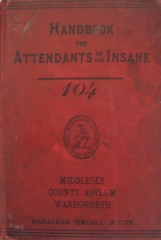
A rather earlier text I also have a copy of is The Handbook for Attendants on the Insane, which Peter Nolan tells us was first published in 1885. This was the first book produced in the UK for the express purpose of instructing people we now uniformly call mental health nurses, and was produced at the instigation of the Medico-Psychological Association (MPA). The MPA later became the Royal Medico-Psychological Association, and eventually the Royal College of Psychiatrists.

No sooner had the Red Handbook (as it was often referred to) appeared than questions were being asked about the wisdom of educating attendants. This is a point Henry Rollin makes in this paper marking the centenary of the Handbook’s publication. In this extract, Rollin quotes from an (unnamed) reviewer writing in the Journal of Mental Science (now the British Journal of Psychiatry) in the year the Handbook went to print:

“We are not quite sure ourselves whether it is necessary or wise to attempt to convey instructions in physiology, etc., to ordinary attendants. Will they be the better equipped for their duties for being told that the brain consists of grey and white matter and cement substance?”, writes the anonymous reviewer. He adjusts his elegant pince-nez and continues, “We hardly see what is to be gained by superficial knowledge of this kind”.

Goodness knows what this anonymous reviewer would have made of Norman and Ryrie’s 728 pages of analysis, guidance and instruction, let alone the idea that mental health nurses now have to complete an undergraduate degree in order to register and practice.

Blogging for teaching

With apologies in advance for making an exceptionally obvious observation, but it has properly dawned on me this week that writing a blog might have significant advantages for teaching. A couple of days ago I was in class with a group of MSc students, talking about what we can learn from the study of service user trajectories. The sensible thing to do was to navigate to this site, and show people where they can download this recent paper. So that’s exactly what I did.

Unrelatedly, Mark Howard (who works at London South Bank University and who I used to work with in East London in the days when I was a community mental health nurse) has also been kind enough to comment on a post, and to mention that he sometimes points his students here. Hello again Mark, and hello to your students too – and thanks for your collective interest.

And today I’ve been planning a new Professional Doctorate module, and have been deliberately embedding links to this blog in my teaching materials. So what all of this is making me realise is that a blog (mostly) oriented towards research and academic stuff might, over time, become a useful educational resource. I actually can’t think of any other way in which a personal repository of papers, commentaries, onwards links and so on might be brought together.