Category: Education

Cardiff Nursing

Undergraduate and postgraduate nursing education in Cardiff commenced in 1972, located within what was then the Welsh National School of Medicine. More than half a century later, the ambition which drove the creation of a four-year Bachelor of Nursing degree and the founding of a School of Nursing Studies continues in the successor School of Healthcare Sciences in Cardiff University. In this School, in which I have worked for over 27 years, nursing academics and students continue an unbroken tradition of education and research, underpinned by shared commitments to excellence in nursing practice and health care services. In this endeavour the School’s mental health, adult and child health nurses work side-by-side with colleagues and students many of whom are members of other health professions: midwifery; physiotherapy; occupational therapy; radiotherapy and oncology; and diagnostic radiotherapy. These networks extend outwards, to encompass collaborations at College and whole-University level. Courses are provided at undergraduate, taught postgraduate and postgraduate research levels and our students arrive from Wales, the rest of the UK and all around the world. The School’s programmes of study bring important opportunities for interprofessional learning, and over the years graduates (of whom there are now many thousands) have gone on to make a real difference and to occupy positions of influence. External reviews of the quality of the research which is undertaken in the School confirm this to be of the highest quality, relevant and applied. In short, we’re very good at what we do, and are recognised for this around the world.

In an editorial for the Journal of Advanced Nursing written shortly after the 40th anniversary of the appearance of graduate education for nurses in Cardiff, Daniel Kelly (now Emeritus RCN Professor of Nursing Research in Cardiff) and Kate Gerrish (a Cardiff nursing graduate who went on to become Professor of Nursing Research in Sheffield) celebrated the School’s successes but, presciently, also observed how ‘nursing’s place may now seem secure in the academy, but it remains a somewhat precarious relationship’. In what has rapidly become a widely publicised and fiercely contested announcement, on January 28th 2025 Cardiff University published a set of ‘Academic Futures’ proposals which include the intention to ‘discontinue activity for all three branches of nursing’. The Royal College of Nursing in Wales has issued a robust response protesting this plan, though the Welsh Government stands accused of a dereliction of duty in standing back whilst the crisis unfolds. To be clear, nursing in Cardiff is not the only discipline earmarked for possible removal or reduction: plans have been put forward to also close programmes in ancient history, modern languages, music, religion and theology, and to merge Schools and reduce staff numbers across the University’s three Colleges.

How have we arrived at this place? It has taken some time to register with the public, and even with policymakers, but the troubles facing the UK’s universities have now become widely known. University life is becoming harder, as the historian Glen O’Hara observes, and in ever-growing numbers of institutions staff numbers are reducing and courses being withdrawn. A combination of large-scale and local factors is driving this process: cost increases; a decline in (particularly international) student numbers; a fees structure which is working for neither home students nor universities; and investments in university estates designed to attract students in a marketised system, but which have become more difficult to sustain in a post-pandemic world in which work and study happen in hybrid ways and where the flow of new students is falling away. Gradually at first and, now, in accelerating fashion, the UK’s universities are in retreat.

Back in Cardiff, generalised concerns for the state of the university sector and for the challenges of providing health care education and doing research have given way to the altogether more terrifying prospect of losing our jobs. This is the reality for nursing and (some) related academics in Healthcare Sciences, for whom messages arrived last week telling us that we are now ‘in scope’ for possible redundancy. The University is being asked by our local branch of the University and College Union to make clear the full extent of its reserves, and to make use of these to protect jobs and courses. People, including staff and students in the School in which I work, are mobilising to protest against the proposals and to marshal counter-arguments. As the Royal College of Nursing has shown, Wales needs nurses in order that population needs are met and, indeed, to help promote the kind of good health which enables people to enjoy music, history and all those other disciplines which are also under threat in Cardiff.

Alongside the harm done to individuals whose jobs are under threat, the potential loss of nursing in Cardiff University also risks destabilising a complex system of commissioning and provision. This is creating uncertainty for existing students, and is likely to disincentivise large numbers of potential applicants. Because we no longer know exactly how, where and by whom the preparation of nurses in South Wales and the generation of new knowledge will take place in the future, staff will begin looking elsewhere for employment. In the School and University, the collaborative and intertwined work that nursing academics do will leave holes everywhere when they depart. In sum, health care education, research capacity and clinical academia are in jeopardy.

@benhannigan.bsky.social

Perinatal mental health care

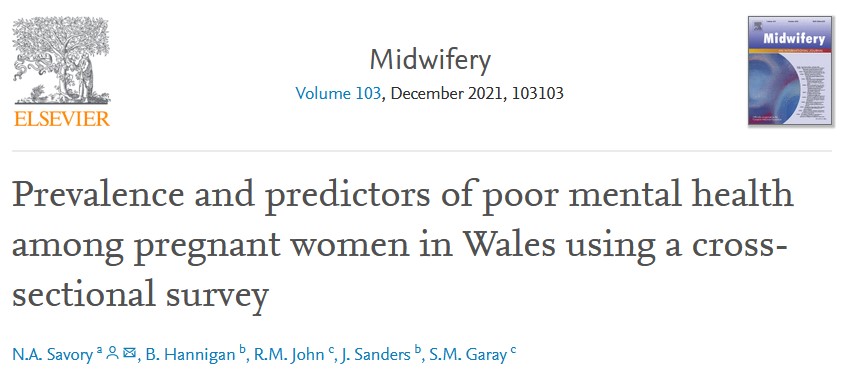
Continuing from this recent post celebrating the publishing of papers from doctorates I’ve had a hand in supervising, here now are links to Nicola Savory’s PhD and to a first article from this in the journal Midwifery. Nicola is a midwife, and in her thesis (funded by RCBC Wales) used quantitative and qualitative methods to investigate women’s mental health needs in the antenatal period.

Nicola’s whole-thesis summary is this:

Background: Existing research on poor perinatal mental health largely focuses on recognition and treatment of postnatal depression. Consequently, there is a need to explore antenatal mental health.
Aim: To assess poor mental health prevalence in pregnancy, its relationship to sociodemographic characteristics, self-efficacy and perceived support networks. To understand experiences and barriers preventing women with mental health problems from receiving help and explore midwives’ understanding of their role.
Method: Questionnaires were completed by women in early pregnancy. A subset identified to have mental health problems, were interviewed in late pregnancy to explore their experiences and barriers to receiving care. Midwives completed questionnaires exploring their experiences of supporting women with mental health problems and focus groups further discussed the issues raised.
Results: Amongst participants (n=302), the Edinburgh Postnatal Depression Scale (EPDS) identified 8.6%, and the Generalised Anxiety Disorder Assessment (GAD-7) 8.3%, with symptoms of depression or anxiety respectively. Low self-efficacy (p=0.01) and history of previous mental health problems (p<0.01) were most strongly associated with anxiety or depression. Thematic analysis of interviews with women (n=20) identified three themes: ‘past present and future’; ‘expectations and control’; and ‘knowledge and conversations’.
Questionnaires were completed by 145 midwives. The three themes identified from the focus groups with midwives were: ‘conversations’; ‘it’s immensely complex’; and ‘there’s another gap in their care’.
Conclusion: Prevalence rates of anxiety and depression amongst women in early pregnancy were found to be similar to those reported in the literature. Low self-efficacy and previous poor mental health were significant predictors of anxiety and depression. Continuity and more time at appointments were suggested by midwives and women to improve discussions regarding mental health. Midwives were keen to support women but lacked knowledge and confidence. Consistent reference was made to the need for training regarding the practical aspects of supporting women’s mental health.

Nicola has a series of journal papers lined up from her doctorate, with the one I’ve linked to above (‘Prevalence and predictors of poor mental health among pregnant women in Wales using a cross-sectional survey’) being just the first.

Understanding continuous education

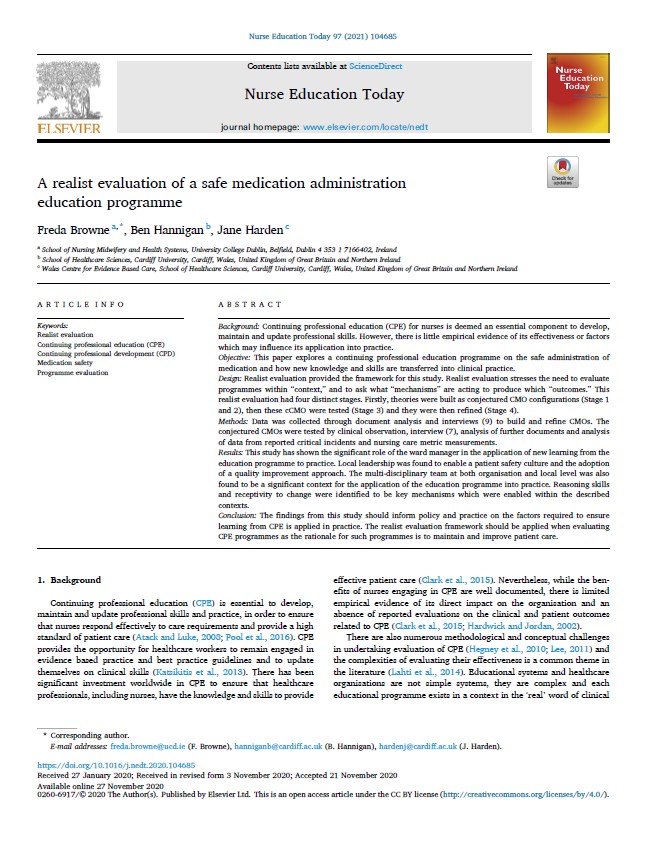
One of the nicest things about my job is the opportunity to supervise and support doctoral students, and to then publish with them. Belatedly (as this has been available for some time), here is a paper arising from Freda Browne’s doctorate. Freda works at University College Dublin, and in her thesis used a realist approach to understand how knowledge and skill are transferred from the education context to clinical practice.

This paper, appearing in the journal Nurse Education Today, is a fine piece of work and a good example of theory-informed evaluation. Here’s the abstract:

Background: Continuing professional education (CPE) for nurses is deemed an essential component to develop, maintain and update professional skills. However, there is little empirical evidence of its effectiveness or factors which may influence its application into practice.

Objective: This paper explores a continuing professional education programme on the safe administration of medication and how new knowledge and skills are transferred into clinical practice.

Design: Realist evaluation provided the framework for this study. Realist evaluation stresses the need to evaluate programmes within “context,” and to ask what “mechanisms” are acting to produce which “outcomes.” This realist evaluation had four distinct stages. Firstly, theories were built as conjectured CMO configurations (Stage 1 and 2), then these cCMO were tested (Stage 3) and they were then refined (Stage 4).

Methods: Data was collected through document analysis and interviews (9) to build and refine CMOs. The conjectured CMOs were tested by clinical observation, interview (7), analysis of further documents and analysis of data from reported critical incidents and nursing care metric measurements.

Results: This study has shown the significant role of the ward manager in the application of new learning from the education programme to practice. Local leadership was found to enable a patient safety culture and the adoption of a quality improvement approach. The multi-disciplinary team at both organisation and local level was also found to be a significant context for the application of the education programme into practice. Reasoning skills and receptivity to change were identified to be key mechanisms which were enabled within the described contexts.

Conclusion: The findings from this study should inform policy and practice on the factors required to ensure learning from CPE is applied in practice. The realist evaluation framework should be applied when evaluating CPE programmes as the rationale for such programmes is to maintain and improve patient care.

Counting the hours

If ‘ten thousand hours is the magic number of greatness‘, then after how many hours of study and practice should a student of nursing be able to register? According to the EU, in the case of nurses with responsibility for general care the answer is four thousand six hundred. Of these total hours, the theoretical component must amount to a minimum of one-third of the overall length of programmes of preparation and the clinical component at least one-half. Here in the UK, in usual times (i.e., not whilst emergency, and then recovery, standards during the pandemic have been in place) this 4,600 hours is split down the middle with 50% spent in practice and 50% devoted to theory.

Now that the UK has left the EU, the Nursing and Midwifery Council (NMC) is sounding out the views of stakeholders on its current education programme standards. As the NMC puts it, the research they are commissioning as part of this work aims to:

[…] provide us with up-to-date evidence about parts of our pre-registration programme standards, looking at standards in other countries and for other professions within the UK.

It covers the areas of the standards that reflect aspects of EU law, including:

  • the length of programmes and the number/ratio of theory and practice hours
  • the definition of practice learning for adult nursing and the lack of reference to simulation
  • general education required for admission
  • recognition of prior learning
  • entry to shortened midwifery programmes
  • content and clinical experience requirements for nursing and midwifery programmes, with specific mention of minimum numbers in midwifery such as 40 births.

By way of comparison, via Lorna Moxham I learn that, in Australia’s generalist nursing education system, students complete only 800 hours in clinical practice:

Meanwhile, students of physiotherapy in the UK must complete a minimum of 1,000 hours in practice as part of their pre-registration preparation, as must students of occupational therapy. Looking at the diagnostic radiography programme run in Cardiff University, where I work, I see a figure of 1,460 hours in practice for students before registration, and for students of social work I see a minimum number of 200 days. As another point of comparison, I am also aware of how the 4,600 hours of theory and practice expected of pre-registration undergaraduate nurses in Ireland is spread over four years, and not the usual three that we have here in the UK.

I have no idea how these differing figures for the minimum number of hours necessary for health and social care professional registration came to be arrived at, or how decisions have been made on the balance between placement learning and university-based learning. As Steven Pryjmachuk has also pointed out, not all hours are necessarily equal:

The ‘number of hours’ question is not one we’ve particularly considered here in the UK in recent reviews of nursing education, this being tied up at EU level: but what we most definitely have done is to have reviewed (and re-reviewed), pretty much everything else about how we educate nurses. I’m grateful to Jo Stucke for sharing this paper written by Karen Ousey, which sets out some key moments in the history of preparing nurses, included in which is the understatement that ‘nurse education is not static’. In universities and in practice areas up and down the country, students of nursing are now either engaged in programmes of preparation linked to the NMC’s 2018 standards of proficiency, or are completing their studies linked to NMC standards of pre-registration education produced in 2010 and to standards of competence for registered nurses produced in 2014. By my count not one new registered nurse will have graduated, by April 2021, from a programme linked to the 2018 standards. Already, though (signalled by the NMC’s newly launched programme to review those parts of the UK’s standards linked to EU law), moves are afoot to  reflect on, and review again, our approach to the initial preparation of nurses. As it happens, I think there is a discussion to be had on the issue of hours: but, more generally, I believe there is a strong case for introducing more stability into nursing education, and for placing much greater emphasis on the evaluation of what we currently do before making wholesale changes.

Early careers

A discussion unfolding at the Mental Health Nurse Academics UK meeting held on March 12th 2021 was how best to support colleagues making the transition from clinical practice into higher education. Given the very limited success within nursing in growing clinical academic careers, through which people might sustainably combine roles in practice with roles in education and/or research, this transition is a very real one. It is also, as Jan Hunter and Mark Hayter observe, relatively neglected.

The rhythms and demands of clinical practice are very different from those in universities. Most nursing, midwifery and allied health professional academics come to work in higher education without having had prior opportunities to hone their research skills through doctoral-level study. Many need to grow their skills and experiences in teaching, too, but it is on developing early career researchers that I wish to focus in this post. Along the way I draw on experiences of my own to illustrate some wider points.

I was helped to write two doctoral fellowship applications, the second after the first was unsuccessful. In this, I proposed using a set of design and methods crafted in an existing study of recovery from stroke to examine work and roles in the trajectories of people using mental health services in the community. With part-funding from a competitively secured fellowship and then employer support I was on my way. I therefore benefited from a very sensible, strategic, approach to research capacity-building which combined mentorship, help with funding applications, ongoing institutional support, and supervision. Very importantly, I was also encouraged to think programmatically, and to link my research to existing lines of enquiry with the aim of adding to a concentration of substantive, theoretical and methodological expertise.

Sharing my thesis findings through publishing was an absolute given, informed by the view that a study is not completed until it is shared. Beyond this, having concluded my PhD I both wanted, and was encouraged, to develop further the body of research commenced in my thesis. I moved swiftly from doctoral studies to a part-time post-doctoral fellowship, in which I again examined service user trajectories, work and roles but this time in the context of mental health crisis services. I was grateful for the support I received for this project from the Research Capacity Building Collaboration Wales. I also reflect, now, that our collective efforts to grow a doctorally qualified nursing, midwifery and allied health profession academic workforce have not been matched by equal efforts to enable holders of new PhDs to grow their research programmes into the post-doctoral period. It is deeply frustrating to see the holders of new doctorates devoured by teaching and related activities, their research expertise and aspirations risking extinction barely as soon as they have emerged. Mentorship to develop ongoing research plans, space for dissemination and grant-writing, and strategies for networking are so very important in the immediate post-doctoral period.

My view is also that institutional and external support for a PhD brings with it the obligation, in time, to become a PhD supervisor. Debra Jackson, Tamara Power and Kim Usher have recently published findings from a study of doctoral supervision within nursing, accurately pointing to the labour involved in this work and the degree to which it needs to be recognised by employers. Without supervision there can be no doctoral study, and without doctoral study no future research leaders.

Finally, my impressions are that, historically, research careers have tended to begin many years after initial registration and periods in practice. I would like to see more encouragement to newly registered nurses to consider research (and a career in academia) as an option, beginning with early registration for PhD study. Quite possibly this takes me back to where I started in this post, which is to observe that, despite many years of talking and trying, we haven’t yet managed to create coherent career pathways for clinical academics in nursing.

Out with the old

As this most difficult of years reaches its end here’s a big shout-out for registered and student mental health nurses everywhere, whose work and study has been tipped on its head during the pandemic. It’s not been easy, as this preprint from the Mental Health Policy Research Unit shows. The article reports pre-peer review findings from a survey examining how the coronavirus crisis has exerted an impact on the care provided by mental health nurses in the UK. Here’s the ‘what this paper adds’ section:

This paper provides a unique insight into the experiences and impact that the Covid-19 pandemic has had on mental health nurses across a range of community and inpatient settings to understand what has changed in their work and the care they can and do provide during this crisis. This includes exploring how services have changed, the move to remote working, the impact of the protective equipment crisis on nurses, and the difficult working conditions facing those in inpatient settings where there is minimal guidance provided.

The detailed findings in this paper paint a picture of members of a profession working at great pace to adjust to new ways of practising, to manage risk to self and others and to continue to provide quality care. It’s worth remembering that mental health nurses were in short supply prior to the pandemic, and possess skills, knowledge and qualities that will continue to place them in great demand in the months and years ahead.

In a second (and very specific) shout-out, here again are my thanks to the #mhTV crew comprising Dave Munday, Nicky Lambert and Vanessa Gilmartin Garrity for the very fine work they’ve been doing with #mhTV throughout the year. #mhTV has helped the mental health nursing (and wider) community to stay connected, despite the challenges of social distancing and repeated lockdowns. Dave, Nicky and Vanessa also stepped in to support the International Mental Health Nursing Research Conference 2020, and to host this year’s Skellern Lecture and Journal of Psychiatric and Mental Health Nursing Lifetime Achievement Award evening

Wishing a safe and a peaceful new year to all, and here’s to a 2021 which improves considerably on the year now departing.

The 876 Group

When I upload blog posts to this site I use tags to help group items together. Today, having looked at the tag cloud created by WordPress I see that ‘Mental Health Nurse Academics UK’ appears in larger size than any other single word or phrase. This tells me that this is my single most-used tag, and I’m not surprised.

This week, over at the Mental Health Nurse Academics UK website, we’ve announced the election of Jim Turner as the group’s Vice Chair and Chair-elect. Jim will first be working in support of Fiona Nolan, who steps into the Chair position at the beginning of the new year following the conclusion of my term of office next month.

I was at the first-ever meeting of the group now calling itself ‘Mental Health Nurse Academics UK’, which took place on April 29th 2003 hosted at City University and convened by Len Bowers, Julie Repper and Mary Watkins. I’ve attached to this post the agenda for the meeting, which reveals how the group began its life linked to organisational arrangements in England, uniquely. That changed once those present determined that the group should simultaneously become both UK-wide and independent from any other organisation or government department.

Very briefly, as I recall, we referred to ourselves as the ‘876 Group’, which was the sum of the ages of all those present at the inaugural meeting. On the naming front, ‘Mental Health Nurse Academics Forum’ was toyed with, and my copy of a draft set of our first-ever terms of reference speaks tenatively of the ‘Assembly of Mental Health Nurse Academics’.

As ‘Mental Health Nurse Academics UK’ our group has grown as time has passed. Membership now includes people from over 70 UK higher education institutions, plus colleagues from other organisations sharing our interests and concerns. We have a number of Standing Groups, principally leading work in the three fields of Education, Research, and Policy and Policy. We’ve always aimed to be proactive, producing (right from the start) independent papers and statements, as well as taking opportunites to respond to consultations. Our first position paper was on post-registration education, and on our website we now have a long list of pieces we’ve produced over the years including evidence submitted to the House of Commons, editorials and journal articles, responses to the NMC, and a whole lot more. An often-referred to piece, written by Steven Pryjmachuk, introduces mental health nursing to people considering making applications for pre-registration degree entry.

I’ll continue getting to meetings once my term as Chair ends, and know that our next meeting (and possibly more) will again be convened online. Our last two meetings, in June and October 2020, were our most-attended: something no doubt related to the fact that they happened using videoconferencing software. For the future, Fiona and Jim are going to be a super combination leading the group onwards, and I’m wishing both all my very best and my support as they press ahead with their work.

International Mental Health Nursing Research Conference 2020

This year’s International Mental Health Nursing Research Conference (#MHNR2020) happened over two weeks in September, as planned through #mhTV and with a whole lot of help from Dave Munday, Nicky Lambert and Vanessa Gilmartin. Along with everyone else who values this annual event I’m indebted to all three for the work they’ve put in over the months to make #mhTV happen, and to do so as an entirely free offering open to anyone with use of an internet connection.
I enjoyed my chance to join Mick McKeown as a co-host of #MHNR2020’s evening panel discussions, and the format of inviting guests to pre-record and upload their presentations ahead of bringing them together in themed groups worked well. Every pre-recorded presentation and panel conflab can be viewed on the conference webpage, and will remain there as a resource for the future. As it happens, I pitched up as a panel member on the evening of September 25th, speaking about findings from the MENLOC evidence synthesis in the area of end of life care for people severe mental illness.  As a shortcut, here’s a link to my pre-recorded presentation summarising our main findings:

Specialist practice in the community

For many years I led a Nursing and Midwifery Council (NMC)-approved post-qualification degree course for mental health nurses working in, or wanting to work in, the community. I wrote about the curriculum we developed in Cardiff, and was involved in two surveys of course leaders of programmes of this type which went on to be published here and here. Our Cardiff course, like others of its type, was recognised by the NMC (and by the NMC’s predecessor, the United Kingdom Central Council for Nursing, Midwifery and Health Visiting) as preparing qualified nurses for ‘specialist practice’. Linked to a set of UK-wide standards, specialist practice was designated as practice beyond that expected at initial registration.

Most programmes of this type have long since disappeared, ours in Cardiff included, but the regulatory standards against which they were validated remain. The specialist practice qualification (SPQ) was first introduced in the 1990s, with the standards for SPQ in community nursing (including community mental health nursing) not being updated since the early 2000s. In 2019 the NMC commissioned an independent review into SPQ, with the final report from this exercise making clear how poorly understood these long-outdated standards had become and how much a root-and-branch review was needed.

A debate can be had on the extent to which standards for practice beyond those linked to professional registration should be prescribed by a regulatory body such as the NMC. For the professions of nursing and midwifery, however, no UK-wide bodies able to definitively set standards of this type exist other than the NMC; this is partly because we have no equivalents to the royal colleges, which exist to set and maintain standards for doctors preparing for post-registration practice in the various fields of medicine.

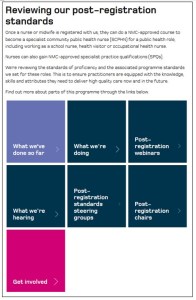
The NMC’s ongoing programme of work developing its standards has so far included the publication of an education framework, the Future Nurse standards of proficiency for registered nurses and new standards for student supervision and assessment. Now, following receipt of its independent evaluation of SPQ the NMC is embarking on a post-registration review. In August, through my membership of the All Wales Senior Nurse Advisory Group for Mental Health I took part in an NMC webinar and discussion on specialist practice in the community, convened as part of this wider post-registration programme of work. With work already happening in parts of the UK to more closely specify ‘advanced’ practice, such as through Health Education England’s Advanced Practice Mental Health Curriculum and Capabilities Framework, the NMC is stepping into an already-crowded space. It is in this context that consistency and joined-up policy and standards will surely be needed: which is something members of Mental Health Nurse Academics UK (me included) will continue to say as this programme of activity continues to progress.

Catch-up post 2: Mental health matters in the pandemic

MHNAUK covidHere’s a belated catch-up post (the second of three), produced largely with the aim of revitalising this blogsite and summarising recent happenings. This one I’ve dated to March 2020, and the period in which UK was first locking down in response to the COVID-19 pandemic.

Towards the end of the month, Mental Health Nurse Academics UK (which I chair) published this statement on mental health nursing in the coronoavirus crisis. It addressed a number of areas: learning from people with early experience of caring for people with mental health problems and coronavirus infection; looking self and others; service responses and guidance for practitioners; the work of mental health nurses; supporting students; and research. I reflect how, in March 2020, relatively little was being said about mental health in the context of the pandemic. That’s changed, more recently, which I’ll perhaps return to in a later short post.