Month: April 2014

Mental health policy for nurses

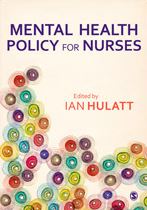
Congratulations to RCN Mental Health Advisor Ian Hulatt for editing this new book, Mental health policy for nurses. This hits the shelves any day now, and I want to give it a plug via this post. Here is what the publisher is saying:

Policy determines much of what nurses actually do on a daily basis, which means it is essential for nurses to engage with policy if they are to understand their own practice. Mental health nursing in particular has been shaped by a variety of policy factors in the past fifty years. In this new textbook, edited by the mental health advisor to the Royal College of Nursing, a range of experts in their field introduce the essential elements of mental health policy to students and experienced practitioners. The book covers a broad range of areas, including settings for care and the historical context, policy affecting various diagnoses and service user groups, and how policy is translated into action. Clinical examples are drawn on throughout, to help students think about the real-life context of what can be a difficult subject.

It will be essential reading for pre-registration mental health nursing students, and valuable to those working in practice who want to gain an understanding of policy.

There are some nice-looking chapters here, as the contents list suggests:

The History of Mental Health Policy in the United Kingdom Peter Nolan
The European Context Neil Brimblecombe
Community Services Ben Hannigan
Psychosis Norman Young
Older People Elizabeth Collier and Catherine McQuarrie
Dementia Trevor Adams
Personality Disorder Karen M. Wright
Service User Involvement Mick McKeown and Fiona Jones
Equalities in Mental Health Nursing Ann Jackson
Child Mental Health Policy in the UK Tim McDougall
Dual Diagnosis Cheryl Kipping
Policy into Action? Cris Allen

I was pleased to have a chance to contribute, writing a chapter addressing past and present policy for mental health care in the community. I started with an account of historical developments, and worked my way towards an analysis of recent policy including changing roles for nurses and the impact of austerity.


Review fever

Just what we need: another review of nurse education. Yesterday the Nursing Times carried this item reporting a joint Health Education England and Nursing and Midwifery Council plan to investigate standards. The NT says:

Health Education England and the Nursing and Midwifery Council will launch the review in May to specifically investigate the standard of education provided to around 60,000 nursing and midwifery students each year.

The Shape of Caring Review, which will be led by Lord Willis of Knaresborough, will also consider the standard of post-registration training for the NHS nurses once they have qualified. The review is due to produce a final report by early next year.

It follows concerns over the standard of nurse training raised by the Francis report into care failings at Mid Staffordshire Foundation Trust.

As part of its work, the review will examine the controversial pre-nursing experience pilots that have seen around 160 students work as healthcare assistants for a year before starting courses, and which were a key plank of the government’s initial response to the Francis report.

This is the same Lord Willis who chaired the RCN’s review of nursing education which reported in 2012, and about which I wrote a piece on this site here. As I wrote then, there was some scepticism on the timing given that universities and their partners in the NHS were in the throes of reshaping their pre-registration curricula following the publication in 2010 of new NMC standards for pre-registration education. This latest review is going to start before more than a handful of new, post-2010, nurses have registered and certainly before we know anything of the impact of these new regulatory standards on practice. This is exactly a point the NT goes on to make:

But Professor Ieuan Ellis, chair of the Council of Deans of Health, said he was concerned the review would duplicate work already underway by “multiple different projects and working groups”.

“This group needs to reflect on the reviews that have already happened, some quite recently – otherwise there will be a lot of duplication going on,” he added.

Jackie Kelly, head of nursing at the University of Hertfordshire, pointed out that the NMC had already imposed new standards for pre-registration courses in 2010, and stressed 50% of nursing students time was spent in a clinical setting away from the classroom.

She said: “We have already gone a long way and I wouldn’t want the review to move in a direction of travel before we have seen the output from the new standards agreed in 2010.”

Quite so.

Synthesising evidence

evidenceToday, returning to this blog after something of a gap, I find reason to reflect on the many flavours of evidence review which now exist.

In the RiSC project we’ve been using the EPPI-Centre approach, developed by people working at the Institute of Education in London. This framework has a number of desirable features, including the combination of a phase 1 mapping with a more in-depth phase 2 involving quality appraisal. Deciding the focus of phase 2 in an EPPI-Centre review involves discussion with stakeholding collaborators. That’s all to the good, proving that in evidence syntheses, as in primary data-generating studies, it is possible for researchers to work jointly with service user, carer and practitioner colleagues.

Last week, with other members of the Wales chapter of the COCAPP team, I spoke on our meta-narrative mapping of care planning and care coordination at a Swansea University seminar. Amongst other things meta-narrative mapping traces the different research traditions found within a given field. And, today, I mock-examined a delightful doctoral thesis containing a scoping review, which lays out what’s there but does not include formal quality appraisal. Then there are realist syntheses, where reviewers look across multiple studies for evidence of the generative mechanisms underpinning change in policy, services or practice. The list goes on, encompassing thematic literature reviews and, of course, Cochrane-style systematic reviews. This latter approach has been very important in driving the evidence-based practice movement, but personally I’ve always been a little disappointed at its insistence on hierarchies with randomised trials as the gold standard.

So how might decisions be made on selecting one approach over another? Practical considerations have a bearing, but perhaps more important are commitments to certain intellectual or other principles. We chose the EPPI-Centre approach in RiSC because we valued user, carer, practitioner and manager perspectives and wanted a way of hearing these and using them to inform our project. Realist reviewers sign up to particular sets of ideas on how programmes work, and meta-narrative mappers embrace the idea, and seek out examples, of paradigmatic differerence. Perhaps the key thing is to be aware of, and articulate, these in justifying the choices which inevitably have to be made.