Tag: School of Healthcare Sciences

Multiple Mini Interviews

Over the weekend I was sorry to learn that Inspector Michael Brown’s much-respected, and award winning, MentalHealthCop blog and twitter account have been suspended. I hope he is able to get back to both in the very near future.

Meanwhile, back at base I spent pretty much all of today helping select future students of nursing using multiple mini interviews (MMIs). Not sure about MMIs? Neither was I until recently. Here’s what we’re saying about them in the School of Healthcare Sciences at Cardiff University:

The interviews at Cardiff University School of Health Care Sciences for Nursing involve the use of a Multi Mini Interview procedure which is based on the Objective Structured Clinical Examination format that is commonly used by Health Sciences programmes to evaluate clinical competence.

The interview process is an opportunity to assess interviewees in person and assess information, such as personal qualities, that is not readily forthcoming in traditional application processes. The majority of these interviews will take place the week commencing 17 February 2014. 

The MMIs are made up of a series of short, carefully timed interview stations which provide information about applicants’ ability to think on their feet, critically appraise information, communicate ideas and demonstrate that they have thought about some of the issues that are important to the nursing profession. There are six stations in total. Each mini interview lasts a maximum of 5 minutes.

The School assesses the ability to apply general knowledge to issues relevant to the culture and society in which students will be practising, should they be successful in gaining admission to (and ultimately graduating from) the School. Equally important will be an assessment of the ability to communicate and defend personal opinions.

That’s pretty much it in a nutshell. Sticking to time is clearly important, and there’s plenty of moving around for applicants as they shuttle from station to station. As a process I rather liked it. I’ll be back for another slice of the same tomorrow, but will spare a thought for my esteemed Mental Health Nurse Academics UK colleagues who will be meeting at Lincoln University.

Mental health R&D 2013

Yesterday I made it to the SWALEC Stadium for the annual Cardiff and Vale UHB Mental Health R&D meeting. I was pleased to again be invited, and appreciated the opportunity to talk about mental health research activity across the new School of Healthcare Sciences.

I was also reminded of the work of the National Centre for Mental Health (NCMH). Funded as Wales’ only Biomedical Research Centre by the National Institute for Social Care and Health Research (NISCHR), and led by Professor Nick Craddock, the NCMH supports mental health research, undertakes mental health research and communicates and engages. Newly housed in Cardiff University’s Hadyn Ellis Building, members of the NCMH do all three elements extremely well. The Centre’s website has recently been revamped, and is well worth a visit. Here, too, is an NCMH call for volunteers video:

Catching up post

Plenty going on in the last week or so. I had the chance to join pre-registration mental health nurses and occupational therapists for a second day as they made preparations for an interprofessional event scheduled for early December. Some of these students have also been giving me drafts of assessed work to comment on, but as the deadline for receipt of these is first thing next week I expect a deluge then. ’twas ever thus.

Elsewhere there has been RiSC reviewing to crack on with, assignment marking, and peer review reports to both consider and write. I’ve also put myself in the frame to act as a reviewer for another university’s proposed new MSc mental health programme, this being the kind of curriculum work I haven’t had the chance to do for a while.

I’m not normally one for formal, suit-and-boot, events, but made an exception last Wednesday (November 27th) to join a posse of colleagues from the School of Healthcare Sciences at the RCN Wales Nurse of the Year awards. These took place at Cardiff City Hall, and the overall winner was Cardiff and Vale UHB ward sister Ruth Owens. Congratulations, Ruth. Congratulations, too, to the individual category winners: including Andy Lodwick (also from Cardiff and Vale) for picking up the Mental Health and Learning Disabilities award and Dr Carolyn Middleton, doctoral graduate from what was the Cardiff School of Nursing and Midwifery Studies, for winning the Research in Nursing award.

This week also brought me to a meeting of the MHRNC Service User and Carer Partnership Research Development Group and, yesterday morning, to the Cardiff City Stadium for an open meeting to discuss NISCHR’s infrastructure and programme funding review. Both were lively events, and on the NISCHR front I see big changes ahead from 2015.

And to close this summary post: via the twitter grapevine I see that the RCN is now giving early notification of the Network for Psychiatric Nursing Research 2014 conference. This will take place at Warwick University on the 18th and 19th of September. I’ll post a link to the call for abstracts once this appears, but for now will reproduce this extract from the event website:

This year [2014] is the 20th international NPNR conference and it’s going to be a celebration.

We wish to celebrate and promote some of the outstanding mental health nursing research that shapes mental health policy and nursing practice across the world. We will also acknowledge some of the best psychiatric and mental health nursing research that helped create the strong foundation for our work today. And we will invite delegates to look ahead to map out the future for mental health nursing research, education and practice.

Doughnut meetings

My esteemed colleague Professor Jane Hopkinson facilitates a Wednesday lunchtime research drop-in, to which people in the School of Healthcare Sciences at Cardiff University are invited. Affectionately known as doughnut meetings (see photo of today’s goodies attached), these provide a loosely-structured, supportive, space for the sharing of ideas and experiences. The gatherings are really very good: informal, but always informed. I make a point of getting along when I can.

Typically those who meet up get to propose themes for future meetings. This afternoon’s topic was ‘research and evaluation’, and more particularly the distinctions between the two. People involved in health services research (or indeed, health services evaluation) will know how important this differentiation is for NHS governance and approval purposes. Projects classified as ‘research’ require independent NHS research ethics committee (REC) approval. Projects classified as ‘evaluation’ do not. The NHS Health Research Authority provides guidance to help people work out what type of project it is that they are proposing, but in my experience making these determinations remains a wholly inexact science.

I have also learned that a project can be ‘evaluation’ in one context (e.g., for NHS research governance and ethics review) and ‘research’ in another (e.g., for academic progression and award purposes). My own PhD was designed, part-funded through open competition, completed and examined as ‘research’: what else could it possibly have been, as a research degree? But it was also categorised as something else when I offered it up for NHS REC approval, as I’ve written about here and (at length) in this paper.

So there we have it. Potentially all rather confusing, and certainly enough to make me want to eat a doughnut.

Postgraduate symposium

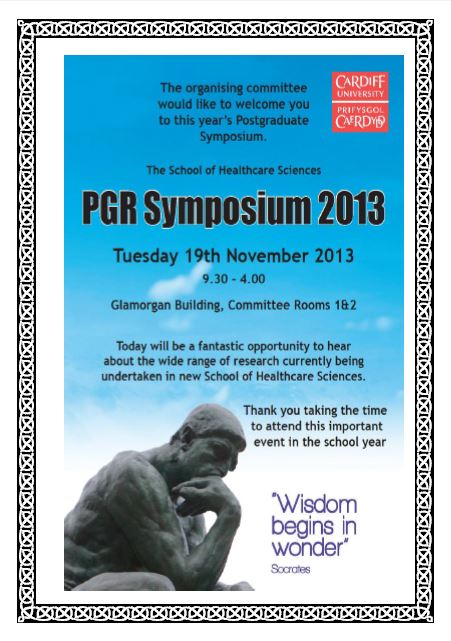
Tomorrow I’m off to the School of Healthcare Sciences’ first-ever Postgraduate Research Student symposium, taking place in the grand surroundings of Cardiff University’s Glamorgan Building.

This has given me the perfect excuse to find out, once and for all, the particular meaning of the word ‘symposium’ (as opposed to ‘colloquium’, for example). So for those interested (which won’t be many of you, I’m sure), the Collins English Dictionary defines ‘symposium’ thus:

  1. a conference or meeting for the discussion of some subject, esp an academic topic or social problem
  2. a collection of scholarly contributions, usually published together, on a given subject
  3. (in classical Greece) a drinking party with intellectual conversation, music, etc

A ‘colloquium’, on the other hand, is:

  1. an informal gathering for discussion
  2. an academic seminar

I’m glad that’s sorted. Looking at the third definition of ‘symposium’ above, and then at the organising committee’s Socratic quotation reproduced in the flyer at the top, I now realise I ought to prepare for an event in the ancient Greek style. I may bring my guitar, all the better to join in with.