
Undergraduate and postgraduate nursing education in Cardiff commenced in 1972, located within what was then the Welsh National School of Medicine. More than half a century later, the ambition which drove the creation of a four-year Bachelor of Nursing degree and the founding of a School of Nursing Studies continues in the successor School of Healthcare Sciences in Cardiff University. In this School, in which I have worked for over 27 years, nursing academics and students continue an unbroken tradition of education and research, underpinned by shared commitments to excellence in nursing practice and health care services. In this endeavour the School’s mental health, adult and child health nurses work side-by-side with colleagues and students many of whom are members of other health professions: midwifery; physiotherapy; occupational therapy; radiotherapy and oncology; and diagnostic radiotherapy. These networks extend outwards, to encompass collaborations at College and whole-University level. Courses are provided at undergraduate, taught postgraduate and postgraduate research levels and our students arrive from Wales, the rest of the UK and all around the world. The School’s programmes of study bring important opportunities for interprofessional learning, and over the years graduates (of whom there are now many thousands) have gone on to make a real difference and to occupy positions of influence. External reviews of the quality of the research which is undertaken in the School confirm this to be of the highest quality, relevant and applied. In short, we’re very good at what we do, and are recognised for this around the world.
In an editorial for the Journal of Advanced Nursing written shortly after the 40th anniversary of the appearance of graduate education for nurses in Cardiff, Daniel Kelly (now Emeritus RCN Professor of Nursing Research in Cardiff) and Kate Gerrish (a Cardiff nursing graduate who went on to become Professor of Nursing Research in Sheffield) celebrated the School’s successes but, presciently, also observed how ‘nursing’s place may now seem secure in the academy, but it remains a somewhat precarious relationship’. In what has rapidly become a widely publicised and fiercely contested announcement, on January 28th 2025 Cardiff University published a set of ‘Academic Futures’ proposals which include the intention to ‘discontinue activity for all three branches of nursing’. The Royal College of Nursing in Wales has issued a robust response protesting this plan, though the Welsh Government stands accused of a dereliction of duty in standing back whilst the crisis unfolds. To be clear, nursing in Cardiff is not the only discipline earmarked for possible removal or reduction: plans have been put forward to also close programmes in ancient history, modern languages, music, religion and theology, and to merge Schools and reduce staff numbers across the University’s three Colleges.
How have we arrived at this place? It has taken some time to register with the public, and even with policymakers, but the troubles facing the UK’s universities have now become widely known. University life is becoming harder, as the historian Glen O’Hara observes, and in ever-growing numbers of institutions staff numbers are reducing and courses being withdrawn. A combination of large-scale and local factors is driving this process: cost increases; a decline in (particularly international) student numbers; a fees structure which is working for neither home students nor universities; and investments in university estates designed to attract students in a marketised system, but which have become more difficult to sustain in a post-pandemic world in which work and study happen in hybrid ways and where the flow of new students is falling away. Gradually at first and, now, in accelerating fashion, the UK’s universities are in retreat.
Back in Cardiff, generalised concerns for the state of the university sector and for the challenges of providing health care education and doing research have given way to the altogether more terrifying prospect of losing our jobs. This is the reality for nursing and (some) related academics in Healthcare Sciences, for whom messages arrived last week telling us that we are now ‘in scope’ for possible redundancy. The University is being asked by our local branch of the University and College Union to make clear the full extent of its reserves, and to make use of these to protect jobs and courses. People, including staff and students in the School in which I work, are mobilising to protest against the proposals and to marshal counter-arguments. As the Royal College of Nursing has shown, Wales needs nurses in order that population needs are met and, indeed, to help promote the kind of good health which enables people to enjoy music, history and all those other disciplines which are also under threat in Cardiff.
Alongside the harm done to individuals whose jobs are under threat, the potential loss of nursing in Cardiff University also risks destabilising a complex system of commissioning and provision. This is creating uncertainty for existing students, and is likely to disincentivise large numbers of potential applicants. Because we no longer know exactly how, where and by whom the preparation of nurses in South Wales and the generation of new knowledge will take place in the future, staff will begin looking elsewhere for employment. In the School and University, the collaborative and intertwined work that nursing academics do will leave holes everywhere when they depart. In sum, health care education, research capacity and clinical academia are in jeopardy.


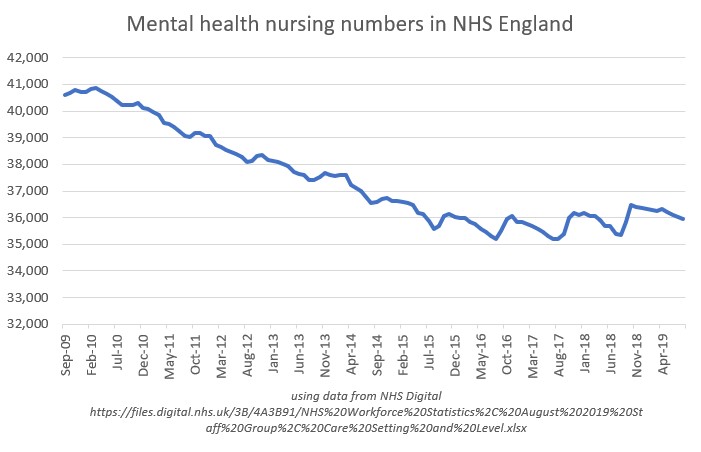 As an aside, data of this type are not published here in Wales. They should be. In any event, quite correctly much concern has been expressed about this startling decline in the workforce, with mental health nursing now singled out as
  Ben Hannigan's blog