Tag: Mental Health Nurse Academics UK

NPNR 2015 review

About to commence: #NPNR2015

The 21st Network for Psychiatric Nursing Research (NPNR) conference took place on Thursday and Friday, September 17th and 18th 2015, with the theme of ‘Building new relationships in mental health nursing: opportunities and challenges’. The occasion was a fine one, with just short of 200 people in attendance. For those not able to make it but wanting to know more, the programme can still be found here and the book of abstracts here.

I’ve been on the NPNR scientific and organising committee this year, courtesy of my membership of Mental Health Nurse Academics UK. This afforded me the chance to welcome delegates at the conference opening, and to draw attention to the just-breaking news of Professor Len Bowers’ planned retirement at the start of 2016. Len has been an inspirational mental health nurse researcher: more on this later.

2015-09-17 15.58.04
#NPNRselfie with Karina Lovell

Introduced by Professor Liz Hughes as day one conference chair, this year’s keynotes commenced with Professor Karina Lovell giving an overview of the current state of knowledge in remote psychological therapies. Karina is a world leader in research into interventions for people with commoner mental health problems such as depression and anxiety, as well as being actively involved in services and practice through her work with organisations like Anxiety UK and others. For an example of important new research in this area check out the REEACT trial into computerised CBT for people with depression. This is an important study which Karina both referenced in her talk, and is actively involved in.

Dr Geraldine Strathdee, NHS England’s National Clinical Director for Mental Health, delivered a second keynote on using mental health intelligence. She praised the work of nurses, and made a strong case for mental illness prevention. Geraldine also reminded delegates of the high rates of premature mortality of people living with mental health difficulties, and the continued exclusion of many from employment. As routes to improvement she pointed to leadership, and the value of data to benchmark and drive up standards.
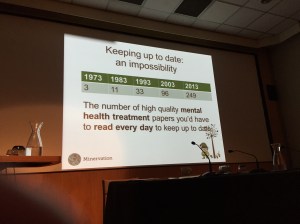
Keeping up with the evidence: an impossibility?

Day one’s final keynote presentation was delivered by André Tomlin, founder of the Mental Elf website and author of this pre-conference blogpost. André is an information scientist, who illustrated the challenge of keeping up-to-date with the evidence using this slide. Podcasts, social media, tweetchats and other new technologies are all part of André’s solution to the challenge of information overload, and as strategies to help plug the leaky evidence pipeline. The National Elf Service, of which the Mental Elf is a part, plays a big part in this area; for an overview of what’s on offer, here’s one of André’s videos:

Therapeutic approach, or therapeutic alliance?

Chair for day two was Professor Doug MacInnes, one of whose duties was to introduce Professor Shôn Lewis from the Institute of Brain, Behaviour and Mental Health at the University of Manchester as the deliverer of the conference’s fourth keynote lecture. Shôn spoke about current approaches to the care and treatment of people with psychosis and schizophrenia, using findings from the non-commercial CATIE and CUtLASS trials to suggest that newer antipsychotics are generally no better than first generation antipsychotics. Shôn also referenced the SoCRATES trial to evidence the idea that outcomes are associated with the quality of the therapeutic alliance, rather than with the specific therapeutic approach used. SoCRATES, I have now discovered, compared the effectiveness of (1) CBT plus routine care, (2) supportive counselling plus routine care and (3) routine care alone for people with schizophrenia. Shôn devoted the last part of his presentation to ClinTouch (a mobile phone app to record and upload symptoms) and CareLoop (which is testing if ClinTouch can be connecteded to NHS IT systems and to everyday practice).

Mark Brown about to begin his talk

#NPNR2015’s final keynote was delivered by Mark Brown, and the full text of his talk can be read here. Mark edited One in Four magazine, and is now development director of Social Spider, runs the Day in the Life project and is part of the team behind the WeMHNurses Twitter meeting place. Drawing on personal experience of its usefulness he described digital technology as less of a possible future than an unfolding present. One example of tech in action, which Mark referred to in his talk, is his own Doc Ready website. This was designed to help people prepare for discussions with doctors about their mental health difficulties.
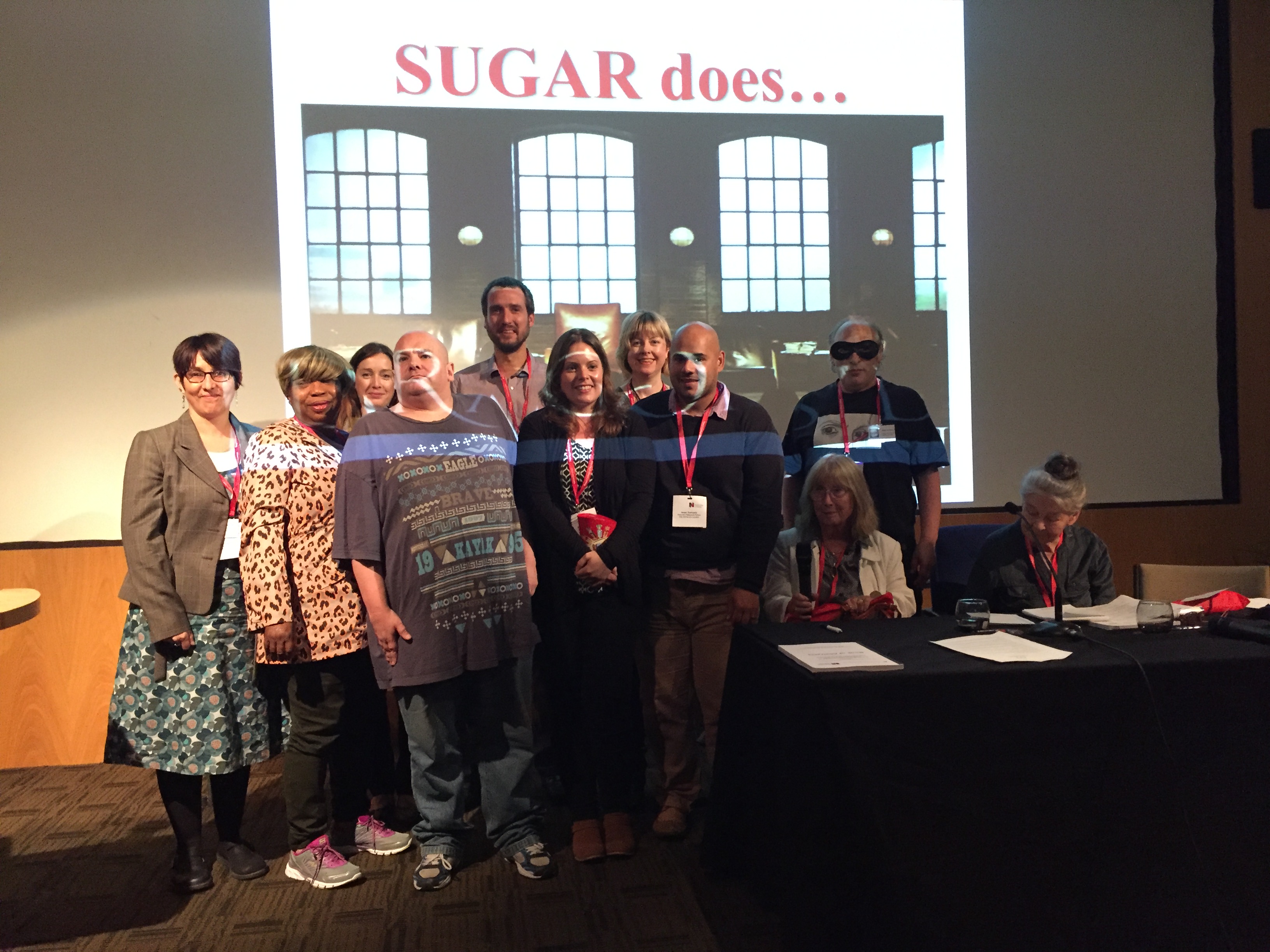
SUGAR does Dragons' Den
SUGAR does Dragons’ Den

That’s summary enough of the keynotes. From the concurrent sessions I participated in, chaired or observed I’ll first start with the SUGAR meets Dragons’ Den workshop. Three volunteers – Jason Hickey, Laoise Renwick and Cher Hallett – pitched their research ideas to SUGAR members. In the event, SUGAR offered their time and support to all three, but also voted Cher’s plans (on intramuscular injections) as the best of the batch. In the second concurrent I’m picking out, Julian Hunt, Alan Meudell and Michael Coffey presented reflections from Plan4Recovery. This project, which I’m also part of, is examining shared decision-making and social networks for people using secondary mental health services. And, finally, a word about our COCAPP symposium. This started with an overview paper from Alan Simpson, was followed by a presentation from Michael Coffey titled, ‘Ordinary risks and accepted fictions: how contrasting and competing priorities work in risk assessment care planning’ and concluded with a paper from Sally Barlow and me on participants’ views and experiences of recovery and personalisation.

The RCN's history of mental health nursing exhibition
The RCN’s history of mental health nursing exhibition

Organised by Laoise Renwick, this year for the first time the NPNR conference featured a poster trail. This worked well. Displayed posters were themed, and during lunchtime on day two guided delegates took opportunities to speak with those associated with them. Along the way I spotted some interesting posters from the RCN, drawing attention to an upcoming history of mental health nursing exhibition (organised with lots of help from Ian Hulatt) about to launch in London.

Elsewhere, the NPNR conference has become the place where the names of the following year’s Eileen Skellern Lecturer and the winner of the Journal of Psychiatric and Mental Health Nursing Lifetime Achievement Award are announced. Check out my tweet below for news for 2016. Many congratulations indeed to both Cheryl and Tony:

Len Bowers at #NPNR2015

Finally, a word on Len Bowers. At Doug MacInnes’ invitation, Len took to the lectern during the afternoon of day two to confirm his upcoming retirement and his plans for the future. These include (we learned) playing the flute, travel, photography and electronic music-making. Very nice. Len is a generous, principled and humble man whose contribution to creating new knowledge for mental health nursing has been immense. Take Safewards as an example. This is Len’s NIHR-funded programme grant, findings from which are changing practice in the UK and around the world. That’s some achievement, in my book. We wish him well.

Mental Health Nurse Academics UK meets in Nottingham

I was unable to make Thursday evening’s Skellern Lecture and Journal of Psychiatric and Mental Health Nursing Lifetime Achievement event hosted by Patrick Callaghan at Nottingham University. My congratulations to Ian Norman and to Marion Janner, this year’s very worthy award winners. As it happens, Ian was one of my PhD examiners. My following of Thursday’s proceedings from afar, via Twitter, tells me I missed a treat.

I was, however, able to make the trip to Nottingham for Friday’s summer term meeting of Mental Health Nurse Academics UK (MHNAUK). This was held in the new, and rather impressive, Institute of Mental Health building:

Here’s a picture I took of the sculpture, titled House for a Gordian Knot, displayed at the entrance to the Institute’s main building:

We had three local presentations. First up was  Paul Crawford, who gave a broad overview of the Creative Practice as Mutual Recovery research programme which he leads, followed by Andrew Grundy giving an account of qualitative findings from the Enhancing the Quality of User Involved Care Planning in Mental Health Services (EQUIP) study. EQUIP is an important, NIHR-funded, programme of work which (along with COCAPP and COCAPP-A) is producing evidence of how care planning is being done and how it might be improved. Here’s a photo, taken and shared by Karen Wright, of one of Andrew’s final slides outlining steps to successful user involvement in this process:

Tim Carter talked us through his freshly-minted mixed methods PhD, in which he investigated the use of a preferred-intensity exercise programme for young people with depression. I thought this to be a very well-designed study, which generated considerable discussion around the active ingredients of the intervention and plans for a future follow-up.

Elsewhere Lawrie Elliott, editor of the Journal of Psychiatric and Mental Health Nursing, was welcomed by the group to give an update on developments at the journal in his first year at the helm. I really liked what I heard, and said as much in our discussion. Quality of papers, and relevance to mental health nursing, are being prioritised. Word limits have been increased to allow for more in-depth analysis in accepted articles. To extend its reach the journal now has a Twitter account, which can be followed by clicking the following link:

Ben Thomas from the Department of Health opened a discussion on the future of the Student Mental Health Nursing Conference, the inaugural event having taken place at the O2 Arena in London in February this year. As I understand it, much of the organising was done by staff and students at Greenwich University: well done, them. A group of MHNAUK members representing different universities has agreed to collaborate to keep this initiative going, and with a view to turning it into a cross-UK, rather than an England-only, opportunity.

Following David Sallah’s meeting with MHNAUK in York in March 2015, Joy Duxbury and Steven Pryjmachuk chaired a discussion on the current status of the Shape of Caring review. Since returning from Nottingham I have found that Health Education England is planning to sound out opinion through a series of events running into the autumn. Details are to follow.

Thanks particularly to John Baker, in the weeks leading up to this latest meeting MHNAUK published a response strongly criticising the announcement that the National Institute for Health and Care Excellence (NICE) was ending its work in the area of safe staffing. This decision, defended two days ago by Jane Cummings (Chief Nursing Officer at NHS England), has also been challenged by others including Sir Robert Francis and now the Council of Deans of Health. The Safe Staffing Alliance campaigns in this area, and MHNAUK will continue to make a contribution via a further response the outline of which was agreed in Nottingham. As a reminder of some of the key evidence supporting the importance of registered, graduate, nurses for quality and safety follow this link to an earlier post on this site and this link to a recording of Linda Aiken delivering the Winifred Raphael Memorial Lecture at the University of South Wales on October 1st 2014. And, for those interested in how #safestaffing is shaping up differently across the countries of the UK, follow this link for a record of the progress of the Safe Nurse Staffing Levels (Wales) Bill through the National Assembly for Wales. Following this link brings you to a report reviewing the evidence, commissioned by the Welsh Government and produced by a team led by Aled Jones in the Cardiff School of Healthcare Sciences.

Fiona Nolan shared progress on her survey of mental health nursing research interests and expertise in UK higher education institutions. And, finally, on behalf of the organising and scientific committee Russell Ashmore, Laoise Renwick and I took the chance to update MHNAUK members on progress for the 21st International Network for Psychiatric Nursing Research conference.

#NPNR2015 takes place at the Manchester Conference Centre on Thursday 17th and Friday 18th September 2015. We think the programme is shaping up perfectly, with keynote speakers including England’s National Clinical Director for Mental Health Dr Geraldine Strathdee, Prof Shôn Lewis from the University of Manchester, Mark Brown who ran One in Four magazine and is now involved with The New Mental Health, and André Tomlin who runs The Mental Elf service. We have symposia, workshops and concurrent sessions with papers accepted from presenters around the world, a walking poster tour and the opportunity for fringe events. Make your booking now!

The shape of nursing (reprise)

York, March 10th 2015
Yesterday I joined other members of Mental Health Nurse Academics UK at the University of York, for what turned out to be a particularly lively spring term meeting. 

We were treated to two high-quality local presentations in the morning: from Simon Gilbody on smoking cessation interventions for people using mental health services, and from Jerome Wright on developing community mental health in Malawi. 

In the early afternoon David Sallah from Health Education England (HEE) took the floor to talk about the Shape of Caring review, the final report from which is due to be published later this week. From David’s presentation it is evident that HEE will be making a case for a significant shake-up to the way nurses are prepared. 

MHNAUK members in York were concerned with what they heard. Uppermost for many was a concern that HEE’s wish for future student nurses to commence their courses with two years of Project 2000-style generalist preparation will erode the time available for mental health-specific learning. People were also struck by the apparent lack of a clear evidence base for change. It is, after all, only a handful of years since the Nursing and Midwifery Council introduced its current standards for education, and curricula up and down the country were rewritten in response. In the absence of robust evaluations of what we already have, are we really sure we know what needs fixing in nurse preparation? 

The Shape of Caring review is sponsored by a body with authority in England only, but I am under no illusions that any changes flowing from it will be felt equally here in Wales. David Sallah mentioned cross-UK talks as having already opened. As people observed yesterday, however, any changes to nursing education recommended at this point may be lost following a general election where greater priorities occupy the time of a newly formed government. 

Meanwhile, and with a firm eye on the forthcoming election, the Council of Deans of Health has been busy making a case for health higher education and research in its new publication Beyond Crisis. This has three main messages, addressing: workforce planning; building on the talents of the current workforce; and investing in research. Amongst other things the Council is asking for proper forward planning to avoid cycles of boom and bust, opening up opportunities for continuous professional development and protecting and advancing research. It is also suggesting that new ways of financially supporting health professional education should be looked at, including models where contributions are made by students and employers.

#NPNR2015 news

I’m pleased to have had the chance to join the scientific and organising committee for the NPNR Conference, and to have taken part in a series of face-to-face and electronic discussions to plan this autumn’s event.

Nowadays the NPNR Conference is a collaboration between Mental Health Nurse Academics UK and the RCN. Early information about the 21st running of the event can be found here. For ease, here is an extract with an outline of this year’s themes and more:

21st International Network for Psychiatric Nursing Research conference
“Building new relationships in mental health nursing: opportunities and challenges”

17 September 2015 – 18 September 2015 – Manchester Conference Centre, Sackville Street, Manchester M1 3BB

As the NPNR conference convenes for the 21st time developments in research, education and delivery of mental health nursing care continue apace. New knowledge opens the way for new forms of relationships with people who use services, their families and with colleagues within and outside our discipline. The way mental health nurses are educated and how they develop and research their practice is also changing, bringing with it new opportunities and many challenges.

This year’s conference will engage with the emerging evidence and changes in the landscape of care as we seek to craft new understandings of what it means to be a mental health nurse. As we become attuned to the vagaries of policy and the volume of new knowledge for our profession we must also rise to the challenge of ‘seeing’ in new ways. Our intention is to provide a space where colleagues can debate and critically engage with flux in the profession.

The NPNR is the place for mental health nurses and those we work with to present and learn new knowledge. We encourage you to submit your research and practice development initiatives and participate in discussion so that you leave the conference informed, enlightened and with new energy to engage with the challenges ahead. Alongside our expert speakers, great practice development and research papers the conference promotes a friendly and welcoming atmosphere that has been the hallmark of NPNR for 20 years. This year in addition to our exciting themes we include new developments for 2015.

Conference Highlights for 2015

• Two day conference for academics and practitioners working across mental health nursing
• Renowned keynote speakers
• Call for abstracts including options to present posters, concurrent, symposia and workshops
• Networking, collaborating and discussing the latest in mental health nursing research
• Conference reception and networking dinner
• Announcing the recipients of both the Eileen Skellern Lecture and the Journal of Psychiatric and Mental Health Nursing Lifetime Achievement Award 2016
• Special discounts for conference presenters; RCN members; students; carers and service users
• Enhance your continuing professional development
• Poster Trail
• Fringe events
• RCN exhibition

Call for Papers will be open from the beginning of March 2015

Concurrent themes:

• New Conversations, New Platforms, New Evidence
• Collaborations and Partnership in Research
• New Voices, New Researchers
• Innovation and Development in Practice and Education
• Changing Systems, Changing Relationships

Abstracts addressing the conference themes are invited for the following types of presentations:

1. concurrent sessions
2. poster presentations
3. symposia
4. workshops
5. fringe events

Key timings:

Thursday 17 September 2015
8.30am – 10am: Registration and Fringe Events
10.00am – 6pm: Conference

Friday 18 September 2015
9.00am – 9.45am: Registration
9.45am – 4.15pm: Conference

The hashtag for the conference will be #NPNR2015:

And, for those who also use LinkedIn, there is this group.

I’ll aim to post further updates on all this over the coming weeks and months.

The shape of nursing?

Congratulations to Steven Pryjmachuk on his pre-Christmas election as Vice Chair, and Chair-elect, for Mental Health Nurse Academics UK. Steven works with Joy Duxbury throughout 2015 and 2016, and becomes Chair for the two years following.

During the December 2014 MHNAUK election, for which I acted as returning officer, news seeped out that Health Education England’s Shape of Caring review (led by Lord Willis) was weighing up the future of UK nursing’s four fields (mental health, adult, child, learning disability). Michael Coffey, in his last month as MHNAUK Chair, led this response sent to the Health Service Journal:

Michael Coffey
Chair of MHNAUK

11th December 2014

Dear Sir

Shaun Lintern writes in the Health Service Journal (11th December 2015) that Lord Willis, chair of the Shape of Caring review envisages changes to nurse education that would see the loss of the current branches of nursing. One of those fields is mental health nursing. Those who practise in this area provide skilled compassionate care to some of the most marginalised and stigmatised people in society. We write on behalf of Mental Health Nurse Academics UK a group consisting of representatives of 65 Higher Education Institutions providing education and research in mental health nursing. As people long experienced in this field we are disappointed though not surprised to read your article presenting these views on the future of nurse education. We are disappointed because the evidence for the changes that Lord Willis claims are needed is largely non-existent. We are not surprised because we have been here before and can see that despite claims to the contrary, there is no evidence that this future for nurse education will deliver what it promises.

Nurses account for the highest number of professionals providing mental health care; the median average number of nurses per 100,000 of the population working in mental health is 5.8, more than all other professionals combined (WHO, 2011), making mental health nurses pivotal to the delivery of the WHO action plan. None of this is likely with a generic curriculum.

To be clear “the greater element of generalism” (which presumably means adult nursing) has been tried previously in the UK and found wanting. Internationally generalism has failed to deliver better care for people with mental health problems. The effect will be to dilute mental health nursing when there is increasing evidence that specialist knowledge, values and skills are required in the care of people with a range of long-term conditions and dementia. We remain unclear from your article what precisely is being proposed though our favoured suggestion would be for nurses to spend two years rigorously learning how to interact with people in compassionate ways that promote dignity and respect (core mental health nursing skills if you will) before launching themselves into the cold clinical world of high technology nursing.

The evidence from abroad and from evaluations here in the UK of the previous version of generalist frontloaded training (Project 2000; Robinson and Griffith 2007) show clearly that mental health nursing as a specialism suffered from a minimal focus on mental health in curricula and a depletion of mental health skills across the workforce. The strengthening of the mental health ‘field specific’ elements within the 2010 NMC standards reflected positive differences in areas such as language, the co–production of care and inter–professional practice. Any move to generic, or general (adult?) nurse ‘training’ as a start point for all will inevitably lead to a different set of values underpinning mental health nursing practice over time.

The expectation that the training of mental health nursing skills will be picked up and delivered in the workplace is without foundation despite the numerous examples to do this. The result will be that in an era of claims of parity of esteem people who use services will effectively be deprived of specialist trained nurses. Moreover, there is no evidence that current models of training are not fit for purpose or that a focus on generalist nursing skills will adequately address the needs of people with complex and enduring mental health difficulties.

The longer term effect of this approach is clear to see from countries who have moved down this road ahead of us, depleted services provided by unskilled workers, extra costs for employers in re-training and educating a workforce not fit for practice, difficulty in securing sufficient qualified staff to provide evidence based mental health care and longer term the stripping away of a set of skills in higher education that are unlikely to be replaced.

We don’t know what advice Lord Willis has taken to come to his view. Our worry though is that already the language being used here is designed to undermine professional skills that have been long in the making. For example, the unhelpful rhetoric embodied in the use of the term “silo” downplays specialist skills for the purposes of promoting something far less specific like “flexibility”. It is a largely hollow rhetoric and is never heard in relation to cardiologists, neurosurgeons or diabetes nurses. It seems that the pressure for change then is not one premised on the needs of people using healthcare services nor one based on the evidence of what works but driven by other factors that choose to position specialist nursing skills (and by corollary those who need these skills) as having little value.

We also note that any modification to the NMC’s standards for pre-registration nursing education and to the four fields driven by the Shape of Caring review will be felt across all parts of the UK. As an HEE-sponsored Review we are concerned that voices from parts of the UK other than England will not have opportunities to be heard.

We readily acknowledge that the full report is not yet due but wish to advance the notion of such a review democratically reflecting the voices of nurses and the people who use their services. In this regard we have been disappointed at the absence of any real attempt by the review to engage with our group specifically and have questions about the level of engagement with mental health service users more generally.

Yours Sincerely

Dr Michael Coffey
Chair of Mental Health Nurse Academics UK
Swansea University

Professor Joy Duxbury
Chair-elect of Mental Health Nurse Academics UK
University of Central Lancashire

Professor Len Bowers
Institute of Psychiatry
Kings College London

Professor Patrick Callaghan
Nottingham University

Professor Alan Simpson
City University London

Professor John Playle
University of Huddersfield

Professor Steven Pryjmachuk
University of Manchester

Professor Hugh McKenna
University of Ulster

Professor Doug Macinnes
University of Canterbury

Professor Karina Lovell
University of Manchester

Professor Geoff Dickens
Abertay University

Dr Ben Hannigan
Cardiff University

Dr Liz Hughes
University of York

Dr John Baker
University of Manchester

Dr Mick McKeown and Dr Karen Wright
University of Central Lancashire

Dr Robin Ion and Emma Lamont
Abertay University

Dr Sue McAndrew
University of Salford

Dr Andy Mercer
Bournemouth University

Dr Naomi Sharples
University of Chester

Dr Majorie Lloyd
Bangor University

Around this time there was some debate, via email, amongst MHNAUK members centring on the kind of nurses people felt were needed for the future and how they might best be prepared for practice. Important differences in view were freely expressed. Not all who are associated with MNHAUK are in favour of the retention of mental health nursing as a pre-registration field, for example, though my reading of the flow of pre-Christmas exchanges is that most are. Joy Duxbury and Steven Pryjmachuk, I suspect, will be returning to some of this debate during their tenures.

December catch-up

Competing priorities have kept me away from this site in recent weeks. There’s been work to do on COCAPP, which is close to the finish line, and doctoral students’ drafts to read and comment on (before imminent thesis submission, in one case). I’ve also been reading a thesis ahead of a PhD examination I’m involved in at the end of the coming week. So if this catch-up post feels a little bitty, then that’s because it is: there’s been lots happening that I want to comment on.

First up is the RiSC study, which I’ve mentioned here plenty of times before. In the last ten or so days the NIHR has published a first look summary of our aims, methods and findings. This is a precursor to the publication of our whole report, which is now post-peer review. Sometime in the new year we’ll be reconvening as a research team to plan our next project.

In October I made the short trip to the University of South Wales to hear Professor Linda Aiken from the University of Pennsylvania deliver this year’s RCN Winifred Raphael Lecture. Professor Aiken spoke on Quality nursing care: what makes a difference?, drawing on findings from the RN4Cast study and more. As promised, the RCN Research Society has now uploaded its video of the event for the world to see. It’s well worth watching.

News on the Mental Health Nurse Academics UK front includes an election, which we are now midway through, for the group’s next Vice Chair and Chair Elect. I’m overseeing this process (as I’ve done twice before), and will be in a position to announce the successful nominee on December 15th. One of the things that MHNAUK does is to work with the RCN to run the annual NPNR conference, and I’m very pleased to have had the chance to join the NPNR scientific and organising committee for a three year stint. More to follow on that front in the future, including details of next year’s event as they emerge.

Elsewhere I read that the Shape of Caring review, chaired by Lord Willis, is looking at the UK practice of preparing new nurses, at the point of registration, for work in one of four fields (mental health, adult, child and learning disability). This is something to keep a close eye on, with reports from last month’s Chief Nursing Officer Summit in England suggesting that the fields may be on their way out. For a useful, balanced, review in this area I refer the reader to the 2008 King’s College London Policy+ paper Educating students for mental health nursing practice: has the UK got it right? and, for a longer read, to Approaches to specialist training at pre-registration level: an international comparison.

Research away day and MHNAUK meet-up

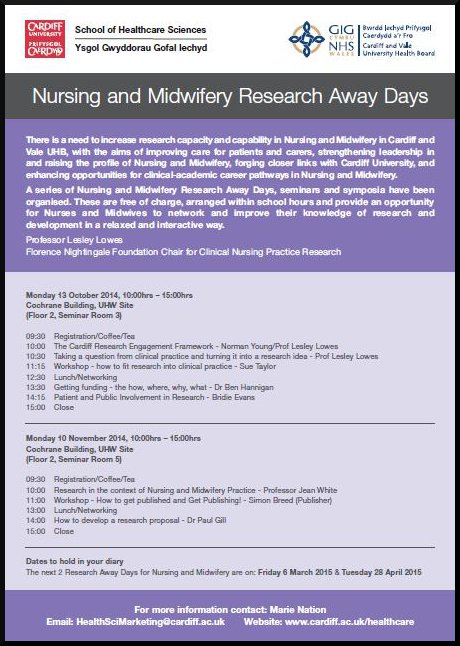
Lots of interesting things to report from a packed week. Monday took me to a meet-up with research-minded nurses from Cardiff and Vale UHB, the first of a series of events organised by Professor Lesley Lowes aimed at supporting research capacity and engagement amongst practitioners. Here’s the flyer:

Lesley's event

In her presentation, Bridie Evans made use of a segment from a NISCHR CRC video introducing the work of Involving People. This has been uploaded to the NISCHR CRC YouTube channel, where the part Bridie used begins at around the 1:53 mark:

https://www.youtube.com/watch?v=IvIgtPSUwAA

Yesterday was the first Mental Health Nurse Academics UK meeting of the 2014-15 academic year. We convened in Manchester, with public involvement and engagement in mental health research and education the theme for the pre-business part of the day. Lauren Walker and Lindsey Cree led with an excellent presentation drawing on their service user and carer researcher experiences working on the Enhancing the Quality of User Involved Care Planning in Mental Health Services (EQUIP) study. Steven Pryjmachuk and I talked about our experiences of involving young people in research, drawing on Steven’s self-care project and our shared RiSC study. John Baker closed this part of the day with an impressive University of Manchester case study of how public and patient involvement in research and education can be embedded at institutional level.

Elsewhere in yesterday’s MHNAUK meeting there was a lively discussion around the promotion of physical health and well-being in people using mental health services, and a review of this year’s NPNR conference. Plans are also being laid for next year’s event, with opportunities about to be notified for people interested in becoming more involved via membership of the conference organising committee.

Voting for mental health

In this post I underestimated the number of charities which specifically fund mental health research. Last week Hugh McKenna sent a message to members of Mental Health Nurse Academics UK alerting us to the Alliance of Mental Health Research Funders, and particularly to this group’s Prioritising Mental Health Research manifesto produced ahead of next year’s general election.

I count 13 members of the Alliance, and read this from the about section of the organisation’s website:

We are a group of charities and foundations that support mental health research. We meet regularly to share progress and generate new ideas for improving mental health research in the UK. We believe that more and better research is urgently needed to find ways of promoting good mental health, treating mental health problems, and supporting the wellbeing of individuals, families and communities. Research can help people with mental health problems, and those around them such as family members or friends, practitioners and leaders of organisations, to find solutions so individuals can enjoy better health and longer, more fulfilling lives.

In its 2015 manifesto the AMHRF says:

We all know someone with a mental health problem and can see how lives would be improved with better treatments and support and less stigma. Mental health research saves lives, relieves significant distress
and improves quality of life. It also benefits the whole of our society by generating social and economic benefits that contribute to thriving communities built upon resilience, reduced levels of mental ill-health and less stigma and discrimination.

Yet mental health research is underfunded and under-prioritised by government. We are missing opportunities to achieve breakthroughs seen in other areas of healthcare that could transform people’s lives and enhance wellbeing.

The 2015 General Election is a landmark opportunity for political parties to build on growing public awareness of mental health and the value of all health and social care research.

The Alliance is right about a growing public awareness of mental health issues, and its message on underfunding is an important one which deserves to be heeded. The LibDems have promised to include a commitment to increasing mental health research in their 2015 manifesto, and other parties (including those with a chance of forming a government) might consider following suit. Personally I would like to see this wrapped up in a more overarching promise to invest properly in mental health across the board, including in services. Elsewhere this week announcements have been made of extra funds to reduce waiting times for mental health care in England. This is a good thing, but needs to be seen in the context of persistent cuts to the mental health system over the lifetime of this government which have  had serious implications for people left in need.

2014 Skellern Lecture, JMPHN Lifetime Achievement Award and MHNAUK meet-up

Last week brought a trip to London for a series of events: a COCAPP update on framework analysis; a COCAPP project advisory group meeting; the 2014 Skellern Lecture and the Journal of Psychiatric and Mental Health Nursing Lifetime Achievement Award; and this term’s meeting of Mental Health Nurse Academics UK.

Gary Winship, who does an excellent job organising the Skellern and JPMHN events, wrote this piece on the MHNAUK blog ahead of the lectures taking place at the Institute of Psychiatry. He wrote how Professor Joy Duxbury in her Skellern Lecture:

…will endeavour to balance the evident need for improved compassionate based care against a backdrop of risk aversion [and will place] a particular focus on coercive practices, more specifically restraint in mental health settings.

And that was exactly what Joy did on the night. She lined up, and tackled, the reasons mental health nurses give for using physical restraint and using video evidence drew her audience’s attention to what can go wrong. This includes patient deaths, something which the national charity Mind has been campaigning about since last year (see this post from June 2013) and which has helped drive the Department of Health’s guidance on positive and proactive care.

Professor Hugh McKenna took a break from his REF duties as Chair of the Allied Health Professions, Dentistry, Nursing and Pharmacy sub-panel to receive this year’s JPMHN Lifetime Achievement Award. Here’s Gary Winship’s preamble from the MHNAUK site:

Professor McKenna has a long and illustrious career. He was appointed an International Fellow of the American Academy of Nursing in 2013 which is an accolade accorded to very few people outside the USA. He was made an Honorary Fellow of the Royal College of Surgeons in Ireland (1999), Fellow of the Royal College of Nursing (2003) and Fellow of the European Academy of Nursing Science (2003). In 2008, Professor McKenna received a CBE for contributions to health care and the community, and in the same year he was appointed to Chair the Nursing Panel in the 2008 Research Assessment Exercise.

Hugh delivered a personable, good-humoured, lecture which also contained some important messages for nurses aiming to build programmes of research. These included the importance of working collaboratively and across disciplinary boundaries, aiming high, and getting funding. These are all things which Hugh has excelled at in his own career, though he was far too modest to draw explicit attention to this himself. Many congratulations both to him and to Joy: two recipients very worthy of their awards.

Following events on June 11th, the 12th brought the final meet-up in the current academic year of Mental Health Nurse Academics UK, convened on this occasion at London South Bank University. The morning was devoted to these presentations:

Colin Gale, Archivist, Bethlem Museum of the Mind
As if to, drive me mad: an Edwardian’s experience of sedatives and the asylum

Tony Leiba, Emeritus Professor, LSBU
Lessons of social inclusion through policy

Tommy Dickinson, Lecturer, Manchester University
‘Curing Queers’: giving a voice to former patients who received treatments for their ‘sexual deviations’, 1935-1974

The afternoon saw MHNAUK members get down to business. This included a discussion, led by Andy Mercer, on how best to influence the latest round of nursing reviews including the Shape of Caring and The Lancet Commission on UK Nursing. Elsewhere on the agenda were updates on this year’s Network for Psychiatric Nursing Research conference, MHNAUK’s in-progress position paper on physical health and well-being (led by Patricia Ryan-Allen and Jacquie White) and possible journal affiliations.


London calling

Time this evening to note tomorrow’s COCAPP project advisory group meeting (to be held at City University London), to be followed by a trip to the Institute of Psychiatry to hear the delivery of this year’s Eileen Skellern Lecture by Professor Joy Duxbury and Professor Hugh McKenna’s acceptance of the JPMHN Lifetime Achievement award. Time, too, to note Thursday’s meeting of Mental Health Nurse Academics UK at London South Bank University.

So, lots to talk about and listen to.