Tag: Dementia

Early intervention for people living with dementia

Here are links to two new papers led by Bethan Edwards, arising from her PhD which she completed in the School of Healthcare Sciences in Cardiff in 2022. Bethan is now working as a Capacity-Building Fellow at King’s College London, and her doctorate focused on the creation of an occupational therapy intervention for people living with early-stage dementia.

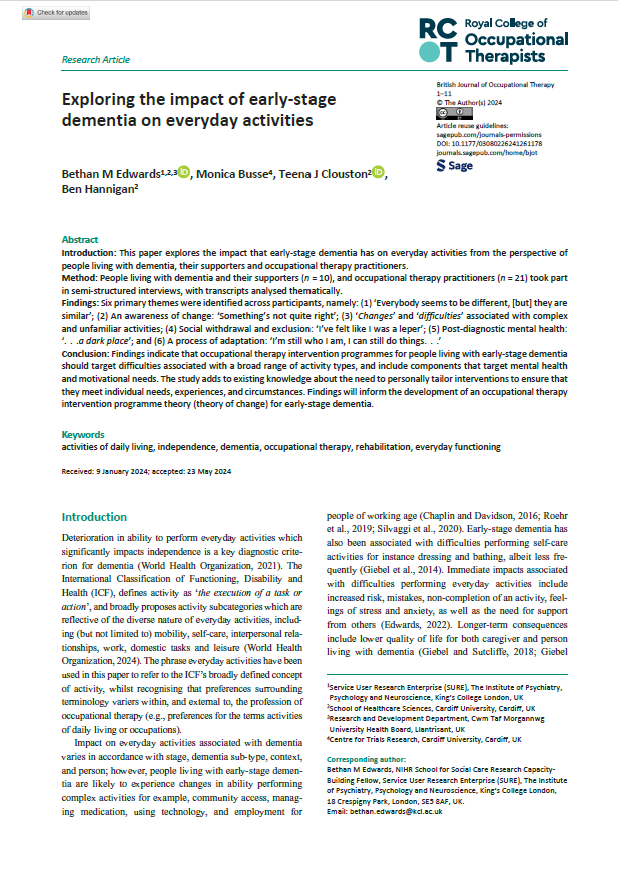
The first of these publications, which appears in the British Journal of Occupational Therapy, reports on interviews with people living with dementia, people supporting them and practitioners and has the aim of examining the impact that early dementia has on everyday activities. Here’s the abstract in full:

Introduction: This paper explores the impact that early-stage dementia has on everyday activities from the perspective of people living with dementia, their supporters and occupational therapy practitioners.

Method: People living with dementia and their supporters (n = 10), and occupational therapy practitioners (n = 21) took part in semi-structured interviews, with transcripts analysed thematically.

Findings: Six primary themes were identified across participants, namely: (1) ‘Everybody seems to be different, [but] they are similar’; (2) An awareness of change: ‘Something’s not quite right’; (3) ‘Changes’ and ‘difficulties’ associated with complex and unfamiliar activities; (4) Social withdrawal and exclusion: ‘I’ve felt like I was a leper’; (5) Post-diagnostic mental health: ‘. . .a dark place’; and (6) A process of adaptation: ‘I’m still who I am, I can still do things. . .’

Conclusion: Findings indicate that occupational therapy intervention programmes for people living with early-stage dementia should target difficulties associated with a broad range of activity types, and include components that target mental health and motivational needs. The study adds to existing knowledge about the need to personally tailor interventions to ensure that they meet individual needs, experiences, and circumstances. Findings will inform the development of an occupational therapy intervention programme theory (theory of change) for early-stage dementia.

The second of Bethan’s two papers has just appeared in Dementia, and draws on interview data to examine real-world community occupational therapy interventions for people with early-stage dementia. Here is this article’s abstract:

Aim: There is an absence of evidence generated in a UK context to support interventions based on occupational therapists’ core skills for people living with early-stage dementia. To inform the development of a programme theory and a future evaluation, this paper aimed to describe real-world (routine) community-based occupational therapy interventions for this population and contextual barriers.

Method: Occupational therapy practitioners (n = 21) from five Health Boards in Wales, UK participated in semi-structured interviews (n = 17) which were audio recorded, transcribed, and analysed thematically.

Findings: The availability of, and access to, real-world community-based interventions was variable, and associated with multilevel contextual barriers (resources, understanding of dementia specialist occupational therapy, professional influence, and evidence base). Where available and accessible, contents comprised a pre-intervention component (relational work, assessment, and goal setting) and intervention component (personalised problem-solving and coping strategies, emotional support, and advice and signposting), to meet needs associated with everyday activities and poor wellbeing. Variation in mode, duration, contents, and who received interventions, was associated with contextual barriers.

Conclusion: Findings indicate that the development of an intervention programme theory and future evaluation design, will need to account for the impact context may have on the variability of real-world intervention characteristics, and how this in turn may influence outcomes.

Bethan’s doctorate was an excellent one, and has laid the foundations for a programme of intervention research. Elsewhere in her thesis is a detailed two-stage evidence synthesis, and this, too, is well worth a read by anyone interested in this important field.

@benhannigan.bsky.social

New theses

Here is news of two completed doctoral theses which I have helped support as a supervisor, both being within the mental health field. First is Fortune Mhlanga’s Implementing recovery-oriented practice in mental health services: a qualitative case study, which is all about how recovery ideas are used in everyday practice. The summary for Fortune’s study is this:

Although the recovery philosophy has been adopted in mental health services in various Western countries including England, its implementation in practice has been described as “slow and patchy”. Furthermore, there are suggestions in the literature that there is a lack of clarity around the implementation of recovery-oriented practice (ROP) and a dearth of research exploring the phenomenon. This study aimed to discover how recovery-oriented practice is implemented in an NHS Trust providing care for people experiencing mental health problems, in order to add to what is already known about the implementation of ROP to inform future practice.

A qualitative case study approach was employed to investigate the implementation of ROP from strategic to grassroots level in two practice settings (Community Mental Health Team and Rehabilitation ward) within one NHS Trust providing mental health services in the South of England. Semi-structured interviews were conducted with 16 participants (senior managers, practitioners, service users) investigating their perceptions and experiences of ROP. Data were analysed using thematic analysis and further interpreted by situating it in the literature.

Main findings

• Whilst there was a shared common understanding of the meaning of recovery and ROP in the organisation, there was a fundamental difference between practitioners and service users’ conceptualisations with service users leaning more towards clinical recovery.

• At strategic level, strategies to facilitate implementation of ROP focused on changing the culture within the organisation through Implementing Recovery through Organisational Change (ImROC) recommended interventions such as: Recovery College, peer workers and use of the Recovery Star. At grassroots level, implementation was via the development of therapeutic relationships between service users and practitioners.

• Salient barriers to the implementation of ROP included: time taken completing paperwork resulting from performance measures used by commissioners in the community team, the shortage of resources and the tension between risk management and ROP in both settings.

Study contribution

This study addresses the gap in research on the implementation of ROP through an exploration of how ROP was being implemented in two practice settings in an NHS organisation providing mental health care. Methodologically, the qualitative case study approach adopted in the study allowed triangulation of data from participants ranging from grassroots level to strategic level. Furthermore, the approach taken with the sample consisting of service users, senior managers and practitioners from inpatient and community practice settings within the same organisation is not comparable with any other studies on ROP that have been conducted in England. This study therefore informs implementation efforts of similar organisations and makes recommendations for practice, commissioners and research.

Second up is Bethan Mair Edwards’ A window of opportunity: Describing and developing an evidence, theory, and practice-informed occupational therapy intervention for people living with early-stage dementia, which addresses the development of OT practice in the support of people with memory difficulties. The summary from Bethan’s thesis is this:

Aim

There is a scarcity of evidence generated in a UK context to inform the practice of occupational therapists working with people living with early-stage dementia. This Thesis’ overarching aim was to describe and develop an evidence, theory, and practice-informed occupational therapy intervention for people living with early-stage dementia.

Methods

In accordance with the MRC Framework for the Development and Evaluation of Complex Interventions, an Intervention Mapping approach was utilised to guide the development process. Thesis Objectives were developed based on Intervention Mapping Steps 1 – 3, and to meet these objectives, this Thesis consists of three studies. Study 1 (a two-stage mixed methods evidence synthesis) and Study 2 (semi-structured interviews with people affected by dementia and occupational therapy practitioners) sought to understand the intervention population and context, as well as identify existing research and practice-based interventions. Study 3 involved describing and developing an intervention programme theory and programme design.

Findings

Studies 1 and 2:

Multiple personal and environmental (social, physical, and occupational) determinants associated with the occupational performance problems that people living with earlystage dementia may experience were identified. Existing research and practice-based interventions were heterogenous in nature and no programme theories were reported; however, strategies that problem-solve occupational performance problems were identified as a primary intervention component. In practice contextual barriers were associated with resources, other professionals’ awareness and understanding of occupational therapy, and a lack of control and influence over service development and policy.

Study 3:

A logic model of the problem and population, matrices of change, and a simple intervention logic model were developed to articulate a proposed programme theory. A broad overview of the proposed interventions’ design, including components and context, were specified and key uncertainties outlined.

Conclusion

This research has developed a robust foundation for further development work at Intervention Mapping Steps 4 – 6, including developing theoretically informed implementation strategies and producing materials in preparation for a feasibility evaluation.

Two super pieces of work, with real relevance for interprofessional mental health services and practice: congratulations to both.

Mental Health Nurse Academics UK meets in Liverpool

Yesterday Mental Health Nurse Academics UK met at Liverpool John Moores University, for its third and final meeting of this academic year. Hosts were Lisa Woods and Grahame Smith, and the chair was Michael Coffey. In the first part of the day Grahame and Lisa gave an excellent presentation on their cross-European Innovate Dementia project. Business items included updates on plans made at the previous MHNAUK meeting held in March in Cardiff. Andy Mercer presented findings from his and Karen Wright‘s survey of the methods used by universities to select new students of mental health nursing. Fiona Nolan asked members of the group for their suggested items to be included in her forthcoming research expertise, interests and capacity mapping exercise. This will be useful indeed, and at some point soon we will have a better idea of the full range of mental health nursing research being conducted within the UK’s universities.
