Tag: Cardiff University

Cardiff Nursing

Undergraduate and postgraduate nursing education in Cardiff commenced in 1972, located within what was then the Welsh National School of Medicine. More than half a century later, the ambition which drove the creation of a four-year Bachelor of Nursing degree and the founding of a School of Nursing Studies continues in the successor School of Healthcare Sciences in Cardiff University. In this School, in which I have worked for over 27 years, nursing academics and students continue an unbroken tradition of education and research, underpinned by shared commitments to excellence in nursing practice and health care services. In this endeavour the School’s mental health, adult and child health nurses work side-by-side with colleagues and students many of whom are members of other health professions: midwifery; physiotherapy; occupational therapy; radiotherapy and oncology; and diagnostic radiotherapy. These networks extend outwards, to encompass collaborations at College and whole-University level. Courses are provided at undergraduate, taught postgraduate and postgraduate research levels and our students arrive from Wales, the rest of the UK and all around the world. The School’s programmes of study bring important opportunities for interprofessional learning, and over the years graduates (of whom there are now many thousands) have gone on to make a real difference and to occupy positions of influence. External reviews of the quality of the research which is undertaken in the School confirm this to be of the highest quality, relevant and applied. In short, we’re very good at what we do, and are recognised for this around the world.

In an editorial for the Journal of Advanced Nursing written shortly after the 40th anniversary of the appearance of graduate education for nurses in Cardiff, Daniel Kelly (now Emeritus RCN Professor of Nursing Research in Cardiff) and Kate Gerrish (a Cardiff nursing graduate who went on to become Professor of Nursing Research in Sheffield) celebrated the School’s successes but, presciently, also observed how ‘nursing’s place may now seem secure in the academy, but it remains a somewhat precarious relationship’. In what has rapidly become a widely publicised and fiercely contested announcement, on January 28th 2025 Cardiff University published a set of ‘Academic Futures’ proposals which include the intention to ‘discontinue activity for all three branches of nursing’. The Royal College of Nursing in Wales has issued a robust response protesting this plan, though the Welsh Government stands accused of a dereliction of duty in standing back whilst the crisis unfolds. To be clear, nursing in Cardiff is not the only discipline earmarked for possible removal or reduction: plans have been put forward to also close programmes in ancient history, modern languages, music, religion and theology, and to merge Schools and reduce staff numbers across the University’s three Colleges.

How have we arrived at this place? It has taken some time to register with the public, and even with policymakers, but the troubles facing the UK’s universities have now become widely known. University life is becoming harder, as the historian Glen O’Hara observes, and in ever-growing numbers of institutions staff numbers are reducing and courses being withdrawn. A combination of large-scale and local factors is driving this process: cost increases; a decline in (particularly international) student numbers; a fees structure which is working for neither home students nor universities; and investments in university estates designed to attract students in a marketised system, but which have become more difficult to sustain in a post-pandemic world in which work and study happen in hybrid ways and where the flow of new students is falling away. Gradually at first and, now, in accelerating fashion, the UK’s universities are in retreat.

Back in Cardiff, generalised concerns for the state of the university sector and for the challenges of providing health care education and doing research have given way to the altogether more terrifying prospect of losing our jobs. This is the reality for nursing and (some) related academics in Healthcare Sciences, for whom messages arrived last week telling us that we are now ‘in scope’ for possible redundancy. The University is being asked by our local branch of the University and College Union to make clear the full extent of its reserves, and to make use of these to protect jobs and courses. People, including staff and students in the School in which I work, are mobilising to protest against the proposals and to marshal counter-arguments. As the Royal College of Nursing has shown, Wales needs nurses in order that population needs are met and, indeed, to help promote the kind of good health which enables people to enjoy music, history and all those other disciplines which are also under threat in Cardiff.

Alongside the harm done to individuals whose jobs are under threat, the potential loss of nursing in Cardiff University also risks destabilising a complex system of commissioning and provision. This is creating uncertainty for existing students, and is likely to disincentivise large numbers of potential applicants. Because we no longer know exactly how, where and by whom the preparation of nurses in South Wales and the generation of new knowledge will take place in the future, staff will begin looking elsewhere for employment. In the School and University, the collaborative and intertwined work that nursing academics do will leave holes everywhere when they depart. In sum, health care education, research capacity and clinical academia are in jeopardy.


@benhannigan.bsky.social

Skellern Lecture and Lifetime Achievement Award 2023

The School of Healthcare Sciences in Cardiff University is hosting the 2023 Skellern Lecture and Lifetime Achievement Award evening, which takes place in the Glamorgan Building on June 15th. An Eventbrite link to book tickets to be there, in person, can be found here. Here, too, is the evening’s order of events:

A packed evening, for sure, with an invitation now to secure a place and to spread the word!

Joining mental health nursing

Mental health nursing is important and fulfilling work, and offers a fine and rewarding career. More people also need to be doing it. By way of background, last month Mental Health Nurse Academics UK (MHNAUK) submitted a response to Health Education England (HEE)’s Facing the Facts, Shaping the Future draft health and care workforce strategy for England to 2027. Contained in this HEE draft are figures on trends in the numbers of nurses, by field of practice, employed in NHS England over the period 2012 to 2017.
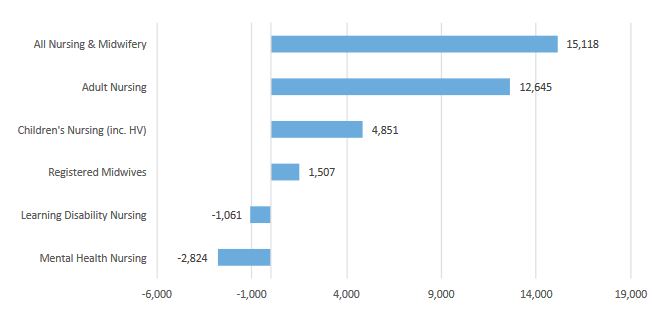
Growth/reduction in NHS employed nurses and midwives by field, 2012 to 2017 (extracted from Facing the Facts, Shaping the Future)

Obvious at a glance from this figure is the decline in both mental health and learning disability nursing numbers over time. Elsewhere HEE also describes a 14% mental health nursing vacancy rate.

Now, the Nursing Times reports a reduction for the second year in a row (£) in the numbers of applications for nursing degrees received via the Universities and Colleges Admissions Service (UCAS). Declining applications need to be viewed in the context of the removal of bursaries for students of nursing enrolling at English universities. In MHNAUK we have said, more than once, that we fear the loss of bursary support poses a particular threat to our field of practice. The same applies to learning disability nursing, where at least one degree programme closed last year (£).

Evidence like this is why initiatives like #MHnursingFuture (see also here, for the Twitter account) are important. Initiated by Dave Munday from Unite the Union, this is all about celebrating the work of mental health nurses and encouraging others to join us. As an occupational group we haven’t always been good at describing what we do, and why what we do is valuable (£). This needs to change, now more than ever.

With all this in mind this may be a good time to remind people of this useful page, hosted on the MHNAUK website, on joining the profession. As this says:

Forget all the stereotypes about straitjackets and Victorian asylums; modern mental health nursing focuses on helping and supporting people from all walks of life with a variety of ‘common’ mental health disorders (such as anxiety and depression) as well as more serious disorders such as drug and alcohol problems, suicidal feelings, psychosis, bipolar disorder and dementia. They also play a key role in promoting mental health and well-being among the public and preventing mental health problems occurring in the first place.

This helpful MHNAUK resource also includes suggestions for further reading, included in which are texts describing in detail many of the skills that mental health nurses routinely use and the context in which they go about their work. And, for any reader contemplating applying to any of the 60+ mental health nursing degree courses offered throughout the UK, do give some thought to our undergraduate nursing programmes here in the School of Healthcare Sciences at Cardiff University.

Why I’m on strike

2018-02-22 13.06.38
Paul Brown, me, Graeme Paul-Taylor: thanks to Kerry Hood for the photo.

I have a fantastic job, which I enjoy very much. But today I haven’t been doing it. I came into it in 1997, leaving a post as a community mental health nurse in East London to relocate to South Wales as a Lecturer in Community Nursing at what was then the University of Wales College of Medicine (UWCM). As a family we made this move even though my initial contract was fixed for a two year term. It was renewed for a further two years, and only then did I become a permanent member of staff. As part of making my transition from the NHS into higher education I transferred my health service pension into the Universities Superannuation Scheme (USS).

I was recruited into UWCM with the chief responsibility of leading a full-time, post-registration, course preparing nurses to work in community mental health settings. I led that programme for 14 years, and over that time taught many hundreds of registered nurses and helped them on their way towards specialist, regulatory body-approved, qualifications. I have continued to contribute to, and to lead, modules involving many other groups of health care professional students, all the way from pre-registration undergraduate through to post-registration postgraduate. I have supervised and assessed umpteen student dissertations, and have supervised and examined many postgraduate researchers. I very much value my work with students, and think that I’m reasonably good at it.

Then there are the other bits of my job, which nowadays occupy as much, or more, of my time as teaching and teaching-related activities. Over the years I have become a researcher, working with excellent colleagues here and elsewhere on projects examining features of the mental health system. I help with the running of the School of Healthcare Sciences as a manager and mentor of valued colleagues, and contribute to the work of a large number of committees and groups. I do work external to Cardiff University, including with Mental Health Nurse Academics UK, at other higher education institutions as an external examiner, and for journals and funding bodies as a reviewer of manuscripts and grants.

Like all the academics I know I work long hours, and accept that my job comes with high expectations. These include securing research income and publishing excellent research papers. For me, 10 to 12 hour working days are exceptionally usual, with far fewer (but certainly not non-existent) hours spent working at weekends. It is easy to become absorbed in what I do. I respond quickly to requests for help and feedback from students and colleagues, and if I’m chipping away at a grant application or a paper for publication can soon become engrossed in the task at hand. Oddly, whilst the hours are long it doesn’t always feel that way, and I appreciate the benefits of being able to work away from the office and to have control over my diary. All in all, I do my best across the full range of activities associated with being an academic. And, as I wrote at the outset of this post I enjoy what I do, and enjoy doing it in Cardiff.

Having committed myself to university life for over two decades I conclude that it suits me well, and find it hard to imagine doing anything else until I retire. Which brings me to today. I’m far from being the most active of Union members, and from time-to-time have had my gripes about the University and College Union (UCU). But today I downed tools to join colleagues up and down the country on strike, as a protest against threats to dismantle our pensions. At the heart of the dispute is a highly contested valuation of the USS fund, and a proposal to move from a defined benefits to a defined contribution scheme. This means a potential loss in retirement of up to £10,000 per year for USS members. Here’s a useful leaflet explaining this in a little more detail:

And for those wanting more on the technical front, there’s this blogpost which I personally found very informative.

Academics are paid modestly considering the qualifications and transferable skills they have, and as I have demonstrated here put the hours in to get the job done. Many, as I did, put up with time-limited contracts in the earlier parts of their careers. We care about our students and our research. We take additional satisfaction when our work makes a contribution to society. In my field this is through the preparation of future health care professionals, and via generating an evidence base for the improvement of practice and services. In return, having a decent pension – of the kind I and others signed up for when we first came into the university sector – does not seem like much of an ask.

I also remain acutely aware of how much more precarious the position is of younger academics. If proposed pension changes go through, people in the future will enter university employment with only defined contribution USS pension arrangements as preparation for their eventual retirements. First saddled with student debt, these are talented individuals who will be employed in their early working years on fixed-term contracts, ahead of settling into careers characterised by working weeks of 60 hours or more for salaries falling far short of a king’s ransom. A working life over, they (and not their employers) will have carried all the risk to secure pensions the value of which will reflect, quite terrifyingly, the fluctuations of the stock market. It isn’t right.

#MHNR2017 recap

Cardiff welcomed delegates to the 23rd International Mental Health Nursing Research Conference (#MHNR2017), which took place at City Hall on September 14th and 15th 2017. This was the conference’s first visit to Wales, with the theme for the year being Imagination, Invention and Inquiry. Papers were welcomed emphasising the need for new ideas, new research and new ways of providing services. As a curtain-raiser, with the involvement of André Tomlin (aka The Mental Elf), keynote speakers took part in a pre-conference streamed webinar which can still be viewed here.

#MHNR2017 (which, as readers of this blog will know, was until last year known as the Network for Psychiatric Nursing Research Conference), was again organised jointly by Mental Health Nurse Academics UK (MHNAUK) and the Royal College of Nursing. It remains the UK’s leading annual event of its kind. I was pleased to serve as chair of the conference steering committee for this year, and got to open proceedings with a short welcome address.

Across the two days keynote speakers (all of whom were live streamed: see below) were Professor Joy Duxbury, who drew on her programme of research into reducing restrictive practices; Dr Phil Cooper, Danny Sculthorpe and Jimmy Gittins who gave inspirational talks drawing on the personal experience of mental distress and their work with State of Mind; Dr Jay Watts, who challenged delegates to embrace the idea of trauma-informed care; Dr Michael Coffey, who spoke as one of two inaugural MHNAUK Lecturers about the problem of assessing risk; Professor Paul French, also an inaugural MHNAUK Lecturer, who talked about his programme of research into psychosis; and Professor Gary O’Reilly who introduced his research into the use of computer games as a vehicle for the provision of psychological therapies for young people with mental health difficulties.

Here are the saved live streams from our excellent keynotes for those who are interested. Eventually we’re hoping to upload higher quality recordings to our conference YouTube account:

#MHNR2017 also provided an opportunity for Cardiff academics to showcase their research and engagement activities. Dr Nicola Evans talked of her work with colleagues in Canada and Australia on benchmarking competencies for mental health nurses working in child and adolescent mental health services, and Alicia Stringfellow and Gemma Stacey-Emile talked of their work promoting mental health and wellbeing in Grangetown through the Community Gateway project. John Hyde presented his research into the boundaries between community mental health teams and crisis resolution and home treatment services. On behalf of the team led by Professor Jon Bisson I introduced the ongoing 3MDR for treatment resistant post-traumatic stress disorder study. I also presented a new (and in-progress) analysis from COCAPP of the practice and processes of care coordination, and introduced a paper uniting theory, design and research methods for the study of complex mental health systems. 

Elsewhere I heard some outstanding presentations from colleagues elsewhere in the UK and around the world, and was particularly heartened to listen to and to meet student nurses. Thanks for coming, everyone. 

Planning for #MHNR2018 will begin shortly, with updates available via the conference twitter account which can be found here.


Educating nurses

The Nursing and Midwifery Council is consulting on its programme of change for education. Information can be found here, and there’s a lot of it. Mental Health Nurse Academics UK (MHNAUK) will be submitting a response, with Anne Felton from Nottingham University (who leads MHNAUK’s Education Standing Group) coordinating this work.

On July 11th, with mental health nurse academic colleagues in the School of Healthcare Sciences in Cardiff I spent part of our annual summer away day formulating a team response to the NMC’s proposals. Once we’re happy with the content we’ll be forwarding it to Anne, and simultaneously submitting directly to the NMC.

Individually and collectively, other mental health nurses will be formulating responses too. For now, the NMC confirms that the four nursing fields (mental health, adult, child and learning disability) will remain. For an explanation of the importance of preserving mental health nursing as a pre-registration speciality, follow this link for MHNAUK’s relevant position paper. But, as MHNAUK Chair Steven Pryjmachuk pointed out last month in this piece (£) for the Nursing Times, the list of nursing procedures contained in the NMC’s draft standards of proficiency is heavily skewed towards the adult field. This is the Cardiff University mental health team’s concern too, and we’ll be saying so (with specific examples) in our response. Another place for this (and any other) view to be given is at this forthcoming WeMHNurses chat:

Meanwhile, last week ended with two days of professional doctorate teaching. With Nicola Evans I lead a module which addresses working in, and examining, complex systems of health and social care. We’ve run this module before, and as always the student group was a lively and engaged one. Amongst the things we discussed together are the connections running within and between systems of different scale, and the sometimes unforeseen consequences of introducing change. These are matters about which both Nic and I have written (see here, here, here and here). 

To link the two parts of this post together: the NMC is a big player, and for better or worse its programme of education reform will trigger significant disruption. A systems thinking perspective encourages us to consider the possible impact of the NMC’s proposals alongside other sources of change. These include the introduction of fees for student nurses in England, the arrival of nursing associates and reductions in the size of the UK’s registered nurse workforce. As cumulative shifts take place I’m hoping mental health nursing as a distinct profession emerges intact, with its current and future practitioners able to fulfil their places in a system which continues to very much need them. 

Reflections on #AfterWhitchurch

Further to my last post looking ahead to #AfterWhitchurch, here now are my reflections on the event as it happened as also recorded on the Cardiff University mental health blog. I’ve selected some photos, too.

The closure of Whitchurch Hospital to inpatients in spring 2016 provided the backdrop for #AfterWhitchurch, a collaborative Economic and Social Research Council (ESRC)/Cardiff University Festival of Social Science event focusing on the changing system of mental health care hosted at Cardiff’s Chapter Arts on November 10th 2016.

2016-11-10-17-42-30

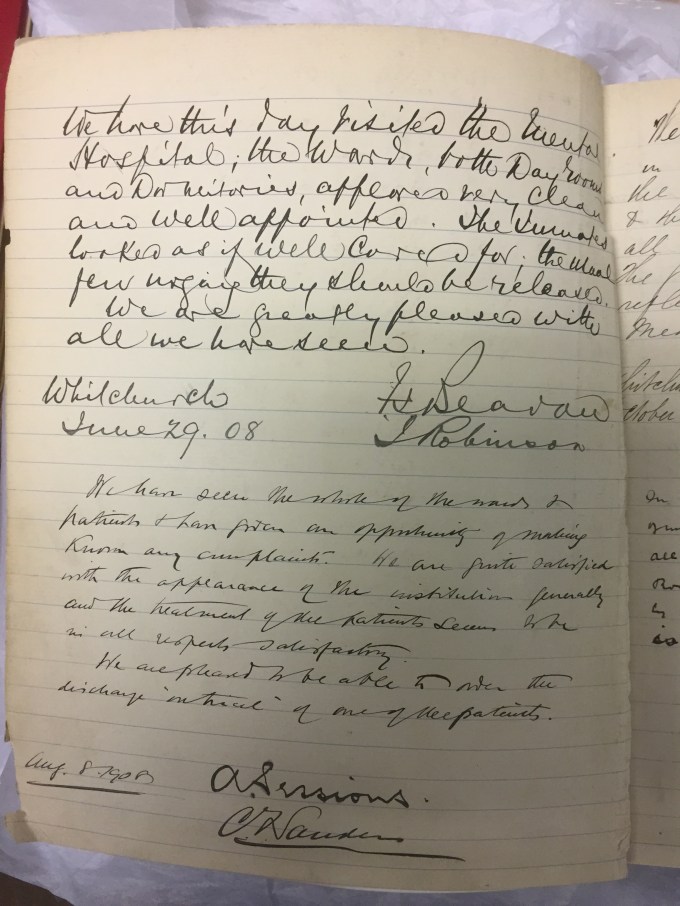
Whitchurch Hospital opened as the Cardiff City Mental Hospital in 1908, the image below being the first entry on the first page of the hospital’s visitors book.

2016-11-10-21-40-00

Members of the hospital’s Historical Society were on hand with objects, documents and photographs from their archive. Artist and director Elaine Paton presented and talked about her work with Moment(o)s of Leaving, a multimedia performance produced to mark the occasion of the hospital’s closure. Audiorecorded interviews, created for Momento(s) of Leaving by artist/curator and researcher Julia Thomas, recounted staff members’ reflections on leaving Whitchurch and their thoughts for the future.

Chaired by Norman Young from Cardiff and Vale University Health Board, School of Healthcare Sciences and service user researchers discussed how mental health care has shifted from hospital to the community, and shared reflections from research into the organisation of services, the work and experiences of service users and staff and the provision and evaluation of novel psychological interventions.

2016-11-10-21-47-35

Ben Hannigan talked about using in-depth case methods to understand mental health services at different levels of organisation, and Nicola Evans discussed her research into the mental health of children and young people. Dean Whybrow drew on 18 years of experience in the Royal Navy to describe how mental health support and interventions is provided in the military. Alan Meudell shared his reflections on being a service user researcher, and Bethan Edwards spoke of her dual identity as an occupational therapy researcher investigating care for older people with dementia and as a service user researcher. Stimulating and informed questions from the floor challenged the panel to think about stigma, the impact of research on changing practice and services offering respite and asylum.

Programme for #AfterWhitchurch

Tomorrow evening at Chapter Arts I’ll be joining friends for #AfterWhitchurch, an Economic and Social Research Council/Cardiff University Festival of Social Science event on the changing system of mental health care. Here is our programme, for those interested:

And here is a link to Elaine Paton’s Moment(o)s of Leaving video, which Elaine herself will be introducing:

As I type this post we have a handful of (free) tickets which have just become available, returned by people no longer able to be there. Follow this link to book in: and look forward to seeing people there.

#AfterWhitchurch

On the evening of Thursday November 10th at Chapter in Cardiff, as part of Cardiff University‘s contribution to this year’s ESRC Festival of Social Science, I’ll be joining friends from the School of Healthcare Sciences, the Whitchurch Hospital Historical Society, the service user community, the National Centre for Mental Health and the world of community arts for an evening reflecting on the changing mental health system. The event is free to members of the public, and further details (and a link for ordering tickets) can be found on our #AfterWhitchurch page.

For a snippet, here’s what we’re planning:

Whitchurch Hospital opened as the Cardiff City Mental Hospital in 1908. The transfer of its last inpatients to new purpose-built facilities in April 2016 provides a backdrop for an event reflecting on the changing shape of mental health care. In conjunction with the Whitchurch Hospital Historical Society and the National Centre for Mental Health, we will invite our public audience to review care as it used to be and care as it is now. We will draw on current Cardiff University mental health services research and use a range of historical and artistic media to maximise participation and provide variety.

Spread the word!

Understanding mental health systems and services — Mental Health / Iechyd Meddwl

Here’s a link to my first post for a new Cardiff University Mental Health Blog. The content will be broadly familar to people who have dipped into my personal blog in the past, insofar as I have chosen to say something general about doing mental health services research.

Working in collaboration with colleagues across the UK, including with people who have directly used services, researchers in the School of Healthcare Sciences at Cardiff University study mental health systems.

via Understanding mental health systems and services — Mental Health / Iechyd Meddwl

Clicking the hyperlink above, which appears beneath the brief snippet of text, will take you to the full piece. There are already some interesting other posts on the site, too, including a piece by Mike Owen written as an opener.