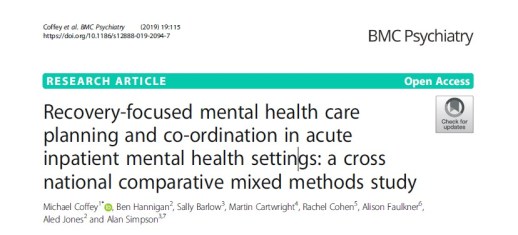
 COCAPP-A, funded by the NIHR Health Services and Delivery Research Programme, investigated care planning and coordination in inpatient mental health services. It was led by Alan Simpson, and I was mighty pleased to have been part of the research team. The full, 270 page, report appeared in 2017. Now, a derived paper reporting main findings has appeared in the journal BMC Psychiatry. Lead authored by Michael Coffey this article amounts to a more modest 18 pages, which means it stands a chance of actually being read by people able to make use of it.
As a gold open access article the paper is free to download to anyone with an internet connection. As a taster, here’s the abstract:
Follow @benhanniganBackground: Involving mental health service users in planning and reviewing their care can help personalised care focused on recovery, with the aim of developing goals specific to the individual and designed to maximise achievements and social integration. We aimed to ascertain the views of service users, carers and staff in acute inpatient wards on factors that facilitated or acted as barriers to collaborative, recovery-focused care.
Methods: A cross-national comparative mixed-methods study involving 19 mental health wards in six service provider sites in England and Wales. This included a survey using established standardised measures of service users (n = 301) and staff (n = 290) and embedded case studies involving interviews with staff, service users and carers (n = 76). Quantitative and qualitative data were analysed within and across sites using descriptive and inferential statistics, and framework method.
Results: For service users, when recovery-oriented focus was high, the quality of care was rated highly, as was the quality of therapeutic relationships. For staff, there was a moderate correlation between recovery orientation and quality of therapeutic relationships, with considerable variability. Staff members rated the quality of therapeutic relationships higher than service users did. Staff accounts of routine collaboration contrasted with a more mixed picture in service user accounts. Definitions and understandings of recovery varied, as did views of hospital care in promoting recovery. Managing risk was a central issue for staff, and service users were aware of measures taken to keep them safe, although their involvement in discussions was less apparent.
Conclusions: There is positive practice within acute inpatient wards, with evidence of commitment to safe, respectful, compassionate care. Recovery ideas were evident but there remained ambivalence on their relevance to inpatient care. Service users were aware of efforts taken to keep them safe, but despite measures described by staff, they did not feel routinely involved in care planning or risk management decisions. Research on increasing therapeutic contact time, shared decision making in risk assessment and using recovery focused tools could further promote personalised and recovery-focused care planning.
 With just under one month to go before the deadline for submission of abstracts for the 2019 running of the
  The call for abstracts for the
 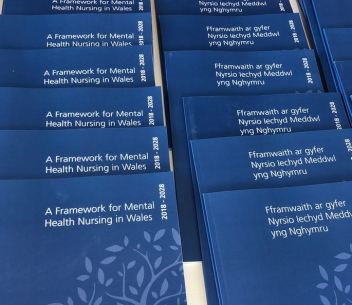 Meanwhile, on
  A big part of my work this year is this recently funded evidence synthesis in the area of
  Right now, having convened a first advisory group meeting, we’re busy searching and sifting for evidence mostly through reviewing citations identified in a series of comprehensive database searches. I’ll be posting more here as the study progresses, but for the detail a good place to go is
 Here are two digital mementos from my trip to Australia: a photograph of a humpback whale (which breached and swam under the boat I was on for a good 45 minutes), and – more pertinently, perhaps, given the usual subject matter of this blog – the slides I used in my keynote talk at
 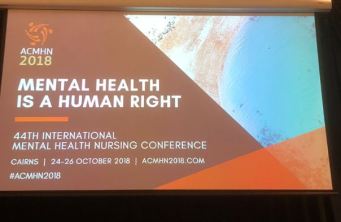 Big thanks to the Board of Directors of the
  Earlier this month I made the journey to the
  In July 2018, in the context of
  Ben Hannigan's blog