This week I received an invitation from a colleague at Cardiff Metropolitan University to spend an hour or so sharing my experiences of integrating my use of the ORCA institutional repository with this blog and my Twitter account in the service of promoting research and scholarship. This has given me the impetus to create this set of slides, embedded here:
Activity based funding and student research in the NHS
Yesterday I spent time with a group of MSc students, talking about research review processes. I’ve written on this blog in the past about my experiences of seeking approvals for my PhD, and in Monday’s session I urged people to be exceptionally cautious about planning NHS-related research in pursuit of their Master’s degrees.
 Preparing for and securing NHS research ethics committee and R&D office approvals takes time. In this part of the world at least, some healthcare organisations are also likely to ask researchers to cover the costs to the NHS of supporting studies which are not portfolio adopted. Here I’m thinking of, for example, the costs arising when staff leave the workplace to participate in interviews or join focus groups, or suchlike.
The relatively new practice of directly seeking payment from research teams for the costs of studies which are not eligible for portfolio registration has appeared with the shift to activity-based funding. Here in Wales, the National Institute for Social Care and Health Research (NISCHR) has published criteria for entry to its portfolio, which are summarised here and are elaborated on here. It is from this second document that I have snipped the following:
A research study is a structured activity which is intended to provide new knowledge which is generalisable (ie of value to others in a similar situation) and intended for wider dissemination.
Studies eligible for the NISCHR portfolio should involve face to face contact with NHS patients, social care service users or people involved with their care. Studies must be led from and/or recruiting participants from Wales. All studies must already have research funding before they can be included in the Portfolio. Research Costs cannot be provided by NISCHR CRC.
The following types of study are not eligible for inclusion in the NISCHR Portfolio:
- audit,
- needs assessments,
- quality improvement projects,
- directly commissioned studies,
- secondary research such as systematic reviews,
- purely laboratory based studies,
- routine biobanking of samples would not be eligible but a hypothesis based sample collection would be if appropriately peer reviewed and funded,
- own account funded studies,
- studies closed to recruitment.
MSc projects invariably do not meet these criteria, meaning that numbers of taught postgraduate students get to cut their dissertation teeth on non-NHS research studies or (where academic regulations allow) on other types of project altogether. Examples are service or quality improvements, service evaluations and systematic reviews. And, in my view, these are sufficiently testing options for students working at MSc level, with some (like local quality improvements) having the added advantage of immediately and obviously benefiting the NHS and those who use its services.
However, a problem arises in the case of postgraduate research degrees. In some disciplines, including nursing, these are often undertaken part-time and are carried out with limited or no external grant income. Opportunities for studentships are relatively rare, and where they are available may be financially unattractive to practitioners who have already built careers in the health service. As with MSc projects, ‘own account’ doctorates will struggle to get onto the portfolio. They therefore run the risk (in some circumstances) of not being supported by organisations within the NHS unless their associated costs are explicitly met. One way of achieving this may be for local NHS managers to agree to carry the costs of non-portfolio studies which it is planned will take place within their services. But securing this kind of support is not straightforward, and for would-be research students the added challenge of finding a means of paying costs is hardly an encouragement. And, where MSc students can usually opt for non-research projects this is not so for those aiming for PhDs or Professional Doctorates. These are awards made only to those who generate new knowledge using sound and defensible research methods.
So what does all this mean? It’s early days, but one likely outcome may be a reduction in small-scale research projects within the NHS, along with an increase in the preparations and negotiations which precede data generation. Another may be the proliferation of non-portfolio projects which are explicitly designed to meet ‘research’ criteria for academic award purposes, but which are constructed to be something else (typically ‘service evaluation’) within the context of NHS research governance. A reasonable, longer-term, concern is that research capacity-building in fields like nursing may falter as potential students rethink their plans. And that, in my view, would be a big step backwards.
‘Psychiatric Ideologies and Institutions’: 50 years and counting
 Happy new year. In the midst of a series of holiday period email exchanges Michael Coffey happened to mention that 2014 marks the 50th anniversary of the publication of Anselm Strauss and colleagues’ Psychiatric Ideologies and Institutions.
This is a fine book indeed, which during my time as a PhD student concerned with work and roles in mental health care was an absolute essential. In it, Strauss and his collaborators reported findings from prolonged and intensive fieldwork conducted in two North American psychiatric hospitals. Whilst today’s qualitative research reports will typically include lashings of direct data extracts, Psychiatric Ideologies and Institutions has little in the way of what Strauss et al referred to as ‘illustration and quotation’. Yet I never once recall, as a reader, doubting that Strauss and his team were truly there, participating in and recording everyday hospital life and its organisation.
It is at this descriptive level that the book initially works: as a meticulous account of the interplay between ideas, professions and practices in an area of health care which (both then, and to this day) happens to be particularly contested. One part of the dataset drawn on in the book comes from a questionnaire, designed to capture information about affiliations to particular treatment ideologies. From this nurses emerge as being ‘ideologically uncommitted’. In a later, detailed, section Strauss et al wrote of the problems faced by nurses in reconciling their managerial, administrative and therapeutic tasks and in answering the still-pertinent question:
…at the heart of her professional identity: What does therapeutic action toward patients actually involve for a psychiatric nurse?
My copy of Psychiatric Ideologies and Institutions is the edition published in 1981, for which a new introduction was added. In this, Strauss and his collaborators wrote of their original ambition to produce a book which was not only descriptive, no matter how detailed or accurate, but which was also theorised. It was the fieldwork and the findings reported most completely in this monograph that gave rise to the idea of the negotiated order. This is a sociological theory of importance which, in the decades following its introduction, went on to develop a life of its own. As Strauss et al wrote in their 1981 introduction, their original observation that theory might emerge from data represented a considerable methodological departure, more fully articulated at a later point with the introduction of grounded theory. Here, then, is a second way in which Psychiatric Ideologies and Institutions works, and remains of interest to people unconcerned with research into the world of mental health care: as an exemplar of how data and theory can dance together.
Today I’ve turned up this review of the book, which appeared in 1965 in the journal now called Psychiatric Services. In it the reviewer sums up with the recommendation that:
All in all, most professionals will find this book profitable to read, study and think about.
I concur, and commend this classic text to professionals and others alike. And as an aside, perhaps this short celebratory post can help persuade students (usually undergraduates, in my experience) that books and articles which happen to be more than five years old can still be worth reading.
Education for community mental health work
This week brought a COCAPP meet-up in Bristol, where we had the chance to plan our work for the immediate period ahead. The RiSC team also met, albeit in teleconference rather than face-to-face fashion. I’ve had pre-registration student nurses’ assignment work to begin marking, and this afternoon will be taking part in a joint Cardiff University/Local Health Board discussion on the future provision of post-qualification modules for community mental health practitioners.
 This afternoon’s meeting has given me pause for thought, and a chance to reflect a little on my long involvement in post-registration mental health education. It was explicitly to lead a full-time, one-year, programme for actual or intending community mental health nurses (CMHNs) that I was recruited into what was then the University of Wales College of Medicine in 1997. Education, and my role, have changed considerably in the period following. In Wales there is no longer a fully funded, full-time, course of this type. Like pretty much everywhere else, here education for health care workers beyond registration has increasingly become part-time, and modularised.
I once wrote about the CMHN course we ran in Cardiff in the journal Nurse Education Today. The article was titled ‘Specialist practice in community mental health nursing‘, and had an abstract which went like this:
Community mental health nurses (CMHNs) work in an increasingly complex health and social care environment. Over recent years, the evolving direction of general health service and specific mental health policy has directed CMHNs towards: the provision of clinically-effective interventions; a closer attention to meeting the needs of people experiencing severe and long-term mental health problems; the simultaneous provision of services to meet the needs of people experiencing a wide range of mental health problems presenting in primary care settings; greater collaboration with workers representing other disciplines and agencies; and the development of active partnerships with mental health service users. This paper explores the context within which CMHNs practise, and within which education programmes preparing specialist practitioners in community mental health nursing have been developed. One recently-validated specialist practice course for CMHNs is described in detail, with the intention of stimulating discussion and debate surrounding the practice of, and the educational preparation for, community mental health nursing.
I can’t claim that this paper did actually trigger any particular debate, but at least I tried.
 I also had the chance, during the time that I ran Cardiff’s full-time CMHN course, to survey the leaders of other programmes of this type offered elsewhere in the UK. A paper called, ‘Specialist practice for UK community mental health nurses: the 1998-99 survey of course leaders‘ appeared in the International Journal of Nursing Studies. This was co-written with Philip Burnard, Debs Edwards (who, I am delighted to say, is now project manager for the RiSC study already mentioned in this post) and Jackie Turnbull. In the paper’s abstract we said:
Surveys of the leaders of the UK’s post-qualifying education courses for community mental health nurses have taken place, on an annual basis, for over 10 years. In this paper, findings from the survey undertaken in the 1998–99 academic year are reported. These findings include: that most course leaders do not personally engage in clinical practice; that interprofessional education takes place at a minority of course centres, and that course philosophies and aims are characterised by an emphasis on both outcomes (in terms of, for example, skills acquisition, knowledge development and the ability to engage in reflective practice), and process (adult learning).
 And then there was a paper called, ‘Education for community mental health nurses: a summary of the key debates‘ which Steve Trenchard, Philip Burnard, Michael Coffey and I wrote for Nurse Education Today. Here we said:
A wide range of post-qualifying education courses exist for community mental health nurses (CMHNs) working in the UK. ‘Specialist practitioner’ courses emphasize shared learning between CMHNs and members of other community nursing branches. These programmes typically include course content drawing on the social and behavioural sciences, as well as on material more tailored to the clinical needs of practitioners. Such courses and their predecessors have been subject to criticism, however. Courses have been described as anachronistic, and failing to take account of recent advances in treatment modalities. In addition concerns about the generic focus of some programmes have also been raised. Educational alternatives, such as programmes preparing nurses and other mental health workers to provide ‘psycho-social interventions’ have, correspondingly, become increasingly popular. In this paper we explore some of the debates surrounding the education of CMHNs, and explore the context in which CMHNs work and in which educational programmes are devised. We consider the multidisciplinary environment in which CMHNs practise, the differing client groups with which CMHNs work, the developing policy framework in which mental health care is provided, demands for more user-responsive education, and the relationship between higher educational institutions and health care providers. We conclude the paper with a series of questions for CMHN educators and education commissioners.
And there are other papers and book chapters, too, which I won’t refer to now. But I am reminded that I once spent large parts of my working life running programmes for community mental health workers, and managed to research and write a fair bit about the same. Perhaps today’s meeting will lead to a modest rekindling.
More on mental health services at a time of austerity
For the second time in two months the BBC and Community Care have collaborated to establish the extent of funding cuts to mental health services in England. Freedom of Information requests were sent to 51 NHS trusts, of whom 43 responded. Summaries of this investigation, and headline findings, can be found on the BBC website here and on the Community Care website here. Community Care says:
Data returned by over two-thirds of the mental health trusts, obtained in two separate Freedom of Information requests, showed that:
- Overall trust budgets for 2013/14 had shrunk by 2.3% in real terms from 2011/12. Ten out of 13 trusts that provided forecast budgets for 2014/15 are projecting further cuts next year.
- Budgets for ‘crisis resolution teams’ fell 1.7% in real terms compared to 2011/12 while the average monthly referrals to these teams rose 16%. The teams provide intensive home treatment in a bid to prevent acutely unwell people being hospitalised.
- Budgets for community mental health teams flatlined in real terms but referrals rose 13.3%. These services provide ongoing support in a bid to prevent people’s mental health deteriorating to crisis point.
Community Care also lists 10 ways this underfunding is damaging care.
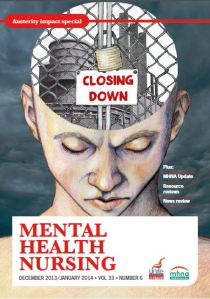 This is also the month that a special, free-to-download, ‘impact of austerity’ edition of Mental Health Nursing journal has appeared. In an email forwarded to all members of Mental Health Nurse Academics UK by Steve Hemingway (who is both an MHNA member and a member of the MHN editorial board), Dave Munday at Unite the Union (which publishes the journal) says:
This month the Mental Health Nursing journal is focused on austerity and mental health. I hope you’ll agree with me that this is a vitally important topic that not only every mental health nurse should know about, but every citizen. We hope that the journal will help to trigger some thoughts and debates that you can have locally in your workplaces but also outside of work. To this end we’re making the journal free to access even if you’re not a MHNA member or MHN subscriber.
Research priorities for mental health nursing
Last week’s arrival in my email inbox of the notes taken at Mental Health Nurse Academics UK‘s most recent meeting, held on October 8th at Teesside University, reminds me that MHNAUK is still conducting a research priorities exercise. These minutes, taken by Joy Duxbury and circulated by Michael Coffey, note that Len Bowers led our discussions on the day and has offered to collate responses:
The group discussed the scope of future research for the profession of mental health nursing. The idea is to develop research priorities to influence what research gets funded and funders will be interested to hear about this. The priority setting exercise included discussions on the following:
- The role of the mental health nurse – What works and what doesn’t? What we are good at and what we aren’t so good at.
- The role of theory as well as empirical research – how does this influence funders and how research might still be theory driven?
- What do mental health nurses contribute that aids recovery?
- Transitions
- Care co-ordination
- Does it have to be unique to mental health nursing? Maybe not
- Underpinning values
- Public Health
As there seemed to be problems with consensus e.g. defining what counts as mental health nursing research as opposed to mental health research of relevance to nursing it was felt that we need first to feedback top ten priorities for research to Len before Christmas. He will then collate to discuss at a future meeting. It might also help if we report what research we are currently doing too.
Meanwhile, over on MHNAUK’s blog there’s this post from Alan Simpson to kick-start this exercise off, and room for people to add their thoughts beneath via the comments function. In his ‘starter for 26’ Alan writes:
Inspired by last week’s MHNAUK meeting, today staff at our mental health research team meeting were asked to identify their research priorities for mental health nursing research. The meeting consists of various academic research staff and clinical academics discussing on-going and forthcoming research studies and various research-related issues. Today, I simply asked each person to write a short list of priorities, which we then shared and discussed. Here’s our Top 30 in no particular order with repeats removed. Most frequent repeat was physical healthcare. Second was recovery. Third – racism and culture. What’s your Top 10?
- Generic vs Specialist MHN training
- Measures of Compassion
- Effects of selection procedures for MHN students and staff
- Nursing and PTSD
- Tool development
- Risk assessment and MHN
- The 6 Cs and MHN
- Mental capacity and issues of consent
- Racism and stigma in MHN
- Values and beliefs and how they impact on practice
- Mental health and the performing arts
- MHN training and learning disabilities
- MHN views on developments that may threaten MHN, e.g. peer support, self-care
- Physical healthcare in secondary mental health care settings
- Philosophy and MHN: The Art of Living
- Identity and body image in people with MI
- Community and third sector organisations and how they link with mental health teams/services
- Communication, especially information giving and the first contact
- Culture and ‘cultural safety’ as a useful model
- Fear – underpinning MHN and service user behaviours
- Brokerage roles, self-care and MHN
- Workforce planning and nurse education/training and physical/mental health divide
- Evaluation of education/training and preparation of MHNs for the job
- Recovery and MHN interventions
- MHN interventions to maximise engagement
- Liaison mental health care
We’re looking to conduct an informal exercise of this type amongst Cardiff University’s mental health nurse academics, with a view to forwarding our collective ideas to Michael Coffey for wider incorporation. Ahead of this, here are some initial suggestions of my own, which I’ll also add to the MHNAUK blog:
- What do mental health nurses do?
- What do/can mental health nurses do which promotes recovery and individually tailored care?
- What do/can mental health nurses do to better promote physical health and well-being in people with severe and enduring mental health difficulties?
- What do/can nurses do to help people in their journeys into, through and out of the mental health system?
- What are mental health nursing values, and what difference do/can they make?
- How are/should students of mental health nursing be prepared for practice?
- How can nurses use new technologies to improve care and its organisation?
- What are the intended and unintended consequences of organisational and therapeutic innovation on the experiences of people both using, and providing, mental health services?
These are all ideas occurring this evening, though it’s also true to say most reflect lines of inquiry I’m fortunate enough to already be associated with. More to follow, perhaps.
Mental health R&D 2013
Yesterday I made it to the SWALEC Stadium for the annual Cardiff and Vale UHB Mental Health R&D meeting. I was pleased to again be invited, and appreciated the opportunity to talk about mental health research activity across the new School of Healthcare Sciences.
I was also reminded of the work of the National Centre for Mental Health (NCMH). Funded as Wales’ only Biomedical Research Centre by the National Institute for Social Care and Health Research (NISCHR), and led by Professor Nick Craddock, the NCMH supports mental health research, undertakes mental health research and communicates and engages. Newly housed in Cardiff University’s Hadyn Ellis Building, members of the NCMH do all three elements extremely well. The Centre’s website has recently been revamped, and is well worth a visit. Here, too, is an NCMH call for volunteers video:
Catching up post
Plenty going on in the last week or so. I had the chance to join pre-registration mental health nurses and occupational therapists for a second day as they made preparations for an interprofessional event scheduled for early December. Some of these students have also been giving me drafts of assessed work to comment on, but as the deadline for receipt of these is first thing next week I expect a deluge then. ’twas ever thus.
Elsewhere there has been RiSC reviewing to crack on with, assignment marking, and peer review reports to both consider and write. I’ve also put myself in the frame to act as a reviewer for another university’s proposed new MSc mental health programme, this being the kind of curriculum work I haven’t had the chance to do for a while.
I’m not normally one for formal, suit-and-boot, events, but made an exception last Wednesday (November 27th) to join a posse of colleagues from the School of Healthcare Sciences at the RCN Wales Nurse of the Year awards. These took place at Cardiff City Hall, and the overall winner was Cardiff and Vale UHB ward sister Ruth Owens. Congratulations, Ruth. Congratulations, too, to the individual category winners: including Andy Lodwick (also from Cardiff and Vale) for picking up the Mental Health and Learning Disabilities award and Dr Carolyn Middleton, doctoral graduate from what was the Cardiff School of Nursing and Midwifery Studies, for winning the Research in Nursing award.
This week also brought me to a meeting of the MHRNC Service User and Carer Partnership Research Development Group and, yesterday morning, to the Cardiff City Stadium for an open meeting to discuss NISCHR’s infrastructure and programme funding review. Both were lively events, and on the NISCHR front I see big changes ahead from 2015.
And to close this summary post: via the twitter grapevine I see that the RCN is now giving early notification of the Network for Psychiatric Nursing Research 2014 conference. This will take place at Warwick University on the 18th and 19th of September. I’ll post a link to the call for abstracts once this appears, but for now will reproduce this extract from the event website:
This year [2014] is the 20th international NPNR conference and it’s going to be a celebration.
We wish to celebrate and promote some of the outstanding mental health nursing research that shapes mental health policy and nursing practice across the world. We will also acknowledge some of the best psychiatric and mental health nursing research that helped create the strong foundation for our work today. And we will invite delegates to look ahead to map out the future for mental health nursing research, education and practice.
One year retrospective
The appearance of a new icon in my WordPress dashboard reminds me that this site has now been registered for a year. My first post was uploaded on 24 November 2012. The title of this piece, revealing a shocking lack of inspiration on my part, was Some opening thoughts (1). In this I wrote about policy and service challenges in health and social care.
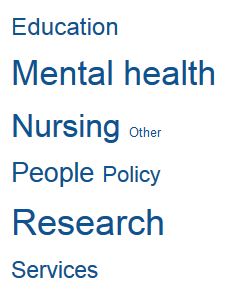
In my first full 12 months of blogging I published 127 posts. I categorised each with one or more of the words appearing beneath the site’s title, and now reproduce here. The size of each word reflects the number of times the category has been used. ‘Research’ is my most-applied category, closely followed by ‘Mental health’. So no surprises there.
Looking at my viewer statistics I see that the Enduring posts page has been popular. This is pleasing, as I deliberately set this up as a way of keeping together my more substantial, often research-related, pieces. Individual posts attracting most views have included those relating to this year’s NPNR conference, nursing and the approved mental health professional (AMHP) role, and the research excellence framework.
The WordPress software I am using also allows me to track clicks, which are the links to other sites I have embedded in posts and pages that readers choose to follow. I see that, over the year, the onwards site which has been visited the most is the Cardiff University digital repository (ORCA). Again, this is pleasing, as this tells me that some people have been sufficiently interested to visit the place from where green open access versions of papers I have provided links to can be obtained. Most popular amongst downloaded articles has been Michael Coffey‘s and my paper on the mental health system’s wicked problems, which was also the first document I made available in this way. Next up are Michael’s and my paper on AMHPs and Davina Allen‘s and my paper on complex caring trajectories in community mental health.
Doughnut meetings
 My esteemed colleague Professor Jane Hopkinson facilitates a Wednesday lunchtime research drop-in, to which people in the School of Healthcare Sciences at Cardiff University are invited. Affectionately known as doughnut meetings (see photo of today’s goodies attached), these provide a loosely-structured, supportive, space for the sharing of ideas and experiences. The gatherings are really very good: informal, but always informed. I make a point of getting along when I can.
Typically those who meet up get to propose themes for future meetings. This afternoon’s topic was ‘research and evaluation’, and more particularly the distinctions between the two. People involved in health services research (or indeed, health services evaluation) will know how important this differentiation is for NHS governance and approval purposes. Projects classified as ‘research’ require independent NHS research ethics committee (REC) approval. Projects classified as ‘evaluation’ do not. The NHS Health Research Authority provides guidance to help people work out what type of project it is that they are proposing, but in my experience making these determinations remains a wholly inexact science.
I have also learned that a project can be ‘evaluation’ in one context (e.g., for NHS research governance and ethics review) and ‘research’ in another (e.g., for academic progression and award purposes). My own PhD was designed, part-funded through open competition, completed and examined as ‘research’: what else could it possibly have been, as a research degree? But it was also categorised as something else when I offered it up for NHS REC approval, as I’ve written about here and (at length) in this paper.
So there we have it. Potentially all rather confusing, and certainly enough to make me want to eat a doughnut.
 Ben Hannigan's blog