Category: Services

Mental health services at a time of austerity

Last week I drafted a short, commentary-type, paper for a special edition of Mental Health Nursing which will be focusing on practice and services during a time of austerity. Some years ago I was on the editorial board of MHN. I’m pleased to learn that having disappeared from the library shelves in favour of becoming an online journal (available only to members of Unite the Union) it has made a return in traditional paper form. I’ve been sent a stack of copies, which I’ll be distributing to students.

Anyway: no sooner had I completed my draft and sent it onwards than yesterday’s big health and social care story broke. Under the banner England’s mental health services ‘in crisis’ the BBC ran a report drawing on a joint investigation conducted with Community Care magazine. The headlines were sobering, suggesting over 1,500 mental health hospital beds being lost since April 2011. These bald figures were illustrated with personal stories, revealing people needing crisis admission being transferred to wherever beds could be found around the country, and wards running at over 100% occupancy.

This is very bad news, and suggests a shrinkage back to the way things last were in the early to mid 1990s. In writing my paper for MHN I fished out my copy of this article by David McDaid and Martin Knapp, in which the point is made that at times of economic hardship demand for mental health care increases. And yet, as we are finding, services are actually retracting as austerity bites.

World Mental Health Day 2013 [update]

Now that I have learned how to embed YouTube videos into this blog (it isn’t difficult, really) I can update this morning’s post by adding a clip of Welsh Government Minister for Health and Social Services Professor Mark Drakeford speaking, on the occasion of World Mental Health Day 2013, at the Senedd. My thanks to Hafal for using its twitter account to draw my (and everyone else’s) attention to this:

World Mental Health Day 2013

Today is World Mental Health Day. Here’s a snip from the WHO:

Every year on 10th of October, The World Health Organization joins in celebrating the World Mental Health Day. The day is celebrated at the initiative of the World Federation of Mental Health and WHO supports this initiative through raising awareness on mental health issues using its strong relationships with the Ministries of health and civil society organizations across the globe. WHO also develops technical and communication material and provides technical assistance to the countries for advocacy campaigns around the World Mental Health Day.

The theme of World Mental Health Day in 2013 is “Mental health and older adults”.

Here in Wales, the day is being marked by (amongst other things) the organisation Hafal bringing its latest campaign, Lights! Camera! ACTION!, to the Senedd in Cardiff. From Hafal’s website I see that this event will be attended by the Welsh Government Minister for Health and Social Services, Professor Mark Drakeford. I hope this all goes well, as I’m sure it will. Last month’s revelation that Asda, Tesco and Amazon were selling ‘mental patient fancy dress costumes’ reminds us (as if it were needed) of the progress still to be made to improve public understanding of mental health issues and to tackle stigma and discrimination.

For a general overview of mental health priorities and challenges around the world, here’s a five minute video produced by the World Health Organization:

MHNAUK meeting at Teesside University

This afternoon I’m off to Darlington (a place I’ve never visited before) ahead of tomorrow’s Mental Health Nurse Academics UK (MHNAUK) meeting. As a reminder, MHNAUK’s website can be found here, and its blog can be found here.
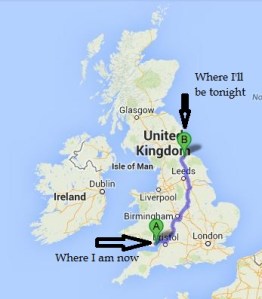
This is going to be a considerable train journey (check out the map below), so I’ll be bringing work to be getting on with and plenty of light refreshments. The other thing I’ll be doing en route is catching up with friends and colleagues, where in the course of a normal working week it can be difficult to find time to converse.

The meeting itself is being hosted by Gordon Mitchell from Teesside University, and is being chaired by Michael Coffey. Taken from the MHNAUK website here is the agenda:

9.15 – 10.00 Arrival and Refreshments

10.00 – 10.10 Welcome from the Chair and Introductions – Michael Coffey

10.10 – 10.20 Welcome to the School and Teesside University – Dean Prof Paul Keane OBE

10.20 – 10.50 Safewards and coercion – Professor Len Bowers

10.50 – 11.20 Department of Health commissioned report on physical interventions – Ian Hulatt, RCN Mental Health Nurse Advisor and Professor Joy Duxbury

11.20 – Discussion re MHNAUK statement on research and education in physical interventions

11.30-11.45 Comfort Break

Main Business

11.45-12.45 Research Priority Setting: a proposal – Professor Len Bowers

Lunch and Networking

13.15 – 13.45 Revisiting Cardiff Proposals – Michael Coffey

13.45 – 14.00 Mental Health Nurse recruitment and selection – Enkanah Soobadoo

14.00 -14.15 NPNR News – Michael Coffey

14.15 – 14.25 Feedback on Academy of Nursing, Midwifery and Health Visiting Research – Professor Alan Simpson

14.25 – 14.35 Mental Health Nurse Metrics – Sue McAndrew

14.35 – 14.45 MHNAUK statement on Dementia care, education and research – Grahame Smith

14.45 – 14.50 Doctoral student network: fringe event at NPNR – Julia Terry

14.50 AOB – Mental Health Nursing history archive – Michael Coffey and MHNAUK new journal discussions – Ben Hannigan

15.00 Close of Meeting

Seminar feast

My, what a treat awaits today: no less than two seminars and discussions in one afternoon. First up (and speaking as part of the School of Health Care Sciences’ 2013-14 seminar series) is Mary Dixon-Woods, who will be talking  on ‘Soft intelligence and hard data: how can we know if care is safe?’. In a later South Wales Mental Health Nursing Journal Club and Seminar group meeting, Gerwyn Jones will be speaking on ‘Mental health pre-registration nurses’ satisfaction with problem based learning’.

Seminars, ay? Like proverbial London buses these have a tendency to arrive in multiples. I’ll be dashing from room to room with scarcely time to pause for breath. Best make sure I put the right questions to the right speakers, lest Gerwyn finds himself facing a query about quality and safety and Mary finds herself fielding something on lecturer facilitation of PBL groups.

Divergence and difference in mental health policy

Yesterday’s main business was a there-and-back trip to the University of Nottingham to act as a PhD external examiner. Reading this (very interesting) thesis in advance, discussing with the candidate at viva and talking with supervisory and examiner colleagues over lunch has reminded me (again) how mental health policy and services in Wales and England are diverging.

As an example, there really is no equivalent to the Mental Health (Wales) Measure on the English side of the Severn Bridge. For those not in the know here, ‘measure’ in this context means ‘law’. The Welsh Government’s brief public summary of this piece of legislation says:

The Mental Health (Wales) Measure 2010 is a new law made by the Welsh Government which will help people with mental health problems in four different ways.
Local Primary Mental Health Support Services
The Measure will make sure that more services are available for your GP to refer you to if you have mental health problems such as anxiety or depression. These services, which may include for example counselling, stress and anxiety management, will either be at your GP practice or nearby so it will be easier to get to them.
You will also be told about other services which might help you, such as those provided by groups such as local voluntary groups or advice about money or housing.
Care Coordination and Care and Treatment Planning
Some people have mental health problems which require more specialised care and support, (sometimes provided in hospital). If you are receiving these services then your care and treatment will be overseen by a professional such as a psychiatrist, psychologist, nurse or social worker. These people will be called Care Coordinators and will write you a care and treatment plan – working with you as much as possible. This plan will set out the goals you are working towards and the services that will be provided by the NHS and the local authority and other agencies to help you reach them. This plan must be reviewed with you at least once a year.
Assessment of people who have used specialist mental health services before
If you have received specialised treatment in the past and were discharged because your condition improved, but now you feel that your mental health is becoming worse, then you can go straight back to the mental health service which was looking after you before and ask them to check whether you need any further help or treatment. You don’t need to go to your GP first, although you may wish to talk it through. You can ask for this up to three years after you are discharged from the specialist team.
Independent Mental Health Advocacy
If you are in hospital and you have mental health problems you can ask for help from an Independent Mental Health Advocate (IMHA). An IMHA is an expert in mental health who will help you to make your views known and take decisions in relation to your care and treatment (but will not take decisions on your behalf!)

COCAPP, as some readers of this blog will already know, is investigating care planning and care coordination in community mental health: so the Care Coordination and Care and Treatment Planning component of the Measure is a really important part of the study’s context. It will be interesting to see how far national-level legal and policy differences are ‘felt’ at the level of everyday practice.

There are other important differences in emphasis across the two countries, too. I hear anecdotally that to save money some of the work done by England’s assertive outreach and early intervention teams is being called back into comprehensive, locality-based, community mental health teams (CMHTs). Assertive outreach and early intervention teams, alongside crisis resolution and home treatment services, sprung up in England in the first decade of this century following the publication of the National Service Framework for Mental Health, the Policy Implementation Guide and the NHS Plan. Here the strategy document Adult Mental Health Services for Wales, which appeared in 2001, was strong in its commitment to CMHTs and as a result (I have always thought) we never had quite the range of differentiated services which England had. We have, of course, got crisis services in Wales, as I have previously written about here, here and here.

And it’s not only in the mental health field that policy and services are diverging. We have no clinical commissioning groups in Wales, for the obvious reason that the Health and Social Care Act 2012 applies to England only (for more on this, check out this post dating back to the time I heard Raymond Tallis speak at the Hay Festival).

Evidence syntheses and the RiSC study

I’ve been working on a document associated with the RiSC study today. RiSC is an evidence synthesis of ‘risk’ for young people moving into, through and out of inpatient mental health services. To guide our review we’re using a framework developed by members of the the EPPI-Centre, about which more can be found by clicking on the logo below:EPPI Centre

Distinct about the EPPI-Centre approach is the emphasis placed on engaging with representatives of groups and communities with interests in the area under review. In their Methods for Conducting Systematic Reviews document the EPPI-Centre people write:

Approaches to reviewing
Involving representatives of all those who might have a vested interest in a particular systematic review helps to ensure that it is a relevant and useful piece of research.
User involvement
Everyone has a vested interest in public policy issues such as health, education, work and welfare. Consequently everyone, whether they wish to be actively engaged or not, has a vested interest in what research is undertaken in these fields and how research findings are shared and put to use.
Reviews are driven by the questions that they are seeking to answer. Different users may have different views about why a particular topic is important and interpret the issues within different ideological and theoretical perspectives.
Involving a range of users in a review is important as it enables reviewers to recognise and consider different users’ implicit viewpoints and thus to make a considered decision about the question that the review is attempting to answer. The aim is to be transparent about why a review has the focus that it does, rather than assuming it is, or is attempting to be, everything to everyone.

In our review (as you’ll see if you download our protocol from the link given at the top of this post above) we’re combining a broad descriptive mapping of the territory with a more selective, in-depth, review guided by the priorities of stakeholder representatives. These are people with experience of using, working in or managing child and adolescent mental health services.

I like this approach to conducting evidence reviews, appreciating the commitment it demands to the agreement of topic areas and to being open in decision-making. All going well I’ll be continuing with some RiSC work tomorrow.

NPNR 2013 conference review

Health and health services are political. I therefore applaud those who selected the ‘personal and the political’ as the theme for this year’s Network for Psychiatric Nursing Research conference.

A word on the keynotes:

Kate Pickett‘s Thursday morning opener pressed home how disastrous inequalities are, for all of us. For those not there to hear Kate speak there’s plenty of compelling evidence available via The Equality Trust website, and indeed in The Spirit Level (which I now realise I must read).

Simon Duffy, in his keynote yesterday, challenged mental health nurses to act collectively and assertively to improve welfare. I believe he was correct in pointing out that public services are often experienced as fragmented, bureaucratic and impersonal. Check out the Centre for Welfare Reform website for more in this area.

Charles Walker, Conservative MP for Broxbourne, has spoken openly about his personal experiences of obsessive compulsive disorder and until recently was Chair of the All Party Parliamentary Group for Mental Health. His Thursday afternoon conversation with the NPNR audience was stylishly done, and whilst I can’t bring myself to vote for his party (not now, not ever) I do appreciate what he has done to challenge discrimination.

Len Bowers used his Thursday keynote to share, for the first time anywhere, results from his Safewards trial. Len is a genuinely world leading researcher, and Safewards is a big and important study with seriously major implications for policy, services, education and practice. Take note, inpatient mental health nurses: the findings from this one are coming your way.

Rounding off the whole event yesterday afternoon was Fiona Nolan, sharing results from her pilot study of the use of protected engagement time (PET) by inpatient mental health nurses. Fiona’s was another great presentation, and her and her colleagues’ findings are important because (despite the push from policymakers) they suggest PET offers no additional benefits to service users.

Other items of news: warm congratulations to Joy Duxbury, who will be delivering the Eileen Skellern Lecture for 2014, and to Hugh McKenna, who will be receiving the Journal of Psychiatric and Mental Health Nursing Lifetime Achievement Award. Two fine people, and worthy winners both.

The concurrent sessions I had the chance to participate in were of uniformly high-quality, and there was plenty of discussion and debate to be had. I’d also like to think that this year’s event maintained the NPNR’s reputation for combining quality with informality and collegiality. For the record, my view is that nothing of great consequence was lost in moving the conference, for the first time ever, away from Oxford. Warwick worked well, and as others have said via their post-event tweets, it’s the people not the place which matter.

See you next year.

Reflections on a pre-conference week

Funding for Welsh students and Welsh universities is in tonight’s news, I see, and I’m beginning to wonder how long the Welsh Government’s current policy in this area will survive. More immediately, it’s been a varied enough week for me personally: and that’s without my two days at the NPNR conference in Warwick which begin with a frighteningly early start tomorrow morning. But at least I’ll have Gerwyn Jones and Mohammad Marie in the car for company, so all will be well.

Highlights so far include a meeting of (most of) the excellent RiSC team (which includes the newly-professored Steven Pryjmachuk), to make further progress on our evidence review of ‘risk’ for young people moving into, through and out of inpatient mental health services. This is a two-phase project, and we’re now in the second segment. This is involving searches for research and other materials across a number of databases, and putting out calls for evidence to local services and other organisations.

Data has continued to be generated in COCAPP, and this week a date has been set for a first planning meeting for an exciting new project I am involved in led by Michael Coffey. More to follow on this in the fullness of time, I expect. And yesterday took me to a second meeting of the Mental Health Research Network Cymru Service User and Carer Partnership Research Development Group, an event convened at Hafal‘s premises located in the grounds of the magnificent St Fagans: National History Museum. A good place, St Fagans: well worth a visit.

Elsewhere there have been comments to make on students’ draft assignments, research ethics committee work, undergraduate teaching to prepare (on roles in health and social care teams) and writing plans to be laid. I’ve also been reading a PhD ahead of a viva scheduled in the next few weeks. So this short post will do for tonight: time to knock off, iron some shirts, pack a bag and have an early night.

Improving physical health

A common refrain amongst mental health nurses is that our knowledge, skills and contributions are poorly understood and undervalued by our physical healthcare nurse colleagues. As a nurse trained in both mental and physical health care fields I have sympathy with this position. But I also wonder if our concern with meeting mental health need has caused us to lose sight of the importance of physical health? I am again reminded of Professor Graham Thornicroft’s recent editorial in the BMJ on the scandal of early death in people with mental illness. Mental health nurses have a real part to play in promoting physical wellbeing and facilitating access to services, in their capacity as direct providers and as coordinators of care. Locally, I see evidence that some are taking this part of their work seriously. I know of mental health nurses who, as part-time MSc students, are motivated to develop smoking cessation programmes in hospitals and to introduce wellbeing screening clinics in the community.

With all this in mind it was interesting to see the most recent issue of the International Journal of Mental Health Nursing carrying a series of papers on this topic. There are contributions on: the work of mental health nurses in primary care; promoting access; attitudes, knowledge and training needs; and the physical activity levels of people with mental ill-health. Worth a read, I think.

Unrelatedly, here in England and Wales we are midway through an extended (bank holiday) weekend. This is all pretty meaningless to those nurses for whom shiftwork goes on as usual. Occupying the privileged position that I do, this afternoon brings not a trip to the office but, instead, the first visit of the new season to the Cardiff City Stadium. There, the newly promoted Bluebirds play their inaugural home game in football’s Premier League. Against Manchester City, it’s going to be tough. But whatever the outcome I know we’ll enjoy the occasion.